23 Renter Friendly Wall Decor Ideas That Won’t Damage Your Walls
Quick answer: The best renter friendly wall decor ideas use adhesive strips for light frames, leaning art on shelves and furniture, fabric hangings on tension rods, mirrors, peel-and-stick decals in small areas and plug-in lights. Check the lease, clean the wall, respect weight limits and photograph the wall before you start.
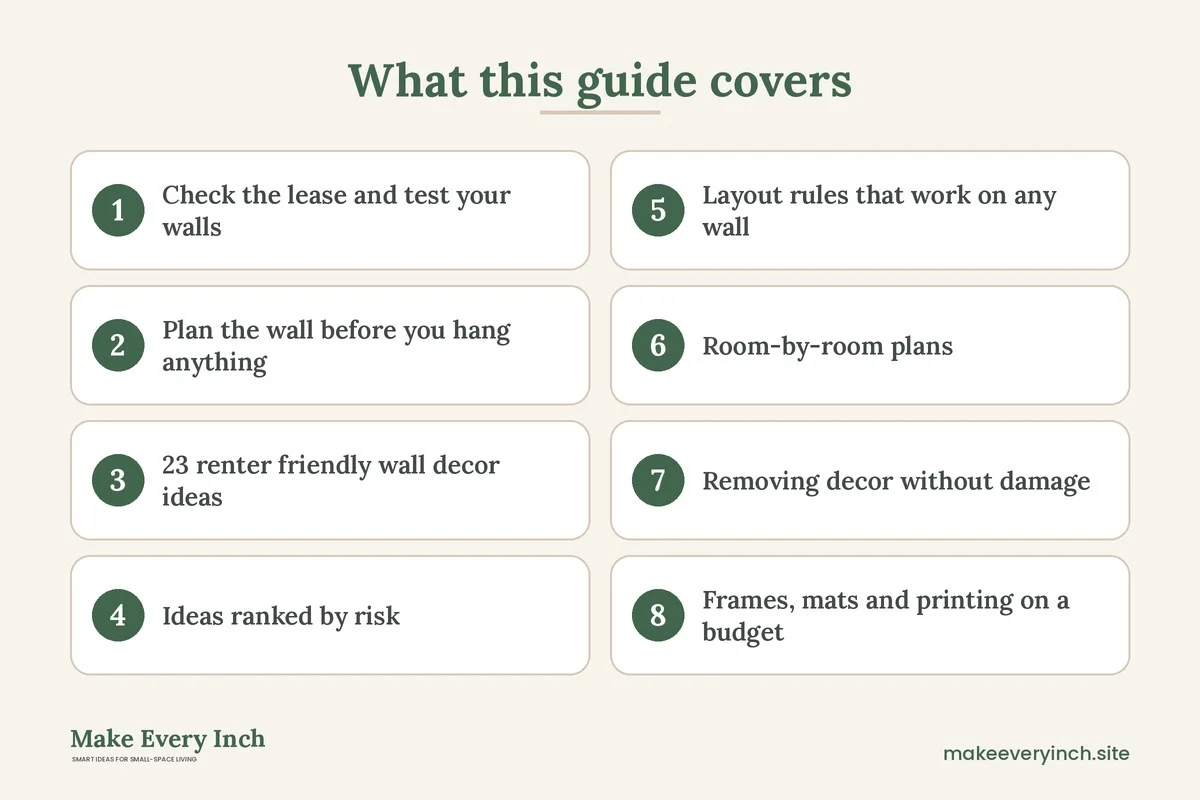
Renter friendly wall decor ideas solve a classic problem: blank white walls and a lease that bans nails. Walls are the biggest surface in any room, and leaving them bare makes a rental feel temporary. The good news is that you can fill them with art, texture and color in ways that leave no trace. This guide covers the lease check, how to plan a wall, 23 ideas, a table that ranks each by risk, layout rules, room-by-room plans, removal steps and a checklist. For the wider approach to decorating a rental, see our hub guide on renter-friendly apartment decorating ideas.
Check the lease and test your walls
Read what the lease says about nails, adhesive, paint and wallpaper. Some landlords allow small nail holes, which you can fill with spackle at move-out, and others ban everything. When in doubt, ask in writing. Photograph each wall before you start, so you can prove its original condition.
Test the wall before you commit. Press a small adhesive strip on a hidden spot, such as behind a door, and leave it for a few days. Pull it slowly and check the paint. Flat, matte and recently painted walls are the most delicate. Textured, dusty or damp walls hold adhesive poorly. If a wall fails the test, use freestanding or tension-based ideas instead.
Plan the wall before you hang anything
Walls look best when art relates to furniture and to each other. Start by choosing a focal wall, usually the one behind the sofa or the bed. Measure the wall and the furniture, and cut paper templates of each piece. Tape the templates to the wall, and move them until the arrangement looks right. Hang the center of the art at about 57 inches from the floor, and keep the gap between frames at 2 to 3 inches. Hang art about 6 to 8 inches above a sofa, and as wide as two thirds of the furniture below.
23 renter friendly wall decor ideas
Hanging without nails
1. Adhesive strips for light frames
Strips rated for the frame’s weight hold small and medium frames. Use two strips per frame, and follow the weight chart.
2. Adhesive hooks for wreaths and bags
Hooks hold light items, such as a straw bag, a wreath or a string of dried flowers.
3. A tension rod gallery
A tension rod across an alcove or a window holds hanging art, fabric and plants.
4. Washi tape and clips
Use washi tape on a wall to hold posters and photos. It peels off easily, though you should test it first.
5. A wire gallery on a door
A wire strung across a door holds postcards and photos with mini clips.
Leaning and resting
6. Lean large art on a dresser or shelf
Large pieces look dramatic when leaned, and you can swap them freely.
7. Use picture ledges that stand
A freestanding ledge on a console holds frames you can change monthly.
8. Stack frames on a bookcase
Frames of different sizes layered on a shelf create a casual gallery.
9. Lean a floor mirror
A tall mirror adds light and space without hanging anything.
10. Use an easel
An easel displays a large print or a canvas and moves with you.
Fabric and texture
11. Hang a tapestry on a rod
A tapestry or a quilt on a tension rod adds color and softness.
12. Use a woven wall hanging
A macramé or woven hanging works on a single adhesive hook.
13. Use curtains as a feature wall
Floor-length curtains on a wide rod cover a wall of windows or an entire blank wall.
14. Use a fabric panel in a frame
Stretch fabric over a frame and lean it, or hang it with strips.
15. Use a rug as art
A small rug or a kilim hung from hooks adds pattern. Check the weight, and use enough hooks.
Peel-and-stick and removable finishes
16. A peel-and-stick accent wall
Peel-and-stick wallpaper makes a strong accent. Test a corner, and check the lease. See removable wallpaper ideas.
17. Peel-and-stick decals
Large decals add shapes and patterns, and remove cleanly from smooth walls.
18. A removable mural
Panels hung with strips make a mural that can be removed.
19. Painted canvas backdrops
Paint a large canvas in the color you want for the wall, and lean it behind a sofa or a bed.
Light and objects
20. Plug-in wall sconces
A sconce with a cord cover adds wall interest and light.
21. Shelves with a lip on a freestanding ladder
A ladder shelf gives you a display wall that stands on the floor.
22. A hanging plant shelf on a tension pole
A pole holds shelves for plants and ornaments.
23. A string light curtain
A light curtain on a rod adds a soft glow to a bedroom or a dining corner.
Ideas ranked by risk
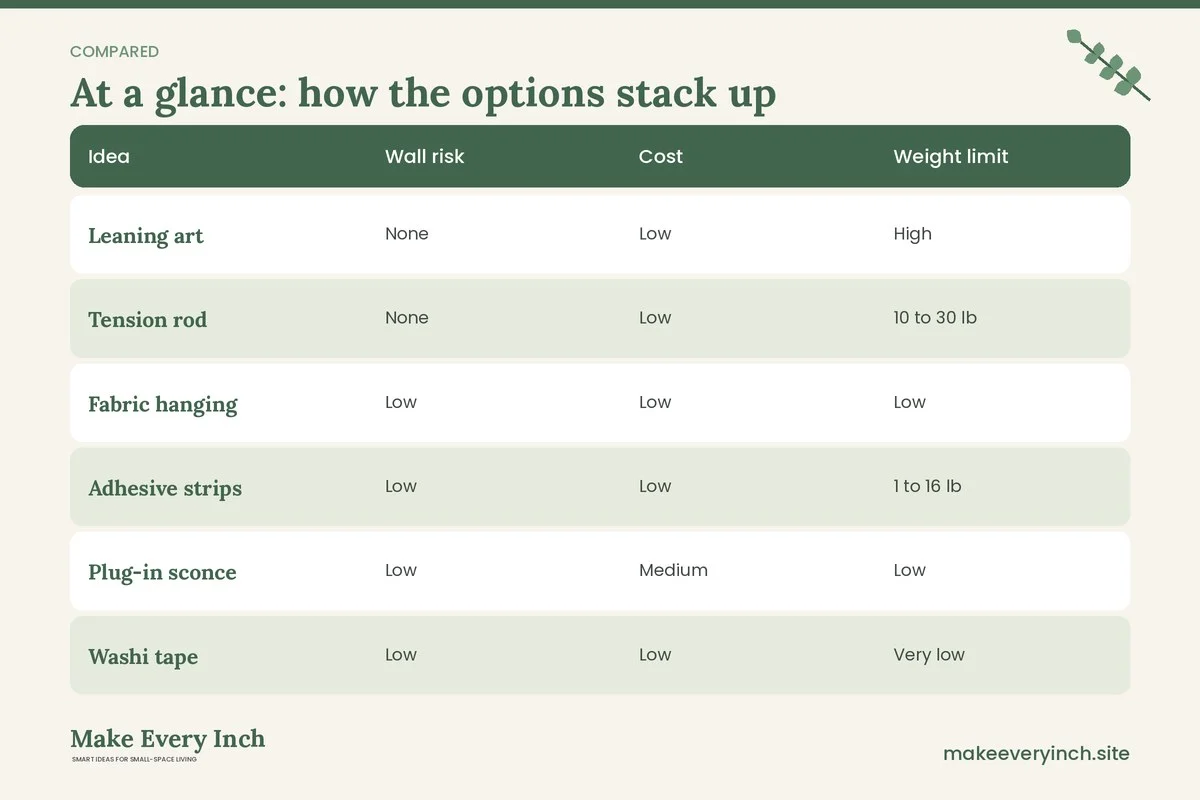
| Idea | Wall risk | Cost | Weight limit | Removal |
|---|---|---|---|---|
| Leaning art | None | Low | High | None |
| Tension rod | None | Low | 10 to 30 lb | Easy |
| Fabric hanging | Low | Low | Low | Easy |
| Adhesive strips | Low | Low | 1 to 16 lb | Careful |
| Plug-in sconce | Low | Medium | Low | Easy |
| Washi tape | Low | Low | Very low | Easy |
| Decals | Medium | Low | None | Careful |
| Peel-and-stick wallpaper | Medium | Medium | None | Careful |
| Painting | High | Low | None | Repaint |
Layout rules that work on any wall
The 57-inch rule
Hang the center of a piece, or the center of a group, at about 57 inches from the floor, which is average eye level.
The two-thirds rule
Art over furniture should be about two thirds to three quarters of the furniture’s width.
The grid
A grid of frames of the same size and spacing looks neat in a hallway or an office.
The salon wall
A cluster of mixed frames feels casual. Start with the largest piece in the middle, and build outward, keeping the spaces equal.
The single statement
One big piece does more than several small ones in a small room. Lean it on a dresser or a console to ground it.
Room-by-room plans
Living room
Lean a large piece behind the sofa on a console, add a mirror and a tapestry and hang a few light frames with strips. Use a lamp to highlight the art. See small living room ideas for renters.
Bedroom
Use a fabric hanging or a leaning canvas behind the bed, a few frames on a dresser and a string light curtain. See small bedroom ideas for renters.
Kitchen
Lean art on the counter, hang a light frame with strips and add a small shelf on a stand. Keep art away from heat and grease.
Bathroom
Use framed prints behind glass, with strips rated for damp rooms, and plants. See renter friendly bathroom ideas.
Entry
Lean a mirror, hang a frame with a strip and add a tray. See small entryway ideas.
Removing decor without damage
Remove adhesive strips slowly, with the tab pulled down and parallel to the wall. Warm the strip with a hair dryer if it resists. Peel decals and wallpaper slowly from a corner at a low angle, and use a hair dryer to soften the adhesive. Clean any residue with a damp cloth and a little rubbing alcohol. Do not scrub the wall, and wait for the adhesive to loosen. If paint lifts, tell your landlord, and offer to touch it up. Photograph the walls after you finish.
Frames, mats and printing on a budget
You can make wall decor cheaply. Buy frames second-hand, and paint them in one color to match. Print your own photos or free art, and use a mat to make cheap prints look professional. Choose a few standard sizes, such as 8 by 10 and 11 by 14 inches, so you can swap prints. Use lightweight acrylic instead of glass for hanging with strips. Create art from fabric, a scarf, pages from a calendar or pressed leaves. A set of matching frames makes anything look intentional.
Choosing colors and themes
Pick a palette, and let the art repeat it. If the furniture is neutral, choose art with one bold color. If the room already has a lot of color, choose black-and-white prints, or art in similar tones. Match frame colors across the room, such as black, wood or white. Use a theme such as botanicals, travel, abstracts or family photos to tie a gallery together. Refresh with the seasons by swapping a single print.
Gallery wall plans you can build without nails
The leaning shelf gallery
Place a long, narrow shelf or a console against the wall, and lean frames in layers, from tall at the back to small at the front. Add a plant, a candle and a small stack of books. Because nothing is fixed, you can swap pieces whenever you like, and it looks relaxed and collected.
The ladder gallery
Lean a wooden ladder against the wall and hang frames, baskets and fabric from the rungs with S-hooks. It doubles as a place to hang a throw or a scarf. Add a plant on the lowest rung.
The door gallery
The back of a door is a blank wall that you rarely use. Hang a wire or a ribbon across the door with adhesive hooks at the top, and clip on photos and postcards. Rotate the pieces monthly, and keep the weight low.
The tension rod gallery
Place a tension rod across an alcove and hang a gallery from clips. This is ideal for a narrow nook beside a bed or in a hallway, and it comes down in seconds.
The headboard wall
Behind a bed, lean a large canvas or a framed print on a low dresser, or hang a woven piece above the bed on a single strong hook. Put two small frames on the nightstands to echo the colors.
Working with difficult walls
Textured walls
Adhesive strips do not stick well to heavy texture. Use leaning art, tension rods and freestanding displays. For small frames, use mounting putty in several spots, and test it first.
Brick or concrete
Strips do not hold on rough masonry. Lean art or use a freestanding shelf. A large rug or fabric on a rod can soften the look of a brick wall, and a plug-in light can warm the surface.
Slanted or angled walls
Use furniture to define the space, and lean art against low walls. Use a tension pole to hold hanging plants, or a hanging rod at the top of the slope.
Walls with outlets and switches
Keep art clear of switches and plugs. A decorative cover for a switch plate adds style, and a small cord cover painted the wall color hides cords from plug-in lights.
Fresh paint
Wait at least two to four weeks before using strips on newly painted walls, since the paint needs to cure. Use leaning displays in the meantime.
Making art look expensive
Cheap art looks costly when it is displayed well. Choose frames with a simple profile, in wood, black or brass. Use a wide mat with a small print, since it gives the piece space and weight. Hang pieces at the right height, and keep spacing even. Light the art with a lamp or a picture light that plugs in. Group art in odd numbers, such as three or five, and align at least one edge. A calm, consistent arrangement matters more than the cost of each piece.
Wall decor for small rooms
In a small room, use fewer and larger pieces, and keep the wall near the ceiling quiet. A mirror opposite a window doubles the light. Vertical pieces make a low ceiling look higher, and horizontal pieces widen a narrow wall. Avoid hanging many small frames, which look like clutter. Choose a palette of light colors, with a few dark accents for depth. A single large leaning piece behind a sofa or a bed can make a small room look composed and calm.
Caring for wall decor
Dust frames weekly, and wipe glass with a soft cloth. Check strips every few months, and replace any that peel. Keep art out of direct sunlight, which fades prints, and away from kitchen steam, which warps paper. Rotate pieces so none stays in one place for years, and the room feels fresh. Store spare art flat in a portfolio under the bed. A little care keeps your art looking new when you move it to the next home.
A weekend plan to finish your walls
Saturday
Photograph the walls and test the adhesive. Choose a focal wall in each main room and make paper templates. Gather frames, prints and strips, and decide on a palette.
Sunday
Hang the focal wall first, then fill the rest. Lean the large pieces, add a mirror and a plant, and stand back. Remove one item from each wall, since less is often more. Take final photos for your records.
Budget guide
Under $50
Adhesive strips, secondhand frames and prints you make yourself.
About $150
A large leaning mirror, a tapestry and a tension rod.
$400 and up
Large art, a freestanding ladder shelf and plug-in sconces.
Mistakes to avoid
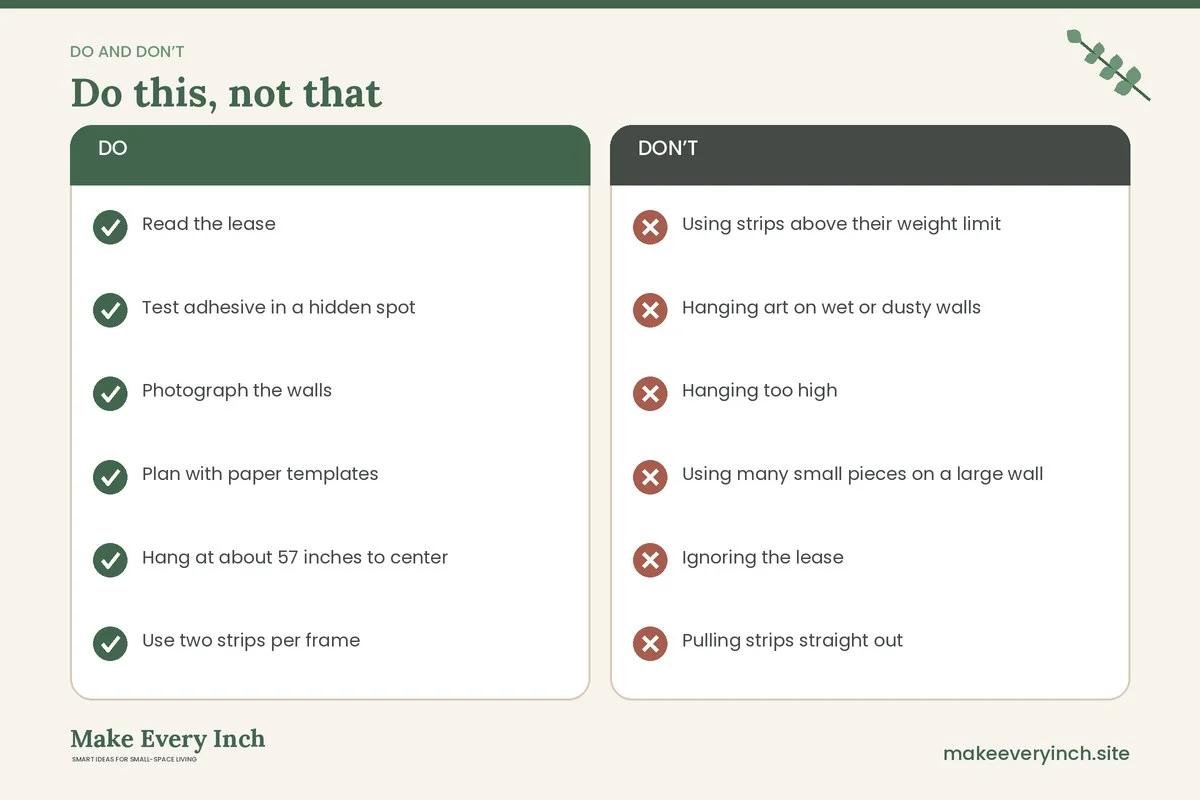
- Using strips above their weight limit
- Hanging art on wet or dusty walls
- Hanging too high
- Using many small pieces on a large wall
- Ignoring the lease
- Pulling strips straight out
- Skipping photos of the wall
Wall decor checklist
- Read the lease
- Test adhesive in a hidden spot
- Photograph the walls
- Plan with paper templates
- Hang at about 57 inches to center
- Use two strips per frame
- Lean heavy pieces
- Keep original hooks and hardware
- Remove adhesive slowly
- Photograph at move-out
FAQ
How can I decorate walls in a rental without nails?
Use adhesive strips, leaning art, fabric on tension rods and plug-in lights.
Do adhesive strips ruin paint?
They can if the paint is fresh or flaking, or if you remove strips wrongly. Test first and remove slowly.
How do I hang a mirror without nails?
Lean it against a wall, or use heavy-duty strips rated well above its weight. Do not hang a large mirror above a bed on adhesive.
What is the best wall decor for renters?
Large leaning pieces, mirrors, tapestries and framed prints with strips.
Is peel-and-stick wallpaper safe for walls?
On smooth, fully cured paint, usually. On new paint or textured walls, it can pull paint.
How many strips do I need per frame?
Check the weight chart, and use at least two strips for most frames.
How do I fill nail holes?
Use spackle, sand lightly and touch up the paint, if the lease allows.
What if my landlord says no to everything?
Use leaning art, tension rods and furniture-based displays.
Keep going: Explore our renter-friendly apartment decorating ideas, no-drill storage ideas for renters and removable wallpaper ideas.
Save this guide for later
Pin the ideas you like to Pinterest so you can come back to them when you plan your space.