21 Renter Friendly Shelving Ideas That Need No Drilling
Quick answer: The best renter friendly shelving is freestanding: a low bookcase, a ladder shelf, a tension-pole unit, an over-door rack, cube storage or stacked crates. Adhesive shelves work only for very light items. Check the lease, load heavy things low, keep tall units from tipping and photograph the walls before you start.
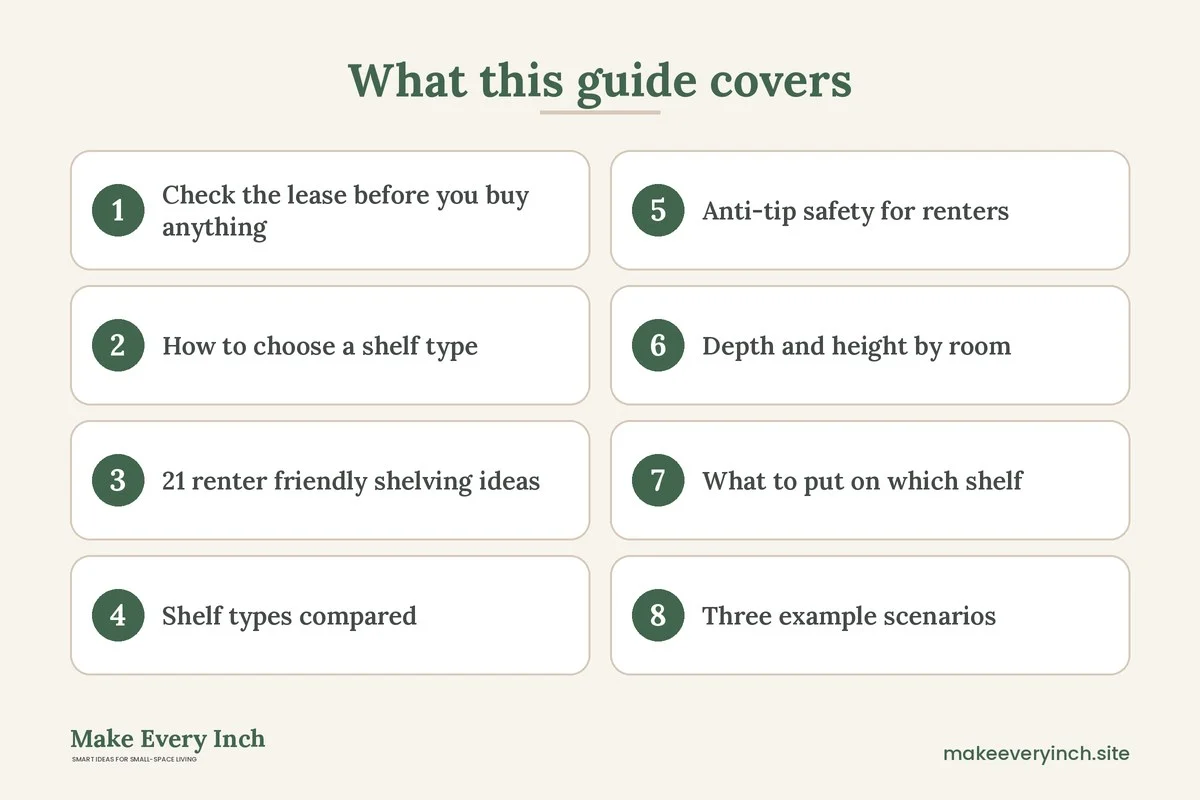
Renter friendly shelving gives you somewhere to put things without a drill, a stud finder or a conversation with your landlord. Shelves are the fastest way to turn a bare wall or a messy corner into storage, and almost every kind of shelf has a version that stands on the floor, grips between floor and ceiling, hangs over a door or sticks on with adhesive. This guide covers the lease check, 21 ideas grouped by type, honest weight limits, a comparison table, anti-tip safety, the right depth and height for each room, what belongs on which shelf, three example scenarios, a step-by-step method, budgets and a checklist. For more ways to store things in a rental, see our guide to no-drill storage ideas for renters.
Check the lease before you buy anything
Read the sections on alterations, wall fixtures and adhesives. Many leases ban nails and screws but say nothing about freestanding furniture, and a bookcase that stands on the floor is furniture. Adhesive products are a gray area. Some leases ban “anything attached to walls,” which can include strips and sticky shelves, so ask in writing if the wording is unclear.
Photograph every wall, floor and door you plan to use, with the date visible if your phone allows it. Take a wide shot and a close shot of any spot where a shelf will touch the wall, the baseboard or a door frame. These photos protect you if the landlord later claims scuffs or marks were your doing. For the full documentation routine, see our guide to security deposit safe apartment upgrades.
How to choose a shelf type
Start with what you need to store, because the weight and shape of the items decide the shelf. Books and dishes are heavy, and they need a floor-standing unit. Plants, candles and picture frames are light, and nearly anything can hold them. Then look at where the shelf will go. A corner, a narrow wall, the back of a door and a gap beside a window each suit a different design.
Next, measure. Write down the width, depth and height of the space, then subtract 1 inch from the width so the unit slides in, and check the path from the door to the room. Check baseboard thickness too, because a thick baseboard keeps a bookcase 0.5 to 1 inch from the wall and can affect how it sits.
21 renter friendly shelving ideas
Freestanding bookcases
1. A low, wide bookcase
A bookcase about 30 to 36 inches tall is stable, holds heavy items and leaves the wall above free for art or a mirror. Look for a solid back panel or cross bracing, because a unit with a flimsy back sways when you load it. It works well as a room divider or a TV stand.
2. A tall, narrow bookcase
A unit 12 inches wide or less and 60 to 72 inches tall fits beside a door or in a corner and uses height instead of floor space. Because it is tall, tipping is a real risk, so load it from the bottom up and read the safety section below.
3. A corner bookcase
Corner units use dead space and often have a wider footprint at the bottom, which helps stability. They suit a living room corner or a bedroom nook, and they hide the awkward angle where two walls meet.
4. A bookcase used as a room divider
In a studio, a bookcase with an open back separates sleeping from living areas and holds storage on both sides. Place it perpendicular to a wall, and use it only if it is stable on its own. Add felt pads to the feet so it does not scratch the floor.
Ladder and leaning shelves
5. A leaning ladder shelf
A ladder shelf leans against the wall at a slight angle, and the shelves get deeper toward the bottom. It holds plants, baskets and books with almost no floor footprint at the top. Check the maximum weight per shelf, which is often 15 to 25 pounds on budget models.
6. A leaning wooden ladder
A plain wooden ladder from a home store becomes a blanket rack or a bathroom towel stand. Add small baskets with S-hooks to hold bottles and brushes. Place rubber feet at the bottom so it does not slide on hard floors.
7. A ladder shelf in the bathroom
In a bathroom, a ladder shelf with a moisture-resistant finish holds towels, baskets and a plant. Keep it away from the shower spray, and wipe it dry. See our guide to renter friendly bathroom ideas.
Tension-pole shelves
8. A floor-to-ceiling tension pole shelf
A spring-loaded pole presses between floor and ceiling, and shelves clip onto the pole. It uses a corner without any screws, and it suits plants, small baskets and toiletries. Check the product’s weight rating, and note that many tension units suit light loads only.
9. A tension rod shelf in a nook
A short tension rod inside a window recess or alcove can hold a lightweight shelf or hanging baskets. Use it for herbs, a few small jars or craft supplies. Do not load it with books.
10. A tension pole behind a sofa
A pole behind a sofa, if the ceiling is standard height, holds a small shelf for a lamp or a drink. It adds a table surface in a room with no space for an end table.
Over-door shelves
11. An over-door pantry rack
Metal racks hook over the top of a door and hold cans, spices and snacks. Measure the door thickness, which is often 1.75 inches for interior doors, and check that the door still closes. Use felt or rubber on the hooks to protect the paint.
12. An over-door organizer for the closet or bathroom
Fabric or wire organizers hold shoes, cleaning supplies and toiletries. They are best for light items, and they use the back of a door that you rarely look at.
13. An over-door hook rail
A hook rail with a shelf holds coats, bags and a small tray at the entry. It helps when there is no space for a hall tree. See our guide to small entryway ideas.
Adhesive and removable shelves
14. Adhesive floating shelves for light items
Some shelves stick on with strong adhesive strips or tape. They suit very small loads, such as a few frames, a candle or a small plant. Most are rated in the low single digits of pounds, so check the packaging, and keep the load well below the limit.
15. Adhesive corner shelves in a shower
Stick-on corner shelves hold soap and shampoo on tile. Check the weight, avoid textured tile and replace the adhesive if the shelf slips. Removal can be tricky, so use heat and floss to cut the adhesive.
16. Adhesive hooks with a small ledge
A small ledge on an adhesive hook holds a phone, keys or a plant. It is a light, low-risk option. Test on a hidden area first.
Cubes and crates
17. A cube organizer
A 2 by 2, 2 by 3 or 3 by 3 cube unit stores bins, books and toys, and it can sit on its side as a bench or a low media unit. Use cubes with a back panel for stability, and stack no more than three high without anti-tip protection.
18. Stacked wooden crates
Wooden crates stacked in a staggered pattern create a shelf that you can rearrange. Sand the edges, and screw or zip-tie them together if you want a stable block. Zip ties leave no marks on walls.
19. Milk crates and plastic bins
Plastic crates are cheap and strong, and they stack in towers or sit on their side as shelves. Use them in a closet, a garage or a kid’s room. Pick neutral colors for a calm look.
20. A crate bench with storage
Two sturdy crates with a board and a cushion make a seat with storage. It works at the foot of a bed or at an entry. Check that the board is wide enough and that the crates are rated for sitting.
21. A rolling cart as a shelf
A rolling cart with three tiers acts as a movable shelf for the kitchen, bathroom or craft area. It fits into gaps as narrow as 10 to 15 inches. See our guide to small kitchen cart ideas.
Shelf types compared
| Type | Typical load | Wall contact | Best for | Main risk |
|---|---|---|---|---|
| Freestanding bookcase | Heavy | Back against wall | Books, dishes | Tipping |
| Ladder shelf | Light to medium | Leans on wall | Plants, baskets | Slipping |
| Tension pole | Light | Floor and ceiling | Small items | Pole slips |
| Over-door rack | Light | Door only | Pantry, shoes | Door will not close |
| Adhesive shelf | Very light | Adhesive on wall | Frames, candles | Falling, paint damage |
| Cube unit | Medium | Back against wall | Bins, toys | Tipping when stacked |
| Crates | Medium | None | Anything | Wobble |

Anti-tip safety for renters
A tall, loaded shelf can fall, and that is a real injury risk, especially with children and pets in the home. Standard anti-tip kits use a screw into a stud, which means a hole. Many landlords allow one small hole for safety, and a hole can be patched at move-out. Ask in writing before you drill, because the lease may say otherwise, and do not assume it is fine.
If you cannot make a hole, use these steps. Choose a low unit, under about 36 inches, for any room where children play. Put the heaviest items on the bottom shelves, and keep the top shelf light. Do not let anyone climb the shelf. Use the unit’s own back panel, and add felt pads under the front feet so the unit leans slightly toward the wall. Place the unit in a corner, where two walls hold it, or between a wall and a heavy piece of furniture. Do not buy a tall unit with a narrow base for a room with toddlers. Check the manufacturer’s instructions, and use the hardware that came with the shelf.
Depth and height by room
Living room
A depth of 11 to 12 inches suits books and decor, and 14 to 16 inches suits a media unit. Keep the top at or below 72 inches in a rental to reduce tipping risk, and leave a gap to the ceiling. For more layouts, see our guide to small living room storage ideas.
Bedroom
A depth of 10 to 12 inches is enough for books, baskets and a lamp. A low bookcase works as a nightstand, and a tall narrow unit fits beside a bed. Keep heavy items low. See small bedroom storage ideas.
Kitchen
A depth of 12 to 16 inches holds plates and pantry boxes. Choose a metal or sealed unit that wipes clean, and place it away from the stove. Heavy cookware belongs on the bottom shelf.
Bathroom
A depth of 8 to 10 inches fits towels and bottles without crowding the room. Choose a finish that resists moisture, such as metal, sealed wood or plastic, and avoid unsealed particleboard.
Entry
A depth of 8 to 12 inches suits shoes, trays and bags. A bench with cubes beneath works well in a narrow hall.
What to put on which shelf
Bottom shelves
Heaviest items go here: large books, appliances, jars, cast iron, boxes of paper, a printer or a stack of binders. Low weight keeps the unit stable.
Middle shelves
Everyday items at hand height: daily dishes, favorite books, baskets of remotes and chargers, folded towels. This is your most used zone, so keep it easy to reach.
Top shelves
Light and rarely used things: baskets of seasonal items, empty vases, spare linens, plants in plastic pots. Nothing heavy should sit above shoulder height.
The front edge
Put small items in baskets so they do not slide off. A lip or a small rail helps in a home with pets or a rental near a busy street.
Three example scenarios
A studio with no wall space
A renter in a 400 square foot studio uses a 30 inch tall bookcase at the foot of the bed as a divider, a ladder shelf in the corner for plants and an over-door rack in the kitchen. Nothing touches a wall except the back of the bookcase. The total cost is about $140, and the unit goes with them at move-out.
A one-bedroom with a landlord who bans everything
Because the lease bans adhesive, a renter chooses a cube unit with bins in the living room, stacked crates in the closet and a tension pole in the bathroom. They photograph each wall before setup, and keep felt pads under all feet.
A shared apartment with limited room
Two roommates share a kitchen with no pantry. They use a rolling cart, an over-door rack and a narrow bookcase for pantry items. Each roommate has a labeled shelf and a bin, which keeps things fair.
How to install shelving without drilling
1. Measure the space, and subtract an inch from the width for clearance.
2. Photograph the walls, floor and door before you start.
3. Assemble on a rug or cardboard to protect the floor, and tighten all fasteners.
4. Place the unit, and check it with a level. Adjust with felt shims at the feet.
5. Load the bottom shelves first, then the middle and the top.
6. Test stability by pressing gently on the top corner. It should not rock.
7. Add the safety measures from above, such as a corner position or a low height.
8. Photograph the finished setup, so you have a record of the condition.
9. At move-out, remove items, wipe the unit and the wall, and take final photos.
For adhesive shelves, clean the wall with rubbing alcohol, let it dry, press for the time on the package and wait the recommended period before loading. Test on a hidden spot first, and remove by warming the adhesive with a hair dryer and pulling slowly.
Budget guide
Under $50
A pair of plastic crates, an over-door organizer or a small adhesive shelf. Second-hand wooden crates cost even less.
About $150
A cube unit with bins, a ladder shelf and a tension pole. This covers most small rooms.
$400 and up
A solid wood bookcase, a set of matching units or a wide media shelf. Spend more on the tall pieces, where stability matters most.
Mistakes to avoid
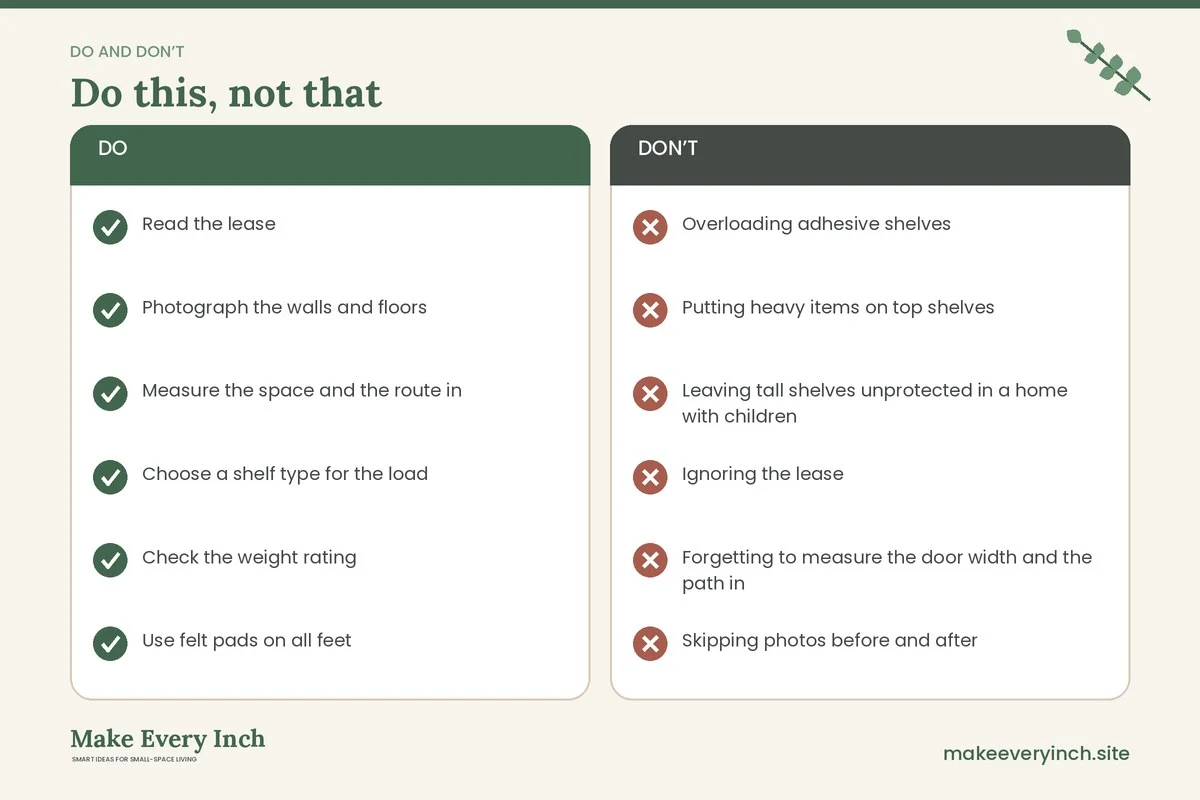
- Overloading adhesive shelves
- Putting heavy items on top shelves
- Leaving tall shelves unprotected in a home with children
- Ignoring the lease
- Forgetting to measure the door width and the path in
- Skipping photos before and after
- Buying unsealed particleboard for a bathroom
Renter shelving checklist
- Read the lease
- Photograph the walls and floors
- Measure the space and the route in
- Choose a shelf type for the load
- Check the weight rating
- Use felt pads on all feet
- Load heavy items low
- Add a safety measure for tall units
- Test the unit by pressing the top
- Keep all packaging and instructions
- Photograph at move-out
FAQ
What is the best shelf for a renter?
A low, solid bookcase is the best all-round choice, because it holds weight and stands on its own. Add ladder shelves and cubes for variety.
How much weight can an adhesive shelf hold?
It depends on the product, and many are rated for only a few pounds. Check the packaging, stay well under the limit and avoid heavy or fragile items.
Do tension pole shelves damage ceilings?
They can leave a mark or press into soft ceilings. Use a pad at the top, and check the lease. Textured ceilings can show a dent.
How do I stop a bookcase from tipping without drilling?
Choose a low unit, load the bottom first and place it in a corner. If the lease allows, ask your landlord about one small anchor, which gives the best protection.
Can I use over-door shelves on any door?
They fit standard interior doors. Check the door thickness and the clearance, and make sure the door still closes. Do not overload them.
Are cube organizers safe to stack?
Stacks of two are usually stable. Taller stacks should be placed in a corner, loaded at the bottom and anchored where the lease allows.
What shelves are best for a bathroom?
Choose metal, plastic or sealed wood, and keep them out of the shower spray. A ladder shelf or a rolling cart both work well.
How do I remove an adhesive shelf?
Warm it with a hair dryer, slide dental floss behind it and cut through the adhesive. Clean the residue with a damp cloth and a little rubbing alcohol.
Keep going: Keep building your rental storage with no-drill storage ideas for renters, renter friendly wall decor ideas and small bedroom storage ideas.
Save this guide for later
Pin the ideas you like to Pinterest so you can come back to them when you plan your space.