21 Removable Wallpaper Ideas for Renters and Small Rooms
Quick answer: The best removable wallpaper ideas for renters are a headboard panel, a bookcase back, a closet interior, a door, a stair riser or a single accent wall, all on smooth, fully cured, satin or eggshell paint. Check the lease, photograph the wall, test a hidden patch for a week, and plan to remove it within a year or two.
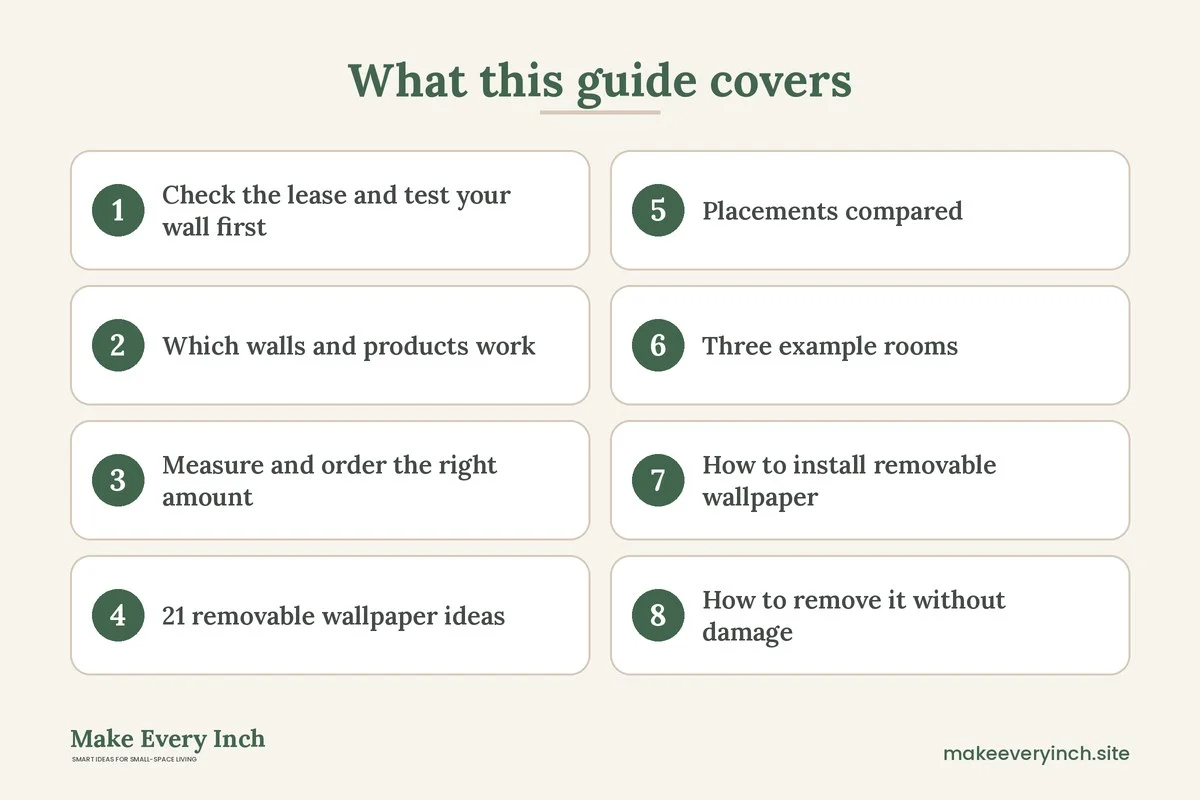
Removable wallpaper ideas are the fastest way to give a rental a personality, because one roll can change how a whole room feels in an afternoon. The catch is that peel-and-stick paper is only truly removable when the wall, the product and the removal method all cooperate. Small rooms benefit the most, since a single pattern on a single surface looks deliberate, while a pattern on every wall can feel heavy. This guide covers the lease and wall test, how to measure and buy, 21 placements ranked from safest to riskiest, a comparison table, three example rooms, step-by-step installation and removal, a budget guide, mistakes, a checklist and an FAQ. For the bigger picture, see our guide to renter-friendly apartment decorating ideas.
Check the lease and test your wall first
Read the lease for words such as paint, wallpaper, adhesive, alterations and decorations. Some leases ban anything stuck to a wall, some allow it if the wall is returned in its original condition, and some say nothing at all. If the wording is vague, email your landlord or property manager and ask a direct question: “May I apply removable peel-and-stick wallpaper to one wall if I remove it before move-out?” A written yes is worth more than a verbal one.
Photograph every wall you plan to cover, in daylight, with a close-up of any existing scuffs, nail holes or flaking. Save the pictures with the date. Take them again after removal.
Then test the wall. Cut a piece of the paper about 6 by 6 inches, apply it in a hidden spot such as inside a closet or behind a door, and leave it for at least a week. Peel it slowly at a low angle. If the paint comes away with it, if the surface looks shiny or stained, or if the sample will not stay on, that wall is not suitable. Paint that was applied within the past 4 weeks is a common problem, because it may still be curing and can pull away. Cheap builder-grade flat paint is another, since it has a weak bond to the wall underneath.
Which walls and products work
Smooth, clean, satin or eggshell paint is the best surface. Flat paint grips the adhesive too hard and can lift in patches. High gloss gives poor grip. Heavy orange-peel or knockdown texture leaves air pockets, so the paper will bubble and edges will curl. Brick, concrete, bare drywall and wood paneling are poor candidates. Rooms with high steam or cold exterior walls can cause edges to lift over time.
Products differ. Some peel-and-stick wallpaper is a thin vinyl with an adhesive back that is easy to reposition, while others are thicker and more forgiving of small wall flaws. Some are labeled “removable” and others “repositionable”, and the two words do not promise the same thing. Read the product page for the surface it recommends, the stated removal method and any warranty, and check the product’s rating rather than assuming. Prices vary by brand, but rolls typically run from about $20 to $60 each, and designer prints can cost more. A common roll is about 20.5 inches wide and 16.5 feet long, which covers roughly 28 square feet, though sizes differ, so always check.
Measure and order the right amount
Measure the width and the height of the surface in inches. Divide the width by the roll width to get the number of strips, and round up. Multiply by the height plus 4 inches of trim allowance, and divide by the roll length. If the pattern has a repeat, such as 16 or 24 inches, add one more repeat per strip so patterns line up. Order one extra roll. Dye lots can vary slightly in color, and one roll bought later may not match perfectly.
For a typical accent wall 8 feet high and 10 feet wide, with a 20.5 inch roll, you need about 6 strips of about 100 inches, which is roughly 600 inches or 50 feet, and that is three rolls of 16.5 feet. With a large pattern repeat, plan for four. Subtract windows and doors only if the saving is a full strip.
21 removable wallpaper ideas
Safest placements
1. The inside of a closet
A closet is hidden, has a low traffic load and is a great place to test a bold print. Cover the back wall or the inside of the doors, and you get a small dose of color every morning.
2. The back of a bookcase
Remove the shelves, cut paper to fit each panel and replace the shelves. Books and objects pop against a pattern, and the wall behind the bookcase stays untouched.
3. A panel on a board
Glue or stick paper to a thin plywood or foam board panel, and lean or hang it behind a sofa or a bed. The paper never touches the wall, so the lease is irrelevant.
4. The inside of a cabinet or a shelf unit
Peel-and-stick paper on the back of an open shelf or a glass-front cabinet adds color and costs very little. Check that the surface is sealed and smooth first.
5. Drawer liners
Line the bottoms of dresser drawers or desk drawers with scraps. This is the lowest risk use of wallpaper offcuts, and it keeps scents and pattern out of sight.
Furniture and flat surfaces
6. A dresser or a desk top
Cover a plain top with paper, and add a sheet of clear self-adhesive laminate or a glass top for protection. Furniture is usually the tenant’s, so removal worries disappear.
7. Stair risers or a short staircase
The vertical riser of a step takes a stripe of pattern, which suits a loft or a townhouse. Check the lease, since stairs are part of the unit. Use paper only on risers, never on the walking surface.
8. Cabinet doors in a rental kitchen
Use paper on cabinet doors only if the door finish is smooth and if the lease allows it. Wipe off grease first. This is a higher risk placement in a kitchen because heat and cooking oil weaken the adhesive. See renter-friendly kitchen upgrades.
9. A room divider or a folding screen
Cover a three-panel screen with paper to divide a studio into zones. It moves with you, and it also hides clutter.
10. A headboard panel
Cut a rectangle the width of the bed and about 48 to 60 inches high from plywood or foam board, cover it and lean it behind the bed. See small bedroom ideas for renters for more ways to dress the area around a bed.
Wall placements
11. A single accent wall
One wall, usually the one behind the bed or the sofa, takes the pattern, and the other three stay plain. This is the standard approach, and it suits small rooms.
12. A half wall or a stripe
Apply paper from the floor to about 36 or 48 inches, and finish with a thin top edge of paint-matched trim or a strip of washi tape. Half walls make a low ceiling feel intentional.
13. A framed panel on the wall
Cut a rectangle of paper, apply it to the wall, and finish the edges with thin lightweight molding held with removable strips. It reads as a built-in picture frame. This is a big impact for under $40.
14. An alcove or a nook
A recessed corner, such as a small desk niche, is a good size for a single roll. The paper emphasizes the nook as a destination.
15. A door
A flat interior door is a manageable surface of about 20 square feet. Remove the hardware, apply, trim and replace. The back of an entry door is a good place for a bold pattern. See small entryway ideas.
16. The ceiling in a small room
A pale pattern on the ceiling can make a small bedroom feel cozy. It is harder to install, since gravity fights the adhesive, so work with a helper, and expect it to be a high risk if the ceiling has texture.
Specialty and higher risk
17. A bathroom accent wall
Paper can work on a wall away from the shower, on satin or semi-gloss paint, in a bathroom with an exhaust fan. Choose a vinyl product that states it is suitable for humid rooms, and keep it out of the splash zone. See renter friendly bathroom ideas.
18. A backsplash alternative
Behind a sink, tile-look peel-and-stick sheets are a better fit than paper wallpaper because they are made to resist moisture. See temporary backsplash ideas.
19. A mural from several panels
Some brands sell murals in panels, which lets you fill a large wall with a single scene. Mark each panel position lightly with a pencil before you begin, and test the adhesive on the paint first.
20. A lampshade or a lightbulb-safe shade
Paper on a plain drum shade adds pattern at eye level. Use only on shades with a cool fitting, such as LED bulbs, and keep the paper away from heat. See renter friendly lighting ideas.
21. Behind a TV or a console
A narrow strip of paper behind a console table frames the furniture. It also hides scuffs without using a full wall of pattern. See small living room ideas for renters.
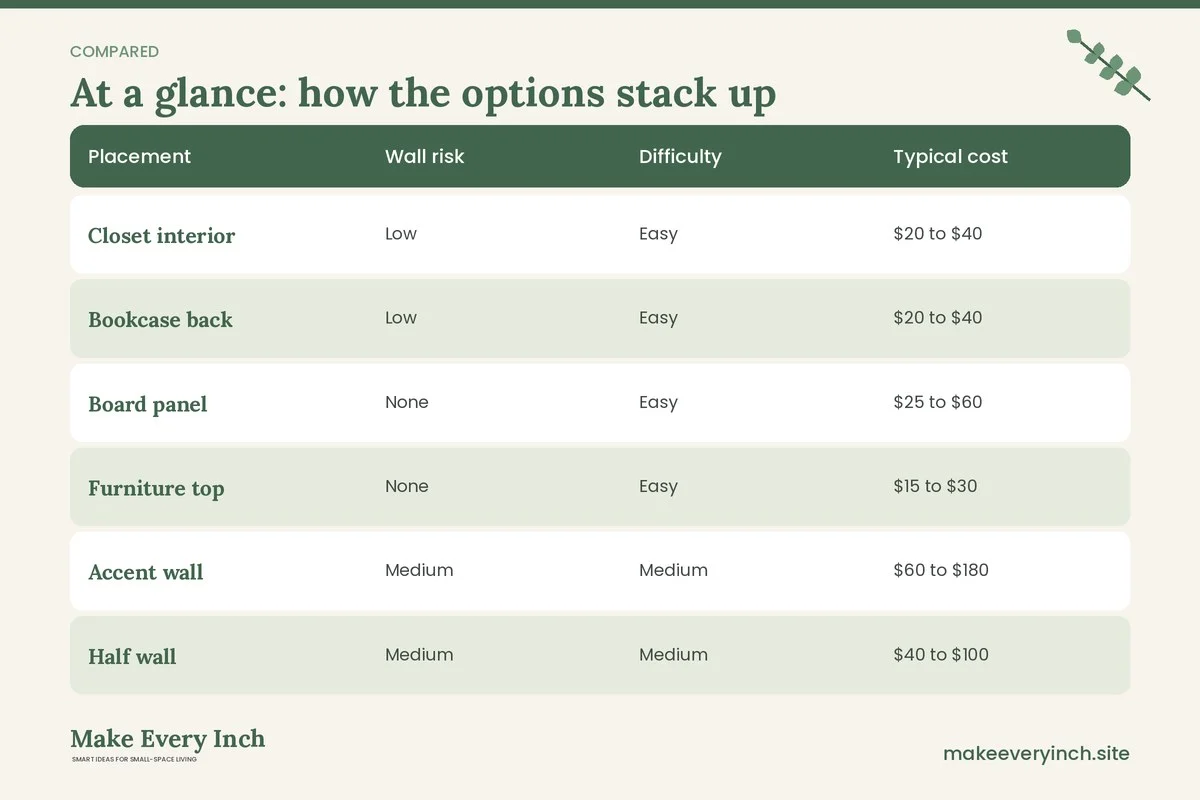
Placements compared
| Placement | Wall risk | Difficulty | Typical cost | Removal |
|---|---|---|---|---|
| Closet interior | Low | Easy | $20 to $40 | Easy |
| Bookcase back | Low | Easy | $20 to $40 | Easy |
| Board panel | None | Easy | $25 to $60 | None needed |
| Furniture top | None | Easy | $15 to $30 | Easy |
| Accent wall | Medium | Medium | $60 to $180 | Careful |
| Half wall | Medium | Medium | $40 to $100 | Careful |
| Door | Low | Medium | $30 to $60 | Easy |
| Ceiling | High | Hard | $60 to $150 | Hard |
| Bathroom wall | Medium | Medium | $40 to $120 | Careful |
| Textured wall | High | Hard | Varies | Likely damage |
Three example rooms
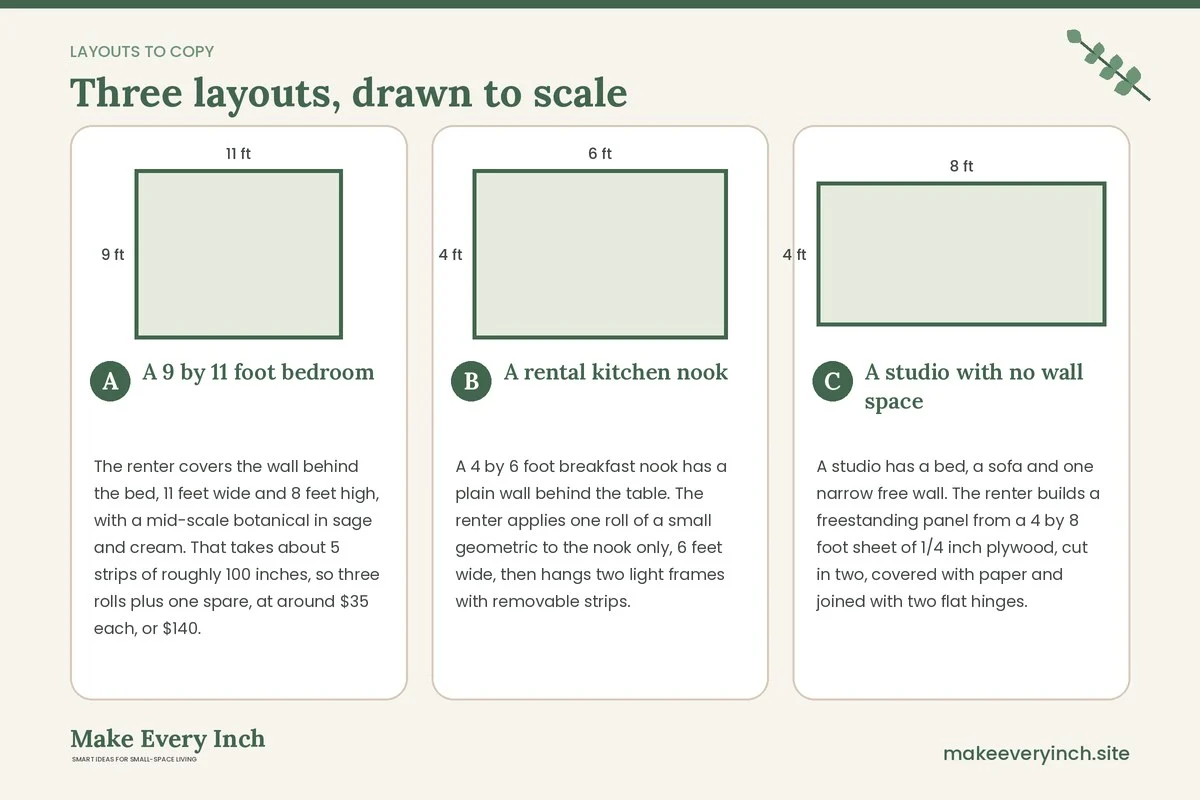
A 9 by 11 foot bedroom
The renter covers the wall behind the bed, 11 feet wide and 8 feet high, with a mid-scale botanical in sage and cream. That takes about 5 strips of roughly 100 inches, so three rolls plus one spare, at around $35 each, or $140. The other walls stay white, and a woven basket and a linen duvet repeat the colors. Two weeks earlier, the wall was test-patched in the closet and the paint had cured. Removal takes about 90 minutes.
A rental kitchen nook
A 4 by 6 foot breakfast nook has a plain wall behind the table. The renter applies one roll of a small geometric to the nook only, 6 feet wide, then hangs two light frames with removable strips. The paper is kept above table height, which keeps splashes away. Cost is about $45, and the project takes about two hours.
A studio with no wall space
A studio has a bed, a sofa and one narrow free wall. The renter builds a freestanding panel from a 4 by 8 foot sheet of 1/4 inch plywood, cut in two, covered with paper and joined with two flat hinges. It works as a headboard and a divider. Cost is about $110 including a hinge set, and it moves to the next apartment. The walls are never touched.
How to install removable wallpaper
Tools and materials
You need a tape measure, a pencil, a level or a plumb line, a sharp utility knife with fresh blades, a smoothing tool or a plastic squeegee, a straightedge, a step stool, painter’s tape, a microfiber cloth and mild soap. A hair dryer helps later.
Prepare the surface
Wipe the wall with a damp cloth and a drop of dish soap, then rinse with a clean damp cloth and let it dry for several hours. Remove dust, grease and loose paint. Fill nothing with spackle that you will not sand and repaint, as bumps show through thin paper. Remove outlet covers and switch plates, and keep the screws in a bag.
Hang the first strip
Mark a vertical line with a level, a few inches in from the corner, because corners are rarely square. Peel about 12 inches of the backing from the top, align the strip to the line with about 2 inches of overlap at the ceiling, and press from the center out. Peel and smooth the next section downward in 12 inch steps. If a bubble forms, lift gently and smooth again. Work slowly, since speed causes wrinkles.
Match and trim
Place the next strip beside the first and match the pattern. Butt the edges, or follow the product’s overlap instruction. Trim at the top and bottom with a knife and straightedge, using a fresh blade for every few cuts. Cut around outlets by pressing the paper over the opening and making an X, then trimming the flaps.
Finish
Smooth the whole wall with a squeegee, and check seams after 24 hours. Replace the outlet covers. Photograph the finished wall, and keep a spare scrap in a folder with the roll label, so you can repair any damage later.
How to remove it without damage
Plan removal in warm weather, and give yourself time. Start at the top corner and pull the strip slowly down and back at a low angle, close to the wall, not straight out. If it resists, warm it with a hair dryer on a medium setting for 20 to 30 seconds, then peel again. Stop if you see paint lifting. Slow down, add more heat, or cut the strip into narrower sections. Wipe any adhesive residue with a damp cloth and a little warm soapy water, then with a cloth and a small amount of rubbing alcohol on a hidden test spot first. Do not scrub the wall. Photograph the result in the same light as the original photos.
If paint lifts, tell your landlord early and offer to touch it up. A small repair on a small patch is usually a minor charge, and honesty protects your deposit better than hoping nobody notices. See our guide to security deposit safe apartment upgrades for more on protecting your deposit.
Choosing a pattern for a small room
Scale matters. A large pattern on one wall makes a small room feel bigger and calmer, while a tiny busy pattern on all four walls can feel crowded. Vertical stripes suggest height, and horizontal lines widen a narrow wall. Dark colors, such as deep green or navy, add depth in a bedroom and can feel cozy, but they need good lighting. Light patterns with a little contrast keep a tiny room airy. Test the paper in the room’s light, because a color seen on a screen can shift under warm bulbs.
Pair the pattern with solids. If the paper is busy, keep bedding, curtains and rugs plain. If the paper is soft, add one bolder object, such as a framed print. Repeat one color from the paper in a small accessory so the whole room looks planned. Avoid mixing more than one large pattern per sightline.
Budget guide
Under $40
One roll for a closet interior, a bookcase back, a dresser top or a drawer liner, plus a squeegee and a fresh blade.
$60 to $180
Two to four rolls for an accent wall or a half wall, a level, a smoothing kit and a spare roll.
$200 and up
A designer mural, a freestanding panel with hinges, or several rooms of accent areas. At this level, check the product warranty and returns policy before you open the rolls.
Mistakes to avoid
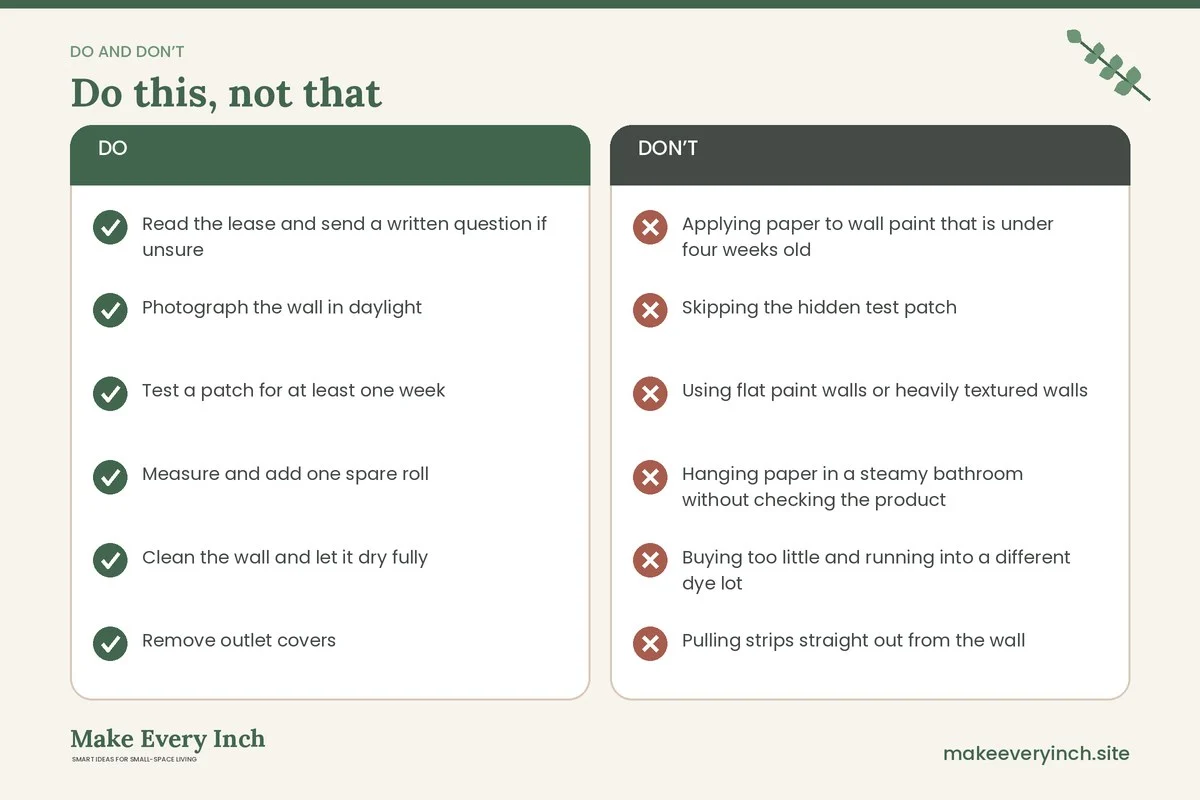
- Applying paper to wall paint that is under four weeks old
- Skipping the hidden test patch
- Using flat paint walls or heavily textured walls
- Hanging paper in a steamy bathroom without checking the product
- Buying too little and running into a different dye lot
- Pulling strips straight out from the wall
- Forgetting to photograph before and after
- Ignoring the lease
Removable wallpaper checklist
- Read the lease and send a written question if unsure
- Photograph the wall in daylight
- Test a patch for at least one week
- Measure and add one spare roll
- Clean the wall and let it dry fully
- Remove outlet covers
- Mark a level line before the first strip
- Keep scraps and the roll label
- Remove slowly with warmth
- Photograph the wall again after removal
FAQ
Is removable wallpaper really removable?
It is on smooth, cured, satin or eggshell paint, if you follow the removal method. On flat paint, new paint or textured walls, it can pull paint away.
How long does peel-and-stick wallpaper last?
Many products are designed for a few years, but how long it lasts depends on humidity, sunlight and the wall. Check the product’s rating and plan on removing it when you leave.
Can I put removable wallpaper in a bathroom?
Only on walls outside the splash zone, with a fan, and with a product that states it is suitable for humid rooms.
How do I get bubbles out?
Lift the section gently and smooth it again with a squeegee. For a stubborn air bubble, prick it with a pin and press the air out.
Can I reuse the wallpaper?
Some can be repositioned a few times, but once removed from a wall it often loses grip. Check the product notes.
How much wallpaper do I need for one wall?
Measure the width and the height, divide the width by the roll width, round up, and add a spare roll for pattern repeats and mistakes.
Will it damage my security deposit?
Not if the lease allows it, you tested the wall, and you removed it slowly. Photograph before and after, and tell the landlord about any problem.
What if my landlord says no wallpaper?
Use a freestanding panel, a bookcase back, furniture, a screen or a fabric hanging. See renter friendly wall decor ideas.
Keep going: Keep going with renter friendly wall decor ideas, temporary backsplash ideas and security deposit safe apartment upgrades.
Save this guide for later
Pin the ideas you like to Pinterest so you can come back to them when you plan your space.