Small Bathroom Ideas with No Counter Space
Quick answer: The best small bathroom ideas with no counter space begin with an edit, not a purchase. List what you touch every day, give each item a home on the wall, in a medicine cabinet, over the sink or in a caddy, and keep only a tray of true essentials near the basin. Use wall-mounted dispensers, a slim over-sink shelf and a shower caddy to move liquids off flat surfaces, and anchor and seal everything for a damp room.
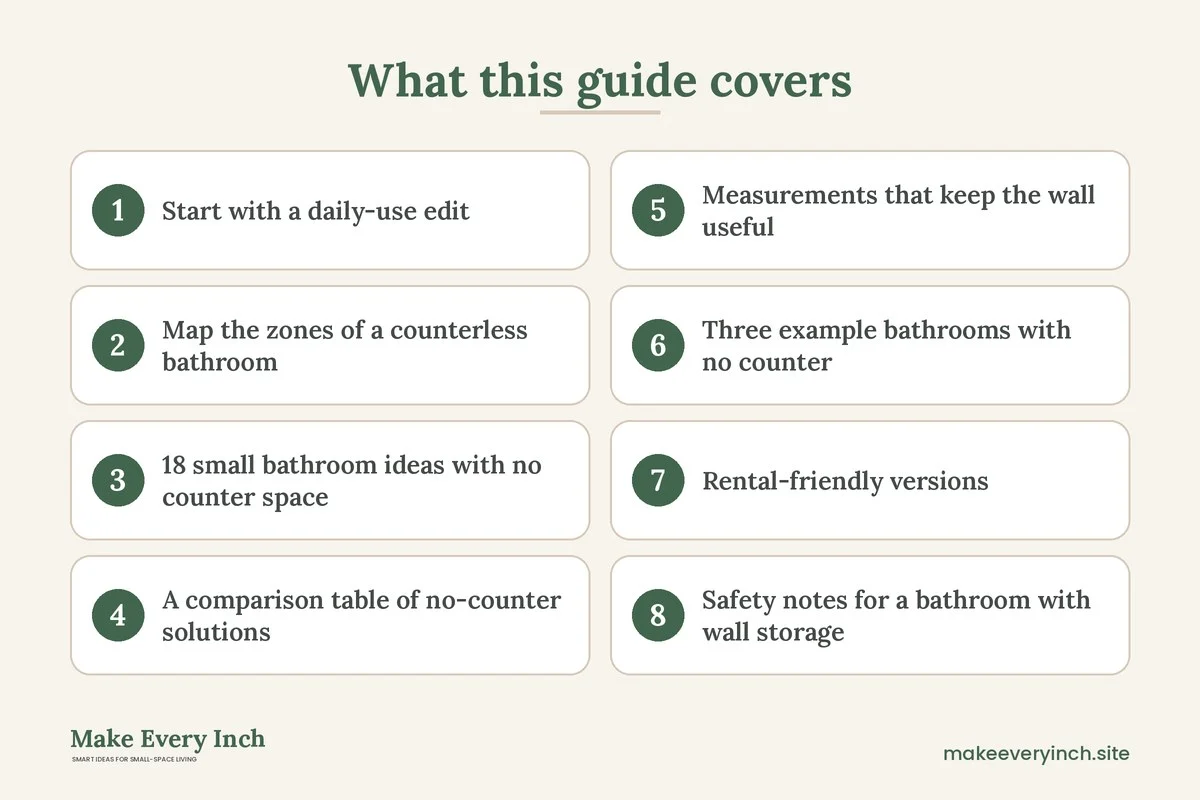
Small bathroom ideas with no counter space are usually about a pedestal sink, a wall-hung basin or a vanity so small that the sink takes the entire top. With nowhere to set down a toothbrush, a soap bottle or a hair tie, clutter lands on the toilet tank, the window sill and the edge of the tub. This guide takes a different route from a typical storage list. It begins with a daily-use edit that decides what really needs to be within reach, then shows how to give those items a spot using the wall, the mirror, the sink and the shower instead of a counter. It includes a zone map, measurements, a comparison table, three example rooms, a weekly reset, safety notes and a checklist. For the full overview, see our main guide to small bathroom ideas, and for the broader topic of keeping shelves tidy, read our guide to small bathroom organization ideas.
Start with a daily-use edit
The most useful step costs nothing. Before you buy a single caddy, empty every surface in the bathroom into a box or onto the bed. Then, over one week, take back only what you actually use. Keep a pencil and a notepad on the shelf, and tick the items as you reach for them.
Most people discover that the daily list is short. A typical morning set is a toothbrush, toothpaste, a cleanser or soap, a moisturizer, a hairbrush or comb and a deodorant. An evening set adds floss, a second skincare item and maybe a retainer case. Everything else, such as backup bottles, travel minis, special-occasion products and half-empty samples, belongs somewhere else or in the bin.
Sort into four groups
- Daily, used at the sink. These need a place within an arm’s length of the basin.
- Daily, used in the shower. These live in the shower, on a caddy or a wall rail.
- Weekly or occasional. These go in a closed cabinet, a basket or a drawer elsewhere.
- Backups and extras. These live outside the bathroom, in a hallway closet or under the bed.
Check expiry dates as you sort. Products last for different times, so read the packaging and discard anything that has changed in smell, color or texture. Dispose of old medicines through a pharmacy take-back scheme where available, rather than flushing them.
Count what must stay at the sink
Aim for a short list, ideally fewer than eight items at the sink. If the list is longer, ask which items could move to the shower or to a mirror cabinet. The fewer items near the basin, the smaller and simpler the solution. This edit is the difference between this post and our guides to tiny bathroom storage ideas and small bathroom shelving ideas, which focus on adding storage. Here the goal is to need less surface in the first place.
Map the zones of a counterless bathroom
Think of the room as zones, each one holding the things used there. A zone map stops clutter from drifting.
- The sink zone. Hands, face and teeth. This zone needs a soap dispenser, a cup or holder for toothbrushes, a small tray or dish, and a hand towel within reach.
- The mirror zone. Grooming and skincare. This zone is above and beside the mirror, where a cabinet or a narrow shelf holds the small items.
- The toilet zone. Paper, a brush and a cleaner. This zone is the wall beside or above the toilet.
- The shower zone. Wash and hair. This zone is a caddy, a rail or a niche.
- The door zone. Towels and robes. This zone is the back of the door or the wall beside it.
Draw a quick sketch of the room and label each zone. You may find that one zone has lots of space and another has none, which tells you where to put the new storage.
18 small bathroom ideas with no counter space
Wall-mounted dispensers and holders
1. A wall-mounted soap dispenser
A wall-mounted dispenser removes the bottle from the basin edge. It sits at hand height beside the sink, and it keeps the soap off the wet surface where it would sit in a puddle. Choose one that fixes with screws into a stud, or a model that fixes with an adhesive suited to damp tile where the surface allows.
2. A wall-mounted toothbrush and cup holder
A holder on the wall beside the mirror frees the cup that normally sits on the sink edge. Choose one with a drip tray or an open base so water does not pool inside it.
3. A refillable dispenser set
A set of matching refillable bottles for soap, lotion and shampoo looks tidy and cuts down the number of mismatched shapes in the room. Label them so that you do not mix them up.
4. A wall-mounted hand towel ring
A ring or a short bar beside the sink holds a small towel so that it hangs rather than lying on the edge of the basin. Hang it where it cannot drip onto the floor.
Trays and small surfaces
5. A small tray on the toilet tank
A shallow tray on the tank lid gives you a spot for a candle, a small plant or a couple of daily items. Keep it light, because the tank lid is ceramic and can crack if it is overloaded, and keep the tray away from the flush handle.
6. A tray on the windowsill
If your bathroom has a deep sill, a narrow tray there holds items that tolerate humidity. Keep it small enough that the window still opens.
7. A magnetic strip
A magnetic strip on the wall holds metal items such as tweezers, nail clippers and bobby pins. Mount it with moisture-rated fixings, and keep it away from direct splash zones.
8. A dish on the soap ledge
If your sink has a small ledge or a shelf at the side, a dish keeps the soap off the surface. Keep it dry so the soap does not melt into a mess.
Over the sink
9. A slim over-the-sink shelf
A narrow shelf above the faucet or above the mirror holds a few jars and a plant. Keep the depth at about 4 to 6 inches so it does not touch your head. Use a shelf with a lip so items do not slide off. If you rent, choose a model that fixes to the wall with permission, or a hook-over design that rests on the basin or the pipe, if your lease allows.
10. An over-the-faucet organizer
Some organizers sit over the tap or the pop-up drain lever. These are narrow, they hold a few items and they tuck away when not needed. Check the weight rating and make sure the faucet is not scratched or strained.
11. A pedestal sink caddy
A small caddy that hugs the pedestal or hangs from the sink edge holds a couple of items. Choose a design that does not interfere with the supply lines or the drain, and do not use it as a handle.
12. A shelf under the sink on a skirt
A skirted pedestal can hide a basket. A curtain around the base, hung from a rod or a tension wire, makes a shallow cupboard. Keep it dry and ventilated, and do not hide leaks. Check the pipes regularly.
Medicine cabinet and mirror options
13. A mirrored medicine cabinet
A mirrored cabinet adds a mirror and hidden shelves in one piece. Surface-mounted models are easier for renters. Recessed models sit between studs and are a renovation job. Keep the daily items on the middle shelf at eye height, and the less frequent ones higher up. Do not store medicines where children can reach them.
14. A mirror with a shelf
A mirror with a narrow shelf at the base is a good choice for the smallest rooms. It gives you a place for a toothbrush and a small cup without any further hardware. Check the weight rating, because a shelf at the bottom puts a load on the mirror frame.
15. A wall-mounted magnifying mirror
For close grooming, a wall-mounted extendable mirror frees the sink and removes the need to keep a handheld mirror on a surface. Make sure the arm is rated for its weight, and the wall fixing is secure.
Caddies, rails and the shower
16. A shower caddy that hangs from the showerhead or a rail
A caddy keeps liquids off the tub edge. Choose rust-resistant materials and drainage holes. Measure the clearance, because a large caddy hanging from the showerhead can restrict the spray.
17. A tension pole in a corner
A pole that spans floor to ceiling in the corner of a shower holds baskets and shelves without drilling. It needs a solid ceiling and a floor, so check the surfaces and the maximum height. Do not overload it, and make sure it cannot slip.
18. Suction or adhesive hooks for razors and loofahs
A set of hooks on tile holds razors, brushes and loofahs off the surface. Test the grip on the tile, keep the load within the rating and check it regularly, because moisture and soap film can reduce adhesion. If a hook fails on a wet day, move the item to a safer place.
A comparison table of no-counter solutions
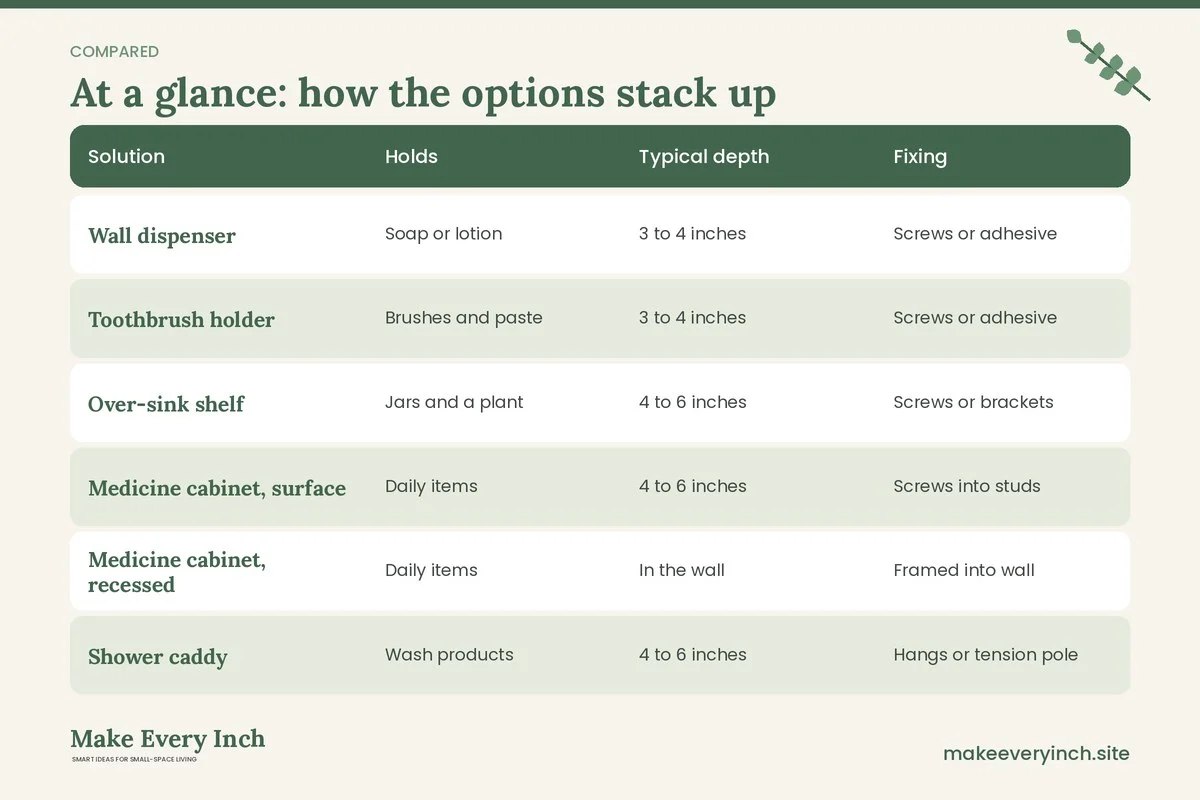
The table compares the main options by what they hold, how they fix and how they suit a rental. The figures are typical, so check the specifications of the product you choose.
| Solution | Holds | Typical depth | Fixing | Renter friendly |
|---|---|---|---|---|
| Wall dispenser | Soap or lotion | 3 to 4 inches | Screws or adhesive | Adhesive versions |
| Toothbrush holder | Brushes and paste | 3 to 4 inches | Screws or adhesive | Adhesive versions |
| Over-sink shelf | Jars and a plant | 4 to 6 inches | Screws or brackets | Often hook-over |
| Medicine cabinet, surface | Daily items | 4 to 6 inches | Screws into studs | With permission |
| Medicine cabinet, recessed | Daily items | In the wall | Framed into wall | No |
| Shower caddy | Wash products | 4 to 6 inches | Hangs or tension pole | Yes |
| Towel ring or hook | Hand towel | 2 to 4 inches | Screws or adhesive | Adhesive versions |
| Toilet tank tray | Light decor | 4 to 6 inches | Rests on lid | Yes |
| Magnetic strip | Metal tools | 1 inch | Screws or adhesive | Adhesive versions |
| Over-door rack | Towels, bottles | 3 to 5 inches | Hooks over door | Yes |
Measurements that keep the wall useful
Without counter space, the wall does the work, so measure before you fix anything.
- Dispenser height. About 36 to 42 inches from the floor suits many adults, or roughly 6 to 8 inches above the sink rim, within comfortable reach.
- Toothbrush holder. Around the height of the faucet and 6 to 10 inches to the side of it so drips land in the basin.
- Mirror shelf. A shelf under the mirror should sit at least 4 to 6 inches above the faucet so that you can wash your hands without banging it.
- Medicine cabinet. The middle shelf is usually best at eye level, around 57 to 60 inches from the floor for many adults.
- Hand towel. Place a ring or bar at about 40 to 48 inches from the floor and a hand’s width from the sink.
- Caddy. Leave at least a few inches between the caddy and the showerhead spray.
These are general guides, and the best height depends on your household. Stand at the sink and mark where your hand falls naturally. Fix items there, then adjust for children or other users.
Three example bathrooms with no counter
A small rental with a pedestal sink
This 5 by 6 foot bathroom has a pedestal sink, a toilet and a tub, with no counter at all. The renter cannot drill into the tile. Use an adhesive-fixed soap dispenser and toothbrush holder on the wall beside the mirror, if the manufacturer’s guidance suits the surface, and a surface-mounted mirror cabinet approved by the landlord, or a mirror cabinet that hangs on the existing mirror fixings. A caddy hangs over the shower rail for liquids, and a tray on the tank holds a candle. A towel ring sits beside the sink. The edit leaves six items at the sink and the rest are in the cabinet.
A guest half-bath with a wall-hung basin
A half bath has a small wall-hung basin and a toilet. The owner can fix to studs. Mount a slim shelf 5 inches deep above the toilet, and a pair of wall dispensers beside the basin. A narrow mirrored cabinet over the basin holds the guest items, such as spare toothbrushes and a hand cream. A rolled towel basket sits under the shelf. Because guests come and go, the space is edited down to the essentials and refilled weekly.
A shared family bathroom with a tiny vanity
A family of four shares one small bathroom with a vanity that is only a basin on a cabinet. Each person gets a labeled hook for a towel, a color-coded cup in a wall holder and one basket in the cabinet. A shelf above the door holds spare toilet paper and extra towels. The shower has a corner caddy for each adult and a low basket for children’s items. A weekly reset clears the sink edge. For more on routines for busy households, read our guide to small home organization for families.
Rental-friendly versions
If you rent, check the lease and ask before you fix anything to a wall. Many leases allow adhesive products, but some ban them on tile and painted walls. Where permission is given, follow the instructions of the manufacturer, clean the surface with a suitable cleaner and let the adhesive cure. Choose items that can be removed without damage. Our guides to renter-friendly bathroom ideas, renter-friendly bathroom upgrades and no-drill storage ideas for renters show more options that leave the walls as they were.
Photograph the bathroom before you start, so you can show its condition when you leave. Keep the original fittings if you replace a towel bar or a holder.
Safety notes for a bathroom with wall storage
A counterless bathroom moves objects onto walls and over water, so the details matter.
- Anchoring. Fix shelves and cabinets to studs or use anchors rated for the weight and the wall type. A cabinet filled with bottles can be heavy. If you are unsure what is behind the wall, ask a licensed pro.
- Waterproof fixings. Use stainless steel or coated screws in damp areas, and seal around fixings in wet zones with a suitable sealant. Plain steel rusts and stains.
- No drilling into tile without permission. Drilling can crack tile and break the waterproof layer behind it. If you rent, get permission in writing. If you own, check for pipes and wires and use a bit made for tile.
- Electrical and GFCI. Keep electrical items such as hair dryers, shavers and heated mirrors away from water. Outlets in bathrooms are generally required to be ground-fault protected. A mirror cabinet with built-in lights or outlets should be installed by a licensed electrician and be rated for damp locations.
- Ventilation and mold. More items near the wall can trap moisture. Run the exhaust fan during and after showers, keep some space behind baskets and wipe wet surfaces. Persistent mold, condensation or a musty smell suggests a ventilation problem to report or fix.
- Slip risk. Do not put heavy items where you might grab them for balance, and keep the floor clear. Use a flat mat with a non-slip back, and wipe up spills quickly.
- Medicines and chemicals. Store medicines and cleaners out of the reach of children, in a closed cabinet, ideally a locked one if children live with you.
- Low-VOC paint. If you refresh the walls before you add fixtures, use low-VOC, mildew-resistant paint and ventilate.
Make it look intentional
When surfaces are gone, the wall becomes the display, so think about its look.
Repeat materials
Choose two or three finishes, such as matte black, brushed metal or white, and repeat them across dispensers, hooks and shelves. A consistent finish makes a lot of small items look like one design.
Use odd numbers and a clear line
Group items in threes and align them along one horizontal line. A row of three hooks at the same height looks planned. Mismatched heights look like clutter.
Leave blank space
Leave gaps between zones, because empty wall gives the eye a rest. A bathroom with every inch filled feels smaller.
Decant carefully
Refillable bottles look neat, but they need cleaning. Wash and dry them before refilling, and avoid mixing products. Keep the original container for ingredient and safety information.
The weekly counterless reset
A room without a counter depends on a short routine. This takes about ten minutes.
- Wipe the sink and the dispenser base.
- Empty the toothbrush holder and dry it.
- Return any strays to their zone.
- Check the caddy and pour away any water.
- Wash the hand towel and replace it.
- Check the adhesive fixings and replace any that sag.
- Remove anything you did not use that week, and send it elsewhere.
Mistakes to avoid
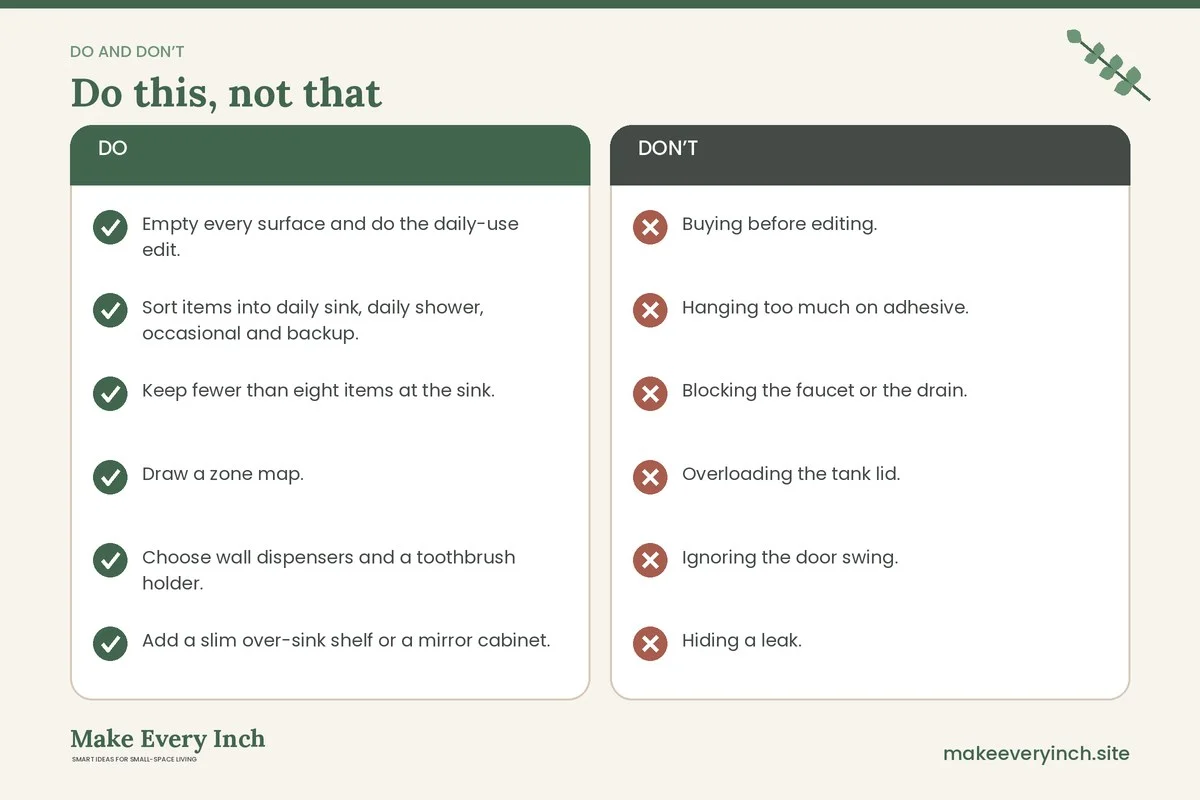
- Buying before editing. Storage fills with items you do not need.
- Hanging too much on adhesive. Load limits are real, and steam weakens many adhesives.
- Blocking the faucet or the drain. A caddy that restricts the tap is a hassle.
- Overloading the tank lid. Ceramic lids crack under weight.
- Ignoring the door swing. A rack that bangs the door soon breaks.
- Hiding a leak. Leave access to the pipes under the sink and check them often.
- Using open baskets in a damp room. Paper and cotton items can grow mold, so use materials that dry quickly.
Counterless bathroom checklist
- Empty every surface and do the daily-use edit.
- Sort items into daily sink, daily shower, occasional and backup.
- Keep fewer than eight items at the sink.
- Draw a zone map.
- Choose wall dispensers and a toothbrush holder.
- Add a slim over-sink shelf or a mirror cabinet.
- Add a caddy or a rail in the shower.
- Install a hand towel ring or hook.
- Use moisture-rated fixings and anchors.
- Get permission before drilling into tile or walls.
- Check the fan and the outlets.
- Set a weekly reset.
FAQ
What can I use instead of a counter in a small bathroom?
Use the wall and the mirror. Wall-mounted dispensers, a slim over-sink shelf, a mirrored cabinet, a hook for the hand towel and a shower caddy cover most daily needs. A small tray on the toilet tank can hold decor.
How do I store a toothbrush with no counter?
Use a wall-mounted holder beside the mirror, a cup that sits in a mirror shelf or a cabinet shelf inside the medicine cabinet. Let the brush dry between uses.
Is a medicine cabinet worth it if I rent?
A surface-mounted cabinet can be worth it if the landlord allows it, because it adds a mirror and storage together. Ask first, since it needs fixings, and use anchors suited to the wall.
Will adhesive products stay up in a steamy bathroom?
Some do and some do not. Steam, soap film and rough surfaces reduce adhesion, so choose products made for bathrooms, follow the instructions and keep loads under the limit. Check them regularly.
How many products should I keep at the sink?
There is no fixed number, but fewer than eight daily items is a workable aim for a room with no counter. Anything you do not use daily can live in a cabinet or in another room.
How is this different from storage ideas for small bathrooms?
Storage posts such as our guide on tiny bathroom storage ideas focus on adding space. This guide focuses on editing what you keep at the sink, then giving the remaining items a wall or mirror home so no counter is needed.
Keep going: Keep planning with our small bathroom vanity ideas, the sibling guide on small bathroom ideas for narrow rooms and our post on best over the toilet storage.
Save this guide for later
Pin the ideas you like to Pinterest so you can come back to them when you plan your space.