Small Home Organization for Families
Quick answer: Small home organization for families works best when you divide the home into shared zones, put kid items at kid height, rotate toys instead of storing them all, give school papers one landing spot and anchor every tall piece of furniture. Short daily routines keep it going, and child-safe storage keeps hazards out of reach.
Small home organization for families is a different challenge from organizing for one or two adults. Children bring a constant flow of objects, from shoes and backpacks to art, toys and school forms, and they cannot organize themselves unless the system is built at their height and their level of patience. In a small home, there is no spare room to hide the overflow, so every item needs a home that a six-year-old can reach and a tired parent can maintain. This guide shows how to build that system. It covers shared zones, kid-height storage with measurements, daily routines, toy rotation, a school paper pipeline, safety rules for anchoring and child-safe storage, a comparison table, three example homes, a checklist and a FAQ. For the wider topic, start with our pillar guide on small space organization ideas. To reduce what comes into the home in the first place, read our rules in decluttering rules for small homes.
Start by watching how your family actually moves
Before buying a single bin, spend a week observing. Notice where backpacks land when the door opens, where shoes pile up, where homework happens and where toys collect at the end of the day. Families are creatures of habit, and the places where clutter gathers show you where the system should be. A pile of coats on the sofa arm means the coat hooks are in the wrong place, or too high, or too few.
Take notes on three things. First, list the daily items each person handles: bags, coats, shoes, water bottles, lunch boxes, devices and chargers. Second, mark the busiest times, usually the morning rush and the after-school hour. Third, note which tasks the children can already do on their own. A system fits when it lets each person do their own part with the least effort. If a child has to ask for help to hang a coat, the hook is in the wrong place.
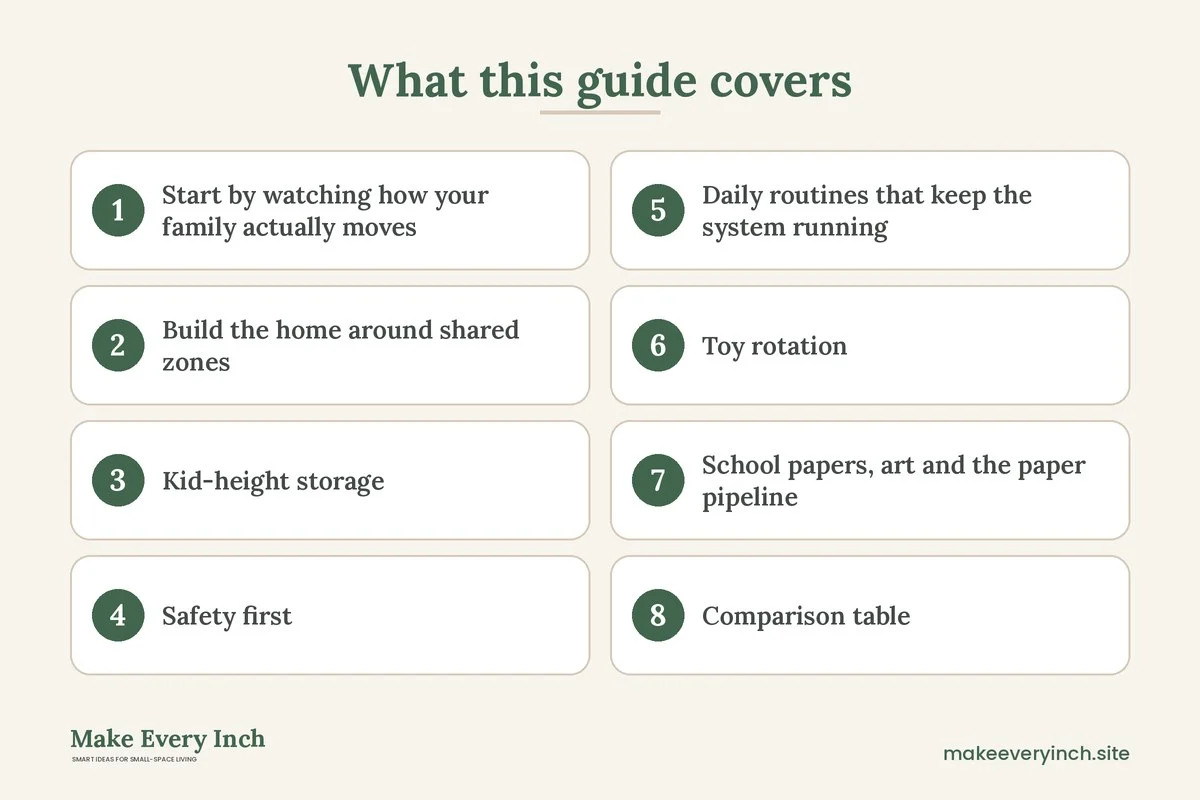
Build the home around shared zones
A small home works best when each area has a clear job. Zones reduce the number of decisions, because everyone knows where something goes. Try these five.
The landing zone
The landing zone is the first meter inside the door. It holds the items that move in and out every day: coats, shoes, bags, keys, sunglasses and school forms. A bench or low shelf with hooks above it, a shoe tray and a basket for gloves and hats is enough. Give each family member their own hook and their own cubby or bin, color coded or labeled with a name or picture. If you have little room, see our guides to small entryway organization and small coat storage ideas. Where there is no entryway at all, no entryway apartment ideas shows how to create one from a wall.
The homework and craft zone
A small home rarely has a dedicated study, so choose one surface for homework and crafts, such as the dining table, a fold-down desk or a corner worktop. Store supplies in a caddy that moves with the child: pencils, paper, scissors, glue and a ruler. When homework is done, the caddy goes back to its shelf and the table is free for dinner. For desk options see our guide to the best desks for small apartments.
The play zone
Define the play area with a rug, a shelf or a corner, and keep toys inside it as much as you can. A clear boundary helps children understand where toys live and makes tidy-up time shorter. In a combined living room, a low shelf behind the sofa or a storage ottoman can hold the main collection. See our guides to the best storage ottomans and small living room storage ideas for families for options that suit a shared room.
The kitchen zone
In the kitchen, give children a low drawer or shelf for their own plates, cups and snacks, so they can help set the table and serve themselves. This builds independence and takes work off the adults. Put anything sharp, hot or breakable above their reach. Our guides to small kitchen organization ideas and small kitchen drawer organization ideas have layout ideas that work in tight kitchens.
The sleep zone
Bedrooms for children are often shared or doubled as play areas. Keep the sleep zone calm: bed, a light, a book basket and clothes for tomorrow. Use under-bed bins for out-of-season clothes or extra bedding, and store toys elsewhere where you can. For more, read our posts on small bedroom ideas for families and under bed storage ideas.
Kid-height storage: the measurements that matter
Storage works for children only when they can reach it. The following ranges are guides and vary by age and child. Measure your own child, and adjust.
- Hooks for toddlers (ages 2 to 4): about 28 to 36 inches from the floor.
- Hooks for school-age children (ages 5 to 8): about 36 to 44 inches from the floor.
- Hooks for older children (ages 9 to 12): about 44 to 54 inches from the floor.
- Open shelves for daily toys and books: the top shelf at roughly 30 to 36 inches for young children, with heavier items on the bottom.
- Clothes rails for children: 36 to 48 inches for younger children, with a second low rail if the closet allows.
- Dresser drawers: the most used clothes in the top two or three drawers that the child can reach, and out-of-season items at the bottom or the top.
- Bins and baskets: shallow, with wide openings and lightweight handles, ideally no deeper than 10 to 12 inches so a child can see inside.
- Table height: a seat that lets the child’s feet rest on the floor or a stool, with elbows at roughly table height.
Raise the heights as the child grows. A good approach is to use an adjustable rail or a rail with several mounting points, so you can move the hooks without re-drilling. If you rent, never drill without permission, and consider freestanding bench units, over-the-door hooks and adhesive hooks rated for the load. Our guide on no-drill storage ideas for renters covers these in depth.
Label for non-readers
Pictures work for children who cannot read. Use a photo or drawing of the contents on the front of each bin: a car for toy cars, a book for books, a sock for socks. For readers, add a word. Labels cut the number of questions a parent answers each day, and children are more likely to tidy up when they can see where each thing goes.
Safety first: anchoring and child-safe storage
Organizing a home for children includes protecting them from hazards. Storage furniture is both a tool and a risk if it is not secure, and a small home often has taller pieces to use the vertical space.
Anchor all tall furniture
Dressers, bookshelves, cabinets and tall shelving units can tip if a child climbs on them or pulls open drawers. Anchor them to the wall using the anchoring kit that suits the furniture and the wall type, and follow the manufacturer’s instructions. Anchor to a stud where you can, or use the correct wall anchor for drywall or masonry. Do not rely on the weight of the furniture alone. Place the heaviest items low, and avoid placing a TV or heavy objects on top of a dresser. If you rent, check the lease and ask your landlord before drilling. If you cannot drill, consider lower furniture, wall-mounted straps with approved fixings that the landlord allows, or furniture that is low and stable enough to avoid tipping. Also check whether your furniture has a built-in tip-over restraint.
Use child-safe storage for hazardous items
Cleaning products, medicines, vitamins, batteries, small magnets, lighters, sharp tools, plastic bags and cosmetics must be out of reach and in a locked or latched cupboard. A high shelf is not always enough, since children climb. Use a locking cabinet, a latch on the cupboard door or a lockable box, and put it above or beyond the child’s reach. Keep products in their original containers with labels, and never put chemicals in drink bottles. Button batteries and magnets deserve special care, since swallowing them can cause serious harm. Check and dispose of old medicines through a pharmacy or local collection scheme.
Watch for other hazards
- Cords and blinds: Keep window blind cords and charging cables out of reach, using cord winders or cordless products, and place cribs and beds away from them.
- Small parts: Keep small toys and parts away from babies and toddlers, and store them in a separate bin until the child is older.
- Heavy items on high shelves: Store heavy objects low, so they cannot fall on a child.
- Window access: Do not place furniture below windows where a child can climb, and use window guards or limiters where appropriate.
- Electrical outlets: Use outlet covers where needed, and do not overload sockets or power strips when you add lamps and chargers in tight areas.
- Ventilation and paint: If you repaint a child’s room, choose low-VOC paint and ventilate until the smell has gone. Apply only with permission if you rent.
- Stair gates and doors: Install them according to the instructions, and keep storage clear of exits.
Safety rules change as children grow, so check them every few months. A toddler and a teen need different arrangements, and the home has to adapt.
Daily routines that keep the system running
Systems fail when they rely on one parent doing everything. Build routines that involve the whole family and are short enough to repeat.
- The morning launch: Each child gets their bag, shoes and coat from the landing zone. Prepare the night before: bags packed, clothes laid out and water bottles by the door.
- The after-school landing: Bags go on the hook, shoes go on the tray, school papers go in the paper basket and lunch boxes go to the kitchen counter. This is a five-minute routine, and it helps to do it before any snack or screen.
- The 10-minute evening tidy: Set a timer and put on music. Each person returns their items to their zone. Toys go to their bins, dishes go to the sink, and the sofa gets cleared.
- The weekly reset: Once a week, spend 15 to 20 minutes on a deeper pass. Clear the paper basket, empty the lost-and-found bin and check the toy rotation.
- The seasonal swap: Four times a year, swap clothes, check what no longer fits and pass on items to other families or to donation.
Children respond to visual routines. A simple chart with pictures of the steps, such as shoes, bag, coat, hands, helps younger children follow along. For older children, a shared list on the fridge works. Praise effort and consistency, and keep the standard realistic: a tidy small home is not a perfect one.
Toy rotation: the biggest small-home win
Toys are the largest source of clutter in family homes. The most effective approach in a small home is toy rotation. Instead of keeping all toys available, keep about a quarter to a third in the play zone and store the rest. Every few weeks, swap the sets. The old toys feel new, play lasts longer, and cleanup is faster because there are fewer items.
How to set up a rotation
1. Sort toys by type: blocks, vehicles, dolls and figures, art supplies, puzzles, books and pretend play.
2. Choose the daily set: pick a few items from each type for the play zone, enough to fill one or two low shelves or bins.
3. Pack the reserve: put the rest into labeled, lidded bins. Store them on a high closet shelf, under a bed or in a cupboard out of the child’s sight.
4. Set a rhythm: swap every two to four weeks, or whenever interest fades. Let the child choose one or two favorites to stay out.
5. Retire the unused: toys that stay in the reserve through two or three rotations without being missed can go to donation.
Keep it manageable
A limit helps: one bin per category, and when it is full, something leaves. Combine this with the one-in, one-out rule at birthdays and holidays. Ask relatives for experiences, books or consumables, such as art supplies, instead of more objects. Large toys that take up floor space can rotate as well, or be shared with friends or neighbors. Keep puzzles and board games in the original boxes or zipped bags, with a photo of the finished puzzle on the outside.
School papers, art and the paper pipeline
Paper is the second great source of family clutter. Children bring home worksheets, notices, forms, drawings and permission slips almost daily. Treat it as a pipeline with an entry, a decision and an exit.
The entry
One shallow basket or tray in the landing zone receives every paper that comes in. Children place their own papers in it, and parents add mail. Nothing is allowed to wait on the kitchen counter.
The decision
Once or twice a week, spend ten minutes sorting the basket into four piles:
- Action: forms to sign, payments, events and deadlines. Add dates to a shared calendar and put the form in an action folder.
- Keep for now: items you will need this term, such as the timetable or contact list. Display them on a board or inside a cupboard door.
- Art and memories: the best pieces go to a memory box. Photograph the others.
- Recycle: everything else.
The exit
Give each child one art box or portfolio, about 12 by 16 by 4 inches, labeled with their name and the school year. When the box is full, the child helps choose which items to keep. Photographing artwork and storing the images digitally preserves memories without taking up space. Display a few current pieces on a cord with clips or a magnetic board, and rotate them with the toy rotation. For items you need to keep for official reasons, such as medical records, school reports and birth certificates, use a single file box with labeled folders, and store it somewhere safe and out of reach of small children.
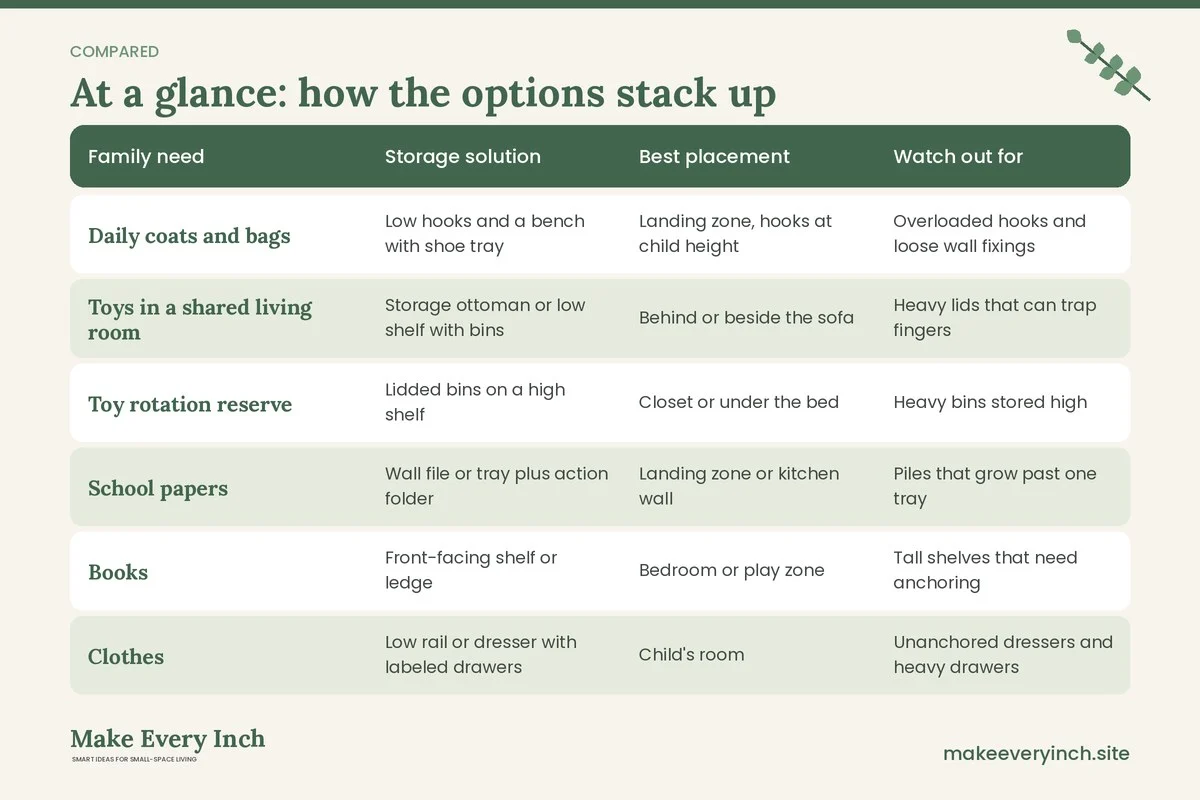
Comparison table: which storage solution fits which family need?
| Family need | Storage solution | Best placement | Watch out for |
|---|---|---|---|
| Daily coats and bags | Low hooks and a bench with shoe tray | Landing zone, hooks at child height | Overloaded hooks and loose wall fixings |
| Toys in a shared living room | Storage ottoman or low shelf with bins | Behind or beside the sofa | Heavy lids that can trap fingers |
| Toy rotation reserve | Lidded bins on a high shelf | Closet or under the bed | Heavy bins stored high |
| School papers | Wall file or tray plus action folder | Landing zone or kitchen wall | Piles that grow past one tray |
| Books | Front-facing shelf or ledge | Bedroom or play zone | Tall shelves that need anchoring |
| Clothes | Low rail or dresser with labeled drawers | Child’s room | Unanchored dressers and heavy drawers |
| Art supplies | Caddy with a lid | Homework zone | Small items for babies and toddlers |
| Hazardous items | Locked cabinet or latched cupboard | High and out of reach | Keys or codes left within reach |
Three example family homes
A two-bedroom apartment for a family of four
Two adults and two children aged 3 and 7 share about 750 square feet. The children share a bedroom, so storage must work in layers. The landing zone is a narrow bench of 36 inches with four hooks on the wall above, at heights of 32 inches for the younger child, 40 inches for the older child and 60 inches for each adult. The living room has a storage ottoman that holds the daily toy set, and a lidded rotation reserve in the parents’ closet. The older child uses a fold-down desk in the bedroom for homework, with a caddy of supplies. Tall furniture, including the bookcase and the dresser, is anchored to the wall with the landlord’s permission, and the medicine and cleaning products are in a locking cabinet at adult shoulder height. The evening tidy takes ten minutes and starts at 7 pm.
A one-bedroom apartment with a baby and a toddler
The parents sleep in the bedroom with the baby in a crib, and the toddler sleeps in a small alcove. Storage is vertical. Wall shelves hold diapers and clothes above the changing area, mounted with the correct fixings or replaced with a freestanding tower anchored in place. The toddler has a low shelf with four bins and a book ledge at 24 inches. Because the baby is mobile, small toys live in a separate lidded bin on a high shelf, and any cords are fixed out of reach. The kitchen has a low drawer with the toddler’s cups and bowls, and latches on the cupboard with cleaning products. The papers pipeline consists of a tray on the fridge-side wall and a monthly session after the children sleep.
A small house with three school-age children
A 1,000 square foot house with three bedrooms has little storage but a short hallway. The hallway becomes the landing zone with a long bench, three cubbies and labeled baskets for sports gear. The children each have a memory box and a weekly 10-minute task: emptying their school bags into the paper basket and the lost-and-found bin. A rotating chore chart gives each child a zone to maintain, such as the shoes, the kitchen table or the toy shelf. The living room keeps one shared shelf of games and books, with a limit of two shelves per child. Seasonal clothes are stored in under-bed boxes, and tall shelves in each bedroom are anchored to the wall. For more storage ideas for shared rooms, read our guide on narrow living room ideas for families.
Make kids part of the system
A system that only adults understand will fail. Children are more likely to follow a system that they helped to build. Let them choose the color of their bin, draw a label or decide where their favorite toy lives. Practice the routine together for a week, and then step back. Offer help at the start and lessen it as the habit forms.
Age expectations vary, but here are some guides:
- Ages 2 to 4: Putting toys in a bin, hanging a coat on a low hook, and carrying a plate to the counter.
- Ages 5 to 8: Packing a bag, setting the table, sorting laundry by color and making the bed with help.
- Ages 9 to 12: Keeping their own room in order, using a calendar and managing homework papers.
- Teens: Owning their own space and schedule, with agreed standards for shared areas.
Keep the rules simple and consistent. A parent who follows the same routine models it for the child. If a system takes more effort than the clutter it solves, simplify it.
Mistakes families make in small homes
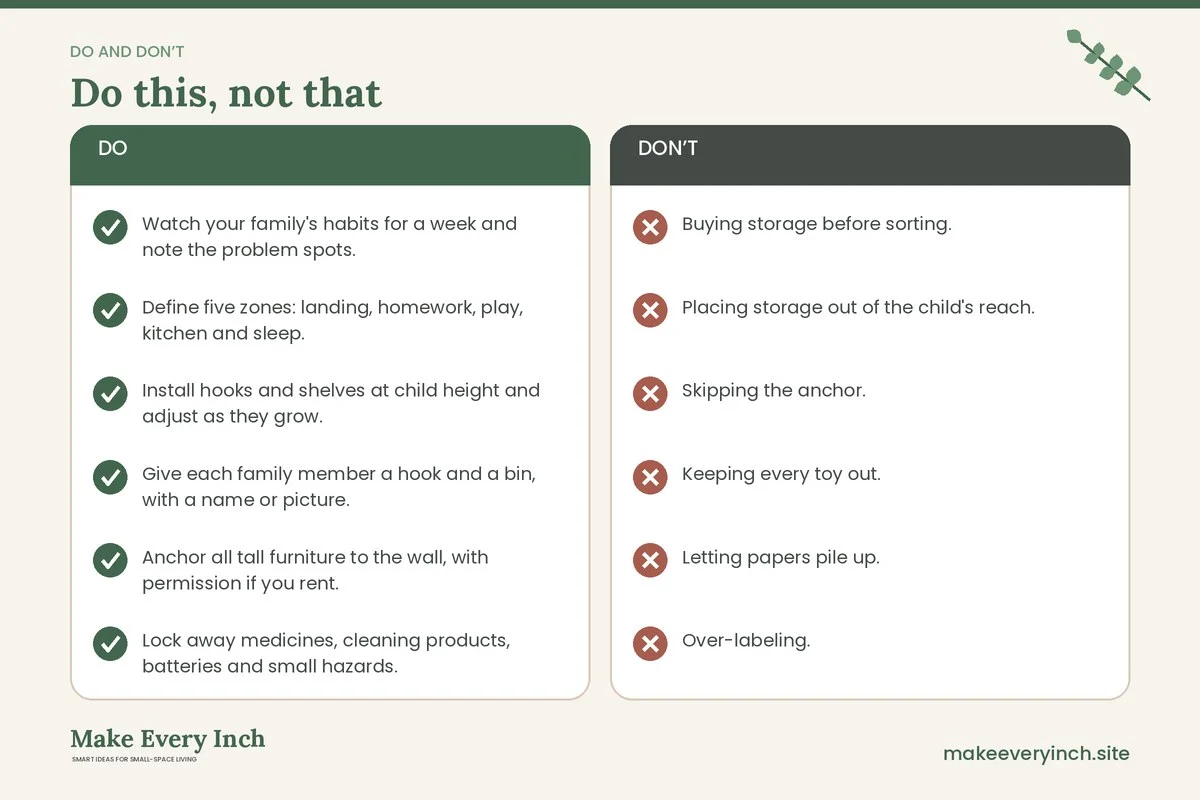
- Buying storage before sorting. Bins fill with whatever you give them. Declutter first, using the steps in our guide on small apartment decluttering ideas.
- Placing storage out of the child’s reach. If the child cannot reach it, the parent does the work.
- Skipping the anchor. Tall furniture should always be secured, even if it feels sturdy.
- Keeping every toy out. Too many toys lead to less play and more mess.
- Letting papers pile up. One tray, one weekly decision, one exit route.
- Over-labeling. Too many labels become clutter. Label the main bins and zones, and leave the rest.
- Trying to be perfect. A family home shows signs of life. Aim for a reset that takes minutes, not a showroom.
Budget and starting points
You do not need to buy everything at once. Start with the zone that causes the most friction, usually the entryway. Use what you already have, such as baskets, crates and shelves from second-hand sources, and check that each piece is stable and has no sharp edges. Test the system for two weeks before adding more. Our guides to cheap storage ideas for apartments and vertical storage ideas offer further options. Always check that any second-hand furniture is stable, has no loose parts and meets current safety standards for children’s use.
Family organization checklist
- Watch your family’s habits for a week and note the problem spots.
- Define five zones: landing, homework, play, kitchen and sleep.
- Install hooks and shelves at child height and adjust as they grow.
- Give each family member a hook and a bin, with a name or picture.
- Anchor all tall furniture to the wall, with permission if you rent.
- Lock away medicines, cleaning products, batteries and small hazards.
- Check cords, blinds and window access every few months.
- Set up toy rotation with a daily set and a reserve.
- Create a paper pipeline with a tray, a weekly sort and a memory box.
- Start a five-minute after-school landing and a 10-minute evening tidy.
- Plan a weekly 15-minute reset and a seasonal swap.
- Involve the children in choosing labels and bins.
FAQ
How do I organize a small home with kids?
Divide the home into zones, put storage at the child’s height, rotate toys and set short daily routines. Start with the entryway, then move to the play area.
How many toys should a small home keep?
There is no fixed number. A useful approach is to keep roughly a quarter to a third of toys available and store the rest for rotation. Adjust based on the size of your play zone and your child’s interests.
What is the safest way to store things in a small home with children?
Anchor tall furniture, lock away medicines, cleaning products, batteries and small hazardous items, and keep heavy objects low. Check your setup regularly as your children grow.
Can renters anchor furniture?
Many leases require permission to drill. Ask your landlord, and explain the safety reason. If drilling is not allowed, choose low and stable furniture, and ask which anchoring options are acceptable. Never drill without permission.
How do I deal with school papers?
Use one tray for incoming papers, sort weekly into action, keep, memory and recycle piles, and give each child one art box. Photograph the rest.
How do I get children to tidy up?
Make it easy and routine. Put bins within reach, use pictures as labels, set a timer and tidy together. Praise effort, and keep the expectations suited to their age.
What if my children share a room?
Give each child their own bin, shelf and hook, mark the boundaries with colors and keep the shared floor clear. Use vertical storage and under-bed boxes for out-of-season items. See our guide to small bedroom storage ideas for more.
Keep going: Keep going with our guides to small space organization ideas, small kitchen organization ideas and small bedroom organization ideas.
Save this guide for later
Pin the ideas you like to Pinterest so you can come back to them when you plan your space.