15 Small Living Room Ideas for Renters Japandi Style Without Renovating
Quick answer: The best small living room ideas for renters japandi style use low, light furniture, natural materials and soft warm light, all freestanding. Choose a low sofa, a round wood table, a flat-weave rug, paper or linen shades on plug-in lamps and a few handmade objects. Keep 30 to 36 inches of walkway, lean art instead of drilling and avoid anything the lease forbids.
Small living room ideas for renters japandi in feeling combine two traditions that both love restraint: the quiet order of Japanese design and the cozy warmth of Scandinavian design. The look is a natural fit for a rental because it relies on objects, not construction. Low furniture, wood tones, linen, paper light and a few well-chosen things can be moved in and out without touching a wall. The challenge is that the usual rental living room has cool white walls, harsh lights and a plain floor, so the warmth has to come from what you add. This guide explains how to build a Japandi room on a lease. It covers the lease check, the proportions that matter, 15 ideas, a materials table, three example rooms, a color and texture plan, a care routine and a checklist. For the wider topic, read our main guide on small living room ideas for renters and the small living room ideas pillar.
What makes a room Japandi, in rental terms
Japandi is built on a few repeating ideas. Once you see them, you can apply them without a renovation.
- Low profile: furniture sits closer to the floor, which makes the ceiling feel higher.
- Natural materials: wood, linen, cotton, wool, paper, clay and stone, in matte finishes.
- Warm neutrals: soft whites, oatmeal, greige, sand and clay, with one dark accent such as charcoal or deep brown.
- Space as a feature: empty floor and wall are part of the design, not a gap to fill.
- Handmade and imperfect: a hand-thrown bowl or a woven basket beats a perfect set.
- Function first: every piece has a job, and the room has a place for each thing.
In a rental, you cannot add a wooden ceiling or a built-in bench, but you can capture each idea with freestanding items. A low sofa gives the profile, a wood table gives the material, a rug gives the warmth, and a single branch in a vase gives the quiet.
Read the lease and plan for removal
Before you buy anything, read the lease on nails, adhesive, paint, light fixtures and window coverings. Japandi tends to use a few wall items, such as a paper lantern or a woven hanging, so decide early whether you can hang anything at all. Photograph the walls, floor and ceiling before you start. Test adhesive on a hidden spot for a few days, since flat paint may lift. Ask your landlord in writing if you want to hang a single hook, and keep the reply.
Also think about floors. A Japandi room often features floor seating, and cushions and low tables can scratch a delicate floor. Put felt pads under every leg. If you plan to sit on a cushion, place it on a rug rather than directly on a hard floor. For related ideas, see our guide to security deposit safe apartment upgrades.
Proportions and measurements for a small Japandi room
Low furniture changes the usual numbers. These ranges are a starting point, and your own measurements decide.
- Room width: in a room about 8 to 10 feet wide, a low sofa 70 to 80 inches long and 30 to 34 inches deep leaves a clear main path.
- Seat height: 14 to 16 inches for a low sofa or lounge seat, compared with 17 to 19 inches for many standard sofas.
- Coffee table height: 12 to 15 inches, so the top sits a few inches below the seat edge.
- Sofa to table gap: 14 to 18 inches, a little less if the table is round.
- Main walkway: 30 to 36 inches. A side path used occasionally can be 24 inches.
- Furniture depth: keep consoles and shelves at 10 to 14 inches deep, and low cabinets under 16 inches.
- Visible floor under furniture: 4 to 8 inches under a sofa, bench or cabinet, since open legs add lightness.
- Rug size: about 5 by 8 feet, with the front legs of the seating on the rug. A jute or wool rug in a natural tone suits the style.
- Art height: the center of a leaned or hung piece at about 57 inches, but in a low room lower art feels natural, so lean pieces lower.
Tape the footprint of each piece on the floor and live with the tape for a day. Low rooms feel open, but the same tape test shows whether you have room to pass.
15 small living room ideas for renters japandi style
Low, light seating
1. A low sofa with slim legs
A sofa with a low seat and wood-toned legs creates the Japandi profile. Choose a linen-look or cotton cover in a warm off-white. Check that you can still stand up easily, because very low seats are tiring for some people. Our guide to the best sofas for small apartments lists features worth checking.
2. A pair of floor cushions
Two large cushions stacked or side by side give extra seating for guests and tuck into a corner. Choose washable covers in natural fibers and keep them on a rug so the floor stays safe.
3. A bench under the window
A slim wooden bench, 14 to 16 inches deep, gives a quiet spot to sit and holds a basket beneath it. It reads as part of the room’s architecture without being fixed to anything.
4. A single accent chair in a natural frame
A chair with a curved wooden frame and a woven or linen seat adds interest. Place it at an angle to the sofa with 30 inches between them. Skip it if the walkway drops below 30 inches.
Tables and storage
5. A round low wooden table
A round table in oak, ash or a similar light wood is the heart of the look. Rounded edges are safe in a tight room, and a low height keeps sight lines open. See our small living room ideas without a coffee table, Japandi for a variation that skips the table entirely.
6. Nesting tables in two woods
A nesting pair in a light and a darker wood slides apart for tea and tucks together afterward. The contrast is the Japandi mix of Nordic light and Japanese dark.
7. A low cabinet with doors
Closed storage keeps the room quiet. A cabinet 14 to 16 inches deep and about 24 to 30 inches tall, on slim legs, holds a TV on top or a few objects. Fabric or slatted fronts add texture. For more, read our small living room storage ideas, Japandi.
8. Woven baskets with lids
A pair of lidded baskets holds throws and the rest of your daily items. Choose natural fibers in a single tone. Baskets are portable and require no mounting.
Anchoring note: if you use any tall shelf or cabinet, strap it to the wall as the maker directs, or use an anti-tip kit that suits your lease. Tall furniture can tip, so a low piece is safer than a tall one when you cannot anchor it.
Light, window and wall
9. Paper and linen shades on plug-in lamps
Soft light is central to Japandi. A paper lantern shade on a floor lamp or a linen shade on a table lamp turns harsh ceiling light into a glow. Use warm bulbs around 2700 kelvin. Our renter-friendly lighting ideas and small living room lighting ideas, Japandi cover the options in more depth.
10. A tension rod with a linen curtain
Hang a plain, loose linen panel on a tension rod inside the window frame, or on a rod that hooks over the casing. Linen softens glare, and a pale panel hides blinds you cannot change. Choose a color a shade darker than the wall for depth.
11. A woven or fabric wall piece, leaned or hung where allowed
One large woven piece or a neutral fabric panel adds texture. Where hanging is not allowed, lean a framed print or a wooden board against the wall on a low cabinet. Keep to one focal piece, and leave the rest of the wall bare. See our renter-friendly wall decor ideas for adhesive choices.
12. A removable panel of textured wall covering
If the lease allows it, a small panel behind the sofa in a plain, textured wall covering adds depth. Test a sample first, and read the removal instructions. Our guide on removable wallpaper ideas covers risks.
Objects and greenery
13. A branch in a vase
A single branch or dried stems in a plain ceramic vase is the classic Japandi gesture. It costs little, takes minutes and leaves no trace. Place it on the low table or the cabinet, where it stands out against empty space.
14. A few handmade pieces, grouped in threes
Group a bowl, a vase and a small sculpture on a tray. Odd numbers feel relaxed, and a tray keeps the group together and makes dusting easy. Rotate the pieces each season.
15. One plant with a clear shape
A single plant with an open, sculptural shape, such as a tall plant in a clay pot, brings life without clutter. If you have pets, check that the plant is safe before bringing it home.
Materials table: what to use and what to watch
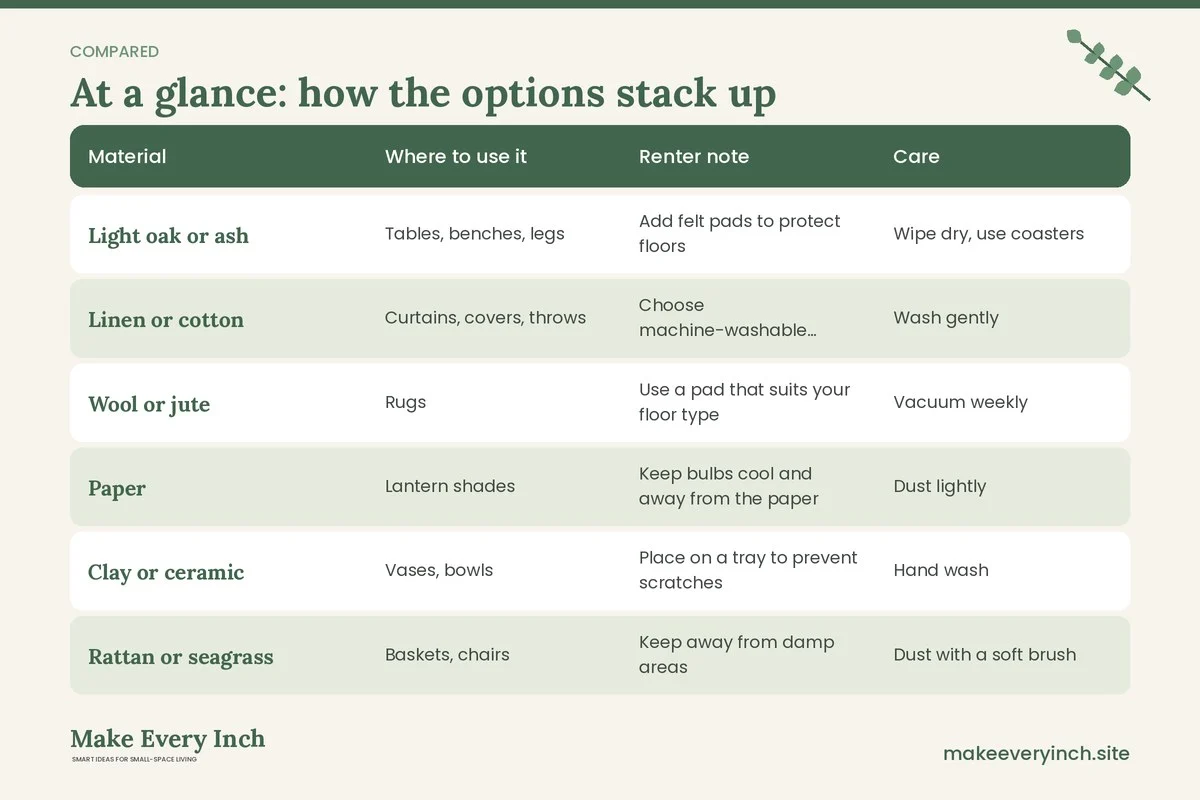
The table below lists the materials that define the style, with notes for renters.
| Material | Where to use it | Renter note | Care |
|---|---|---|---|
| Light oak or ash | Tables, benches, legs | Add felt pads to protect floors | Wipe dry, use coasters |
| Linen or cotton | Curtains, covers, throws | Choose machine-washable covers | Wash gently |
| Wool or jute | Rugs | Use a pad that suits your floor type | Vacuum weekly |
| Paper | Lantern shades | Keep bulbs cool and away from the paper | Dust lightly |
| Clay or ceramic | Vases, bowls | Place on a tray to prevent scratches | Hand wash |
| Rattan or seagrass | Baskets, chairs | Keep away from damp areas | Dust with a soft brush |
| Dark wood or metal | Accent legs, frames | Use sparingly as the contrast | Wipe with a cloth |
Color and texture plan
Japandi works when the palette is calm. Use a base of warm white or oatmeal for large pieces such as the sofa and curtains. Add wood tones in the middle: light for the table and bench, medium for the cabinet. Finish with a dark accent, such as charcoal or deep brown, in two or three small objects. Muted green or clay can appear in a plant or a pot.
Texture does more work than color. Pair a smooth wood table with a nubby wool rug, a crisp linen curtain and a matte ceramic bowl. If every item has the same finish, the room feels flat, so mix at least three textures. Avoid shiny plastic, loud patterns and many small decorative items. The empty space around the objects is part of the design, so leave some of it alone.
For a related approach that leans cozier, see our cozy small living room ideas, Japandi. If you are still deciding between styles, the broader Japandi apartment ideas guide and the Scandinavian small apartment ideas post compare the details.
Three example rooms
A 9 by 12 foot room with a low sofa
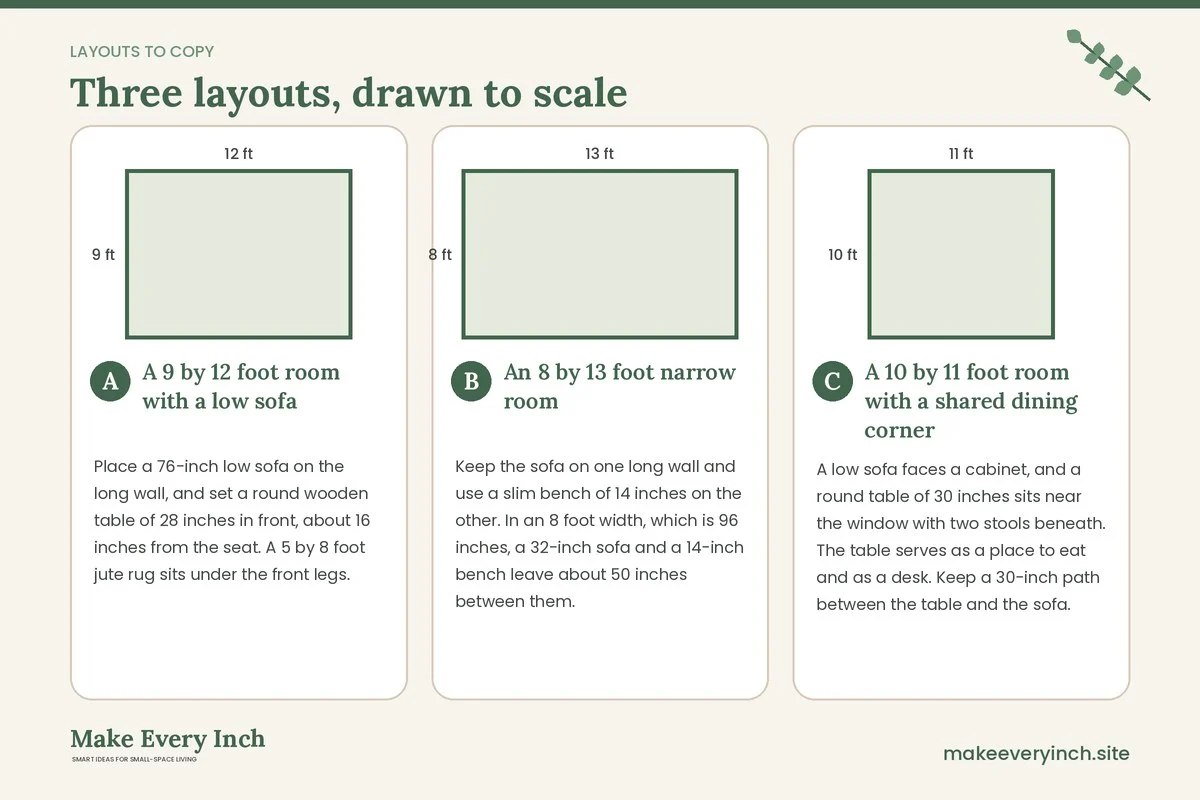
Place a 76-inch low sofa on the long wall, and set a round wooden table of 28 inches in front, about 16 inches from the seat. A 5 by 8 foot jute rug sits under the front legs. A low cabinet of 14 inches deep sits on the opposite short wall, and a paper floor lamp stands in the corner. The path to the window is about 34 inches, and the room has four visible objects on the table and cabinet. This plan suits one or two people.
An 8 by 13 foot narrow room
Keep the sofa on one long wall and use a slim bench of 14 inches on the other. In an 8 foot width, which is 96 inches, a 32-inch sofa and a 14-inch bench leave about 50 inches between them. That is enough for a 30 to 36 inch path and a floor cushion at one end. Skip the coffee table and use a small stool as a drink surface. A leaned mirror at the end of the room reflects the window and adds depth.
A 10 by 11 foot room with a shared dining corner
A low sofa faces a cabinet, and a round table of 30 inches sits near the window with two stools beneath. The table serves as a place to eat and as a desk. Keep a 30-inch path between the table and the sofa. A paper pendant-style shade on a floor lamp arcs over the table, and a curtain on a tension rod frames the window. The two zones read as one calm space because they share the same wood tone.
Floor seating in a rental
Floor seating is part of the style, but it needs a few precautions. Choose a rug with a pad so cushions do not slide. Use thick cushions, 3 to 5 inches, with firm filling so they support your back. Place a low back support, such as a floor chair or a bolster, if you plan to sit for long periods. Keep the sitting area away from drafts and heaters. If knees or hips make low seating uncomfortable, keep to chair-height furniture and add the style through materials and light. The look does not depend on sitting on the floor.
A seasonal and weekly routine
Japandi rooms stay calm through small habits.
- Weekly: return everything to a basket or cabinet, dust the paper shade and shake the throw.
- Monthly: turn the rug end to end and move the furniture an inch or two to avoid permanent marks on the floor.
- Seasonal: swap the branch and one object. Keep the rest.
- Every few months: check felt pads and replace any that have worn out.
- At move-out: remove adhesive slowly, wipe the walls and clean the floor under the rug.
Mistakes renters make with Japandi
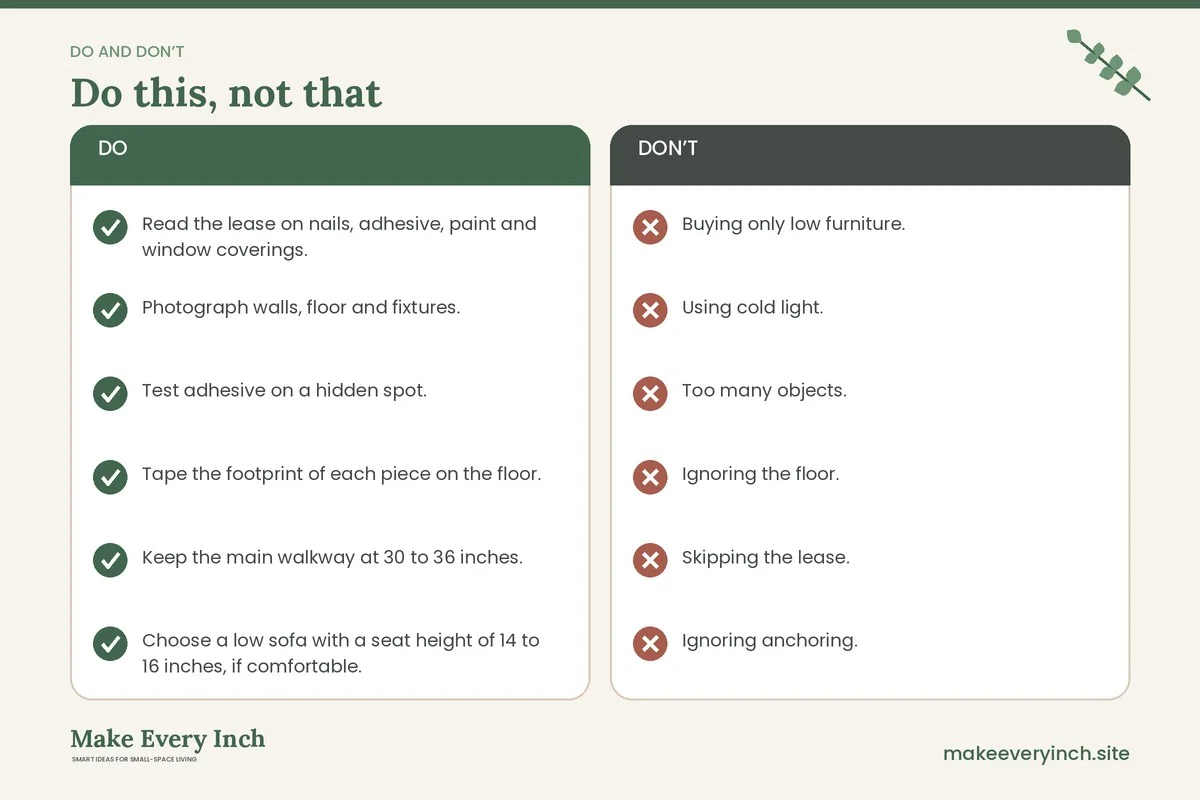
- Buying only low furniture. A room with everything at floor level can feel heavy. Mix one or two taller items, such as a lamp or a plant.
- Using cold light. Cool white bulbs destroy the warmth. Choose warm bulbs.
- Too many objects. Three on a tray is better than ten on a shelf.
- Ignoring the floor. Wood and ceramic can scratch. Use pads and trays.
- Skipping the lease. A paper shade near a hot fixture or a wall panel that damages paint costs more than it saves.
- Ignoring anchoring. Tall slim cabinets look elegant and need straps.
- Copying a photo exactly. A staged room has professional lighting and no daily mess. Adapt it to your habits.
Move-out notes
Keep your lease, your move-in photos and any written permissions in one folder. The Japandi approach helps here, because most of what you own is furniture and textiles that simply leave with you. Before you go, lift the rug and check the floor, remove felt pads that have collected grit and wipe baseboards. Remove any adhesive according to its instructions, and take photos in the same spots as the move-in set. For layout ideas that suit the style, read our small living room layout ideas, Japandi and small living room furniture ideas, Japandi guides. For a sibling take on the same lease limits, see small living room ideas for renters, minimalist and small living room ideas for renters, cozy.
Japandi renter checklist
- Read the lease on nails, adhesive, paint and window coverings.
- Photograph walls, floor and fixtures.
- Test adhesive on a hidden spot.
- Tape the footprint of each piece on the floor.
- Keep the main walkway at 30 to 36 inches.
- Choose a low sofa with a seat height of 14 to 16 inches, if comfortable.
- Add a round wooden table, 12 to 15 inches high.
- Lay a 5 by 8 foot natural-fiber rug with a pad.
- Use paper or linen shades with warm bulbs.
- Hang a linen curtain on a tension rod.
- Add felt pads under all furniture legs.
- Anchor tall furniture or choose low pieces.
- Group objects in threes on a tray.
- Add a branch or a single plant.
- Keep a move-out folder.
FAQ
Can I do Japandi in a rental with white walls?
Yes. White walls suit the style as a quiet backdrop. Add warmth with wood, linen, a natural rug and warm light.
What is the difference between Japandi and minimalist?
Minimalism focuses on having less. Japandi also values warmth, natural materials and handmade objects, so the room feels softer.
Do I need to sit on the floor for Japandi?
No. Low furniture and natural materials define the look. Floor seating is optional.
How do I get Japandi lighting without changing fixtures?
Use plug-in lamps with paper or linen shades and warm bulbs. Place them at different heights to create pools of light.
What wood tones should I buy?
Choose one light tone as the main wood and one darker tone as an accent. Matching the finish across pieces is less important than matching the warmth.
How can I get the look without spending much?
Start with the rug, the lamp shade and a branch in a vase. Buy furniture second-hand and clean or refinish only what the lease allows.
Keep going: Keep planning with our small living room ideas for renters, small living room ideas and small apartment living room ideas, Japandi.
Save this guide for later
Pin the ideas you like to Pinterest so you can come back to them when you plan your space.