Small Bathroom Ideas Without a Window
Quick answer: The best small bathroom ideas without a window combine three jobs: layered light (ceiling, mirror and a soft accent), a properly sized exhaust fan that runs during and after showers, and surfaces that bounce light and dry fast. Use bulbs around 2700 to 3000 kelvin for warmth and 3500 to 4000 for grooming, keep every fixture rated for damp or wet zones, and add mirrors or a faux window for the feeling of daylight.
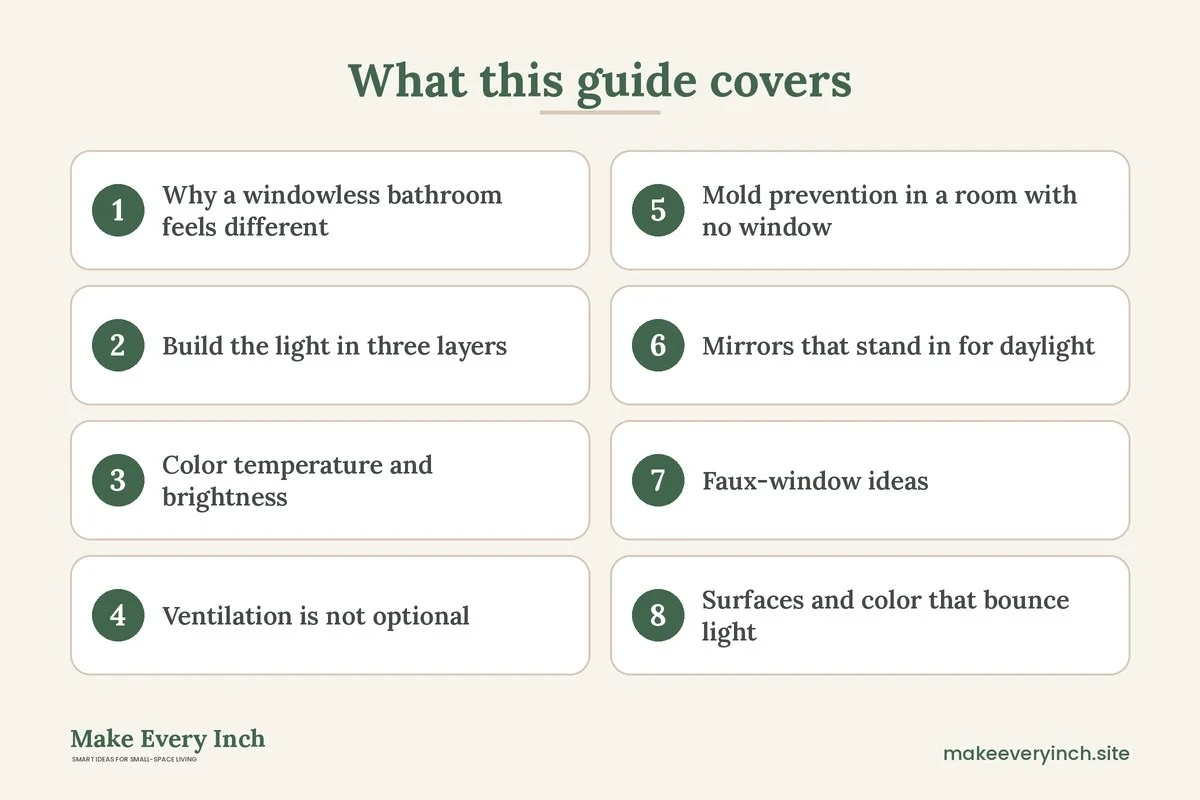
Small bathroom ideas without a window face two problems at once. The room is dark, because no daylight ever enters it, and it is damp, because steam has nowhere to go unless a fan removes it. Fixing only the first problem leaves you with a pretty room that grows mildew. Fixing only the second leaves a gloomy cave. This guide treats both together. It covers light layers, color temperature, ventilation, mold prevention, mirrors, faux-window options, finishes, three example rooms, a comparison table, a routine and a checklist. For the wider topic, read our pillar guide to small bathroom ideas. For fixtures and bulbs in more detail, see small bathroom lighting ideas. If your main concern is where to put things, the companion guide to small bathroom storage ideas for tight spaces covers that.
Why a windowless bathroom feels different
A window does three quiet jobs. It brings in daylight that changes through the day, it lets humid air escape and it gives the eye somewhere to rest. Without it, the light is the same at every hour, steam lingers and the walls feel close. Knowing these three missing jobs tells you what to replace.
- Daylight changes: replace it with layered electric light at the right color temperature.
- Air exchange: replace it with a fan, correctly sized and correctly vented.
- A view: replace it with a mirror, art, a faux window or a pale, glowing wall.
Many windowless bathrooms are also inside rooms in apartments, which makes them cheaper to heat but harder to dry. That is why this guide spends as much time on air as on light. For general guidance on dim homes, you may also like our post on dark apartment ideas.
Build the light in three layers
One ceiling light is the usual mistake. A flat overhead fixture throws shadows under your eyes and nose and leaves the corners dim. Three layers fix this.
Layer 1: ambient light
This is the general glow from the ceiling. A flush or semi-flush fixture works in a low room, and a recessed light works where the joists allow. Use a fixture with a diffuser, so the light is soft and not a glaring point. In a 5 by 8 foot room, one good ceiling fixture is usually enough for general light, though two small ones can spread it more evenly.
Layer 2: task light at the mirror
This layer matters most for shaving and makeup. Light should hit your face from the sides, not from above. Two vertical fixtures on either side of the mirror, at about eye height, roughly 60 to 66 inches from the floor, with about 30 to 40 inches between them, give the most even light. If wall space is tight, a horizontal fixture above the mirror works, though it casts more shadow below the chin. A lit mirror with built-in edge lighting is another option.
Layer 3: accent light
A low, warm light turns the room from clinical to calm. Options include a wall sconce, a dimmable strip light under the vanity and a small night light for late trips. An accent light is handy at night because you can leave the bright lights off. Our guide to renter-friendly lighting ideas lists no-wiring options for tenants.
Put the layers on separate switches or a dimmer, if the wiring allows. Being able to dim the ambient layer in the evening is one of the best comforts a windowless room can have.
Color temperature and brightness
Bulb color is measured in kelvin. Lower numbers look warm and yellow, and higher numbers look cool and blue.
- 2700 kelvin: warm and cozy, flattering to skin, but can look dim for grooming.
- 3000 kelvin: a soft white that suits most bathrooms.
- 3500 to 4000 kelvin: neutral and crisp, good at the mirror, but it can feel clinical overhead.
- 5000 kelvin and above: daylight white, which can look harsh at night in a windowless room.
A useful approach is to mix temperatures carefully. Use 3000 kelvin overhead and 3000 to 3500 at the mirror, so skin tone and makeup look natural. Avoid combining very warm and very cool lights in one room, since the difference looks odd. Whatever you pick, buy all bulbs of one type from the same range, because bulbs of the same stated temperature can still differ slightly between makers.
Color rendering index, or CRI, tells you how true colors look. A value of 90 or higher is generally considered good for a mirror light. Brightness is measured in lumens. A rough guide for a small bathroom is a total of about 1000 to 2000 lumens across all layers, with more at the mirror. These are ranges, not rules, and your room may need more or less.
Ventilation is not optional
A windowless bathroom depends on its fan. Without one, steam condenses on cool surfaces, paint blisters, grout darkens and mold can spread. If your room has no fan, ask a landlord or an electrician about adding one.
Sizing the fan
Fans are rated in cubic feet per minute (CFM). A common rule of thumb is about 1 CFM per square foot of floor area for bathrooms of up to 100 square feet, with a minimum of about 50 CFM. A 5 by 8 foot room is 40 square feet, so a fan rated at 50 CFM is a typical floor. Add some capacity for a tall ceiling, a shower with strong heat or a long duct run. Check local rules, since requirements vary.
Noise and speed
Noise is rated in sones. A lower number is quieter, and about 1.0 or less is generally considered quiet. A quiet fan is one you will actually run. Many people turn off a loud fan after a minute, which defeats its purpose.
Venting properly
The duct should lead outdoors, not into the attic or a ceiling space, where the moisture will cause damage. Use a short, straight, smooth duct, since long or kinked ducts reduce airflow. A professional should handle roof or wall work. In an apartment, you cannot change the duct yourself, so report a fan that does not pull a tissue to the ceiling.
Running the fan
Run the fan during the shower and for roughly 20 minutes afterward. A timer switch or a humidity-sensing switch does this automatically. Leave the door slightly ajar after use if the rest of the home is dry, which helps replace the air that the fan removes. If the door is closed tight and the room has no air inlet, the fan will struggle.
Electrical safety around fans and lights
Fixtures in a shower or over a tub must be rated for wet locations, and others in the room for damp locations. The rating is on the label. Outlets should be protected by a ground fault circuit interrupter (GFCI). Never switch a fixture or a fan with wet hands where a switch is not meant for it, and have a licensed electrician do any wiring, including adding a fan or moving a light. Do not use a plug-in heater, a lamp or an extension cord in a wet bathroom.
Mold prevention in a room with no window
Mold needs moisture, a food source such as soap scum or dust, and time. You cannot remove the second, so remove the first and third.
- Keep humidity down: aim for indoor humidity of roughly 30 to 50 percent. A cheap hygrometer shows the number.
- Dry the surfaces: a quick squeegee on the shower wall, and a towel on the glass, removes a lot of water.
- Hang towels fully open: a rail with space around each towel dries faster than a hook that bunches them.
- Wash the bath mat and shower curtain: fabric holds water. Swap it weekly, and wash it often.
- Clean the caulk lines and grout: these hold dampness. Reseal when the caulk cracks or darkens.
- Pick the right paint: use a mildew-resistant, moisture-rated finish, in satin or semi-gloss. Choose a low-VOC product, and ventilate the room during painting and curing.
- Look behind things: check behind the toilet, under the sink and behind the door for dark spots.
- Fix leaks fast: a slow drip is a mold source, even if it looks small.
If you find a patch of mold smaller than about a square foot, you can usually clean it yourself with the cleaner recommended for the surface, while wearing gloves and a mask and keeping the room ventilated. Never mix cleaning products, especially those containing bleach and ammonia. Large or recurring mold suggests a hidden moisture problem, and a landlord or professional should look at it. People with asthma or allergies should take extra care.
Mirrors that stand in for daylight
A mirror can double the apparent light and the apparent size of the room, but placement matters.
- Face the light source: a mirror opposite a light fixture bounces the glow around the room.
- Go large: a mirror that covers most of the wall above the vanity gives the most gain. Widths of 24 to 36 inches suit a small vanity.
- Add a second mirror: a round mirror on a side wall adds depth, as long as it does not show the toilet.
- Choose a lit mirror: an edge-lit mirror is task light and decoration in one. Check that it is rated for bathrooms.
- Anchor it: a large mirror is heavy. Fix it to a stud or use anchors rated for its weight. In a rental, ask before drilling, or lean a mirror on the vanity top.
- Clean it: a spotted mirror reflects less light.
A mirror cabinet adds storage behind the glass, which fits a small room. Our post on small bathroom organization ideas shows how to sort what goes inside.
Faux-window ideas
A faux window gives the eye a focus and a hint of daylight. Several types suit different budgets and different rules.
A framed light box
A thin box with an LED panel behind a frosted pane glows like a window. Choose a low-voltage version with a safe driver, and mount it out of reach of splashes. Check its rating for damp areas. This is the closest imitation.
A window-shaped mirror
A mirror with a grid of black frame bars looks like a window and reflects light. It is the lowest effort and works in a rental as a leaning piece.
Printed or painted landscape art
A framed print of sky, a garden or the sea draws the eye. Use moisture-proof art, such as a print behind acrylic, and keep it away from the shower spray.
A peel-and-stick window film panel
Window film on a frame, lit from behind, can give a stained-glass or frosted effect. Check the adhesive and the heat of the light.
A sun tube or skylight
In a house with a roof above the bathroom, a tubular skylight brings in real daylight with no wall window. This is a remodel project that needs a roofer. It is the only option here that brings in real sun.
Keep the faux window at about the height of a real one, with the center roughly 54 to 60 inches from the floor. Put it on the wall you see first from the door, so it works as a welcoming focal point.
Surfaces and color that bounce light
In a room with no daylight, finishes do a lot of work.
- Walls: light, warm whites, soft greys or pale colors reflect more light. Satin and semi-gloss bounce light better than flat paint. Dark colors can work if you add enough light layers, but they absorb light and show more water spots.
- Tile: large format tile with thin grout lines reduces visual clutter. A glossy tile reflects more light than a matte one, though it can be slippery underfoot, so choose a textured or small-format tile for floors.
- Floors: a pale floor helps, but slip resistance comes first. Look for a floor tile with a suitable slip rating, and use a rug with a non-slip backing.
- Ceiling: paint it a bright white, in a moisture-rated product.
- Metal finishes: brushed or polished metals reflect a little light, and glass shelves let light pass through.
- Shower enclosure: a clear glass panel keeps the room open. A curtain should be a light color or translucent.
For a rental, removable wallpaper ideas cover peel-and-stick options, though a bathroom with heavy steam can make adhesive fail, so test a small patch. Our guide to renter-friendly bathroom ideas suggests more upgrades that leave the walls intact.
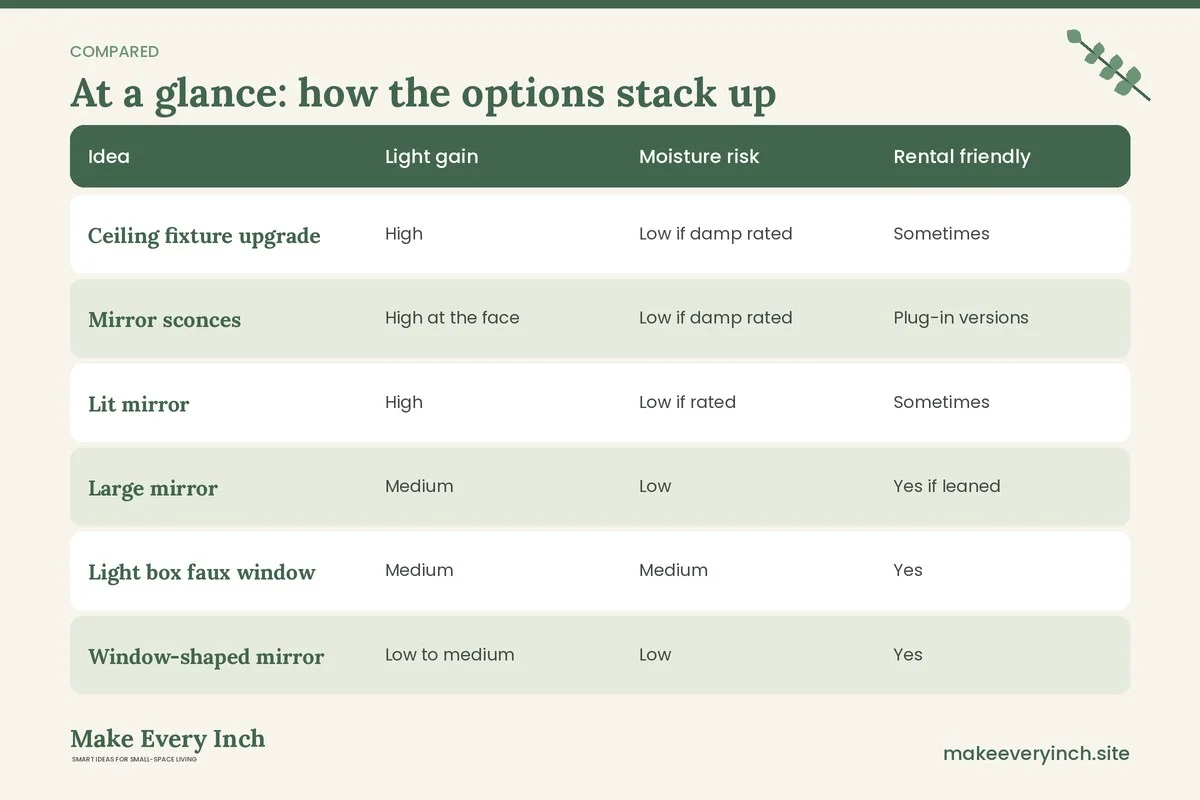
Comparison table: ways to add the feeling of daylight
| Idea | Light gain | Moisture risk | Rental friendly | Notes |
|---|---|---|---|---|
| Ceiling fixture upgrade | High | Low if damp rated | Sometimes | Needs wiring |
| Mirror sconces | High at the face | Low if damp rated | Plug-in versions | Even light |
| Lit mirror | High | Low if rated | Sometimes | Task and decor |
| Large mirror | Medium | Low | Yes if leaned | Doubles light |
| Light box faux window | Medium | Medium | Yes | Needs power |
| Window-shaped mirror | Low to medium | Low | Yes | Easy |
| Pale glossy paint | Medium | Low | Needs permission | Moisture rated |
| Tubular skylight | Very high | Low | No | Roof work |
Three example rooms
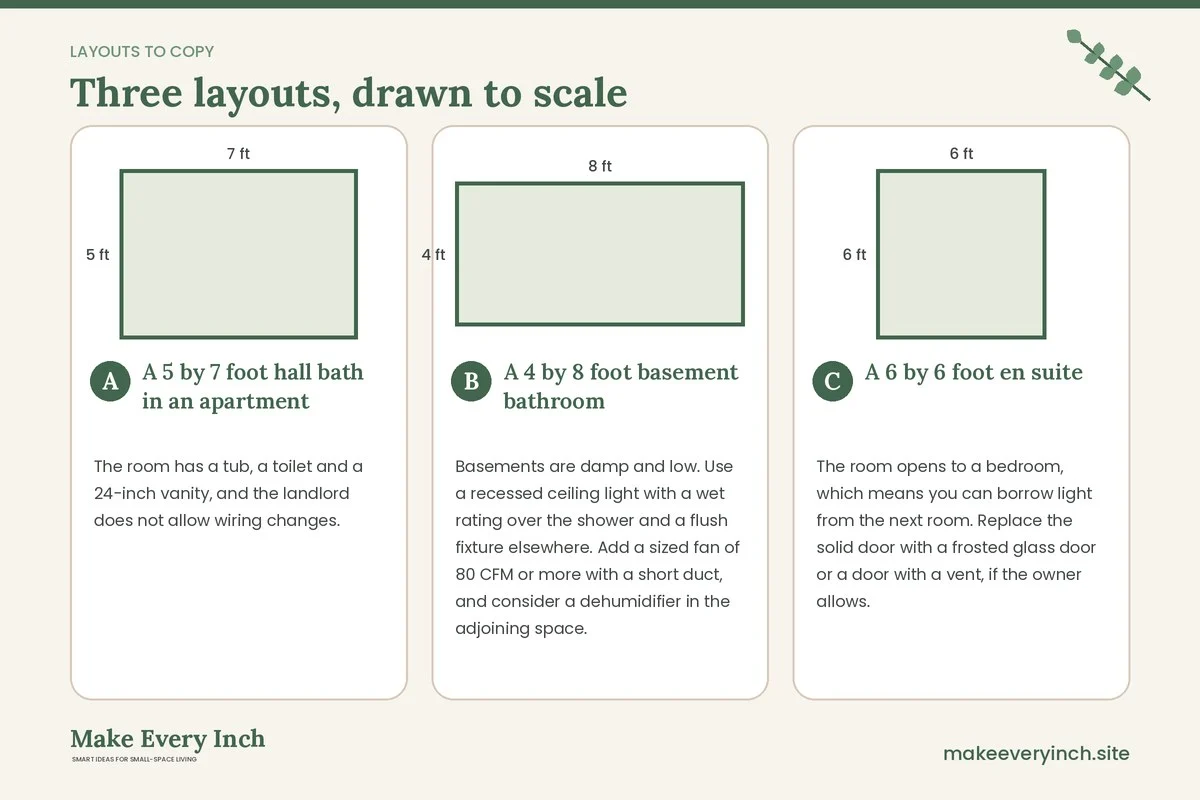
A 5 by 7 foot hall bath in an apartment
The room has a tub, a toilet and a 24-inch vanity, and the landlord does not allow wiring changes. Use a plug-in or stick-on sconce pair at the mirror with 3000 kelvin bulbs, a 30-inch wide mirror, a pale shower curtain and a window-shaped mirror on the side wall. Run the existing fan for 20 minutes after each shower, hang towels on a rail and wash the mat weekly. The room feels brighter without any rewiring.
A 4 by 8 foot basement bathroom
Basements are damp and low. Use a recessed ceiling light with a wet rating over the shower and a flush fixture elsewhere. Add a sized fan of 80 CFM or more with a short duct, and consider a dehumidifier in the adjoining space. Pick a pale, mildew-resistant paint and glossy tile. A light box faux window on the end wall adds daylight. Check floors for moisture with a professional if you see dark patches.
A 6 by 6 foot en suite
The room opens to a bedroom, which means you can borrow light from the next room. Replace the solid door with a frosted glass door or a door with a vent, if the owner allows. Add a vertical sconce pair, a large frameless mirror and a dimmable accent strip at the floor for the night. Run the fan on a timer, and leave the door ajar to air the room.
A weekly routine for a windowless bathroom
- After each shower: run the fan, wipe the glass or tile, and open the towel.
- Weekly: wash the mat, wipe the mirror and vanity, and check for damp spots.
- Monthly: clean the fan cover. Dust blocks airflow, and a quiet fan can fail slowly.
- Twice a year: check the caulk, reseal if needed and test the GFCI outlet with the test button.
- Each season: replace dim bulbs and review the lighting.
If the fan cover can be removed without tools, wash it in warm soapy water. Switch off the power at the breaker before touching anything wired.
Mistakes to avoid
- Relying on one ceiling light. It causes shadows and dim corners.
- Using cool daylight bulbs everywhere. They look harsh at night.
- Skipping the fan. Light fixes darkness, but only air fixes damp.
- Using indoor-only fixtures in the shower. Check wet ratings.
- Hanging a heavy mirror on weak anchors. It can fall and break.
- Choosing dark paint without enough light. The room will look like a cave.
- Closing the door tightly with a weak fan. The fan needs make-up air.
- Ignoring early signs of mold. Small spots grow quickly.

Checklist
- Confirm there is a working exhaust fan that vents outdoors.
- Size the fan, roughly 1 CFM per square foot with a 50 CFM minimum.
- Run the fan during and for about 20 minutes after showers.
- Add three layers of light: ambient, task and accent.
- Choose bulbs around 3000 kelvin, with CRI of 90 or higher at the mirror.
- Check that fixtures have damp or wet ratings.
- Confirm outlets are GFCI protected.
- Hang a large mirror opposite a light source and anchor it.
- Add a faux window on the first wall you see.
- Use moisture-rated, low-VOC paint in satin or semi-gloss.
- Wipe wet surfaces and wash mats weekly.
- Ask permission before drilling or changing fixtures.
FAQ
How can I make a bathroom without a window feel bigger?
Use layered light, a large mirror, pale reflective finishes and a faux window. Keep the floor and counters clear, since clutter shrinks a small room.
What color temperature is best for a windowless bathroom?
Around 3000 kelvin suits most rooms, with 3000 to 3500 at the mirror for natural skin tones. Avoid mixing very warm and very cool bulbs.
Do I need a fan if the bathroom has no window?
Yes. A fan is the only way for steam to leave, and building codes in many places require one. Size it for the room and run it during and after showers.
How do I stop mold without a window?
Control humidity with a fan, dry wet surfaces, hang towels open, keep caulk in good shape and use mildew-resistant paint. Fix leaks quickly.
Can I add a faux window in a rental?
Yes, a window-shaped mirror or a plug-in light box can lean or sit on a surface without drilling. Ask before fixing anything to tile or walls.
Is a dark color a bad idea in a windowless bathroom?
Not always. A deep color can feel cozy, but it needs strong, layered light and good ventilation, and it will show water spots more.
Keep going: Keep planning with our small bathroom makeover ideas, narrow bathroom ideas and small apartment bathroom ideas.
Save this guide for later
Pin the ideas you like to Pinterest so you can come back to them when you plan your space.