17 Small Bedroom Furniture Ideas That Save Space
Quick answer: The best small bedroom furniture ideas are low, slim and double-duty: a platform or storage bed, a tall narrow dresser, floating or stool nightstands and a bench or desk that folds away. Measure the room and doorways first, keep a 24 to 30 inch path around the bed and choose pieces with visible legs.
Small bedroom furniture ideas start with a simple fact: every inch of floor and every inch of wall competes with the bed. The right pieces give you sleep, storage and a place to get dressed without crowding the room. This guide shares 17 furniture ideas, size rules, a comparison table, three example rooms and a buying checklist so each piece you add earns its place.
Measure before you shop
Measure the room, the door, the hallway, the stairs and the elevator. Write down the ceiling height, window position, closet door swing and the location of outlets and vents. Tape the footprint of the bed and each large piece on the floor and live with it for a day. In a small bedroom, aim for 24 inches of clear space on each side of the bed you use, 30 inches in the main path and about 36 inches in front of a dresser so drawers can open fully. If a piece fails any of these numbers, choose a smaller one.
Think in layers: the bed first, then storage for clothes, then a surface for the nightstand, then extras such as a chair, a desk or a mirror. Add each layer only if the room can still breathe.
17 small bedroom furniture ideas
1. A platform bed with drawers
A platform bed 14 to 18 inches high with two or four drawers can replace a dresser. Check that the drawers open fully without hitting a wall or a nightstand, and choose full-extension runners.
2. A low bed frame with slim legs
Visible legs let the eye see the floor, which makes the room feel larger. Avoid solid bases and heavy footboards, which can add 6 to 10 inches to the bed length.
3. A lift-up storage bed
A gas-lift frame stores duvets, luggage and out-of-season clothes in a big compartment under the mattress. It is best for rooms with no closet, but you need clearance at the foot to lift the mattress.
4. A tall, narrow dresser
A chest 30 to 36 inches wide and 48 to 54 inches tall holds as much as a wide, low dresser while using less floor. Put it on the wall by the door or at the foot of the bed if the walkway stays at 30 inches.
5. A wall-mounted nightstand
Floating nightstands attach to the wall, free the floor and make it easy to vacuum. They suit rooms where the bed sits in a corner.
6. A stool or round table as a nightstand
A stool, a pouf or a small round table has no corners and fits tight spaces. It is also easy to move to a new room.
7. A bench with a lid
A storage bench at the foot of the bed holds blankets, shoes or bags and gives you a place to sit. Choose one 14 to 16 inches deep.
8. A wardrobe with sliding doors
Sliding doors save the swing space a hinged door needs. Look for a depth of 20 to 24 inches and an interior rod that fits full-length hanging.
9. A garment rail with shelf
A rail with a bottom shelf for shoes costs less than a wardrobe and can be hidden with a curtain. See bedrooms without a closet.
10. A wall-mounted fold-down desk
A desk that folds flat gives you a workspace without a permanent footprint. See bedroom desk ideas.
11. A dresser that doubles as a vanity
A dresser at 30 to 32 inches high with a mirror and a lamp becomes a dressing table. Add a small stool that slides under it.
12. A narrow console
A console 10 to 12 inches deep fits behind a door or along a short wall and holds a lamp, a tray and a basket.
13. A floating shelf above the bed
A shelf 8 inches deep and 48 inches wide holds books and a lamp and adds a headboard effect. Keep heavy items low and secure the shelf into studs.
14. A freestanding mirror
A full-length mirror leaned against a wall doubles the light and saves hanging a mirror on the door. Choose a slim frame.
15. A loft bed
In rooms with ceilings of 9 feet or more, a loft bed frees the floor for a desk, a wardrobe or a sofa. Check headroom and safety.
16. A daybed or sofa bed
In a studio or a guest room, a daybed is a bed at night and a seat by day. Choose one with trundle storage.
17. A rolling cart
A narrow cart with wheels holds books, skincare or a plant and moves out of the way. Choose locking casters.
Furniture options compared
| Piece | Typical size | Space saved | Best for | Watch for |
|---|---|---|---|---|
| Platform bed with drawers | 60 x 80 x 16 in | A dresser | Rooms with no closet | Drawer clearance |
| Tall dresser | 32 x 18 x 50 in | Floor area | Narrow walls | Weight and tipping |
| Floating nightstand | 16 x 12 in | Floor | Corner beds | Needs wall mounting |
| Storage bench | 36 x 15 x 16 in | A chest | Foot of bed | Lid clearance |
| Sliding wardrobe | 36 x 22 x 72 in | Door swing | No closet | Interior layout |
| Fold-down desk | 36 x 20 in | A desk | Work from home | Wall type |
| Loft bed | 60 x 80 x 60 in | Floor | High ceilings | Headroom |

Three furnished bedrooms
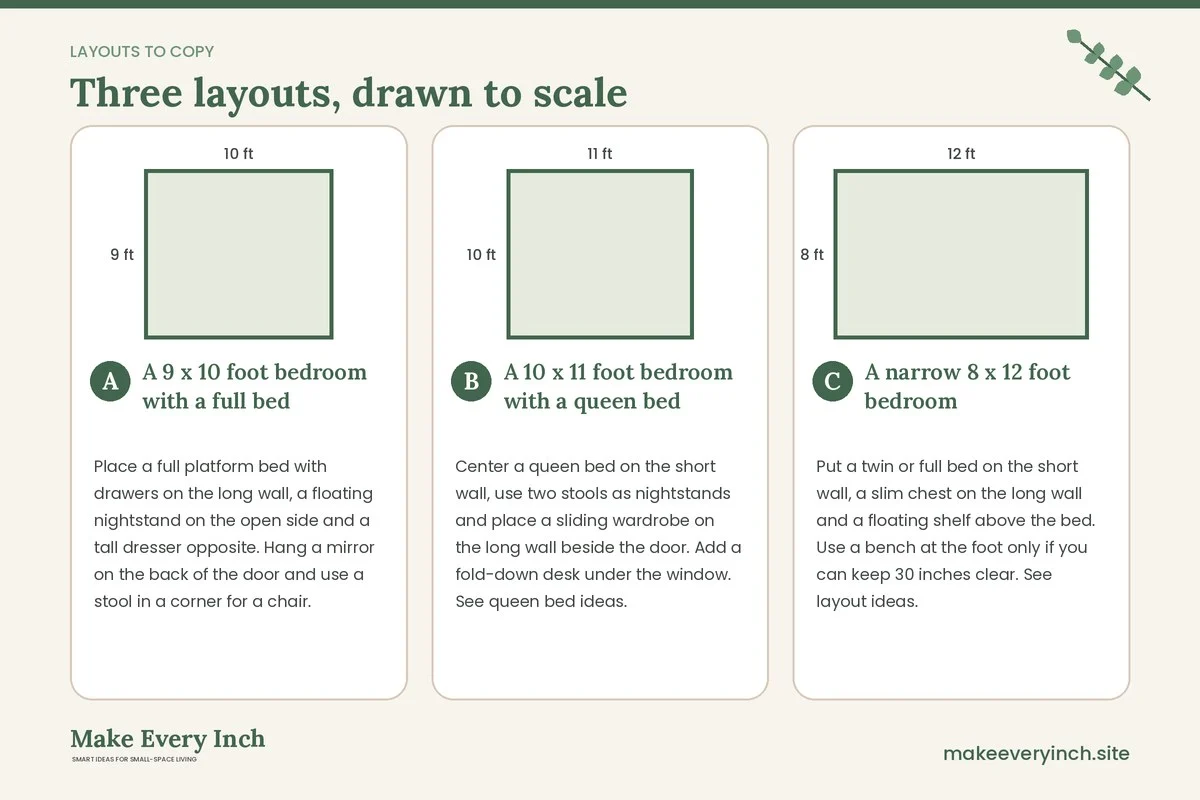
A 9 x 10 foot bedroom with a full bed
Place a full platform bed with drawers on the long wall, a floating nightstand on the open side and a tall dresser opposite. Hang a mirror on the back of the door and use a stool in a corner for a chair. The walkway stays at 28 inches.
A 10 x 11 foot bedroom with a queen bed
Center a queen bed on the short wall, use two stools as nightstands and place a sliding wardrobe on the long wall beside the door. Add a fold-down desk under the window. See queen bed ideas.
A narrow 8 x 12 foot bedroom
Put a twin or full bed on the short wall, a slim chest on the long wall and a floating shelf above the bed. Use a bench at the foot only if you can keep 30 inches clear. See layout ideas.
How to choose the bed
The bed is the largest, most expensive and most-used piece, so choose it first. Pick the size from the room, not from habit: a full or queen bed fits most 10 x 10 foot rooms, while a twin suits rooms under 8 x 9 feet. Choose the height by thinking about storage: a 12 inch frame with a 10 inch mattress sits about 22 inches high, while a 16 inch frame with risers can reach 28 inches. Check the slats, the frame weight and the delivery size, since a boxed frame can be easier to carry up stairs than a pre-assembled one. A simple frame lets the bedding be the feature.
How to choose storage furniture
Count your hanging and folded clothes before you buy. A person with 20 hanging items and 30 folded items needs about 24 inches of rod and 5 drawers. Choose a dresser with full-extension drawers and a wardrobe with an adjustable rod. Look at the depth: a standard dresser is 18 to 20 inches deep, while a slim one is 14 to 16 inches. Check the weight of the piece when full and anchor tall furniture to the wall to prevent tipping. See storage ideas for what goes where.
Materials and finishes
Light woods, white paint and soft colors reflect light and make furniture look smaller. Dark woods suit a feature piece but can dominate a small room. Metal frames look light, and glass or acrylic adds sparkle but shows marks. Choose a single wood tone or two at most, and repeat a color in the bedding or art. Matte finishes hide fingerprints and glare. If you rent, choose finishes you can live with for years, and avoid trends that date quickly.
Furniture layouts that go with each piece
Bed and dresser on opposite walls
This is the simplest arrangement and works in rooms from 9 x 11 feet. Keep 36 inches between the foot of the bed and the dresser, and 24 inches on each used side of the bed. Put a lamp and a mirror on the dresser so it serves as a dressing area.
Bed in the corner with a wardrobe on the long wall
Use the free side for a bench or a chair and keep the wardrobe door swing clear. A sliding door makes the wardrobe easier to use when space is tight.
Bed on the short wall with a desk by the window
Use a narrow desk 20 inches deep and a chair that tucks under. Keep the bed lower than the sill so the window stays clear, and use a rail and a bench for storage on the other wall. See desk ideas for more.
Bed at the center of a narrow room
Leave 24 inches on each side and use a tall bookcase at the foot. This creates a symmetrical look that suits long, thin rooms.
Styling furniture so the room stays calm
Keep the tops of dressers and nightstands mostly clear. Use a tray for small items and display one lamp, one plant or one framed photo. Match the metal finish of the pulls, lamps and frames. Use baskets inside open shelves to hide visual noise. Choose bedding in a single color family so the bed looks tidy even when it is not perfectly made. Repeat one color from the rug in the pillows or a throw, and hang art at eye level so the eye has somewhere to rest. A calm surface makes a small piece look intentional.
Taking care of small bedroom furniture
Small rooms get heavy use, so protect each piece. Use felt pads on legs, avoid placing furniture against radiators and wipe wood with a damp cloth followed by a dry one. Rotate mattresses as directed and vacuum under the bed monthly. Tighten screws on flat-pack furniture twice a year, since parts loosen with use. Keep drawers from overloading, and do not stand on a desk or a shelf. If a piece wobbles, shim it or wedge a folded card under a leg. With care, furniture can last through several moves.
Furniture for shared and guest bedrooms
A shared room needs two of everything that matters: a lamp, a drawer, a hook and a surface. Use twin beds pushed together or a bunk if the ceiling allows, and keep a clear path between them of at least 24 inches. A guest room can use a sofa bed or a daybed, a luggage stand and a small chest that is empty for visitors. Choose washable bedding and a rug that hides marks, and keep a small basket with a spare charger, a towel and a bottle of water. Flexible furniture helps a small room serve more than one person without feeling crowded.
Choose furniture for the life you have now, and let the room grow with you by leaving a little space for what you might add.
Delivery day tips for bedroom furniture
Clear the path from the door to the bedroom and protect the floor with a blanket or cardboard. Measure the stairwell turns, and ask the delivery team to bring flat-pack boxes in before you assemble. Keep screws and fittings in a labelled bag and photograph each step of assembly. Check every piece for damage before the team leaves, and keep the packaging until the return window ends. Assemble the bed first, so the room is usable that night, and the rest over the following days.
Take a moment to sit on the bed and look at the room as a guest would before you call it finished.
Furniture on a budget
You can furnish a small bedroom in stages. Begin with the mattress and the bed frame, then add a dresser or a wardrobe, then nightstands and a mirror. Look for secondhand dressers and refinish them with paint and new pulls. Buy flat-pack furniture from a store that offers returns and check the dimensions twice. Wait for sales on beds and mattresses, which are common around holidays. Set a budget for each piece and keep a list of items you will add only when you find the right one.
Furniture mistakes to avoid
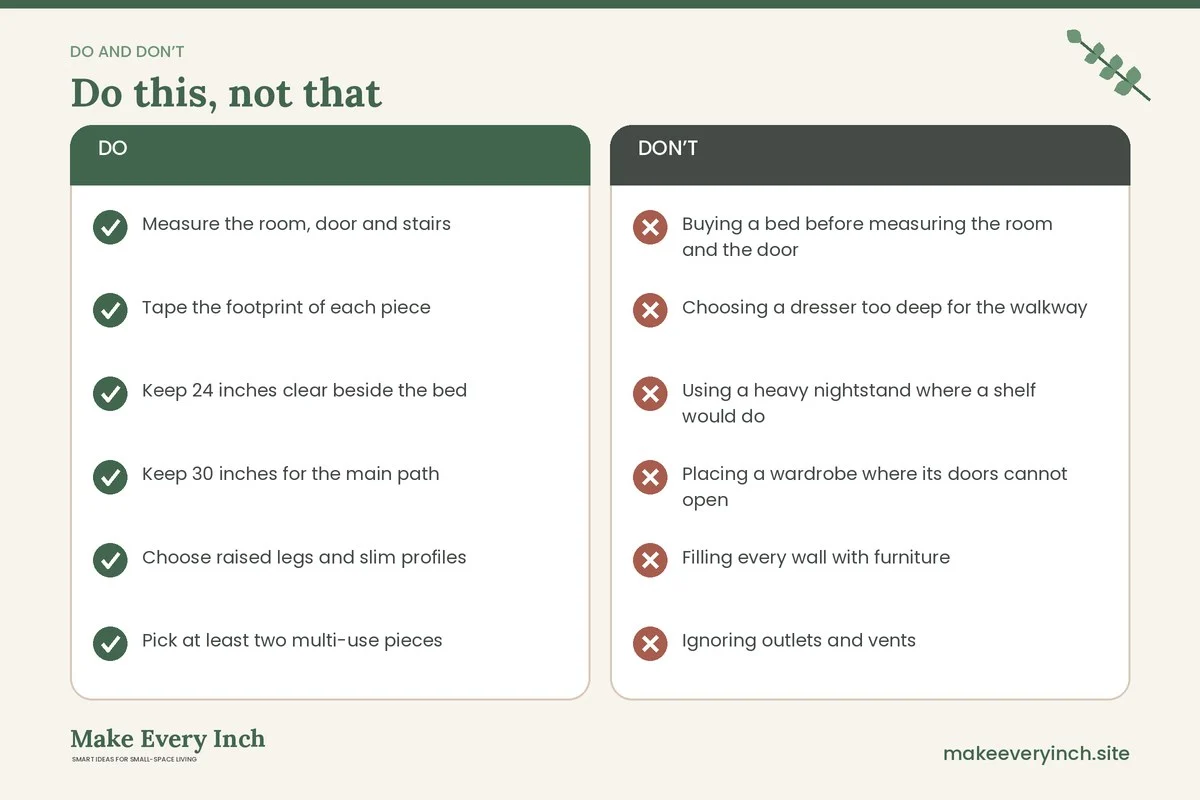
- Buying a bed before measuring the room and the door
- Choosing a dresser too deep for the walkway
- Using a heavy nightstand where a shelf would do
- Placing a wardrobe where its doors cannot open
- Filling every wall with furniture
- Ignoring outlets and vents
- Buying a matching set that is too large for the room
- Forgetting that tall pieces need to be anchored
Furniture checklist
- Measure the room, door and stairs
- Tape the footprint of each piece
- Keep 24 inches clear beside the bed
- Keep 30 inches for the main path
- Choose raised legs and slim profiles
- Pick at least two multi-use pieces
- Check drawer and door clearance
- Review the return policy
FAQ
What furniture do I need in a small bedroom?
A bed, a place to store clothes and a surface for a lamp are the essentials. A mirror, a chair or a desk are optional extras if space allows.
What size bed is best for a small bedroom?
A full bed suits rooms around 9 x 10 feet, and a queen suits rooms of about 10 x 10 feet if the other furniture is slim.
How do I fit a dresser in a small bedroom?
Choose a tall, narrow dresser, put it inside the closet or use a bed with drawers instead. Keep 36 inches in front of it.
Are storage beds worth it?
Yes, if you lack closet space and have clearance for the drawers or lift. They are less useful if the bed sits against walls on both sides.
What can I use instead of a nightstand?
A wall shelf, a stool, a small round table or a headboard with a ledge.
How can I make a small bedroom look bigger with furniture?
Choose low pieces with legs, light colors, a mirror and a clear floor. Avoid dark, heavy furniture on every wall.
Is a loft bed a good idea for adults?
It can be, in rooms with high ceilings and clear headroom. It frees up the floor but is harder to make and climb into.
Where should furniture go in a small bedroom?
Place the bed first, then the wardrobe and the dresser, and finally small pieces. Keep the door and window clear.
Keep going: Explore our small bedroom ideas, bedroom storage ideas and small living room furniture ideas.
Save this guide for later
Pin the ideas you like to Pinterest so you can come back to them when you plan your space.