15 Small Bedroom Ideas With a Queen Bed
Quick answer: A queen bed (60 x 80 inches) fits a small bedroom of about 10 x 10 feet if you keep slim nightstands, use wall lighting and leave a 24 inch path on each side. Choose a low headboard, add under-bed storage and test the plan with tape before you buy.
Small bedroom ideas with a queen bed come down to numbers. A queen takes 60 x 80 inches, which is about 33 square feet before the walkway. This guide shows how to make it fit in a small room with 15 ideas, a comparison table, three plans and a checklist so you can keep the bed you want without losing the room.
Will a queen bed fit?
A queen bed fits comfortably in a room of about 10 x 10 feet and works in 9 x 10 feet if you push one side against the wall. In a room smaller than that, consider a full bed (54 x 75 inches). Leave at least 24 inches on the sides you use and 30 inches at the foot when possible. If the door or closet door swings into the room, measure from the edge of the swing, not from the wall.
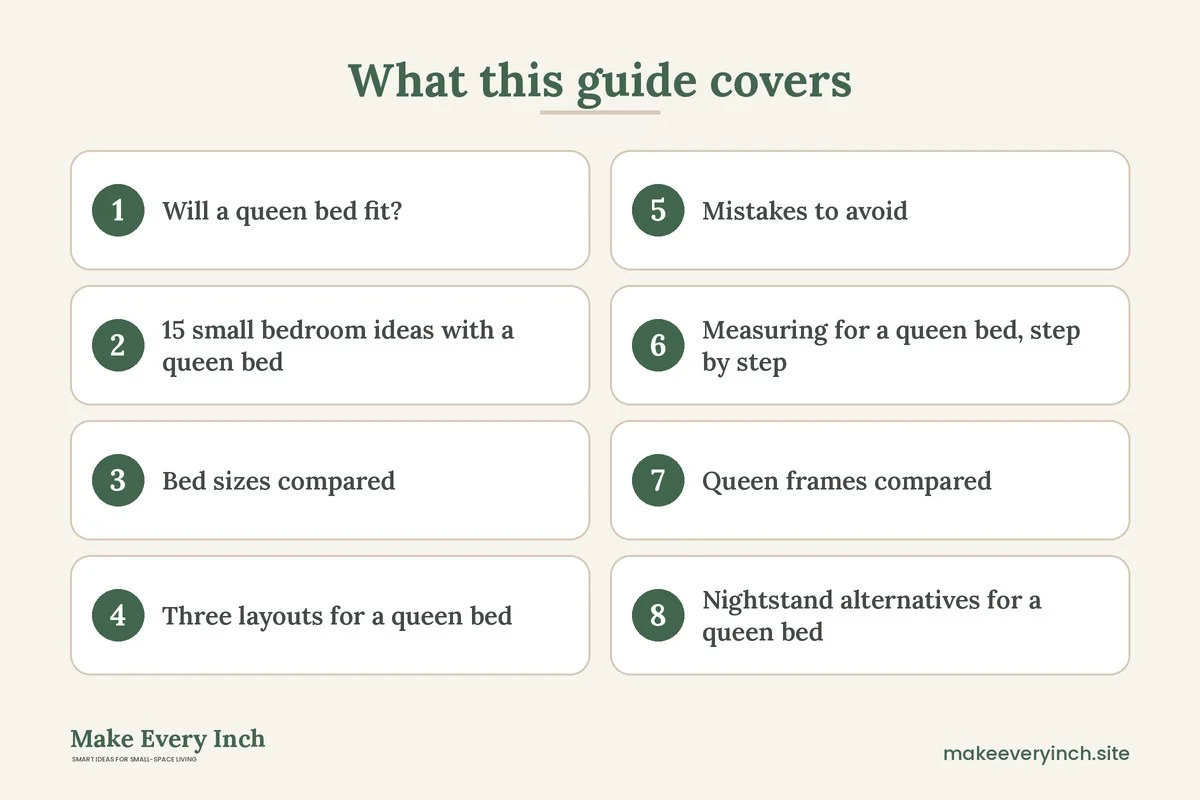
15 small bedroom ideas with a queen bed
1. Center the bed on the longest wall
The cleanest layout. A queen with two slim nightstands needs about 8 feet of wall.
2. Push one side against the wall
Gives you a single path and frees space for a dresser or desk. Works if one person gets in on the open side.
3. Use floating nightstands
Wall shelves 8 inches deep free the floor and let a rug run closer to the bed.
4. Use wall-mounted reading lamps
Replace table lamps and keep the surface clear. See small bedroom lighting ideas.
5. Choose a low-profile bed frame
A frame with slim legs shows the floor and makes the room look larger. Avoid bulky footboards.
6. Use a storage bed
Drawers under the mattress replace a dresser. Check that the drawers can open without hitting a wall.
7. Use a slim headboard or paint one
A painted arch or a wall-mounted board saves 4 to 6 inches over a thick upholstered headboard.
8. Choose a tall, narrow dresser
A 36 inch wide, 48 inch tall chest stores as much as a 60 inch dresser and takes less floor.
9. Use the back of the door
Hooks and an over-the-door organizer hold clothes, bags and belts.
10. Use a light bedding palette
Light bedding reflects light and makes the bed look smaller.
11. Keep the foot of the bed clear
Skip the bench or choose a narrow one. Use the space for a walkway.
12. Use a large rug
A 5 x 8 or 6 x 9 rug under the bottom two thirds of the bed anchors the sleep zone.
13. Add a mirror
A full-length mirror opposite the window adds depth. Lean it to avoid wall damage.
14. Use sliding closet doors
They save the 18 to 24 inches a swinging door needs. See small bedroom ideas without a closet.
15. Test the plan with tape
Tape the bed and walkway. Sleep on the plan for a night before buying.
Bed sizes compared
| Bed size | Dimensions | Minimum room | Notes |
|---|---|---|---|
| Twin | 38 x 75 in | 7 x 10 ft | Best for tight rooms |
| Full | 54 x 75 in | 9 x 10 ft | Good compromise |
| Queen | 60 x 80 in | 10 x 10 ft | Needs slim side tables |
| King | 76 x 80 in | 12 x 12 ft | Rarely fits a small room |

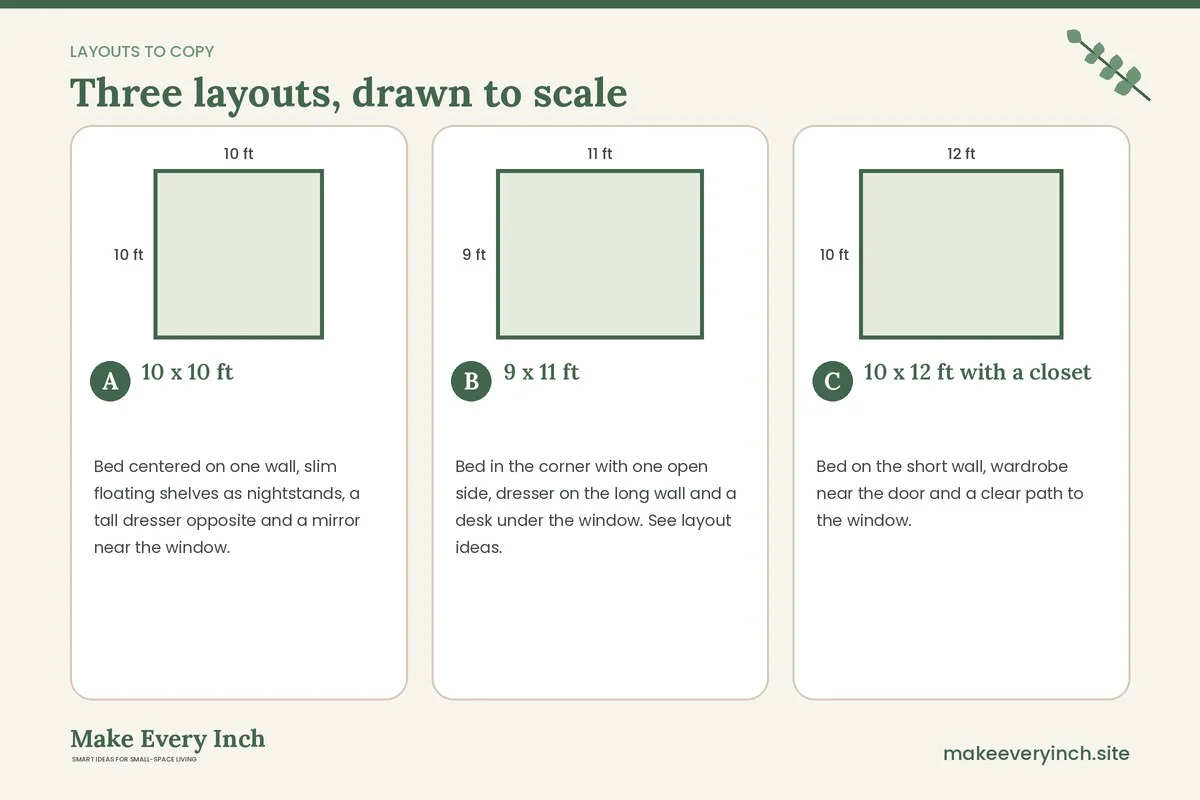
Three layouts for a queen bed
Plan A: 10 x 10 ft
Bed centered on one wall, slim floating shelves as nightstands, a tall dresser opposite and a mirror near the window.
Plan B: 9 x 11 ft
Bed in the corner with one open side, dresser on the long wall and a desk under the window. See layout ideas.
Plan C: 10 x 12 ft with a closet
Bed on the short wall, wardrobe near the door and a clear path to the window.
Mistakes to avoid
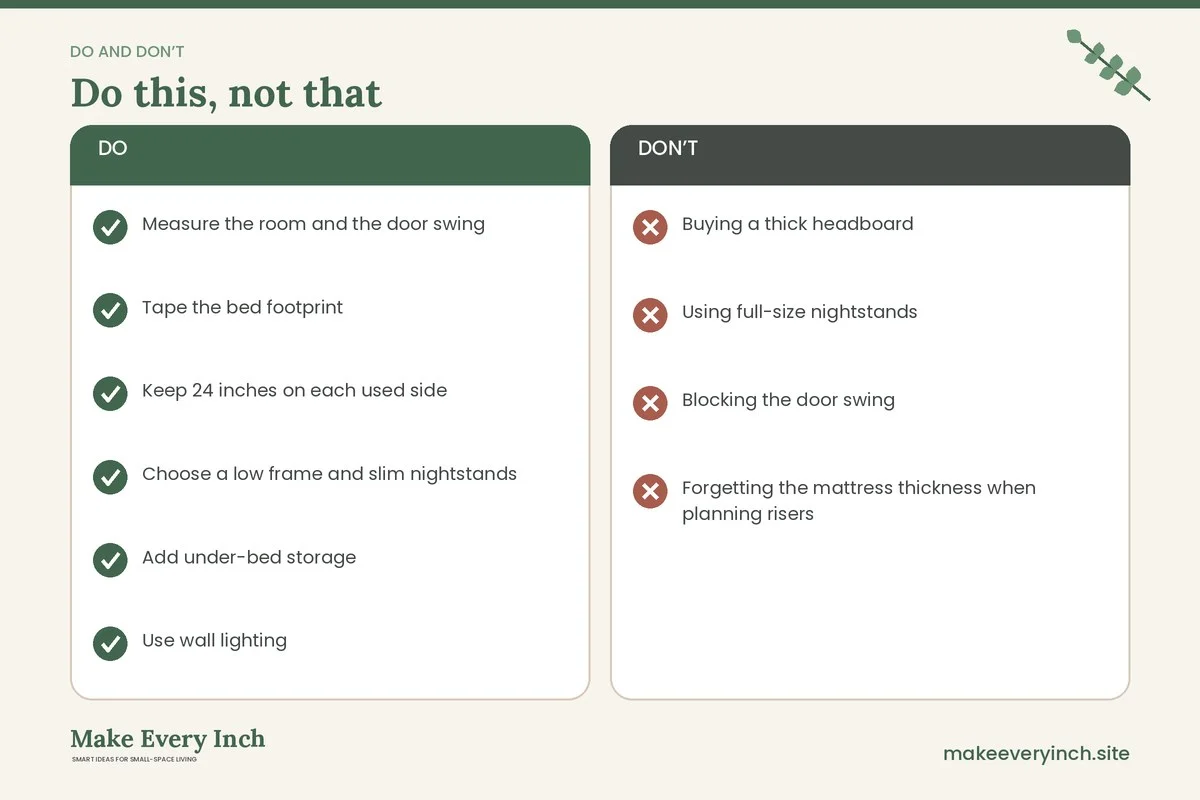
- Buying a thick headboard
- Using full-size nightstands
- Blocking the door swing
- Forgetting the mattress thickness when planning risers
Measuring for a queen bed, step by step
Measure the room at the floor and again at hip height, since baseboards, radiators and window sills can reduce the usable space. Mark the door swing and the closet door swing. Measure the headboard wall, then subtract 60 inches for the bed and 12 to 18 inches for each nightstand. If less than 5 inches remain, use wall-mounted nightstands. Measure the distance from the end of the bed to the opposite wall and subtract 80 inches for the mattress. You need at least 24 inches in front of a dresser to open drawers, and 30 inches is more comfortable. Write these numbers on a sketch and take it shopping.
Queen frames compared
| Frame | Height | Storage | Best for |
|---|---|---|---|
| Platform with slim legs | 12 to 14 in | Low | Rooms where light matters |
| Platform with drawers | 14 to 18 in | High | Rooms with little closet |
| Upholstered with headboard | 40 to 50 in | Low | Cozy rooms |
| Metal frame | 12 to 16 in | Medium | Narrow budgets |
| Lift-up storage | 14 to 18 in | Very high | Bulky bedding |
| Wall-mounted headboard | Flexible | Depends | Tight spaces |
Choose the frame based on the room. A low platform frame makes ceilings feel higher, and a frame with drawers can replace a dresser. A thick headboard or a footboard can add 6 to 10 inches to the length of the bed, so check the full dimensions before you order.
Nightstand alternatives for a queen bed
The nightstand is often the first thing to go in a small room. A floating shelf 6 to 8 inches deep and 18 to 24 inches wide holds a lamp and a book. A narrow stool or a small round table has no corners. A wall-mounted ledge behind the headboard holds a phone and a glass. A headboard with built-in shelves saves floor and wall space. A hanging basket on the bedpost holds small items. If you share the bed, choose the same style on both sides for balance.
Bedding for a queen bed in a small room
A queen duvet cover measures about 90 x 90 inches. Choose a lighter weight and a neutral color, and layer a throw at the foot. Use two standard pillows and one or two decorative ones. Make the bed neatly, since a smooth surface looks tidy and reflects light. Choose sheets with a high thread count and a fit that matches the mattress depth. Wash bedding weekly and keep a second set in a drawer so you can change it quickly.
Queen bed ideas for different bedroom shapes
A long, narrow room
Place the bed on the short wall and leave a path along one side. Use a tall bookcase on the long wall and a floating shelf as a nightstand.
A square room
Center the bed on one wall and place a dresser on the opposite wall. Use symmetry for a calm look.
A room with a slanted ceiling
Place the foot of the bed under the lowest part and keep the head near the tallest part. Use built-in drawers under the eaves, and keep the walkway on the high side.
A room with a bay window
Place the bed on the wall opposite the bay, and use the window as a reading nook with a cushion and a lamp.
Making the most of a queen bed room
Use the bed as the anchor and everything else as a supporting player. Keep colors soft and the floor visible. Choose one decorative element, such as a bold headboard or a piece of art, and keep the rest quiet. Avoid using heavy curtains that crowd the window. A lighter window treatment lets more light in and makes the room feel larger. If you need more space, see layout ideas and small bedroom ideas.
Small bedroom ideas with a queen bed: the full shopping list
Before you spend, make a list with prices and measurements. A realistic list for a 10 x 10 foot room includes the following items.
- Bed frame: a low platform frame or a storage bed, 14 to 18 inches high
- Mattress: a 10 to 12 inch queen that fits the frame
- Nightstands: floating shelves or slim tables, 12 to 16 inches wide
- Lighting: two wall lamps or two small table lamps
- Dresser: a tall, narrow chest, 30 to 36 inches wide
- Rug: 5 x 8 or 6 x 9 feet
- Curtains: floor-length panels with a blackout liner
- Mirror: a full-length or large wall mirror
- Storage: under-bed bins, hooks and baskets
Prioritize the mattress, the lighting and the bed frame, because these have the greatest effect on sleep and comfort. Choose the other items to match your budget and the room.
Common questions about fitting a queen bed
Can I fit a queen bed and a dresser in a small room?
Often yes, if the room is at least 10 x 10 feet. Use a tall, narrow dresser or under-bed drawers, and keep the walkway at least 24 inches wide.
Should the bed go in the corner?
A corner is a good option when the room is under 10 x 10 feet. It frees floor space but gives only one side access. If two people share the bed, one person must climb over the other, so choose with care.
Is a headboard necessary?
No. A headboard supports pillows and protects the wall, but you can use a painted shape, a mounted shelf or a large pillow instead. A thin upholstered headboard adds comfort and takes only a few inches.
What if the room has sloped ceilings?
Place the low side along the foot or the side of the bed, not at the head, and use the high side for the walkway.
A weekend plan to fit a queen bed
On Friday evening, measure and tape the room, then decide the bed position. On Saturday morning, remove or sell pieces that do not fit, and assemble the new bed and frame. In the afternoon, add the nightstands or shelves, install the lamps and hang the curtains. On Sunday, add the rug, the mirror and the dresser, then style with bedding and one piece of art. Keep the old bed or mattress until you are sure the new layout works. Take photos at each stage so you can see progress and spot problems, and check that the door and drawers open freely.
Final checks before you buy
Confirm that the bed fits through the door and up the stairs. Check that the frame height suits the mattress and the person using it. Make sure the headboard does not block outlets or switches. Verify that the room still has a 24 inch path on each used side. Check the return policy and warranty on the frame and the mattress. Read reviews from owners with small rooms, since they give the most practical feedback. See small bedroom ideas and lighting ideas for finishing touches.
Queen bed myths
A queen bed is too big for a small room. Not always. A room of 10 x 10 feet can hold a queen if the other pieces are slim and the walkway is clear. The problem is usually the other furniture, not the bed.
You need two nightstands. You need two surfaces, not two tables. A shelf, a stool or a wall ledge works just as well and takes far less room.
A bigger bed means a better night’s sleep. Comfort depends on the mattress, the pillows and the room temperature. A full bed with a good mattress can be more comfortable than a queen with a poor one, so choose based on your needs.
A bed must be centered. A corner or off-center position can work well in a small room. Check the layout with tape before you decide.
A footboard is needed. A footboard adds length and weight. Most small rooms are better without one, and a bench or a folded throw can finish the look.
After you set it up
Live with the room for two weeks. Notice whether you bump into the bed, whether the lamps give enough light and whether the closet is easy to reach. Adjust the position by a few inches, move a lamp or change the rug. Take a photo from the doorway to see the room as a visitor would. Small adjustments often matter more than a new piece of furniture. If something still bothers you, solve it with one of the ideas above before you buy anything new.
Keep the room feeling open around a queen bed
Use an uncluttered palette, so the bed does not dominate. Choose bedding that is close in tone to the walls, and add contrast with a single throw or a pair of pillows. Hang the curtains high, and keep the area under the window clear. Place a mirror where it reflects the window, and use a small plant on a shelf, not on the floor. A queen bed looks smaller when the floor is visible, so choose a frame with legs and leave a gap under the dresser. Open the blinds each morning to let in daylight, and keep the room ventilated.
As a final check, lie on the bed with the lights off and look around. If you can see the door, the window and a calm wall, the position is likely to feel secure. If a mirror or a bright screen faces you, move it. Sleep position matters as much as square footage, and a queen bed in the right spot feels larger than a smaller bed in the wrong one.
If you are still unsure, cut a sheet of cardboard to 60 x 80 inches and place it where the bed will go. Walk around it for a day, carry laundry past it and open the closet. The cardboard test costs nothing and shows you right away whether the queen suits the room or whether a full bed would make daily life easier.
Queen bed checklist
- Measure the room and the door swing
- Tape the bed footprint
- Keep 24 inches on each used side
- Choose a low frame and slim nightstands
- Add under-bed storage
- Use wall lighting
FAQ
Can a queen bed fit in a 10 x 10 room?
Yes. Keep the furniture slim and the walkway at least 24 inches wide.
What is the smallest room for a queen bed?
Around 9 x 10 feet with one side against the wall.
Where should a queen bed go in a small room?
On the longest wall or in a corner, away from the door swing.
Do I need nightstands?
Not always. Floating shelves or a wall-mounted table work.
Is a queen or a full better for a small room?
A full saves 6 inches of width. A queen is better for couples if the room allows.
How do I store clothes with a queen bed?
Use under-bed drawers, a tall dresser and wall hooks. See small bedroom storage ideas.
Keep going: Explore our small bedroom ideas, layout ideas and cozy apartment bedroom ideas.
Save this guide for later
Pin the ideas you like to Pinterest so you can come back to them when you plan your space.