Small Living Room Ideas With a Sectional: 10 Layouts That Actually Fit
Quick answer: For small living room ideas with a sectional, pick a sectional about 32–38 inches deep with slim arms, leave roughly 30–36 inches for your main walkway, and float or anchor the chaise toward the longest wall. Modular or loveseat-size sectionals fit most rooms under 12 x 12 feet better than a standard L-shape. Always tape the footprint on the floor before you buy.
The best small living room ideas with a sectional start with the right shape and placement. A sectional has a reputation for swallowing small rooms, but it can be the most space-efficient seating you can buy. One sectional often seats more people than a sofa plus two chairs, and because it fills a corner, it can free up the middle of the room. The catch is that size, shape and placement all matter much more than they do with a regular sofa. This guide walks through ten layouts that work in compact living rooms, how to choose the right shape, what to measure, and the mistakes that make a sectional feel too big.
Before you choose a layout: measure these five things
Most sectional regrets come from skipping measurements. Grab a tape measure and note:
- Usable wall length. Measure the longest uninterrupted wall, then subtract windows you want to keep clear, radiators, and vents.
- Room width and length. The sectional’s longest side plus the chaise depth must still leave a walkway.
- Traffic paths. Trace the route from the door to the kitchen, balcony or bedroom. Keep roughly 30 inches clear where you walk most.
- Delivery path. Doorways, hallways, elevators and stairwells decide whether the piece can even arrive in one section.
- Ceiling and window height. A high-back sectional under a low window can block light and make the room feel boxed in.
Tip: cut paper or painter’s tape to the sectional’s footprint and leave it on the floor for a day. You will notice quickly if it blocks a path or crowds a door swing.
10 small living room ideas with a sectional (layouts that fit)
1. Corner L with the chaise toward the window
The classic arrangement tucks the long side against your longest wall and points the chaise toward a window. Because your eye travels past the chaise to the light, the room reads as deeper. This works especially well in rectangular rooms where the TV or focal point sits on the short wall opposite the chaise.
Best for: rectangular rooms with one clear long wall. Watch for: a chaise that sticks out into the walkway; if it does, choose a shorter chaise or a loveseat-size L.
2. Floating sectional that divides an open plan
In a studio or open-plan apartment, turn the sectional so its back faces the entry or kitchen. This creates a defined living area without walls. Add a narrow console table (10–14 inches deep) behind the back for keys, a lamp or a plant, which also hides the sectional’s unfinished back.
Best for: studios and open-plan rooms. Watch for: leaving less than about 30 inches between the sectional and the kitchen or entry paths.
3. Reversible chaise for renters who move
If you may move in a year or two, a reversible chaise lets you flip the layout to suit a new room. Check whether the chaise is truly reversible or whether you need to buy a different configuration, since some pieces only offer left- or right-facing options.
Best for: renters and anyone who moves often. Watch for: assuming the new place will work in the same direction; measure first.
4. Slim modular sectional
Two loveseat-size modules, a corner piece and an ottoman can be rearranged into an L, a straight sofa or a two-piece conversation set. Modular pieces are also easier to get through narrow doors and tight stairwells because each section is smaller.
Best for: small doorways, walk-ups, changing layouts. Watch for: sections that drift apart; look for connector clips or a non-slip base.
5. Sectional with wall shelves instead of end tables
Bulky side tables eat floor space. A floating shelf, a wall-mounted ledge or a clip-on tray table gives you a place for a drink and a lamp without extra legs on the floor. Renters can use removable hooks or ledge shelves that leave small holes, if the lease allows.
Best for: narrow rooms. Watch for: weight limits on adhesive hardware; check the manufacturer’s rating.
6. Sectional plus one lightweight accent chair
Instead of adding a second sofa, pair the sectional with one armless or open-frame chair across from the open end. The chair completes a conversation circle but can be pushed against a wall when you need space.
Best for: rooms where you entertain occasionally. Watch for: heavy upholstered chairs that crowd the sectional; choose a visible-leg design.
7. Under-window sectional with a low back
A low-back sectional placed under a window keeps sightlines clear, so the ceiling feels higher and light reaches the whole room. Use sheer curtains hung high and wide to add height.
Best for: rooms with one large window. Watch for: radiators or heating vents directly behind the sectional, which can affect comfort and some upholstery.
8. Storage chaise instead of a coffee table plus basket
A chaise with a lift-up storage compartment holds spare blankets, board games and pillows. It replaces a trunk or a floor basket, which is useful in apartments with little closet space.
Best for: storage-starved apartments. Watch for: added weight and depth; confirm the storage lid opens fully in your layout.
9. Light-colored, leggy sectional
Visible legs let you see more floor, and lighter upholstery tends to look less heavy than dark fabric. Choose performance fabrics or removable, washable covers if you have pets or kids.
Best for: dark or windowless rooms. Watch for: light colors showing wear; test fabric swatches in your lighting.
10. Sectional with a pull-out or daybed function
In a one-bedroom or studio, a sectional with a sleeper section doubles as guest space. This can replace a separate guest bed, but check the mattress thickness and how much clearance you need to open it.
Best for: occasional overnight guests. Watch for: opening clearance; measure the unfolded length, not just the sofa length.
Three example rooms and the sectional that suits each
These are illustrative layouts, not rules. Adjust for your doors, windows and furniture, and always confirm with a taped footprint.
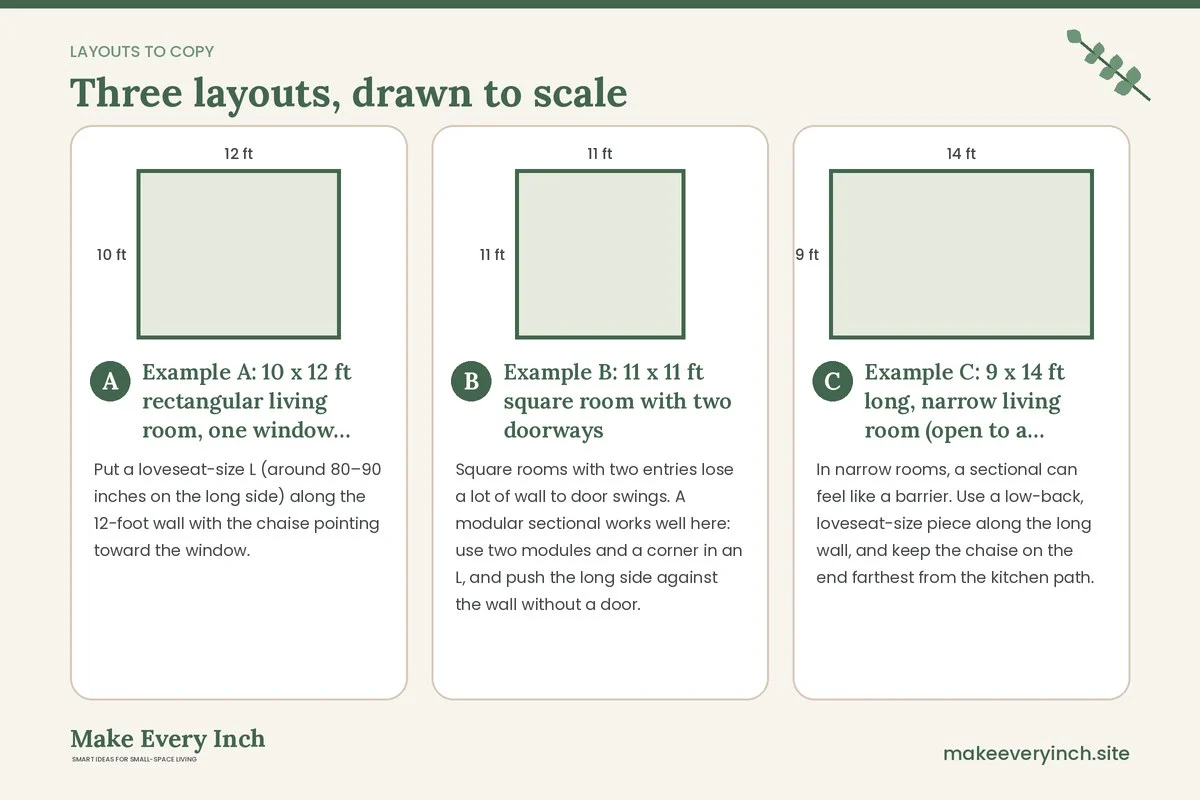
Example A: 10 x 12 ft rectangular living room, one window on the short wall
Put a loveseat-size L (around 80–90 inches on the long side) along the 12-foot wall with the chaise pointing toward the window. That leaves a walkway along the opposite wall for a slim media console, and a round coffee table or ottoman sits in the center. Skip a second large seating piece and use one floor pouf or a light chair that can move.
Example B: 11 x 11 ft square room with two doorways
Square rooms with two entries lose a lot of wall to door swings. A modular sectional works well here: use two modules and a corner in an L, and push the long side against the wall without a door. If the second door is rarely used, you can float the chaise slightly into the room, but keep the main route clear.
Example C: 9 x 14 ft long, narrow living room (open to a kitchenette)
In narrow rooms, a sectional can feel like a barrier. Use a low-back, loveseat-size piece along the long wall, and keep the chaise on the end farthest from the kitchen path. Hang mirrors or art above the back to pull the eye up, and use a narrow rug that follows the room’s long axis.
Which sectional shape fits your room?
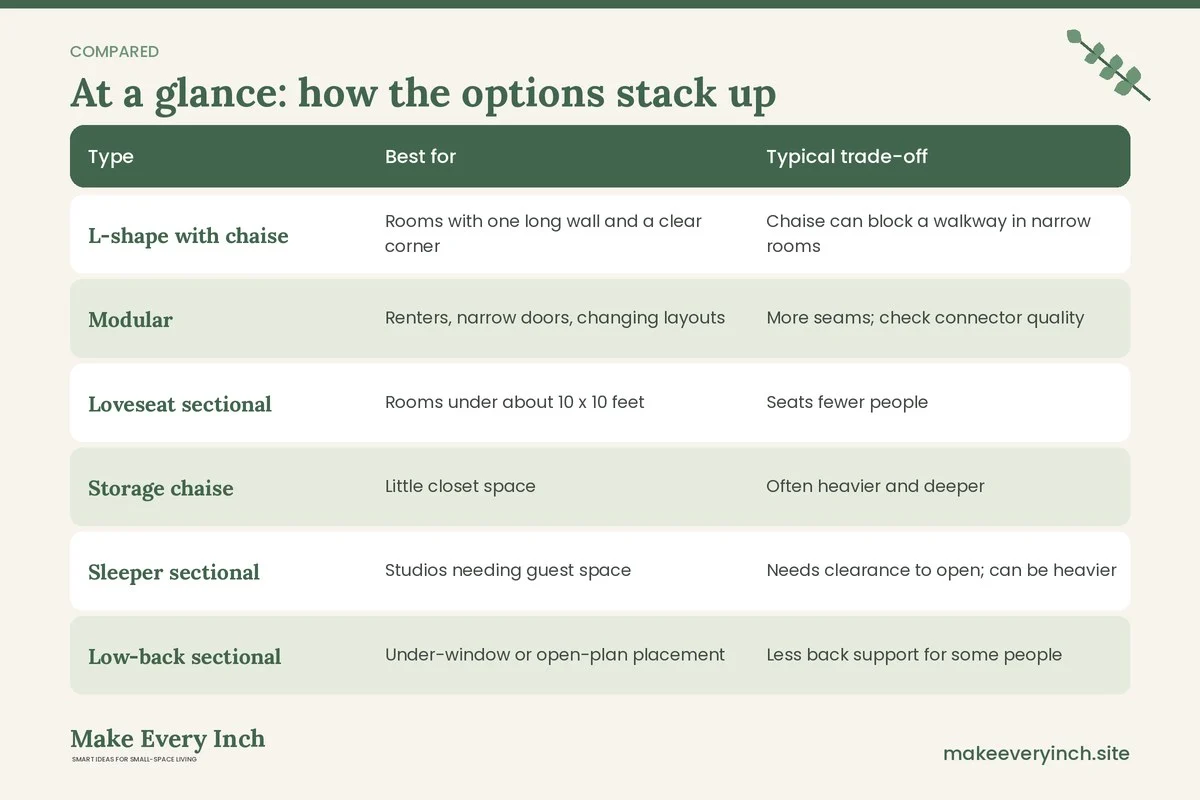
| Type | Best for | Typical trade-off |
|---|---|---|
| L-shape with chaise | Rooms with one long wall and a clear corner | Chaise can block a walkway in narrow rooms |
| Modular | Renters, narrow doors, changing layouts | More seams; check connector quality |
| Loveseat sectional | Rooms under about 10 x 10 feet | Seats fewer people |
| Storage chaise | Little closet space | Often heavier and deeper |
| Sleeper sectional | Studios needing guest space | Needs clearance to open; can be heavier |
| Low-back sectional | Under-window or open-plan placement | Less back support for some people |
Common mistakes with small living room ideas and a sectional
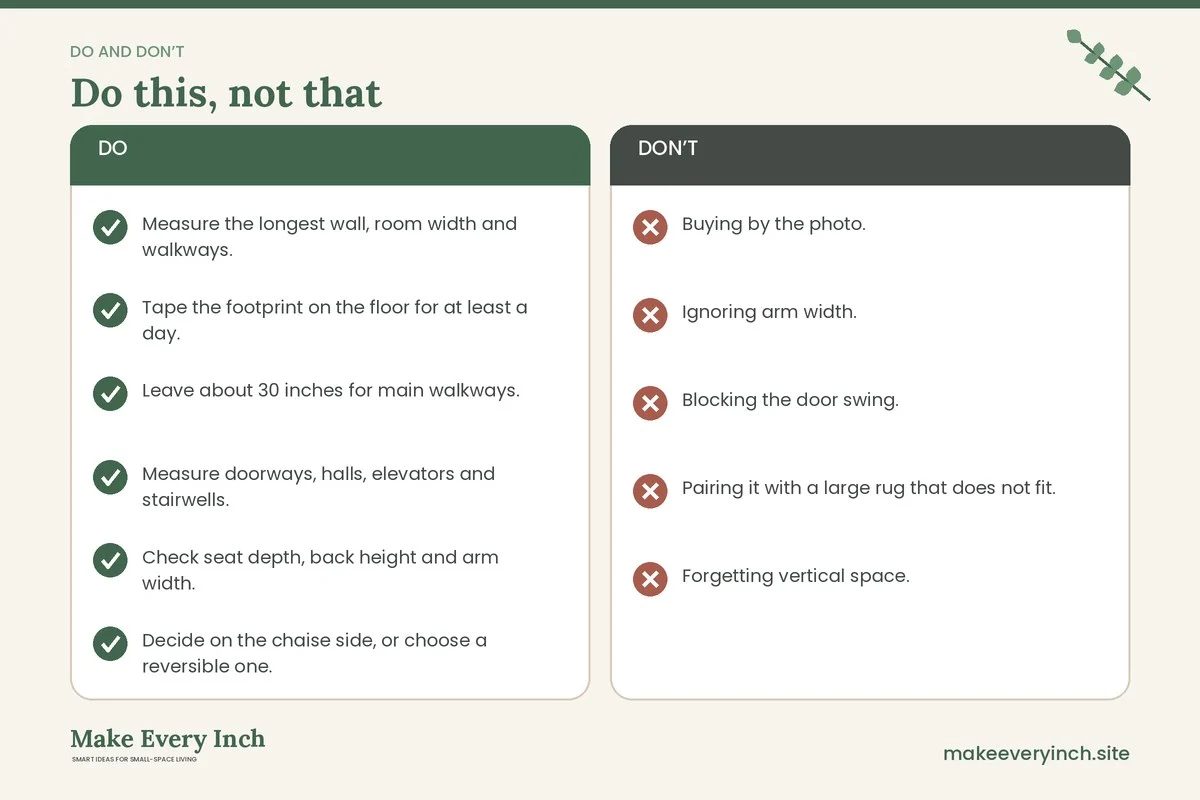
- Buying by the photo. Product photos hide depth. Check the dimensions in inches, including the chaise and arms.
- Ignoring arm width. Wide rolled arms can take 6–10 inches off the seating length. Slim track arms save space.
- Blocking the door swing. Open every door and window fully when you test the taped footprint.
- Pairing it with a large rug that does not fit. A rug should extend under at least the front legs of the sectional; one that is too small makes the room look choppy.
- Forgetting vertical space. Floor lamps, wall sconces and tall shelves keep the room feeling balanced, not just filled at floor level.
Styling small living room ideas with a sectional
Rug. Choose a rug that sits partly under the sectional so the seating anchors to one zone. In many small rooms, a 5 x 8 or 6 x 9 foot rug is easier to fit than an 8 x 10, but measure your own space.
Lighting. Use a floor lamp beside the arm instead of a table lamp, and add a swing-arm wall lamp if you can mount one. Layered lighting makes the sectional feel cozier, not cramped.
Pillows and throws. Limit yourself to three to five pillows. Too many pillows reduce seat depth and make the sectional look bulkier.
Coffee table. Try a round table, nesting tables or an ottoman with a tray. Round edges are easier to move around in tight spaces.
Budget and renter-friendly tips
- Buy fewer, better modules. A two-piece set you can expand later often costs less up front than a large L you may outgrow.
- Test before you commit. Visit a showroom, or order from a retailer with a clear return policy, and sit on it for a few minutes. Look at cushion firmness, seat height and depth.
- Check the frame and cushion specs. Kiln-dried hardwood or plywood frames and higher-density foam usually hold up better than particleboard and low-density foam, though specs vary by brand, so read the product details.
- Use furniture sliders. They protect floors and make it easier to adjust the layout in rentals.
- Consider secondhand. Local marketplaces often have sectionals at a discount; measure carefully and ask for the model so you can check dimensions.
- Add a slipcover. If the fabric is the only issue, a fitted slipcover can refresh an older sectional for less than replacing it.
How to rearrange your sectional as your needs change
If you work from home, a modular sectional can split into a loveseat and an armchair to open up a desk corner. If you host dinner or friends, you can push the ottoman toward the middle for extra seating. Seasonal changes, such as moving a chair near a window in winter, are easy when pieces are light. The goal is a layout that you can adjust in under ten minutes without help.
Sectional sizing cheat sheet
Use these numbers as a quick check before you fall in love with a sectional. A compact L-shape of about 80 x 60 inches suits rooms from 10 x 12 feet. A larger 100 x 65 inch sectional needs about 12 x 14 feet. A sectional with a chaise adds about 20 to 24 inches of length on one side, so check that the chaise does not block the path to a door or window. Keep 30 to 36 inches clear in the main walkway, and at least 18 inches between the sectional and a coffee table or ottoman.
| Room size | Sectional shape | Approx. size | Notes |
|---|---|---|---|
| 9 x 11 ft | Loveseat with chaise | 70 x 60 in | Float or push into a corner |
| 10 x 12 ft | Compact L-shape | 80 x 60 in | Leave 30 in on the open side |
| 11 x 13 ft | Standard L-shape | 90 x 65 in | Add one accent chair |
| 12 x 14 ft | Large L or U | 100 x 65 in | Use a round table |
| Open plan | Modular | Flexible | Use as a divider |
Questions to ask before you order
Which side is the chaise on, and does it match the room? Will the sectional fit through the door, up the stairs and into the elevator? Can the pieces be separated for delivery? What are the seat depth and height, and are they comfortable for the people who use it? Is the fabric easy to clean and suitable for pets or children? What is the return policy, and who pays for shipping if you send it back? Writing these down before you shop prevents expensive mistakes.
Checklist: before you buy a sectional
- Measure the longest wall, room width and walkways.
- Tape the footprint on the floor for at least a day.
- Leave about 30 inches for main walkways.
- Measure doorways, halls, elevators and stairwells.
- Check seat depth, back height and arm width.
- Decide on the chaise side, or choose a reversible one.
- Look at removable, washable covers if you have pets or kids.
- Check the return policy, delivery options and whether delivery includes assembly.
- Order fabric swatches and view them in your room’s light.
- Plan where the TV, lamps and side tables will go.
FAQ
Can small living room ideas with a sectional work in a 10 x 10 room?
Often yes, if you choose a compact or loveseat-size sectional and keep a clear walkway. A standard large L-shape is more likely to crowd a room that small. Taping the footprint first is the safest test.
Should the chaise go on the left or right?
Place the chaise so its open end faces the main traffic path or a window, not the door you use most. If you are unsure, a reversible chaise gives you flexibility.
Is a sectional or a sofa better for a small room?
A sofa is usually the better fit when your longest wall is under about 9 feet. A sectional works better when you need more seating and have a corner to use.
How much space do I need behind or beside a sectional?
Aim for roughly 30–36 inches of walkway where people move often. Against a wall, a few inches of gap can help with cleaning, but it is not required.
What color sectional makes a small room look bigger?
Lighter colors and tones close to the wall color tend to look less heavy. Texture and legs matter too, so a mid-tone sectional with visible legs can still feel open.
Can I use a sectional in a rental?
Yes. Choose modular or easy-to-disassemble pieces, avoid anything that needs to be fixed to the wall, and check delivery access in your building before you order.
How do I keep a sectional from looking bulky?
Choose slim arms, visible legs and a back height that does not block windows. Keep the surrounding furniture light, and leave some empty floor on at least one side so the sectional has visual breathing room.
Where should the TV go with a sectional?
Place the TV where it can be seen from the main seating section, not from the chaise end. If the chaise is on the far side, a TV on the wall opposite the long side usually works well.
Do I need a coffee table with a sectional?
Not always. An ottoman, a nesting set or a small round table can work, and some people skip a table and use a tray or a side shelf instead.
Keep planning your space: Read our small living room layout ideas and storage ideas, or get the free small-space measuring checklist by email.
Save this guide for later
Pin the ideas you like to Pinterest so you can come back to them when you plan your space.