Small Living Room Makeover Ideas Renter Friendly: A Reversible Plan With Deposit-Safe Photos
Quick answer: The best small living room makeover ideas renter friendly plan is built to be undone. Photograph every wall, floor and fixture before you start, read the lease, then work in reversible layers: layout, lighting, textiles, removable wall treatments and freestanding storage. Keep a written log, label what you add and restore the room at move-out so the before and after photos protect your deposit.
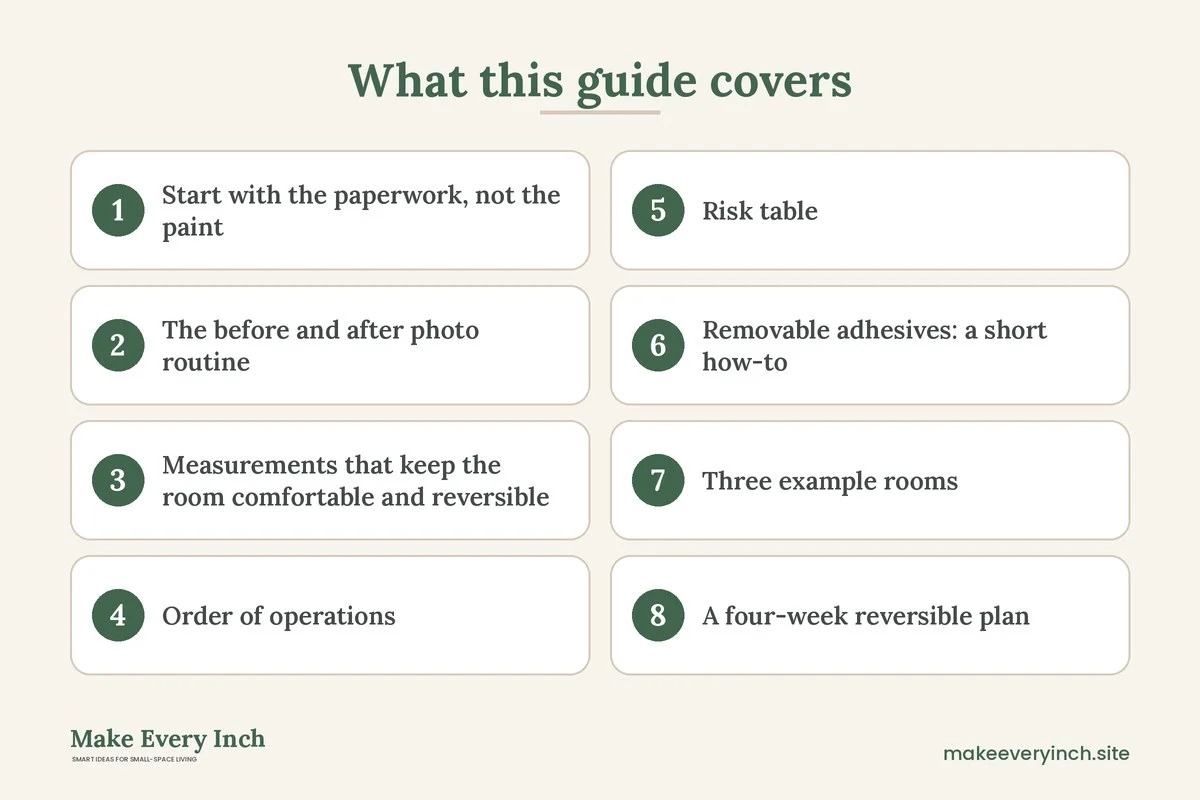
Small living room makeover ideas renter friendly enough to leave no trace are really a project in two halves: the makeover itself and the paper trail that proves you left the place as you found it. Most renter guides cover the first half only. This post treats the deposit as part of the plan. You will start with a documentation routine, learn which changes are usually safe and which need permission, follow an order of operations that puts reversible work first, and finish with a move-out reset. It includes measurements, a risk table, three example rooms, a four-week plan, a checklist and a FAQ. For the wider topic, read our parent guide to small living room makeover ideas, the broader small living room ideas pillar and the related guide to small living room ideas for renters.
Start with the paperwork, not the paint
A renter makeover is lower risk when you know exactly what the lease allows. Read it before you buy anything. Look for clauses about nails and drilling, painting, flooring, light fixtures and “alterations.” Rules differ by place and by landlord, and this article is general guidance rather than legal advice. If a clause is unclear, ask in writing and keep the reply.
A short email works well. Describe the change in plain words, such as “I would like to use removable adhesive hooks for lightweight frames and plug-in wall lamps,” and ask for confirmation. A written yes is worth more than a verbal one. Save it with your lease.
Make a short list of three categories as you read:
- Allowed without asking: moving furniture, rugs, curtains on tension rods, plug-in lamps, freestanding shelves.
- Ask first: painting, nails or screws, wall-mounted shelves, replacing a light fixture, changing hardware.
- Not allowed or not worth the risk: structural changes, anything that needs rewiring, flooring replacement, permanent wallpaper.
Your makeover lives mostly in the first category, uses the second only with permission, and avoids the third.
The before and after photo routine
Photos are the cheapest deposit insurance there is. Do them properly before the first box moves.
Take the before set
Photograph each wall straight on, then each corner, the ceiling, the floor, the baseboards, the windows, the door and the light fixtures. Take close-ups of anything already damaged, such as scuffs, chips, nail holes, stains or a scratched floor. Include a ruler or coin for scale on small marks. Turn on the flash or use daylight so detail is visible. Take photos with the date stamp visible, or email them to yourself so the message carries a timestamp.
Keep a change log
Create a simple note listing each change, the date, the method and whether you asked permission. For example: “Week 2, three adhesive hooks above sofa, rated for the weight of one lightweight frame, removed on [date].” The log also reminds you what to undo at move-out.
Take the progress and after sets
Repeat the same angles at mid-point and at the end, and again on move-out day once everything is restored. Standing in the same spot for each shot makes comparison easy. Store the images in a folder named by the address and year, and back it up. If a dispute arises, you have a before set, an after set and a log.
Measurements that keep the room comfortable and reversible
The measurements below suit most small living rooms, and they matter more when you cannot change the walls.
- Main walkway: 30 to 36 inches wide. A rarely used side path can be 24 inches.
- Sofa to coffee table: 14 to 18 inches of knee room.
- Rug size: 5 by 8 feet is common in small rooms, with the front legs of the sofa and chairs on the rug.
- Curtain rod: a tension or adhesive-free option sits about 4 to 6 inches above the window frame where the frame allows and extends 6 to 10 inches beyond it on each side.
- Art height: the center of a frame or group about 57 to 60 inches from the floor, or 8 to 10 inches above the sofa back.
- Floor lamp placement: at least 12 inches from curtains and other fabrics, and clear of walkways.
- Shelving depth: 10 to 12 inches for a narrow freestanding unit so it does not intrude on the walkway.
- Cable runs: keep cords along the baseboard, out of the walkway, and clear of door swings.
Mark each plan on the floor with painter’s tape. Low-tack painter’s tape is meant for easy removal, but test a hidden patch first, since sticky tape can lift some finishes.
Order of operations: a reversible makeover from first step to last
The usual makeover order is declutter, layout, paint, furniture, lighting, textiles and styling. A renter version keeps the same order but swaps permanent steps for reversible ones.
Step 1: Declutter
Clear the room in three passes. First remove what does not belong, then duplicates and broken items, then things you do not use. For a rented room, decluttering has an extra benefit: fewer belongings means fewer things to pack and a faster move-out. See our guide to small apartment decluttering ideas for a method.
Step 2: Layout
Try three layouts with tape before moving anything heavy. Use felt pads under furniture legs to protect floors, and lift rather than drag. Float the sofa away from the wall if the room is wide enough, use the back as a divider, and keep the path to the door clear. Layout is free, reversible and the biggest single change you can make.
Step 3: Walls, the removable way
If paint is forbidden or you prefer not to risk it, treat the walls with temporary options. Hang light frames with removable adhesive strips rated for the weight of the frame, lean larger pieces on a shelf or console, and use a fabric hanging on a tension rod across an alcove. Removable wallpaper and peel-and-stick tiles can work in small areas, but test a hidden spot first and note that results vary by wall surface and paint type. Painted walls may lose paint when adhesive comes off, especially on recently painted or low-quality surfaces. If you do have permission to paint, ventilate the room, choose low-VOC paint, protect floors and keep a record of the original color so you can restore it. See our post on renter friendly wall decor ideas.
Step 4: Furniture
Furniture is where a rented room can change most without touching the building. Choose pieces that earn their keep: a sofa with raised legs, a storage ottoman, nesting tables and a freestanding shelf. Prefer furniture you can take with you, so the money follows you to the next home. Compare options in our guides to best sofas for small apartments and best storage ottomans.
If you buy a tall unit, such as a bookcase, follow the manufacturer’s instructions for stability. Wall anchoring is the safest option for tall furniture because it can tip, especially around children and pets. If drilling is not allowed, ask the landlord for permission to fit a single anchor, since a small hole can be filled at move-out. Without anchoring, choose shorter pieces, keep heavy items on the lowest shelves and avoid putting a TV on a tall, unstable stand. See best narrow bookshelves.
Step 5: Lighting
Lighting is the easiest way to change a rented room without touching the fixtures. Use plug-in wall lamps with a cord cover, floor lamps, table lamps and clip-on or adhesive-mounted LED strips. Use warm bulbs, around 2700 kelvin, for evenings. A few safety rules apply:
- Match bulb wattage to the lamp’s rating and never exceed it.
- Do not daisy-chain extension leads or overload a power strip.
- Keep cords out of walkways and do not run them under rugs.
- Do not change a ceiling fixture or touch wiring unless the landlord approves and a qualified electrician does the work.
- Turn power off before changing a bulb.
For more options, see our guides to renter friendly lighting ideas and small living room lighting ideas for renters.
Step 6: Textiles
Textiles are the most powerful reversible layer. A rug defines the seating area and hides worn flooring, curtains on a tension rod add height and softness, and cushions and throws bring color. Choose a rug with a non-slip pad that is safe for your floor, since some rubber backings stain certain finishes. Layer two or three textures and repeat the same colors.
Step 7: Styling
Styling finishes the room. Add plants, a tray, books and a few objects with meaning. Group items in threes, vary heights and leave empty space. Place a mirror opposite or beside a window to bounce light, and lean it rather than hang it if you cannot drill. A large leaning mirror needs a secure position where it cannot slide or be knocked, so use a stopper or anti-tip strap if the lease allows.
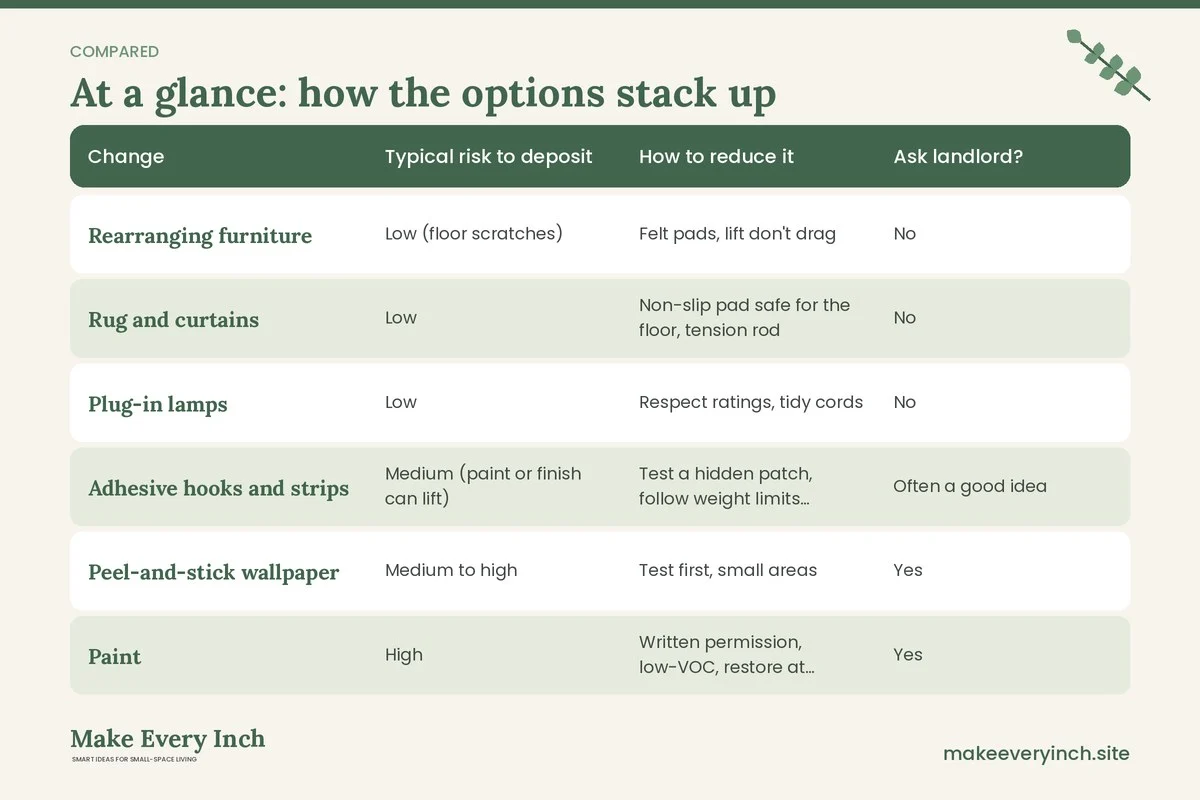
Risk table: what is usually safe, what to confirm
| Change | Typical risk to deposit | How to reduce it | Ask landlord? |
|---|---|---|---|
| Rearranging furniture | Low (floor scratches) | Felt pads, lift don’t drag | No |
| Rug and curtains | Low | Non-slip pad safe for the floor, tension rod | No |
| Plug-in lamps | Low | Respect ratings, tidy cords | No |
| Adhesive hooks and strips | Medium (paint or finish can lift) | Test a hidden patch, follow weight limits, remove slowly | Often a good idea |
| Peel-and-stick wallpaper | Medium to high | Test first, small areas | Yes |
| Paint | High | Written permission, low-VOC, restore at move-out | Yes |
| Screws and wall anchors | Medium (holes) | Fill holes at move-out | Yes |
| Replacing hardware or fixtures | High | Store originals, reinstall at move-out | Yes |
Removable adhesives: a short how-to
Adhesive strips and hooks are popular with renters because they promise no holes. They work best when used as directed.
- Clean the surface with a gentle cleaner and let it dry fully.
- Check the weight rating on the packaging and stay well under it.
- Press firmly for the time the instructions state, then wait before hanging anything.
- Test a hidden patch first, since paint type and age affect how the strip releases.
- Remove slowly: pull the tab straight along the wall, parallel to the surface, stretching it slowly, as the instructions say. Warming with a hair dryer can help soften adhesive, but keep the dryer moving and do not overheat.
- Do not use adhesives on wallpaper, textured walls, damp or flaking paint.
Even with careful use, a small patch of paint may lift, so photograph the result and mention it honestly if needed.
Three example rooms
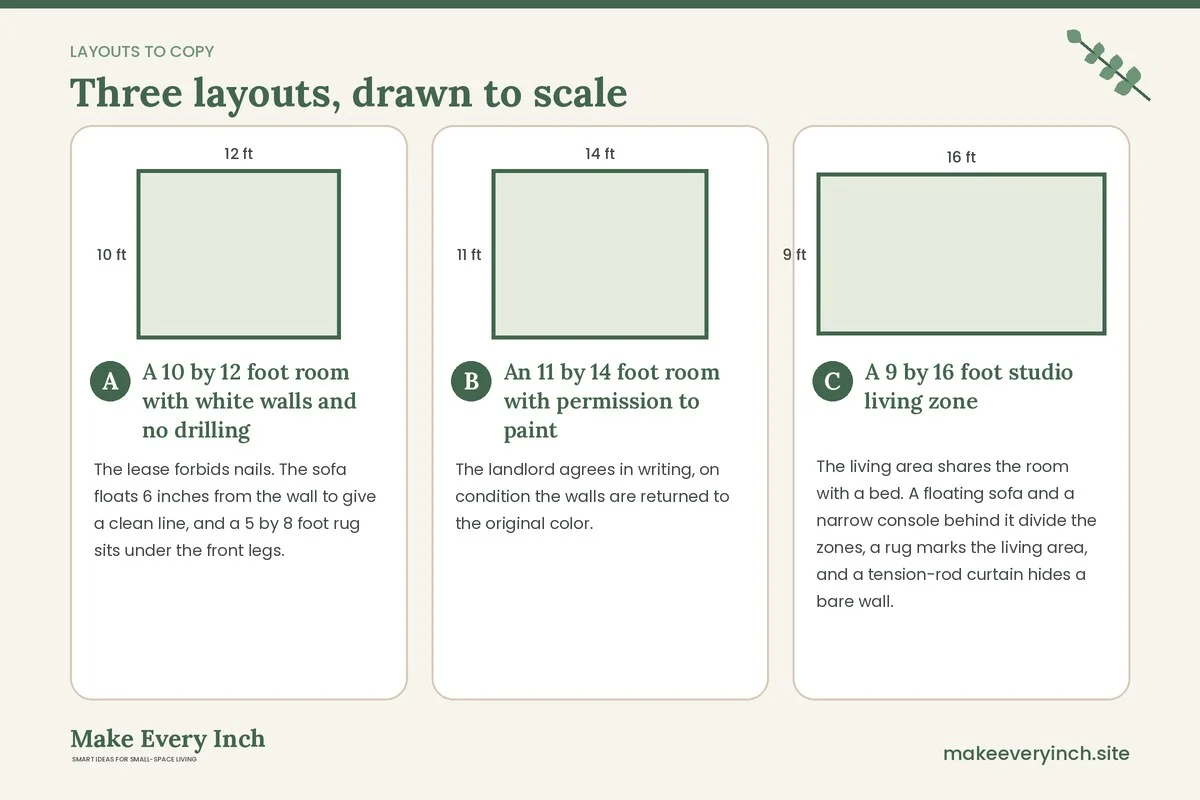
A 10 by 12 foot room with white walls and no drilling
The lease forbids nails. The sofa floats 6 inches from the wall to give a clean line, and a 5 by 8 foot rug sits under the front legs. A leaning mirror stands opposite the window on a low console, with a plug-in wall lamp and a tension-rod curtain above the window. Light frames hang from adhesive strips rated well above their weight. At move-out, the strips come off slowly, the rug and mirror go with the tenant and the after photos match the before set.
An 11 by 14 foot room with permission to paint
The landlord agrees in writing, on condition the walls are returned to the original color. The tenant records the original paint name or takes a labeled sample, paints with ventilation and low-VOC paint, and keeps spare paint for touch-ups. The room gains a calm, warm color, a pair of side tables, a narrow shelf and layered lamps. At move-out, a repaint is planned into the budget, and the photo log shows the agreed condition.
A 9 by 16 foot studio living zone
The living area shares the room with a bed. A floating sofa and a narrow console behind it divide the zones, a rug marks the living area, and a tension-rod curtain hides a bare wall. A freestanding shelf holds books, with heavy items low. Cords run along the baseboard, away from the walkway, and the walkway stays at 30 inches. Everything is movable, so move-out takes a day.
A four-week reversible plan
Week 1: Paperwork and photos
Read the lease, email questions, take the full before set and start the change log. Measure the room and tape three layouts.
Week 2: Declutter and layout
Declutter in three passes, choose a layout and move furniture with felt pads. Take a mid-point photo set.
Week 3: Light, walls and textiles
Add plug-in lamps and warm bulbs, hang light art with tested adhesives and lay down the rug and curtains. Add storage that stands on its own.
Week 4: Styling and a restore test
Add plants, mirrors and objects. Then do a restore test: imagine moving out, and check that you could remove every change within a day. Take the after set from the same angles as the before set. Store a labeled box for fixings, original hardware and spare parts.
If you only have a weekend, spend Saturday on photos, decluttering and layout, and Sunday on lamps, rug and curtains. Leave wall treatments for later, once you have permission.
Move-out reset checklist
- Remove adhesive strips slowly and clean residue.
- Fill any small holes if you were permitted to make them, using the right filler for your wall.
- Reinstall original hardware and fixtures you stored.
- Restore paint to the agreed color if you painted.
- Wipe baseboards, windows and floors.
- Photograph each wall, corner, floor and fixture from the same angles as the before set.
- Compare the images side by side and note any difference.
- Send the after photos to the landlord with a short note and keep a copy.
Mistakes that cost renters their deposit
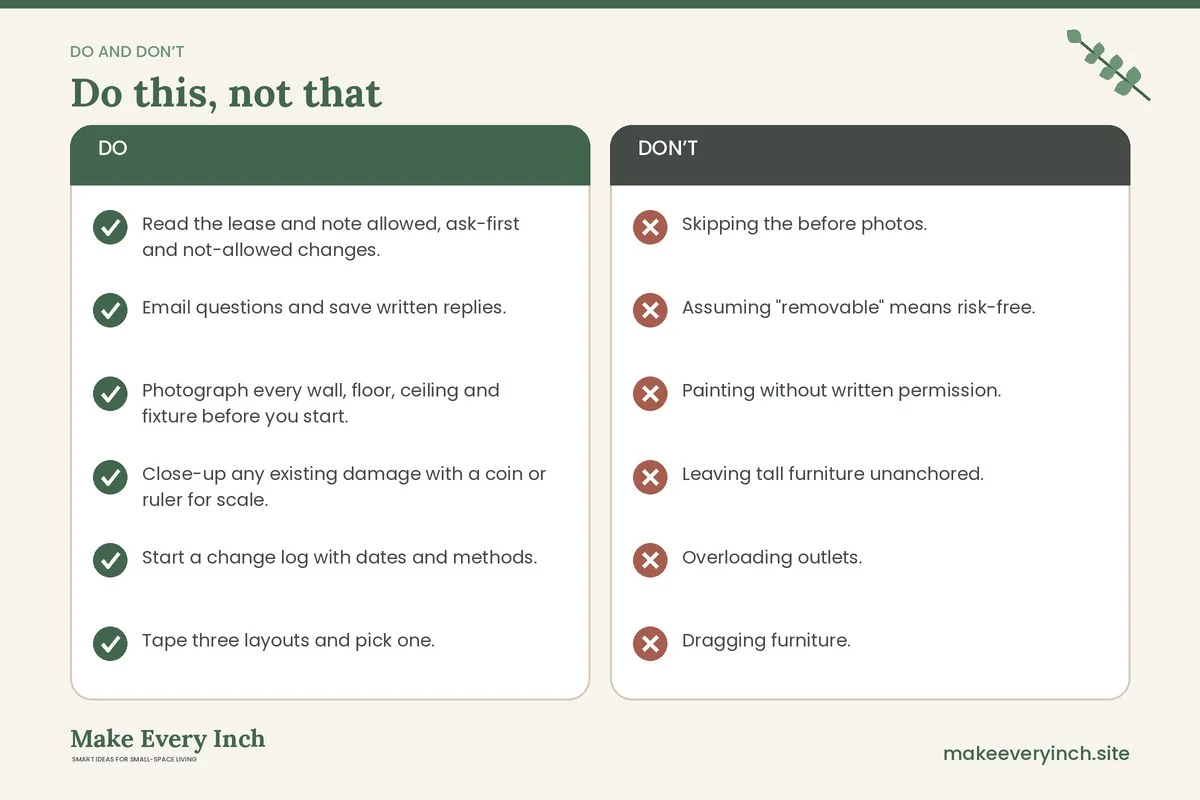
- Skipping the before photos. Without them, you cannot show what was already there.
- Assuming “removable” means risk-free. Test every adhesive first.
- Painting without written permission. Verbal approval is easy to forget.
- Leaving tall furniture unanchored. Tipping is a safety risk, so ask about a single anchor.
- Overloading outlets. Respect the ratings on lamps and power strips.
- Dragging furniture. Felt pads and a lift prevent scratches.
- Forgetting the log. A change that is not written down is easy to miss at move-out.
Small living room makeover ideas renter friendly checklist
- Read the lease and note allowed, ask-first and not-allowed changes.
- Email questions and save written replies.
- Photograph every wall, floor, ceiling and fixture before you start.
- Close-up any existing damage with a coin or ruler for scale.
- Start a change log with dates and methods.
- Tape three layouts and pick one.
- Declutter in three passes.
- Keep the walkway at 30 to 36 inches.
- Add plug-in lamps and warm bulbs, within ratings.
- Choose a rug that reaches under the front legs.
- Hang curtains on a tension rod.
- Test adhesives on a hidden patch.
- Use freestanding storage and keep heavy items low.
- Take progress and after photos from the same angles.
- Plan the move-out reset before you finish.
FAQ
What are the best small living room makeover ideas for renters?
Start with layout, lighting, a large rug, tension-rod curtains, freestanding storage and removable wall treatments. These make a big visual change without touching the building. Document the room first so you can prove its original condition.
How do I use before and after photos to protect my deposit?
Photograph every wall, floor, ceiling and fixture before you start, with close-ups of existing damage. Keep a dated log of changes, take after photos from the same angles and send them to the landlord at move-out. Store copies in more than one place.
Can I paint a rental living room?
Only with written permission. If you are allowed, ventilate the room, use low-VOC paint, protect the floor and plan to restore the original color if asked. Rules differ by lease and by place.
Do adhesive hooks damage walls?
They can, especially on fresh or poor-quality paint. Test a hidden patch, stay well under the weight rating and remove slowly as the packaging instructs.
How do I secure tall furniture if I cannot drill?
Ask your landlord whether a single wall anchor is allowed, since a small hole can be filled later. If not, choose shorter pieces, keep heavy items low and avoid putting a TV on an unstable stand. Check the manufacturer’s guidance.
How long does a reversible makeover take?
Most can be done in a weekend for the layout and lighting, and over about four weeks if you want to work at an easy pace. Plan the restore step before you begin.
Keep going: Keep planning with our small living room ideas for renters, small living room storage ideas for renters and renter friendly apartment decorating ideas.
Save this guide for later
Pin the ideas you like to Pinterest so you can come back to them when you plan your space.