16 Small Living Room Storage Ideas Modern Rooms Use to Stay Clean
Quick answer: The best small living room storage ideas modern rooms use hide most things behind flat fronts, keep open surfaces to about one third of the storage, run furniture on legs so floor shows, and use shallow wall-hung units at 12 to 16 inches deep. Count what you own first, give every category a closed home, and leave one calm surface empty.
Small living room storage ideas modern in style have one job: make a lot of stuff disappear without making the room feel like a warehouse. A modern room reads as calm because the lines are straight, the colors are few, and the surfaces are clear. That look is only possible if the clutter has somewhere to go. This guide takes a different route from our general guide to small living room storage ideas. It starts with an inventory, sets a closed-to-open ratio, gives you 16 clean-lined plans with depths and heights, adds a sizing table and walks through three example rooms. If you want the wider design picture first, read our pillar on small living room ideas.
Why modern storage works differently
Traditional storage celebrates objects. Modern storage edits them. In a modern small living room, the eye should land on a few intentional things: a lamp, one piece of art, a plant, a single stack of books. Everything else lives behind a door or a drawer front. That is why the same bookcase can feel cluttered in one room and sleek in another. The difference is how much of it is open and how much is closed.
Three habits define the look. First, flat fronts: doors and drawers with no raised panels, and handles that are slim, recessed or replaced by a push latch. Second, visible floor: pieces on legs, or wall-hung pieces that float, so the eye can see under them and read more space. Third, one material family: two or three finishes repeated across the room, such as pale oak, matte black and white, so the storage blends into the walls instead of announcing itself.
None of this needs a big room. In a 10 by 12 foot space, a modern plan can hold a surprising amount if you use the vertical wall and the dead zones: the space above a door, under a window, behind the sofa and beside the TV. The ideas below are organized around those zones.
Start with an inventory, not a shopping list
Most storage fails because it was bought for an imaginary pile instead of the real one. Spend twenty minutes sorting everything that currently lives in or near your living room into categories. Do not buy a single box until you have done this.
Sort into six groups: media (discs, consoles, cables, remotes), books and magazines, throws and cushions, games and hobby gear, paperwork and tech (chargers, a laptop), and guest or seasonal items. Measure each group by stacking it on the floor. A rough guide is that a stack of 30 paperbacks needs about 24 inches of shelf, a throw blanket folds to roughly 12 by 14 inches, and a laptop with a charger needs a drawer at least 3 inches tall and 15 inches wide.
Then mark each group as closed, open or out. Closed means behind a door or inside a drawer. Open means displayed on a shelf. Out means it leaves the room, whether donated, moved to the bedroom or put in a closet. Be honest. A modern room cannot absorb everything, and the fastest storage you will ever gain is the item you stop keeping in the room.
The closed-to-open ratio
A useful rule for modern rooms is about two thirds closed storage and one third open. Closed storage hides the visual noise, and open storage gives the room personality. If you flip the ratio, the room starts to look like a shop display. If you go all closed, it feels cold and flat.
Here is how to apply it. Add up the shelf and cabinet width you have or plan to buy. If you have 9 feet of total horizontal storage across the room, aim for about 6 feet behind doors and drawers, and about 3 feet open. Within the open part, leave a third of each shelf empty. The empty shelf space is not wasted. It is what keeps the styled objects from reading as clutter.
Be careful with glass fronts. Glass looks light, but it shows what is inside, so it counts as open storage for the purposes of the ratio. Frosted or ribbed glass is a middle path, since it softens the contents into shapes and colors.
16 small living room storage ideas modern rooms use
Along the main wall
1. A wall-hung media cabinet
Mount a low cabinet 14 to 16 inches deep on the TV wall with the bottom 8 to 12 inches off the floor. The visible floor makes the wall look longer, and the cabinet hides consoles and cables. Leave a gap behind the unit for cable routing, and fix it to studs or use anchors rated for the load. Keep the top clear apart from a lamp or a plant.
2. A low credenza with push-to-open doors
Where wall mounting is not possible, a credenza on slim legs does the same job. Choose a depth of 14 to 16 inches and a height of 24 to 30 inches so it stays below a window sill or a wall-hung screen. Push-latch doors remove handles, and the front reads as one clean plane. See our guide to small living room TV wall ideas for ways to pair it with a screen.
3. A shallow floor-to-ceiling shelf wall
A single wall of shelves 11 to 12 inches deep, running from floor to about 8 feet, holds a lot while taking only a foot of floor. Mix closed cabinets in the bottom 30 inches with open shelves above. Paint the unit the same color as the wall, so it recedes and the room looks bigger. Our list of the best narrow bookshelves covers what to look for in shallow units.
4. Modular cubes in a grid
A grid of square cubes, 12 to 14 inches on each side, lets you build the exact width you need. Fill about half with fitted doors or drawers and leave the rest open. The even grid is naturally modern, and you can add a column later when you have more to store.
Around the sofa
5. A slim console behind the sofa
If the sofa floats away from the wall, a console 10 to 12 inches deep behind it holds lamps, a tray, a few books and closed baskets underneath. Keep the console 2 inches lower than the sofa back, so the line stays calm. Leave 30 inches of walkway behind it.
6. A sofa on legs with space beneath
A sofa raised 6 to 8 inches on legs lets you slide flat bins, a robot vacuum or a low box underneath. Measure the clearance first. A bin 5 inches tall needs a gap of at least 6 inches. Use bins in a color close to the floor, so they disappear. For sofas that suit small rooms, see our best sofas for small apartments.
7. A narrow side table with a drawer
Choose a side table 12 to 14 inches wide with one shallow drawer for remotes, chargers and coasters. A drawer keeps the tabletop clear, and a table of this width fits between the sofa arm and the wall without blocking the path.
8. A storage ottoman in a solid color
One lidded ottoman, about 30 to 36 inches across and 16 to 18 inches tall, doubles as a coffee table, a footrest and a throw blanket store. Pick a low-texture fabric or leather-look finish in a neutral shade. For options, read our guide to the best storage ottomans.
Walls and corners
9. Floating shelves with hidden brackets
A floating shelf 8 to 10 inches deep and 36 to 48 inches wide looks like a line drawn on the wall. Hang two or three in a staggered pattern, with 14 to 18 inches between them. Load only books and light objects unless you have confirmed what the wall can hold. Renters can read our guide on no-drill storage ideas for renters.
10. A slim wall-mounted rail system
A rail with movable brackets, mounted vertically, lets you change shelf heights as your stuff changes. The thin metal verticals add a clean line. It is a good option when you cannot predict what you will need next year.
11. A corner unit with doors
Corners are often wasted. A narrow corner cabinet, 14 to 16 inches on each face, holds a surprising amount behind doors and keeps the corner visually quiet. Pair it with a floor lamp on the nearest wall.
12. A storage bench by the door
If the living room opens straight into the front door, a bench 14 to 16 inches deep and 36 to 48 inches long can hold shoes, bags and packages. Keep a closed front so the shoes do not appear in the room. For more ideas, see small entryway storage.
Hidden and dual-purpose
13. A desk that closes
A wall-mounted drop-down desk or a console that opens into a work surface hides a laptop, paper and a lamp when you are done. Look for a depth under 16 inches when closed, and a cable hole at the back. More on this approach is in hidden storage ideas.
14. A lift-top coffee table
A table that raises the top gives you a work or dining surface and a storage well below. The well holds blankets, games or a laptop. Choose a clean rectangle or a plain round shape. You can compare similar pieces in our guide to small space storage furniture.
15. Vertical storage above the door
A single long shelf or a row of closed boxes above a door frame uses space that nobody looks at. Keep the load light, such as off-season throws, and stay within what the wall can hold. See more in vertical storage ideas.
16. A window seat or a bench with drawers
Under a window, a built-in or freestanding bench 16 to 18 inches high and 14 to 18 inches deep gives you seating and drawers. If the window sits low, keep the bench at least a few inches below the sill, so curtains hang cleanly.
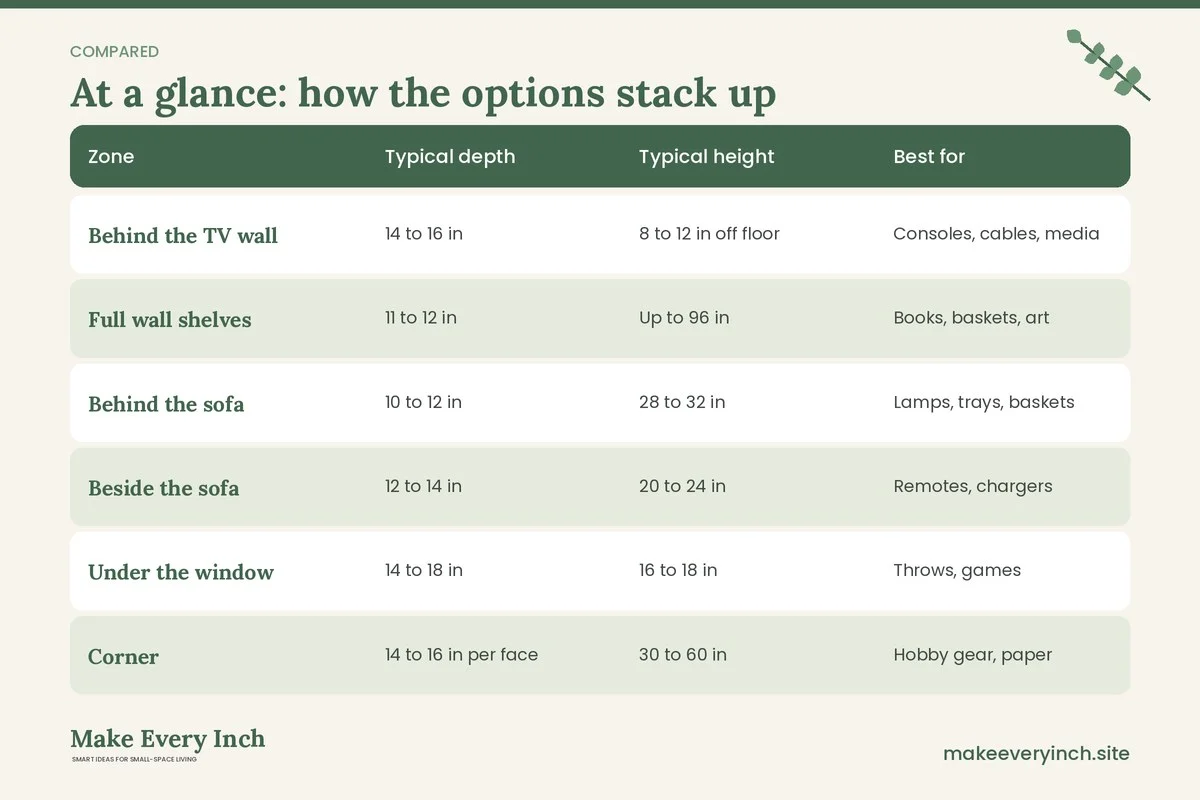
Sizing table: what fits where
| Zone | Typical depth | Typical height | Best for | Open or closed |
|---|---|---|---|---|
| Behind the TV wall | 14 to 16 in | 8 to 12 in off floor | Consoles, cables, media | Closed |
| Full wall shelves | 11 to 12 in | Up to 96 in | Books, baskets, art | Mixed |
| Behind the sofa | 10 to 12 in | 28 to 32 in | Lamps, trays, baskets | Mostly closed |
| Beside the sofa | 12 to 14 in | 20 to 24 in | Remotes, chargers | Closed drawer |
| Under the window | 14 to 18 in | 16 to 18 in | Throws, games | Closed |
| Corner | 14 to 16 in per face | 30 to 60 in | Hobby gear, paper | Closed |
| Above the door | 6 to 8 in | At the top of the frame | Light, seasonal items | Closed boxes |
| Entry side | 14 to 16 in | 17 to 19 in | Shoes, bags | Closed |
Keep the look clean: finishes, handles and cables
Storage turns messy at the edges, not in the middle. Pay attention to three details.
Finishes
Pick one wood tone and one accent. If your floor is pale oak, choose storage in the same oak or in a white that matches your wall. A single dark accent, such as matte black on a lamp or a rail, ties the room together. Avoid mixing three wood tones in one wall of storage, because the eye reads each as its own block.
Handles
Handle-free fronts, finger pulls or slim bars all keep the plane flat. If you rent and cannot swap handles, choose a unit that already has push latches, or add a strip of the same finish to cover old holes. Keep handle styles consistent across the room.
Cables
Cables are the main source of visual mess in a modern room. Use a cable box on the floor, a channel along the baseboard painted the wall color, and a short power strip fixed inside the media cabinet. Label both ends of each cable, so you can unplug the right one later.
Three example rooms
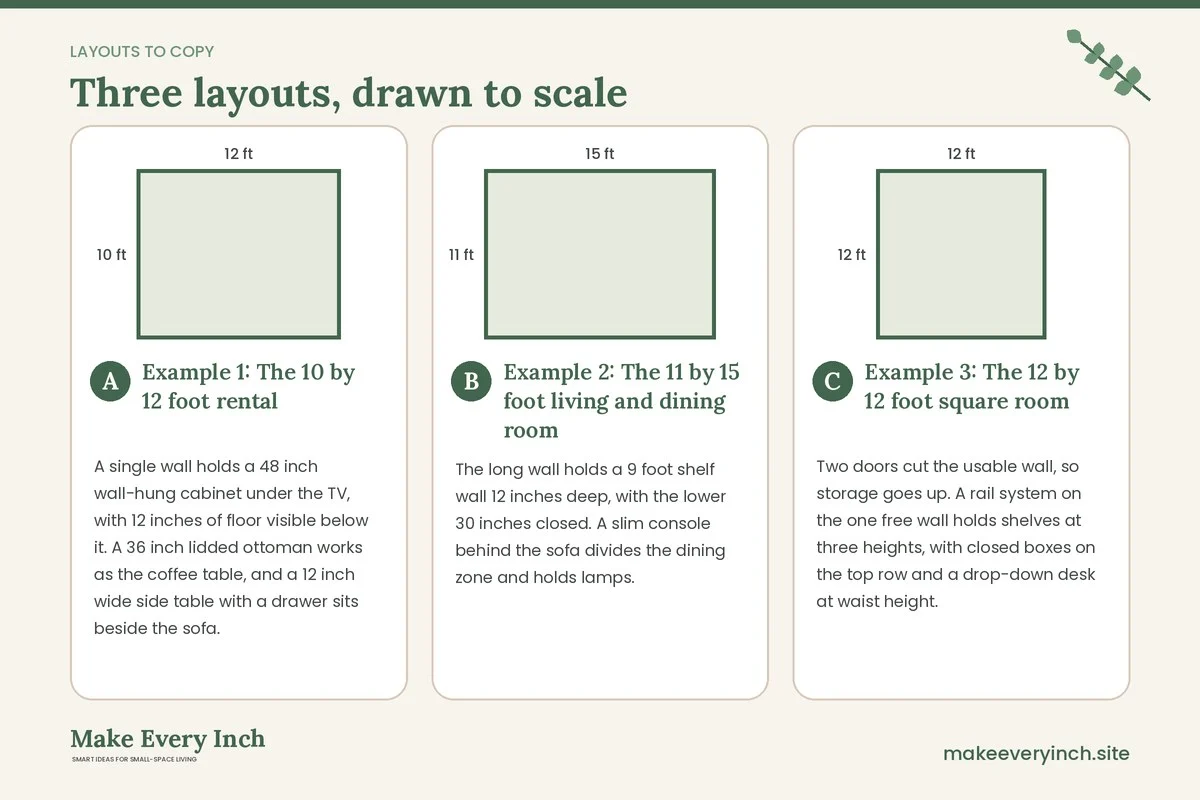
Example 1: The 10 by 12 foot rental
A single wall holds a 48 inch wall-hung cabinet under the TV, with 12 inches of floor visible below it. A 36 inch lidded ottoman works as the coffee table, and a 12 inch wide side table with a drawer sits beside the sofa. Two floating shelves 40 inches wide hold books and a plant. The closed storage totals about 7 feet and the open storage about 3 feet, which keeps close to the two-thirds rule.
Example 2: The 11 by 15 foot living and dining room
The long wall holds a 9 foot shelf wall 12 inches deep, with the lower 30 inches closed. A slim console behind the sofa divides the dining zone and holds lamps. The sofa stands on legs 7 inches high, so two flat bins slide under it. A bench with drawers sits under the window at the dining end for placemats, candles and game boxes. The walkway behind the console stays at 32 inches.
Example 3: The 12 by 12 foot square room
Two doors cut the usable wall, so storage goes up. A rail system on the one free wall holds shelves at three heights, with closed boxes on the top row and a drop-down desk at waist height. A corner cabinet 15 inches on each face handles hobby gear. A lift-top coffee table takes care of blankets and games. No piece of furniture is deeper than 16 inches, which keeps the center clear.
A weekend plan to set it up
Day one: edit and measure
Do the inventory. Mark closed, open and out. Measure the walls, the sill heights, the door swings and the outlets. Draw the room on paper, and sketch each storage zone from the table above.
Day two: tape and place
Tape the footprint of each new piece on the floor and the wall. For wall units, stick paper cut to size, and stand back from the doorway. Check the walkways, which should stay at 30 to 36 inches. Move the tape until the room feels calm.
Day three: fill and style
Load the closed storage first, with the heaviest things lowest. Then style the open third. Group objects in odd numbers, vary heights, and leave one shelf in three empty. Put the remotes, chargers and keys in drawers so the surfaces stay clear.
Mistakes modern rooms make
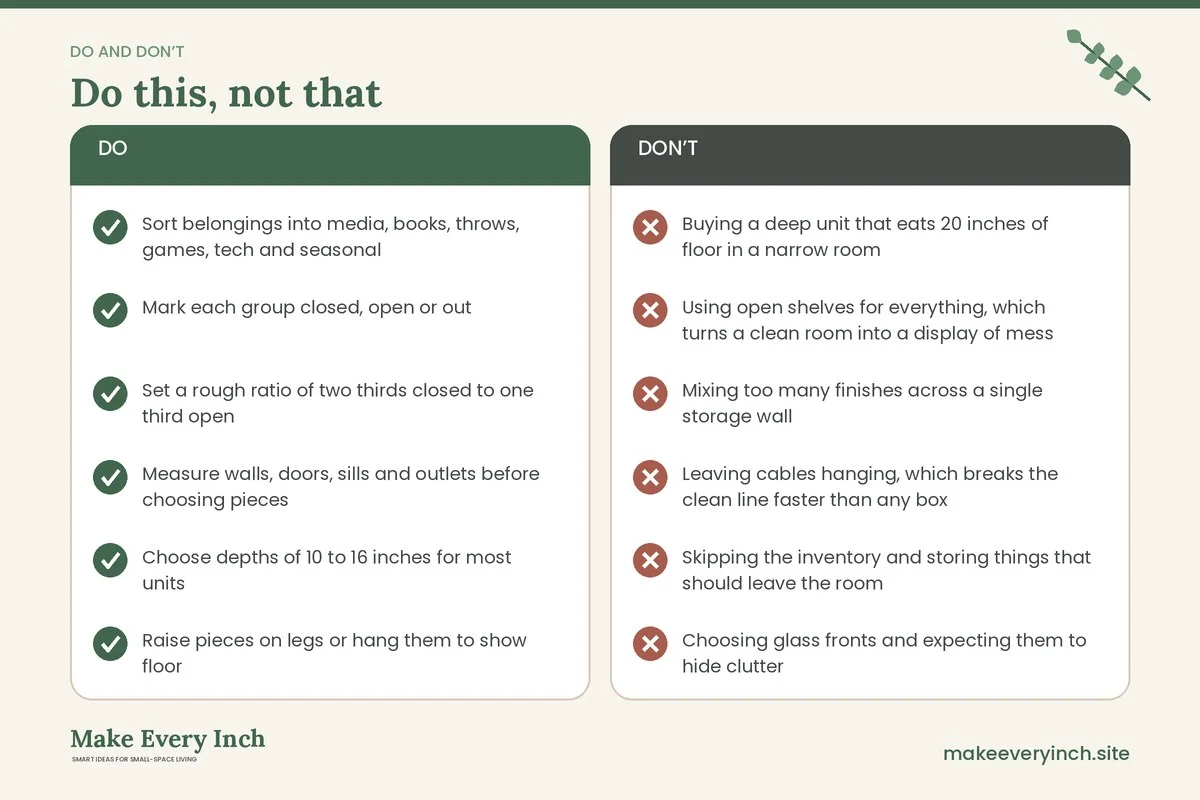
- Buying a deep unit that eats 20 inches of floor in a narrow room
- Using open shelves for everything, which turns a clean room into a display of mess
- Mixing too many finishes across a single storage wall
- Leaving cables hanging, which breaks the clean line faster than any box
- Skipping the inventory and storing things that should leave the room
- Choosing glass fronts and expecting them to hide clutter
- Loading wall units beyond what the wall and the fixings can hold
- Placing a bulky piece in front of a window, which blocks light
Modern storage checklist
- Sort belongings into media, books, throws, games, tech and seasonal
- Mark each group closed, open or out
- Set a rough ratio of two thirds closed to one third open
- Measure walls, doors, sills and outlets before choosing pieces
- Choose depths of 10 to 16 inches for most units
- Raise pieces on legs or hang them to show floor
- Keep one finish family across the storage
- Use push latches or slim pulls for flat fronts
- Plan cable routes before mounting a screen
- Leave one third of each open shelf empty
- Keep one surface completely clear
- Confirm wall fixings and load limits for wall units
FAQ
What makes storage look modern in a small living room?
Flat fronts, slim handles, pieces raised on legs or hung on the wall, and a limited set of finishes. Most things sit behind doors, with a small open display.
How deep should storage be in a small living room?
Most units work well at 11 to 16 inches deep. Anything over 18 inches starts to take over the floor in a room under 150 square feet.
How much of my storage should be open?
About one third is a good starting point. Open storage adds personality, and closed storage keeps things calm. Leave a third of each open shelf empty too.
Can I get modern storage in a rental?
Yes. Use freestanding credenzas, leaning shelves, a console behind the sofa, a storage ottoman and no-drill options. Our guide on small living room ideas for renters covers more.
Where can I hide the TV cables?
Use a cable channel painted the wall color, a box on the floor and a power strip inside a cabinet. A wall-hung cabinet with a gap behind it also keeps cables out of sight.
What if I have too much stuff for the room?
Do the inventory and move or remove the out group. A modern room works best when it holds fewer things in better places. Move seasonal items to a closet or under the bed, as in our under-bed storage ideas.
Is a wall-hung cabinet better than a floor unit?
Wall-hung units show more floor, which makes a room look larger. They need solid fixings and a wall that can take the load. A floor unit on legs is the easier option for renters.
What colors work for modern storage?
White, pale wood, warm gray and matte black are common. Choose storage that matches your wall or floor so it blends in.
Keep going: Keep planning with our small living room ideas, modern small apartment ideas and small living room layout ideas for a modern look.
Save this guide for later
Pin the ideas you like to Pinterest so you can come back to them when you plan your space.