21 Small Living Room Storage Ideas for Every Inch
Quick answer: The best small living room storage ideas use vertical space, hidden compartments and furniture that does two jobs. Add closed storage at eye level, open shelves above, and a bench, ottoman or console with a lid or drawer. Keep floors clear and store only what you use in the room.
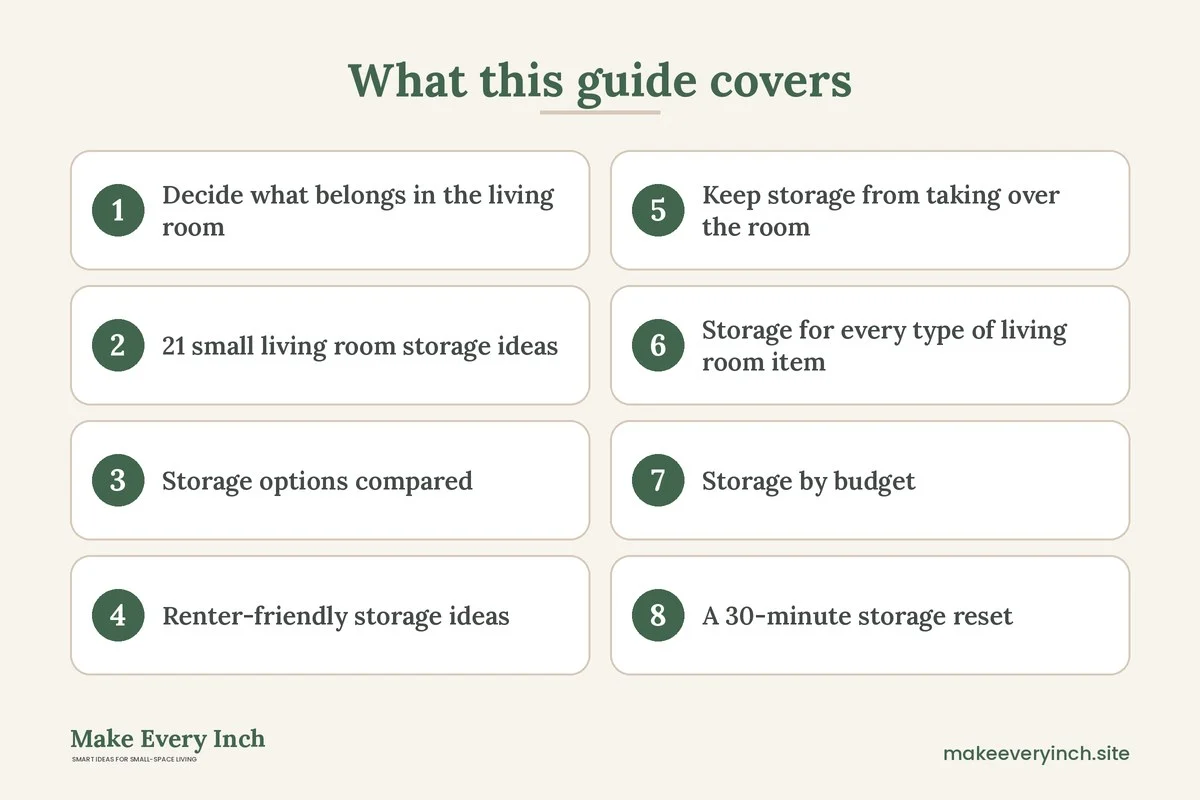
Small living room storage ideas work best when they begin with what you actually keep in the room. Remote controls, blankets, books, games, chargers and shoes are the usual suspects. This guide shares 21 ways to store them, a comparison table, a renter-friendly section and a checklist so the room stays calm without more clutter.
Decide what belongs in the living room
Sort everything in the room into three piles: used weekly, used monthly and rarely used. Weekly items get easy access. Monthly items can go behind a door or in a basket. Rarely used items belong in a closet, under a bed or in the garage. Buying storage before sorting only moves clutter around.
21 small living room storage ideas
1. Choose a storage ottoman
An ottoman with a lid hides blankets, games and remotes and doubles as a footrest or extra seat.
2. Use a coffee table with shelves or drawers
A lower shelf holds books and baskets. Drawers hide small items. Our no coffee table ideas show alternatives if the table is too big.
3. Go vertical with tall bookcases
Tall, narrow shelves use wall height instead of floor space. Keep the bottom third closed with baskets or doors.
4. Mix open and closed storage
All-open shelves look messy fast. Put the best items on display and the rest behind doors.
5. Use floating shelves
Shelves 8 to 10 inches deep hold books and plants without taking floor space. Leave a few inches of empty space on each shelf so it looks styled, not stuffed.
6. Add a console behind the sofa
A narrow console with drawers or baskets gives you a home for keys, chargers and mail. Keep it 10 to 12 inches deep.
7. Choose a sofa with storage
Some sofas and chaises have hidden compartments under the seat. They are useful for bedding if you host guests.
8. Use the space under furniture
Low bins on wheels slide under a sofa or chair. Choose ones that match the floor tone so they disappear.
9. Install wall-mounted cabinets
A shallow cabinet above a TV or on a side wall keeps things out of sight and out of the walkway.
10. Build or buy a window bench
A bench under a window offers seating and a lift-up lid for blankets and toys.
11. Use a TV stand with doors
Closed doors hide consoles, cables and games. Choose one with ventilation for equipment.
12. Hang baskets on the wall
Wall baskets work for magazines, throws or plants and add texture without floor space.
13. Use the back of the door
Hooks or a slim organizer on the back of a door hold bags, umbrellas and coats if the room doubles as an entry.
14. Add a corner shelf
A corner shelf or tall plant stand turns dead space into a display or storage zone.
15. Try a ladder shelf
A leaning ladder shelf holds blankets, books and plants with a small footprint.
16. Use trays to group small items
A tray on a coffee table or ottoman keeps remotes and coasters together so the surface looks tidy.
17. Hide cables
Cable boxes, sleeves and a power strip behind the TV stand keep the wall calm.
18. Store blankets in a basket or ladder
A large basket by the sofa is easy to reach. A blanket ladder keeps throws folded and visible.
19. Use hooks and rails for chargers and headphones
A rail with hooks holds headphones, tote bags and cords near the outlets you use most.
20. Use a hidden storage bench at the entry
If the room has no entry closet, a shoe bench with a lid keeps shoes and bags contained.
21. Rotate and edit seasonally
Swap blankets, books and decor with the seasons so the room never holds more than it needs.
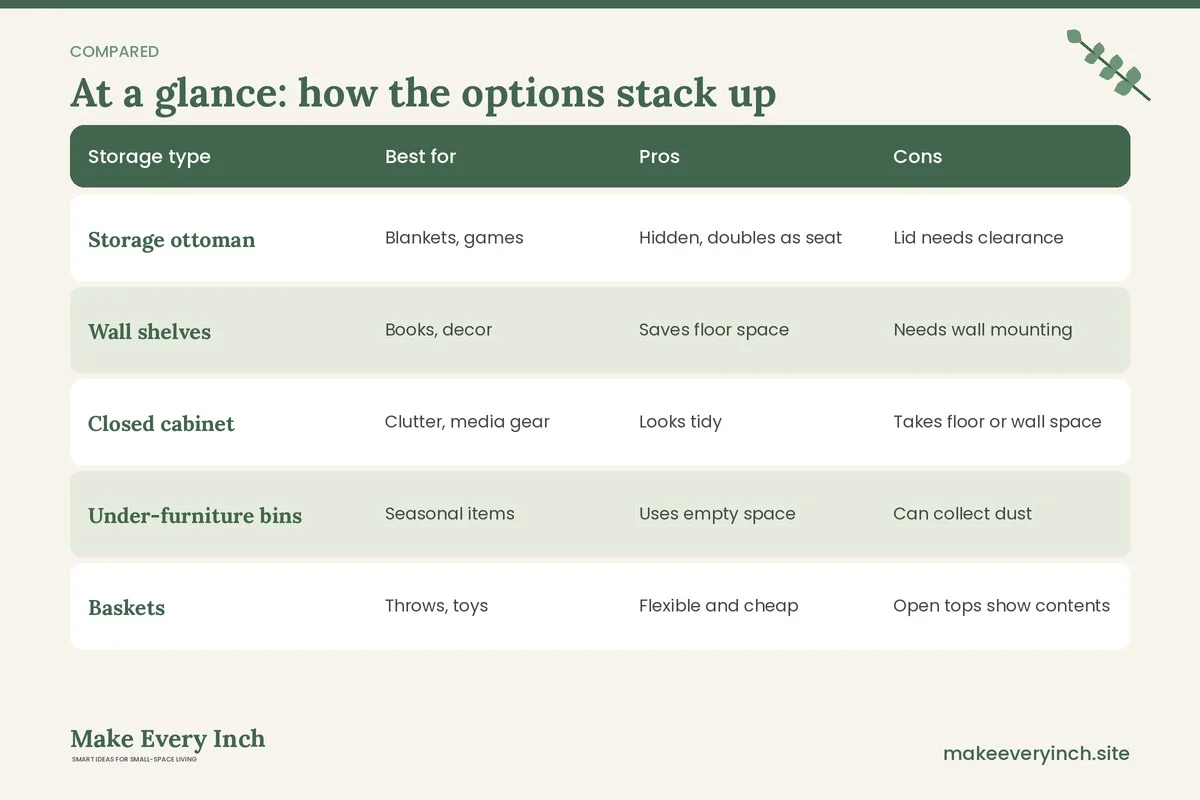
Storage options compared
| Storage type | Best for | Pros | Cons |
|---|---|---|---|
| Storage ottoman | Blankets, games | Hidden, doubles as seat | Lid needs clearance |
| Wall shelves | Books, decor | Saves floor space | Needs wall mounting |
| Closed cabinet | Clutter, media gear | Looks tidy | Takes floor or wall space |
| Under-furniture bins | Seasonal items | Uses empty space | Can collect dust |
| Baskets | Throws, toys | Flexible and cheap | Open tops show contents |
Renter-friendly storage ideas
If you cannot drill, lean on freestanding pieces. Use a ladder shelf, a tall bookcase anchored with a removable strap, adhesive hooks rated for the weight and a console with drawers. Command-style strips hold light items. Choose furniture that moves with you so the storage is not tied to the apartment.
Keep storage from taking over the room
Leave at least one open wall or surface so the room has space to rest. Follow the one in, one out rule for decor and books. A good test is whether you can clear every surface in five minutes. If you cannot, edit before buying more storage.
See small living room layout ideas to plan where storage fits, and small apartment living room ideas for rooms that double as a workspace.
Storage for every type of living room item
Different items need different homes. Matching the storage to the item makes it more likely that you will use it.
Media and electronics
Use a TV stand with doors or a console with ventilated shelves. Keep game controllers and chargers in a drawer or a lidded box, and run cords through a cable box. A slim shelf under the TV holds a streaming box without cluttering the wall. See our TV wall ideas.
Books and decor
Use shelves 10 to 12 inches deep for books and 8 inches deep for decor. Arrange books by color or size and leave a few inches of empty space for a plant or a lamp. Group decor in odd numbers and keep a clear shelf for items you rotate.
Blankets and pillows
A lidded basket, a storage ottoman or a blanket ladder keeps throws close but tidy. Keep only the number of pillows you use and store the rest in a closet. Fold blankets in thirds and stack them with the fold facing out for a neat look.
Toys and games
Use baskets with lids that fit under a console. Store games on a shelf with the spine facing out and put small pieces in a bin. Choose bins you can see into so children can find what they want.
Paper and mail
Use a wall file, a small tray or a desk organizer near the door. Sort the mail the same day and recycle what you do not need. Put bills in a folder so they do not spread across the coffee table.
Seasonal items
Use under-bed bins, vacuum bags or a high shelf for items you only use a few times a year. Label each box with its contents and the date. See our bedroom storage ideas for more under-bed tips.
Storage by budget
- Free: edit what you own, move items to rooms where they belong and use boxes you already have.
- Under 50 dollars: baskets, hooks, a tray, a cable box and a set of matching bins.
- Under 200 dollars: a storage ottoman, a bookcase, a console and wall shelves.
- Over 200 dollars: a custom shelf, a TV stand with doors or a built-in unit.
A 30-minute storage reset
Set a timer and work in a loop. For ten minutes, remove everything from one surface and sort it into keep, move and donate. For ten minutes, put the keep pile back neatly in baskets or on shelves. For ten minutes, move items to the right rooms, take out the trash and wipe the surface. Repeat weekly and the room will stay under control. If you rent, remember that storage can move with you, so choose pieces that fit other rooms too. See small living room ideas for renters.
Storage mistakes in small living rooms
Buying storage before editing is the most common mistake. The second is choosing open storage for items that look messy. The third is filling every shelf completely, which makes the room feel heavy. The fourth is putting tall units against the window. The fifth is forgetting that doors and drawers need room to open. Measure the clearance before you buy, and tape the footprint of every piece on the floor.
Make storage part of the look
Storage can be a feature. A wooden bench with baskets looks like furniture. A bookcase painted the wall color blends in. A console with a lamp and a tray looks styled. Choose materials that match the rest of the room, such as wood, rattan or metal in a finish you already have. When storage matches the room, it makes the space feel finished, not crowded. See layout ideas to plan where each piece will go.
Room-by-room storage zones in the living room
Think of the living room as five storage zones and give each one a purpose.
Zone 1: the entry
Even if your living room opens straight from the front door, create a landing spot. A narrow console or a wall shelf with hooks holds keys, mail and bags. Add a bench or a basket for shoes. If you have no space, use a hook rail on the wall beside the door.
Zone 2: the media wall
Keep devices, games and cables in one place. Use a console with doors or a wall unit with closed lower cabinets. Reserve the open shelves for a few books, a plant and a lamp. Keep the cable box and the router in a ventilated cabinet so they do not overheat.
Zone 3: the seating zone
This zone needs only what you use while sitting: a throw, a remote, a coaster and a book. Use a side table with a drawer or a lidded ottoman. Keep a basket within reach for items that wander, such as phone chargers and glasses.
Zone 4: the work or hobby corner
Use a shelf or a rolling cart for supplies and a lidded box for papers. Keep only what you need for the current project on the surface. When the project is done, put everything away.
Zone 5: the display shelf
Use one shelf or one wall for objects you love. Rotate items seasonally and keep the shelf partly empty so it stays light. A display shelf makes storage feel like a design choice rather than a chore.
Storage that works for common problems
| Problem | Solution | Where to put it |
|---|---|---|
| Cables everywhere | Cable box and clips | Behind the TV stand |
| No place for coats | Wall hooks | Beside the door |
| Too many books | Tall slim bookcase | On the short wall |
| Blankets on the floor | Lidded basket | Next to the sofa |
| Kid’s toys | Rolling bins | Under a console |
| Mail pile | Wall file | Near the entry |
| Craft supplies | Lidded box | On a high shelf |
Declutter rules that keep storage working
Use the one in, one out rule so the amount of stuff stays the same. Choose a limit for each category, such as 30 books or 3 blankets, and review it every few months. Keep a donation bag in a closet and fill it throughout the year. Take a photo of any item you feel guilty about discarding, then let it go. Store sentimental items in one box in another room rather than on open shelves. These habits matter more than any shelf or basket, because storage only works when there is a limit.
Storage for shared and family living rooms
If several people use the living room, give each person a small, labelled home for their things. A basket per person on a shelf, a hook per person by the door and a drawer per person in a console reduce the number of arguments about whose item is whose. Use color coding for children, such as a blue bin and a green bin. Teach everyone to return items at the end of the day, and run a five-minute reset before bed. Shared storage works when it is easy to use, so avoid lids that are hard to open and shelves that are too high for children.
Storage when you move often
Choose modular storage that you can take apart, such as cube shelves, stackable bins and freestanding bookcases. Avoid built-ins and wall-mounted items that need drilling. Use boxes of a standard size so they pack well, and keep one box of tools and anchors with the furniture. Measure the pieces so they will fit in the next place, and sell or donate items that no longer fit your life. See renter ideas for damage-free options.
Seasonal storage rotation
Create a simple calendar so the room never holds more than the current season needs. In late autumn, bring out heavy throws, candles and darker pillow covers, and pack away light linen items. In spring, reverse the swap and store wool in sealed bags with cedar. Keep a labelled bin for each season on a high shelf or under the bed, and write the contents on the lid. Do the swap on a weekend morning and use it as a quick edit: anything you do not want to unpack next year goes to donation. Rotation keeps the room fresh, protects textiles and prevents the slow build-up that makes small rooms feel full. Pair this with the 30-minute reset above and the room stays easy to live in all year.
What a well-stored living room looks like
Surfaces are mostly clear, with one or two items on each. The floor is open, and the walkway is wide. Baskets and boxes are labelled and match the room. Cables are hidden, shelves are partly empty and every item has a place. You can find the remote in ten seconds and clear the room in five minutes. That is the standard to aim for, and it is achievable in even the smallest room.
Storage checklist
- Sort items into weekly, monthly and rarely used
- Add closed storage at eye level and open shelves above
- Use one multi-purpose piece, such as a storage ottoman
- Hide cables and chargers
- Keep floors and the main walkway clear
- Edit seasonally
FAQ
How do I add storage to a small living room?
Use vertical shelves, a storage ottoman, a console with drawers and under-furniture bins. Closed storage hides clutter and open storage handles display.
What is the best storage for a living room with no closet?
A storage bench, a tall closed cabinet and a lidded ottoman together give you hidden space without a closet.
How do I store blankets in a small living room?
Use a lidded basket, an ottoman or a blanket ladder so the throws are easy to reach and look tidy.
How do I hide the TV clutter?
Use a stand with doors, a cable box and a power strip behind the stand. Keep only the remote you use on the surface.
Is open or closed storage better?
Use both. Closed storage hides items you do not want to see, and open storage lets you display a few favorites.
How do I keep storage from making the room look crowded?
Choose pieces in the same color as the walls or the main furniture, keep shelves partly empty and avoid placing tall units in the walkway.
Keep going: Explore our small living room layout ideas, narrow living room ideas and cozy small living room ideas.
Save this guide for later
Pin the ideas you like to Pinterest so you can come back to them when you plan your space.