Small Living Room Ideas Without a Coffee Table: 15 Smart Swaps
Quick answer: For small living room ideas without a coffee table, replace it with a storage ottoman, a pair of C-shaped side tables, a tray on a pouf or a narrow console behind the sofa. Keep roughly 30 inches of open floor in front of the seating so the room is easy to walk through.
Small living room ideas without a coffee table are popular because a standard coffee table, often 40–48 inches long, can take up a large share of a compact floor plan. Skipping it frees space for walking, play, yoga or a bigger rug. But you still need a place for drinks, remotes and snacks. This guide gives you 15 alternatives, a comparison table, layout tips and a checklist for making the change.
Should you skip the coffee table?
Dropping the coffee table makes the most sense when:
- The distance between the sofa and TV or opposite seating is less than about 6 feet.
- Pets or kids need floor space.
- You often rearrange the room for guests or exercise.
- You prefer a more open, minimal look.
It may be less practical if you eat in the living room every day or have no other surface nearby. In that case, a smaller or movable table can still work.
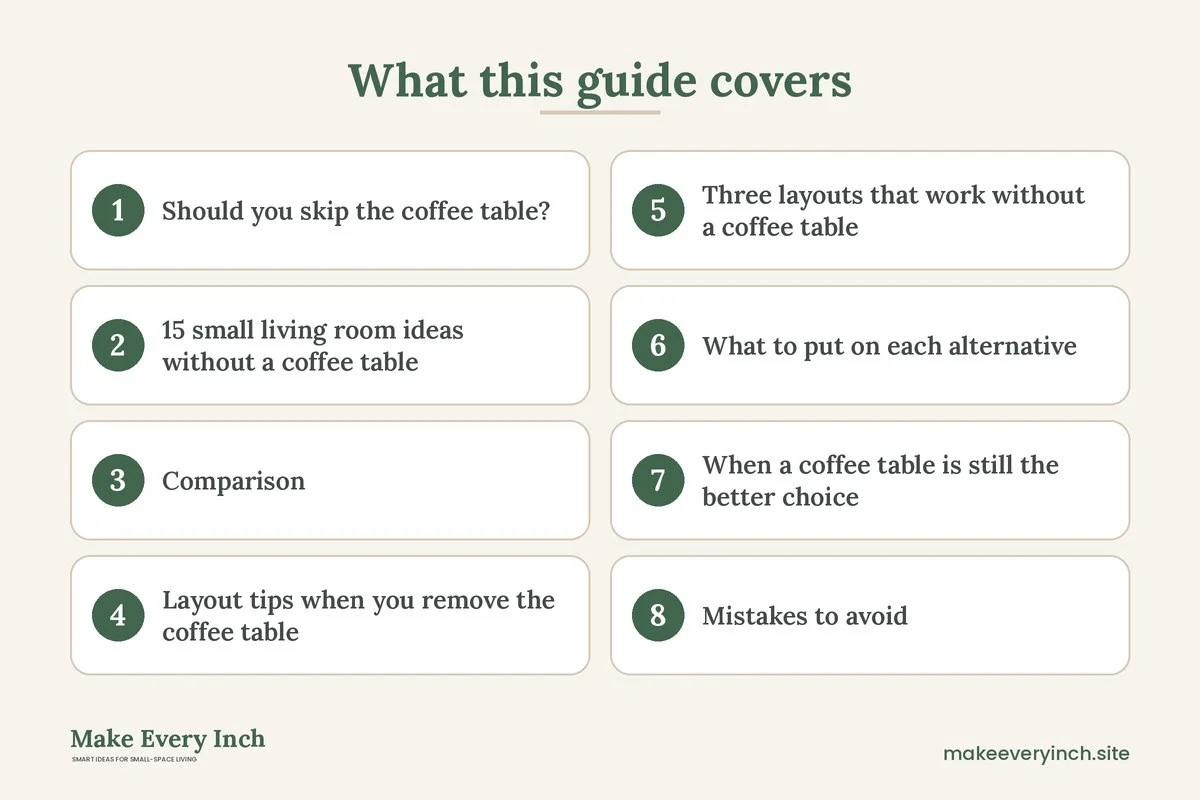
15 small living room ideas without a coffee table
1. Use a storage ottoman with a tray
An ottoman gives you a soft surface plus hidden storage. A flat tray on top turns it into a table when you need one.
2. Add C-shaped side tables
C-tables slide over the sofa seat or arm so you can use them within reach without a table in the middle of the room.
3. Place a pair of small side tables
Two small round tables at either end of the sofa spread out surface space and are easier to walk around than one big table.
4. Use a pouf with a serving tray
Poufs are light and can be moved aside when not in use. A tray keeps drinks stable.
5. Try a narrow console behind the sofa
A console 10–14 inches deep holds lamps, drinks and decor and works well when the sofa floats.
6. Choose a sofa with a built-in table or console
Some sofas include fold-down trays, cup holders or attached side tables, which cut the need for extra furniture.
7. Use wall-mounted shelves or ledges
Wall ledges beside the sofa hold drinks and small items without a floor footprint. Check your lease before drilling.
8. Float a nesting table set
Nesting tables stack for storage and spread out when guests arrive.
9. Use a bench or trunk
A low bench or trunk at the foot of the seating gives a surface and storage, and doubles as extra seating.
10. Use a rolling cart
A slim cart can serve snacks, store magazines and move to another room afterwards.
11. Rely on floor cushions and a low table for gatherings
For casual gatherings, bring out a folding low table and floor cushions, then store them afterwards.
12. Add a floor-level rug zone
A large rug defines the seating area without a table and makes the space feel intentional.
13. Use a bar cart or sideboard near the sofa
If you have a spare wall, a narrow sideboard holds drinks and decor within reach.
14. Choose a recliner or chair with a cup holder
For lounging, a chair with a side tray or integrated holders avoids extra tables altogether.
15. Create a media-console surface
If the TV wall is close, a low media console can hold lamps and decor, so the middle of the room can stay clear.
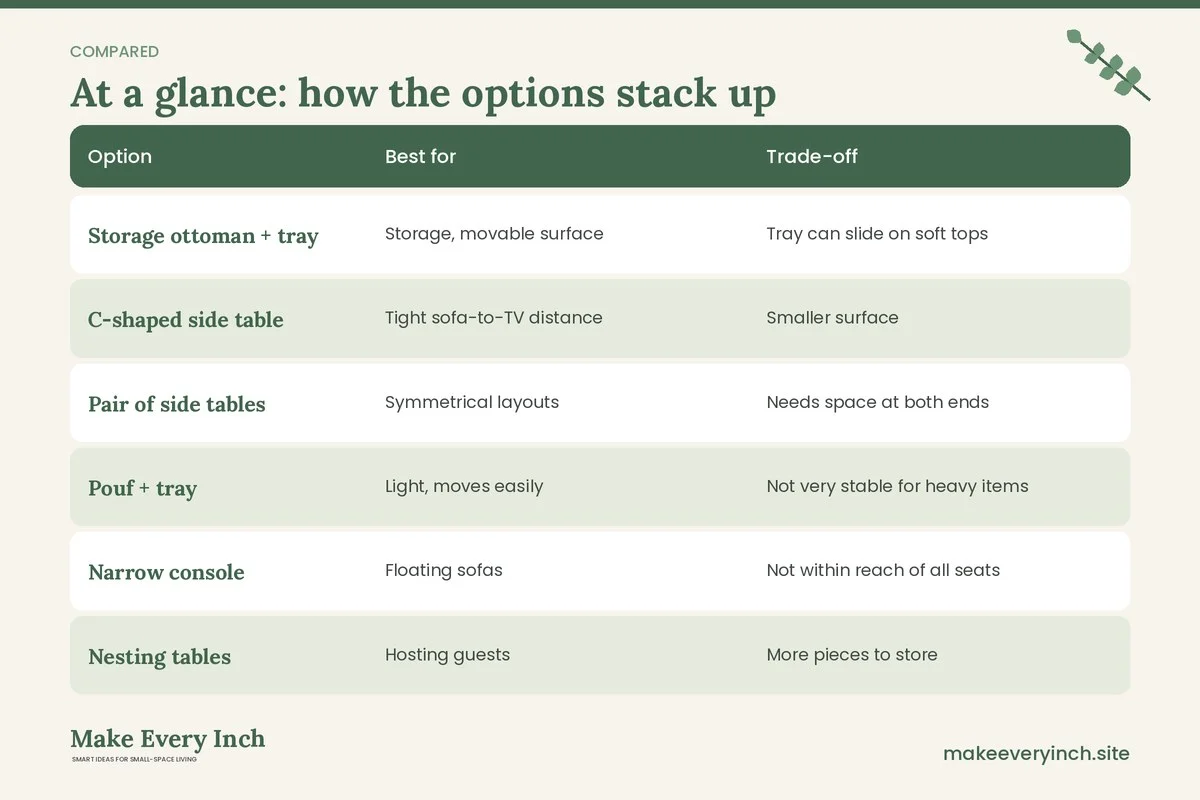
Comparison: coffee table alternatives for small living rooms
| Option | Best for | Trade-off |
|---|---|---|
| Storage ottoman + tray | Storage, movable surface | Tray can slide on soft tops |
| C-shaped side table | Tight sofa-to-TV distance | Smaller surface |
| Pair of side tables | Symmetrical layouts | Needs space at both ends |
| Pouf + tray | Light, moves easily | Not very stable for heavy items |
| Narrow console | Floating sofas | Not within reach of all seats |
| Nesting tables | Hosting guests | More pieces to store |
Layout tips when you remove the coffee table
- Use a larger rug. A rug that fits under the front legs of the sofa and chairs anchors the room.
- Add a surface within reach of each seat. Every seat should have a spot for a drink.
- Keep the center open. An open middle makes the room easier to use and clean.
- Add lighting at the sides. Floor or wall lamps free up the table tops you replaced.
- Choose rounded edges. Rounded poufs, ottomans and tables are safer in tight spaces.
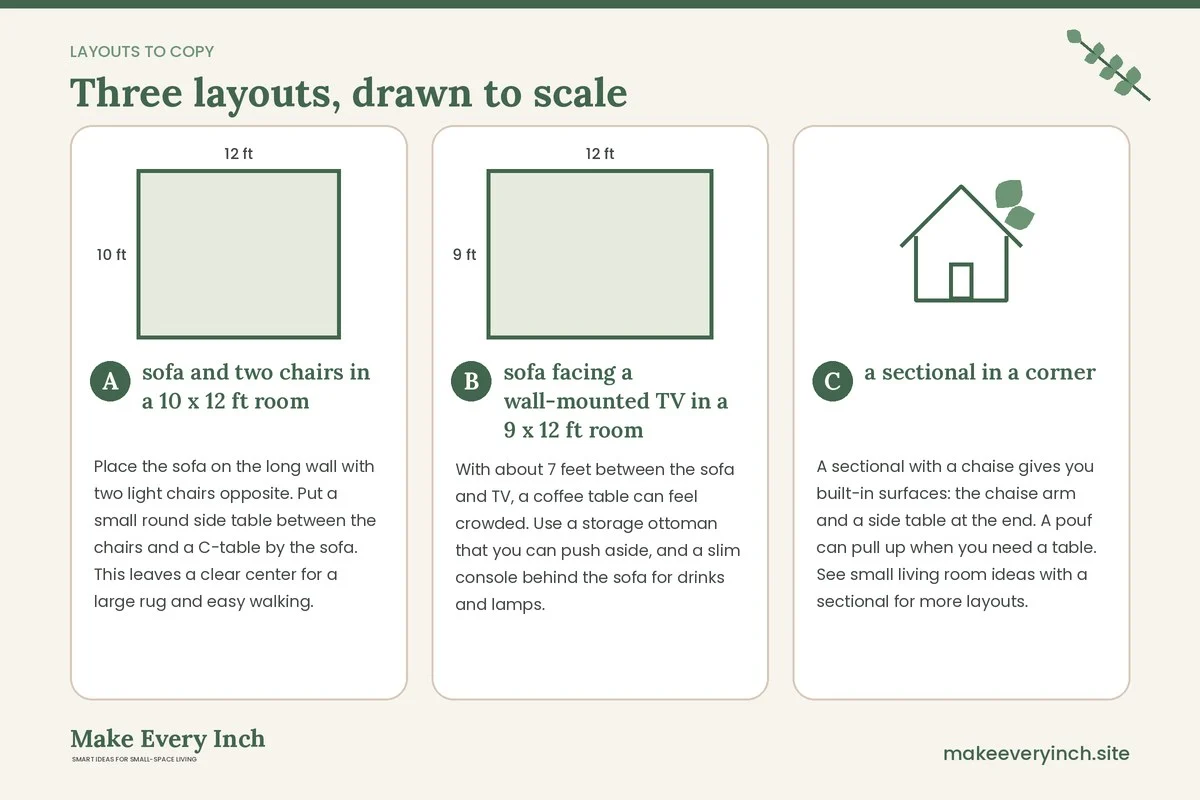
Three layouts that work without a coffee table
Layout A: sofa and two chairs in a 10 x 12 ft room
Place the sofa on the long wall with two light chairs opposite. Put a small round side table between the chairs and a C-table by the sofa. This leaves a clear center for a large rug and easy walking.
Layout B: sofa facing a wall-mounted TV in a 9 x 12 ft room
With about 7 feet between the sofa and TV, a coffee table can feel crowded. Use a storage ottoman that you can push aside, and a slim console behind the sofa for drinks and lamps.
Layout C: a sectional in a corner
A sectional with a chaise gives you built-in surfaces: the chaise arm and a side table at the end. A pouf can pull up when you need a table. See small living room ideas with a sectional for more layouts.
What to put on each alternative
- Ottoman + tray: a stable tray with a lip, a candle or small plant and the remote.
- C-table: a drink, a book and a phone while you sit.
- Console: lamps, a plant and a few books or a bowl for keys.
- Nesting tables: snacks and drinks when guests arrive, then stack them away.
- Bench or trunk: blankets inside and a tray on top for games or a laptop.
When a coffee table is still the better choice
A coffee table is useful if you eat or work in the living room, have limited side surfaces or want a central place for family games. In that case, choose the smallest table that does the job: a round table about 24–30 inches across, a nesting set or a lift-top table that doubles as a desk. Rounded corners and a lower profile also help the room feel less crowded.
Mistakes to avoid
- Leaving no surfaces. You still need somewhere for drinks and remotes.
- Using tables that are too tall. Side tables should be near the height of the sofa arm.
- Overcrowding with new furniture. Replace the coffee table with one or two pieces, not five.
- Forgetting stability. Trays on soft poufs can tip; use a grippy tray or a firm base.
What to use instead of a coffee table, in detail
A coffee table does three jobs: it holds a drink, it holds things you need nearby and it fills the space between the seats. When you remove it, you need to cover those jobs another way. Here is how each alternative handles the three jobs, so you can choose based on how you use the room.
Side tables and C-tables
A C-shaped table slides under the sofa or chair arm and holds a drink or laptop within reach. It takes about 1 square foot of floor, and you can move it to wherever it is needed. Choose one 16 to 24 inches high so it is level with the sofa arm. The weakness is capacity: it holds one or two things, so pair it with a tray for remotes.
Ottomans and poufs
An ottoman is the closest substitute because it fills the space in the middle. A tray on top turns it into a table when you need one, and you can lift the tray off and use the ottoman as a seat or footrest. Choose a firm top and a height close to the sofa seat, about 16 to 18 inches. A storage ottoman has the extra benefit of hiding blankets, games and remotes.
Nesting tables
Nesting tables come apart for guests and tuck together when not in use. Two or three tables cover a lot of surface when you need it and almost none when you do not. Choose a set with different heights so a person can use the lower one for a drink and the higher one for a laptop.
A console behind the sofa
A console 10 to 14 inches deep behind the sofa holds lamps, a tray and books. It does not replace a table in front of the sofa, but it keeps essentials close and lets you leave the middle of the room open. Make sure there are at least 30 inches between the back of the sofa and the next object.
A bench or a daybed
A low bench in front of the sofa works as both seat and table. Choose a wood or upholstered bench with a flat top and add a tray. It is a good idea in narrow rooms where you want the sofa and bench to share the same width.
A floor cushion or tray
In a very small room, a large tray on the floor or a low floor table lets you eat, play and then put everything away. It is the smallest footprint, but it suits people who are happy to sit low.
Zone the middle of the room without a table
When there is no table, the center of the room can become a feature. Use a rug to define the space and make sure it is large enough that the front legs of the seats rest on it. A 5 x 8 foot rug works for rooms under 11 x 13 feet and a 6 x 9 foot rug suits larger ones. Choose a pattern that hides the occasional spill. Place a floor plant or a floor lamp at the end of the rug to anchor the arrangement. If the floor feels empty, move an accent chair closer rather than adding a table.
Eating and working on the sofa without a table
If you eat or work in the living room, think about how it feels in daily use. A lap tray with legs, a bed tray or a laptop stand keeps a meal or a laptop stable. A side table that rolls on wheels can be pulled over and moved away. A C-table is a good choice if you work on a laptop and need a surface at the right height. Keep a basket near the sofa for trays so they do not clutter the room.
Children, pets and guests
With small children, an open floor is an advantage because there are no sharp corners. Add a soft rug and a toy basket that fits under a console. For pets, avoid low tables that cats can knock things off. For guests, plan one place for each person to put a drink. A pair of side tables or a tray on an ottoman usually covers four people.
| Situation | Best alternative | Why |
|---|---|---|
| Movie nights | Ottoman with a tray | Footrest and snack surface |
| Working on a laptop | C-table | Right height and easy to move |
| Hosting four people | Two side tables | Surface within reach for everyone |
| Kids at home | Open floor and a soft ottoman | No sharp corners |
| Tiny room | Nesting tables | Tuck away when not needed |
| Narrow room | Bench or console | Fits the width |
Common problems after removing the table
- The room feels empty: add a larger rug or a plant, or bring a chair closer to the sofa.
- Nowhere to put a drink: add a C-table or a small side table within reach of each seat.
- Remotes go missing: use a tray or a basket on the console or ottoman.
- The sofa feels far from the TV: move the sofa a few inches forward or choose a smaller sofa. See our TV wall ideas.
- Guests do not know where to put things: put a tray or two coasters on every surface that can hold a drink.
For a full floor plan, read our small living room layout ideas and furniture ideas.
A short buying guide for coffee table alternatives
Whatever you choose, check four things before you buy. First, the height: surfaces about 16 to 18 inches high suit most sofas. Second, the footprint: measure the floor space it needs and tape it out. Third, the top: look for a flat, wipeable surface, since a rough or uneven top makes drinks tip. Fourth, the base: pieces with legs show the floor, which makes the room feel bigger, while solid bases hide storage. If you rent, avoid anything that must be bolted to the wall and choose a piece that will also work in the next apartment. Use furniture sizing rules to check what else fits.
How to test life without a coffee table
Before you sell or donate your table, move it out of the room for two weeks. Keep a tray and a side table within reach. Notice what you miss: if you keep searching for a place for a drink, add a C-table. If you notice the floor feels bigger and easier to clean, you have your answer. You can always bring a smaller table back, and it is much easier to add a table to an open room than to remove one from a crowded room.
Checklist
- Measure the distance between seating and the TV or opposite seats.
- Decide where drinks, remotes and snacks will go.
- Pick one main alternative, such as an ottoman or C-table.
- Add a rug that fits under the front of the seating.
- Check that every seat has a nearby surface.
- Test the layout for a week and adjust.
FAQ
Is it OK not to have a coffee table?
Yes. Many small living rooms work better without one, as long as seating has nearby surfaces for drinks and remotes.
What can I use instead of a coffee table?
Ottomans, poufs, C-tables, side tables, benches, trunks and rolling carts are common alternatives.
How do I fill the empty space in front of the sofa?
Use a rug, a pouf or leave it open. A clear floor can make the room feel larger.
How far should the TV be from the sofa?
It depends on your TV size. A common rule of thumb is roughly 1.5 to 2.5 times the screen diagonal; check your TV maker’s guidance.
Will a rug look odd without a table?
No. A well-sized rug anchors the seating zone on its own.
What if I eat on the sofa?
A lap tray, a C-table or a rolling cart gives a stable surface without taking floor space.
How do I style a room without a coffee table?
Anchor the seating with a rug, use side tables at the ends and add a plant or a floor lamp to fill the visual center.
Can I use a rug alone without a table?
Yes. A rug can define the seating area on its own, and a clear floor makes the room feel larger.
What is the best coffee table alternative for kids and pets?
A soft ottoman or pouf with rounded edges is gentler than a hard table and can be moved when needed.
More ideas: See our small living room furniture ideas, layout ideas and small living room ideas with a sectional.
Save this guide for later
Pin the ideas you like to Pinterest so you can come back to them when you plan your space.