Small Living Room TV Wall Ideas: 15 Space-Saving Looks
Quick answer: The best small living room TV wall ideas keep the screen at eye level, hide cables and use shallow storage. Wall-mount the TV where allowed, add a slim shelf or console under it, and frame it with art or lighting so the wall feels designed and the floor stays open.
Small living room TV wall ideas have a double job: they need to hold the TV and its gear, and they must not make a compact room feel heavy. A TV is often the largest dark rectangle in the room, so how you frame, light and surround it matters. Below are 15 ideas, a table comparing mounting approaches, a safety and cable checklist, and answers to common questions.
Plan before you mount
- Check the lease. Many landlords allow mounting if you patch holes, but ask first.
- Find the studs. Mount into studs or use anchors rated for the TV weight, and follow the mount maker’s instructions.
- Set the height. The center of the screen is often around eye level when seated, which for many people is roughly 40–42 inches from the floor. Adjust to your seating.
- Avoid glare. Place the TV opposite or perpendicular to windows when possible.
- Plan power and cables before you drill so cords can be hidden neatly.
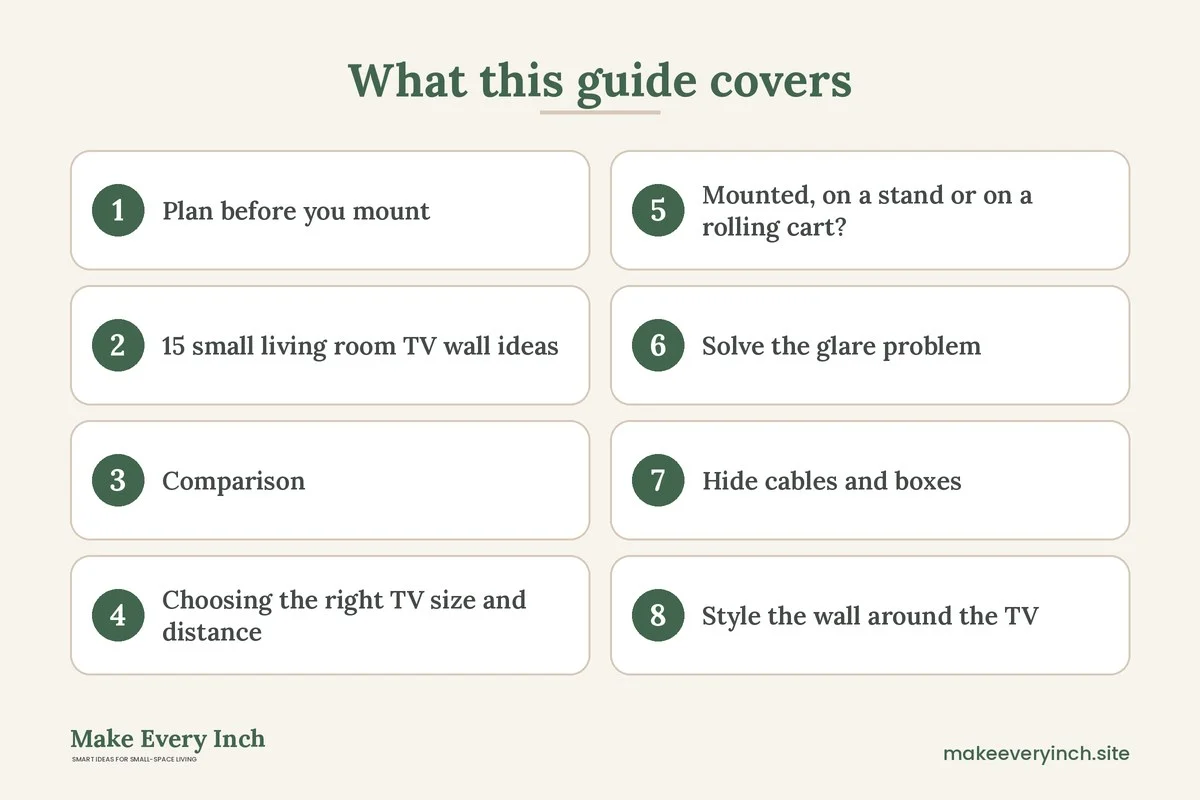
15 small living room TV wall ideas
1. Wall-mount the TV and add a slim console
Mounting frees floor space. A console 12–16 inches deep below holds a streaming box, a game console and decor.
2. Use floating shelves beside the TV
Shelves on either side add storage and frame the screen without a bulky cabinet.
3. Create a gallery wall around the TV
Arrange frames at varying sizes around the screen so it blends into the wall. Keep spacing consistent.
4. Paint the wall a dark, matte color
A dark wall helps the TV blend in when it is off. Test paint samples and check your lease first.
5. Use a picture-frame TV (or frame the TV)
Some TVs display art when off. You can also add a frame kit made for your model.
6. Add LED backlighting
Bias lighting behind the TV can reduce eye strain and add ambiance. Choose a warm or neutral tone.
7. Hide cables inside the wall or with a cover
In-wall cable kits are designed for this but must be installed safely and follow local rules. Paintable cord covers are a simple renter-friendly option.
8. Use a TV console with closed storage
Closed doors hide clutter. Pick a console with a low profile so it does not overwhelm the wall.
9. Place the TV in a built-in or bookcase wall
Freestanding bookcases on both sides of the TV can mimic a built-in look and add storage.
10. Mount the TV on a swivel arm in a corner
A corner arm can free up the main wall for art. Check the arm’s weight limit and reach.
11. Use a rolling TV stand
In a very small room, a rolling stand can move the TV where you need it.
12. Hide the TV behind art or sliding panels
A hinged or sliding panel can cover the screen when it is off. Allow ventilation and cable access.
13. Mirror or art on the opposite wall
A mirror opposite the TV can reflect light but may reflect glare, so check angles first.
14. Use a projector and screen
A pull-down screen or a wall painted for projection frees the wall when not in use. Consider room brightness and throw distance.
15. Keep the wall simple
Sometimes the best idea is restraint. A TV, one shelf and a plant can look intentional.
Comparison: TV wall setups for small rooms
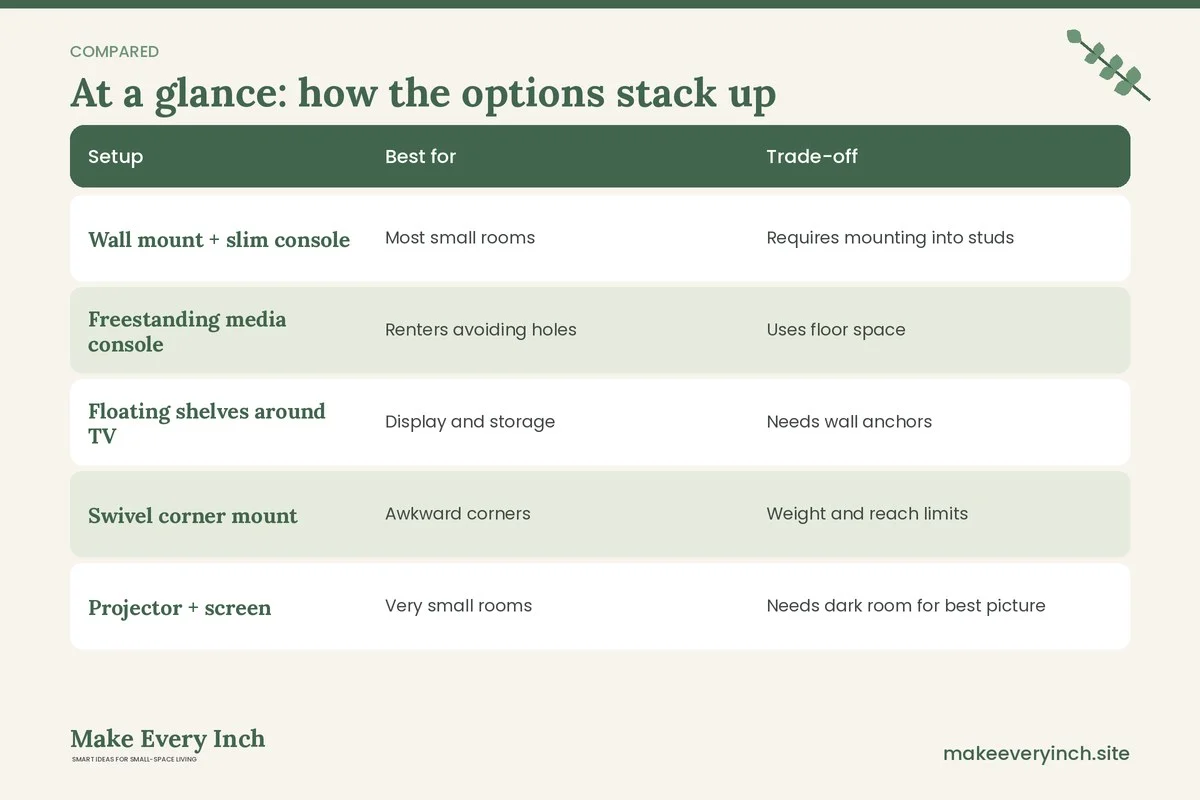
| Setup | Best for | Trade-off |
|---|---|---|
| Wall mount + slim console | Most small rooms | Requires mounting into studs |
| Freestanding media console | Renters avoiding holes | Uses floor space |
| Floating shelves around TV | Display and storage | Needs wall anchors |
| Swivel corner mount | Awkward corners | Weight and reach limits |
| Projector + screen | Very small rooms | Needs dark room for best picture |
Choosing the right TV size and distance
A TV that is too big for the room makes it feel smaller, and one that is too small makes you lean forward. A simple rule: for a 4K screen, sit about 1 to 1.5 times the screen diagonal away. A 55 inch screen suits a sofa about 4.5 to 7 feet away, and a 65 inch screen suits 5.5 to 8 feet. In a room under 12 feet long, a 50 to 55 inch TV is usually enough. Mount the center of the screen at about eye level when seated, which is typically 40 to 45 inches from the floor to the center. If you tilt the TV up too high, it strains your neck and you will not enjoy it.
Mounted, on a stand or on a rolling cart?
| Setup | Best for | Pros | Cons |
|---|---|---|---|
| Wall mount, fixed | Most rooms | Saves floor, clean look | Cables need planning |
| Wall mount, swivel | Open-plan rooms | Turn to face dining or sofa | Needs strong anchors |
| Low console | Renters, rooms with no studs | No drilling | Takes floor and needs cable management |
| Rolling cart | Tiny rooms | Move it away | Less stable |
| TV in a cabinet | Hiding the screen | Looks like furniture | Costly and deep |
Solve the glare problem
Glare is the most common complaint in small living rooms with a window. Place the TV on a wall that is perpendicular to the window rather than opposite it. Use curtains with a blackout lining or sheer panels plus a blind. Choose a matte screen if you are buying new. Avoid putting lamps directly behind or opposite the screen, and use a dimmer on the lamps near it. A small light behind the TV, such as an LED strip, reduces eye strain by softening the contrast between the screen and the wall. See small living room lighting ideas.
Hide cables and boxes
A clean wall depends on tidy cables. Use an in-wall cable kit if the lease allows it, or a paintable cord cover that matches the wall. Keep the streaming box, game console and router in a ventilated cabinet or a shelf beside the TV. Label each cable with a tag so you can swap devices without untangling everything. Use a power strip with surge protection and mount it on the back of the stand. If you rent, choose adhesive cable clips and a cord cover that peels off without damage.
Style the wall around the TV
A black screen is a large dark rectangle, so the wall around it matters. Here are five ways to style it.
- Paint the wall a darker color. A deeper tone helps the TV blend in.
- Add shelves on both sides. Symmetrical shelves frame the screen and add storage.
- Hang a gallery around it. Use frames with a similar color to create a frame for the TV.
- Use a frame TV or art mode. If your budget allows it, a screen that shows art when off looks less like a TV.
- Use a sliding panel. A wood or fabric panel hides the TV when you are not using it.
TV walls for small rooms with no free wall
If the room has no solid wall for a TV, use a corner mount with an arm, a TV on a rolling stand or a projector with a pull-down screen. In an open-plan apartment, a swivel mount on the wall between the living and dining areas lets you turn the screen for either. In a rental, a low media console under a window with a slim TV on a stand keeps drilling to zero. See small apartment living room ideas for open-plan layouts.
A buying checklist for the TV wall
- Measure the wall width and the seating distance
- Check that the wall has studs or use the right anchors
- Choose a mount rated for the screen weight with a safety margin
- Plan where the cables enter and exit
- Check for glare at different times of day
- Add a soundbar or small speaker below or beside the TV
- Keep 30 inches of walkway in front of the stand
Sound for a small room
Built-in TV speakers sit at the back of the screen and sound thin in a room with hard surfaces. A compact soundbar fits under a wall-mounted TV and costs far less than a surround system. Place it at ear level if you can and keep it clear of decor. In an apartment, a wireless subwoofer set to a lower volume avoids noise complaints. Soft surfaces such as a rug, curtains and upholstered furniture reduce echo, so you may not need to turn the volume up. If you share walls, put a bookcase on the shared wall and use headphones for late-night viewing.
Plan for the TV you will own in five years
Screens get thinner and wider. Choose a mount that supports a larger size than your current TV and has a flexible arm, and keep the wall free of fixed shelves that would block an upgrade. Leave a few spare outlets and a spare cable run behind the wall. Think about how you watch: if you mostly stream on a laptop or tablet, a smaller screen on a shelf might be all you need, and the wall can be left for art or a gallery. See small living room layout ideas before you decide where the screen should go.
Safety notes for mounting
Find the studs with a stud finder and use lag bolts into at least two. If you use drywall anchors, choose ones rated well above the TV weight. Keep a second person on hand to lift the screen. Do not mount above a fireplace unless the wall stays cool, since heat damages electronics. Anchor tall stands to the wall with a strap, especially if children or pets are around. If you rent, ask your landlord about wall mounts and get permission in writing.
Quick wins if you cannot mount the TV
If the wall will not take a mount, place a low console or a slim stand under the TV and keep the top clear apart from one lamp and a plant. Anchor the TV to the stand with the supplied bracket and a safety strap. Use a stand with legs so the floor stays visible, and choose one slightly wider than the screen so the TV looks balanced. Hang art above the TV only if it does not make the wall look crowded. Add a shelf or two nearby for books and baskets, and keep the cables in a box behind the stand. A tidy base makes a small TV wall look planned, even without a mount.
How to rehearse the wall
Cut a piece of cardboard to the size of the screen, tape it to the wall and live with it for a few days. Sit on the sofa at different times of day and look for glare, neck strain and blocked light. Move it until it feels right, then mark the studs and mount the real screen. This costs nothing and avoids extra holes in the wall.
Cable and safety checklist
- Confirm the mount’s weight and size ratings match your TV.
- Mount into studs or use anchors rated for the load.
- Leave space around the TV for ventilation.
- Use certified in-wall rated cables if running cords inside walls and follow local rules.
- Keep power strips off the floor and away from water.
- Secure freestanding TVs and tall furniture to prevent tipping, especially with kids.
Styling tips for a small TV wall
- Keep scale in check. Choose a TV size that suits the viewing distance, not just the biggest available.
- Use odd numbers of decor items on shelves for balance.
- Repeat colors from the room in the items near the TV.
- Add greenery to soften the hard lines of the screen.
Three TV wall layouts for small living rooms
Layout A: a mounted TV with a slim console and shelves
Mount the TV centered over a 12–16 inch deep console. Add two floating shelves on one side to hold books, a plant and a lamp. Keep the opposite side lighter so the wall does not feel heavy.
Layout B: a gallery wall that frames the screen
Arrange frames in a loose rectangle around the TV with consistent spacing of about 2–3 inches. Use similar frame colors and a mix of art and photos so the screen feels part of the wall.
Layout C: a corner setup that frees the main wall
In a room with a window on the main wall, a corner swivel mount lets you angle the TV toward the sofa. Use the main wall for art, a bookshelf or a desk.
Choosing a console or media unit for a small room
- Depth: 12–16 inches is usually enough for streaming devices and soundbars.
- Legs: visible legs keep the floor open and make cleaning easier.
- Cable management: look for back panels with cutouts for cords.
- Ventilation: devices need airflow, so avoid fully closed cabinets with no vents unless the maker allows it.
- Material: light wood or painted finishes look less heavy than dark, bulky ones.
Sound and lighting around the TV
A soundbar is usually easier to fit in a small room than a full speaker set. Place it directly under the TV, centered. For lighting, a dim lamp near the TV reduces contrast between the bright screen and the dark wall, which can help reduce eye strain. Avoid placing bright lamps so they reflect on the screen.
Mistakes to avoid
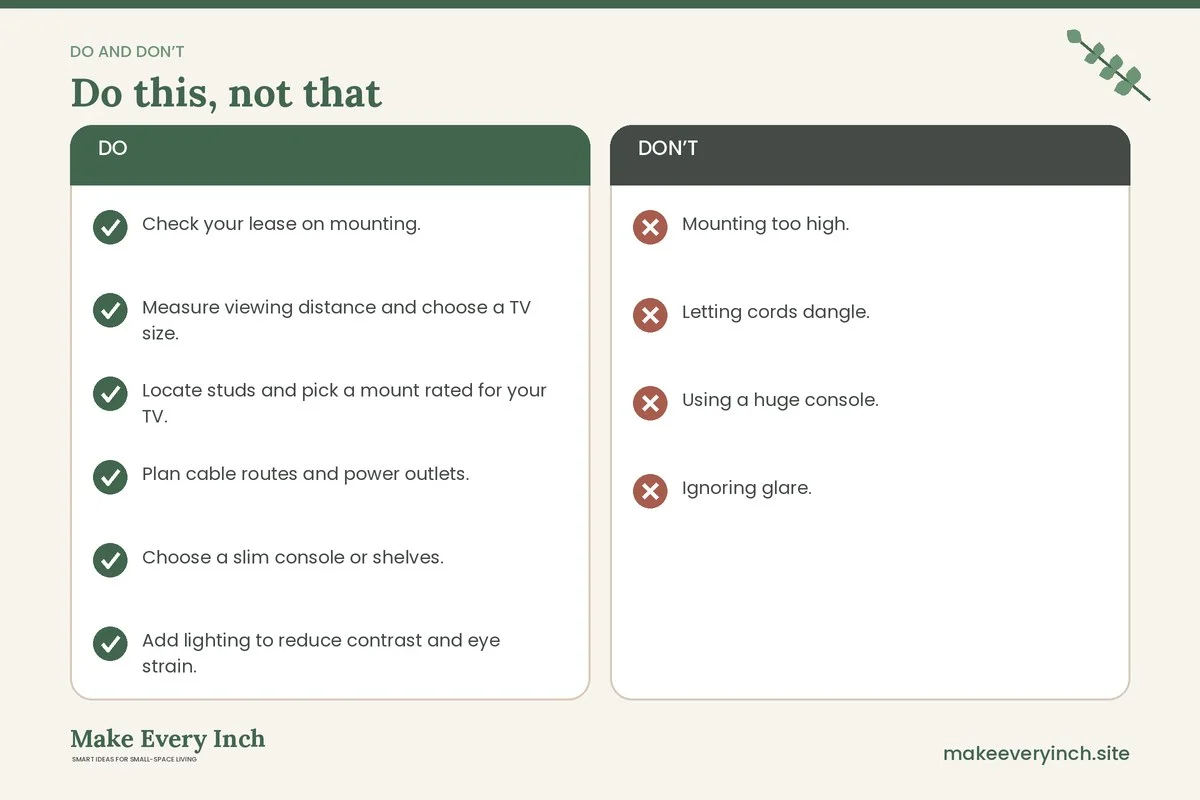
- Mounting too high. A TV above eye level can cause neck strain.
- Letting cords dangle. Visible cables make a small room look messy.
- Using a huge console. Deep consoles eat floor space.
- Ignoring glare. Windows and lamps can reflect on the screen.
Checklist
- Check your lease on mounting.
- Measure viewing distance and choose a TV size.
- Locate studs and pick a mount rated for your TV.
- Plan cable routes and power outlets.
- Choose a slim console or shelves.
- Add lighting to reduce contrast and eye strain.
- Style with art, plants and a few decor pieces.
FAQ
How high should I mount a TV in a small living room?
Many people center the screen around eye level when seated. Sit in your usual spot and measure before drilling.
Can I hide the TV cables without cutting into the wall?
Yes. Paintable cord covers and cable raceways hide cords without in-wall work.
What size TV fits a small living room?
Match size to viewing distance. Check your TV maker’s guidance and your room’s layout.
Should the TV be centered on the wall?
Usually, but it can be off-center if you want shelves on one side. Balance the visual weight with decor.
What can I put under a wall-mounted TV?
A slim console, shallow shelves or a soundbar shelf work well.
Can I put a TV in a corner?
Yes, with a corner stand or swivel mount, which can free the main wall for other uses.
What do I do with the cables if I cannot cut into the wall?
Use paintable cord covers or a cable raceway. They run from the TV down to the outlet and blend into the wall color.
Should I paint the TV wall a dark color?
A dark matte color helps the TV blend in when it is off, but check your lease and test samples first.
Is a projector better for a small living room?
It can free the wall, but it needs a dim room and the right distance. Check your space and the projector’s specifications before buying.
Keep going: Read our small living room storage ideas, lighting ideas and layout ideas to finish the room.
Save this guide for later
Pin the ideas you like to Pinterest so you can come back to them when you plan your space.