Small Space Ideas with Fold-Down Furniture
Quick answer: The best small space ideas with folddown furniture use a hinged surface that is flat against the wall or frame when closed and opens only when needed: a wall table, a desk, a drop-leaf, a wall bed or a bench seat. Check the rated load, find the studs, leave the swing and legroom clear, watch the pinch points and ask permission before drilling in a rental.
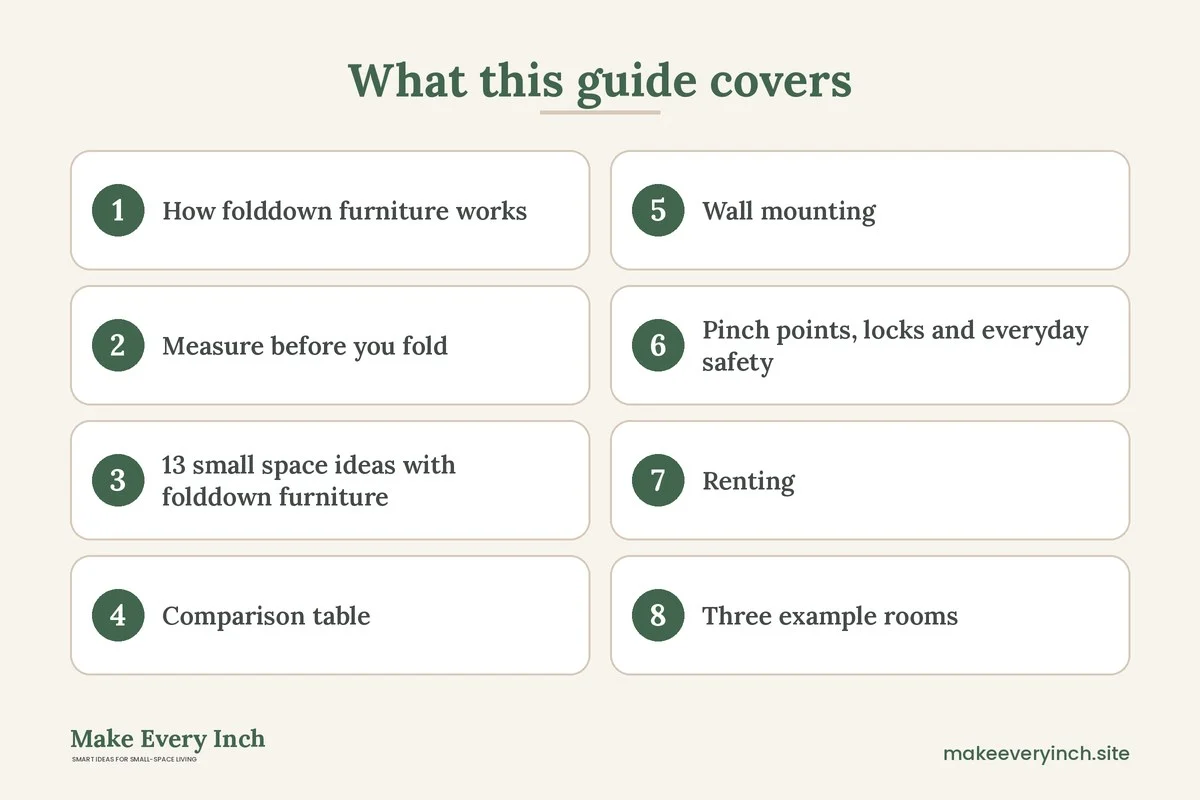
Small space ideas with folddown furniture start from a simple trade: you give up a permanent object and gain floor space for most of the day. A table that folds flat against the wall is only a thin panel for 20 hours out of 24, and a bed that folds up turns a bedroom into a living room by morning. Done well, a single hinge can make a 350 square foot apartment behave like a larger one. Done badly, it can mean a loose table, a pinched finger or a damaged wall. This guide explains how folddown pieces work, which types suit which rooms, how much clearance to plan, and how to stay safe. It includes 13 ideas, a comparison table, three example rooms, a rental checklist and an FAQ. For the buying framework behind these choices, read our pillar guide to the best furniture for small apartments. The sibling post on small space furniture mistakes to avoid covers the errors that folding furniture helps you dodge, and the ones it can introduce.
How folddown furniture works
Almost every folddown piece depends on one of three mechanisms. Understanding them tells you what to look for and where the risks sit.
- A wall hinge. The panel is fixed to the wall (or a cabinet) along one edge and swings down on hinges. A support, usually a leg, a bracket or a folding arm, holds the open surface up. This is the usual design for wall tables, desks and ironing boards. The whole load travels through the fixings into the wall.
- A drop leaf. A fixed table has one or two hinged leaves that hang down when not needed and lift up on a bracket or swing-out leg. The weight sits on the table’s own frame, so no wall fixing is needed. Drop-leaf tables are the easiest option in a rental.
- A lift or pivot frame. A wall bed or a fold-up sofa uses a pivot, a counterbalance such as a spring or piston, and sometimes a frame that sits on the floor. The mechanism is the most complex, and the moving mass is the largest. It deserves the most care.
Because the mechanism decides the risk, a good first question is, “What carries the load, and what moves?” A drop leaf on a freestanding table has low risk. A wall-mounted desk loads the wall. A wall bed adds a large moving weight and a pinch zone. Whatever you choose, follow the maker’s instructions for installation and use, and read the stated load limit.
Measure before you fold
Folddown furniture is efficient only if the open position fits. You need to plan two states, closed and open, and the path between them.
- Closed depth: how far the piece sticks out from the wall when folded, often 2 to 6 inches for tables and desks, and larger for beds.
- Open projection: how far the surface extends, usually 16 to 30 inches for a wall table or desk and 80 or more inches for a bed.
- Height from the floor: a typical dining or work surface is about 28 to 30 inches high. A bar-height wall shelf is higher, near 40 to 42 inches.
- Legroom: about 24 to 28 inches of width per person at a table and at least 12 to 15 inches of knee depth beneath the surface.
- Chair clearance: around 36 inches from the table edge to the next obstruction, so a person can sit down and stand up.
- Swing arc: the path of a drop-down panel, wall bed or door. Mark it with tape on the floor.
Tape the open footprint on the floor, and then place a chair and a box at the right height. If you can sit, stand and walk past without turning sideways, the plan will probably work. If you cannot, try a smaller surface or a different wall.
13 small space ideas with folddown furniture
Tables and surfaces
1. A wall-mounted dining table
A wall table folds flat against the wall and drops down for meals. A surface about 24 by 36 inches seats two for dinner and works as a counter the rest of the time. It suits narrow kitchens and studio walls. Fix it into studs or the support recommended by the maker, and check the rated load before you put heavy dishes on it. For more seating ideas, read our guide to studio apartment dining area ideas.
2. A drop-leaf table in a kitchen or living room
A drop-leaf table is a small fixed table with leaves that lift up. With both leaves down it may be only 10 to 14 inches wide, so it sits against a wall as a console. With the leaves up it might seat four. It is the easiest way to add a folding surface in a rental, because nothing is attached to the wall. See our best small dining tables for shapes and sizes.
3. A fold-down desk
A hinged desk that closes into a shallow cabinet or a flat panel lets you put the work area away at the end of the day. A depth of 16 to 22 inches fits a laptop, and a wider top suits a monitor. Add a small shelf or hooks above so cables and notebooks stay in one place. Our post on small home office ideas with wall-mounted desks covers the mounting details, and small bedroom desk ideas shows how to place one near a bed.
4. A fold-down kitchen counter
A hinged shelf or counter extension beside a stove or sink adds prep space for cooking and folds away afterward. Keep it well away from burners, open flame and splashes, and use a surface that handles heat and moisture. See how to add counter space to a small kitchen for more options.
5. A fold-down console or entry shelf
In a hallway, a slim shelf about 8 to 12 inches deep can fold down for sorting mail and keys and fold up to keep the path open. It suits narrow corridors. See narrow entryway ideas for better flow for planning the rest of the area.
Beds and seating
6. A wall bed (Murphy bed)
A wall bed folds into a cabinet, which frees most of the floor during the day. It suits rooms that serve as an office or a living room by day. The mechanism uses a spring or a piston to counterbalance the weight, and the cabinet must be fixed firmly to the wall. Because it is a large moving mass, it deserves professional installation or very careful following of the instructions. Read our post on studio apartment ideas with a Murphy bed before you decide.
7. A fold-up guest bed or a futon
A fold-up frame, a fold-flat futon or a roll-away bed stores in a closet or behind a sofa. Choose a frame with a lock that holds the folded position, and a mattress that is comfortable for more than one night. Check how heavy it is before you buy, because you will be the one moving it.
8. A fold-down bench or seat
A hinged bench seat against a wall or a window, or a seat on a storage box, adds seating that folds away. Choose a design with a safety stop that stops the seat from dropping on fingers.
9. Folding chairs on wall hooks
Slim folding chairs hang flat against a wall on hooks, so they cost no floor space. Look for chairs with a solid lock on the hinge, and use hooks rated for the weight. In a rental, choose the type of hook that does not need drilling, or keep the chairs behind a door.
Specialty and multipurpose folding pieces
10. A fold-down ironing board or craft table
A flat panel on a wall or inside a cupboard door gives you a worktable for ironing, crafts or packing, and disappears afterward. Keep the hinge side clear of hair, clothing and cords. Pair it with small closet door storage ideas for tools and supplies.
11. A folding screen or room divider
A hinged screen is a fold-down idea on the floor. It splits a studio into zones, hides a messy desk and folds flat. See studio apartment ideas with a room divider and our diy room divider ideas for studio apartments.
12. A folding laundry or drying rack
A wall-mounted drying rack folds out when you need it and flattens when you do not. Make sure it is rated for wet laundry, which is heavy, and fixed into studs or an equivalent support.
13. A fold-away workbench or hobby table
A hinged panel in a closet or alcove turns into a table for sewing, models or packing. Add a light above and a shelf beside, and close it when guests come. This is a good choice if you need a small work area in a studio apartment or a one-bedroom.
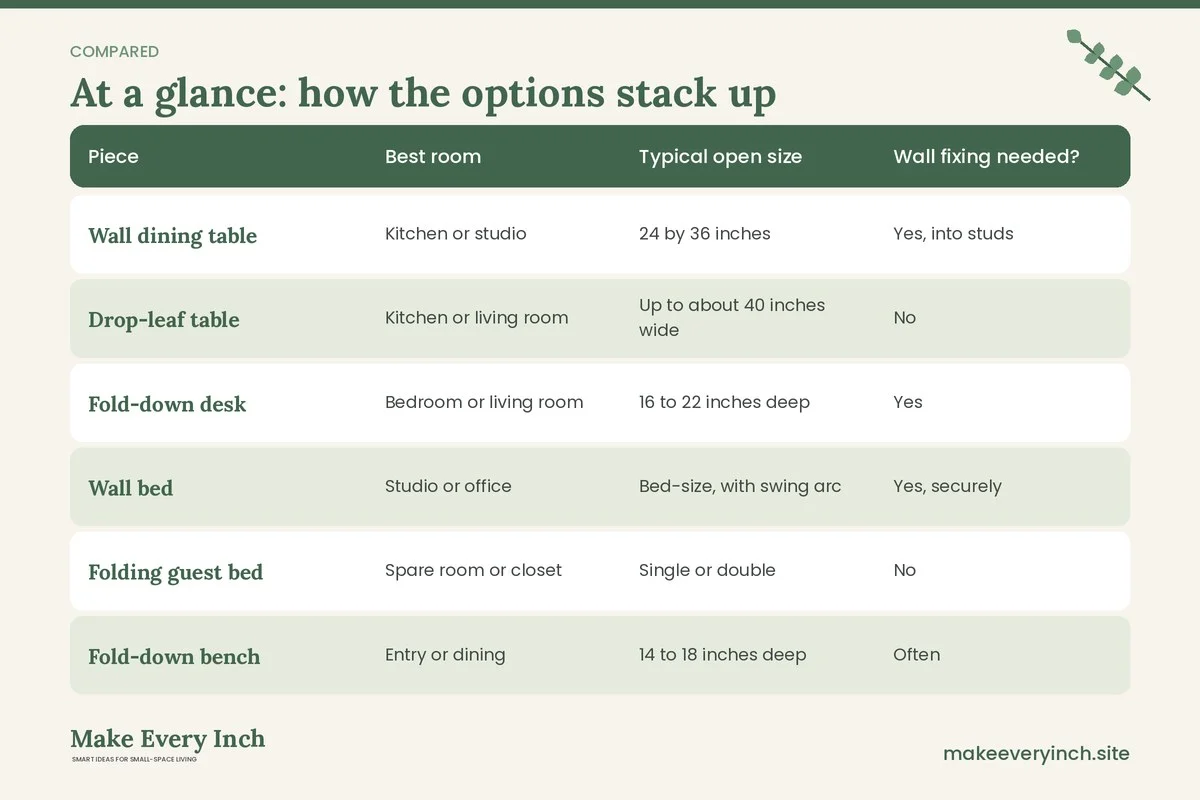
Comparison table: which folddown piece suits which room
| Piece | Best room | Typical open size | Wall fixing needed? | Main trade-off |
|---|---|---|---|---|
| Wall dining table | Kitchen or studio | 24 by 36 inches | Yes, into studs | Limited seating and load |
| Drop-leaf table | Kitchen or living room | Up to about 40 inches wide | No | Always has a footprint |
| Fold-down desk | Bedroom or living room | 16 to 22 inches deep | Yes | Small work surface |
| Wall bed | Studio or office | Bed-size, with swing arc | Yes, securely | Cost, weight, installation |
| Folding guest bed | Spare room or closet | Single or double | No | Comfort for longer stays |
| Fold-down bench | Entry or dining | 14 to 18 inches deep | Often | Seat strength |
| Folding chairs on hooks | Dining or entry | 14 to 16 inches | Light hooks | Hook rating and hinge lock |
| Fold-down ironing board | Closet or laundry | 12 by 48 inches | Yes | Hinge position |
| Folding screen | Studio | 3 to 6 panels | No | Stability and lightness |
Wall mounting: studs, anchors and load limits
Most wall-mounted fold-down furniture depends on the wall. This section is the part most people skip, and it is the part that decides whether the piece is safe.
- Find the studs. In many homes, wall studs sit about 16 inches apart on center, though this varies, and older buildings can differ. A stud finder helps, and so does the maker’s guide. Fix the main brackets into studs where the instructions say to.
- Know your wall type. Drywall, plaster, brick and concrete all need different fixings. Use the type that the maker recommends for your wall, and when in doubt, ask a qualified installer.
- Read the rated load. A wall table that is rated for a stated weight is rated for that weight with the legs or brackets in place. Do not exceed the rating, and remember that people sometimes lean or sit on a surface.
- Use a level. A drop-down surface that is not level will drift when closed or open and may fail early.
- Check for wires and pipes. Before drilling, check where electrical lines and plumbing run. If you are unsure, hire a professional.
- Re-check the fixings. Hinges and brackets can loosen. Check them every few months, and tighten as needed.
Pinch points, locks and everyday safety
Folding mechanisms trade space for moving parts. A few habits keep them safe.
- Keep hands clear of hinges, joints and folding edges. Close a panel by the handle or the edge, not by pushing near the hinge.
- Use the lock. If the piece has a latch, strap or catch to hold the closed position, use it every time. A wall bed in particular should be locked when closed.
- Keep children and pets clear. Do not let children play with wall beds, fold-down tables or sofa mechanisms. A piece that is easy for an adult can trap a small hand.
- Support the open position. A leg or bracket should be fully extended and locked before you put weight on the surface.
- Keep the swing zone clear. Do not place a chair, a lamp or a rug where a panel will drop. A tripping hazard or a blocked door is a risk.
- Mind the cords and lamps. A fold-down desk with a lamp or a laptop charger needs a cord path that does not snag when closed. See renter-friendly ways to hide cords.
- Maintain it. Wipe hinges, check for squeaks and replace worn parts, following the maker’s guidance.
Renting: how to use folddown furniture without damage
Many folddown pieces need the wall, and that is a challenge in a rental. Use this order of preference.
- First choice: pieces that need no fixing, such as drop-leaf tables, folding chairs, folding beds and screens.
- Second choice: freestanding units that lean on the wall or sit on the floor, such as a fold-up cabinet desk with its own frame.
- Third choice: wall-mounted pieces with permission. Ask your landlord in writing before making holes, and agree on how to repair them at move-out. Keep a copy of the reply.
- Not recommended: adhesive strips or tension methods for any load-bearing hinge. A fold-down table or desk puts a lot of leverage on its fixings, and adhesive may fail.
Never drill without permission. If the answer is no, a drop-leaf table or a freestanding folding desk gives much of the same benefit. Our posts on renter-friendly shelving ideas without drilling and security deposit safe apartment upgrades have more safe options.
Three example rooms
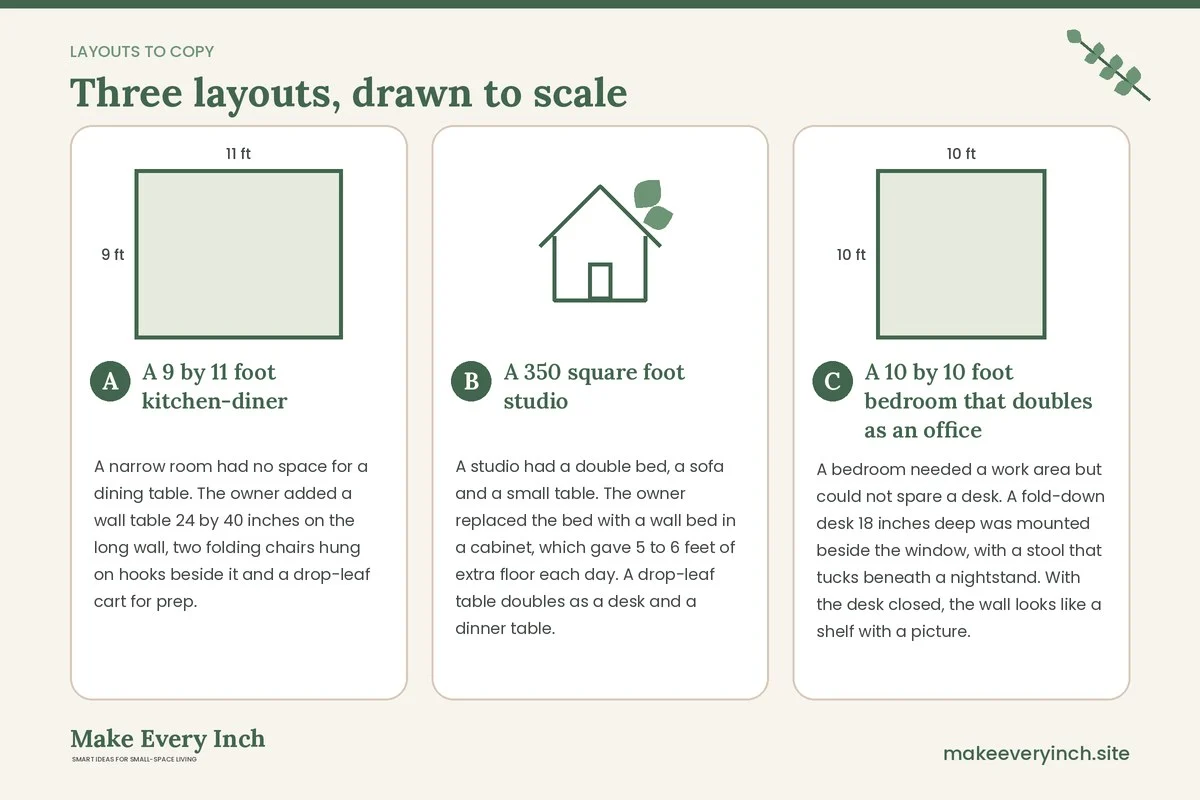
A 9 by 11 foot kitchen-diner
A narrow room had no space for a dining table. The owner added a wall table 24 by 40 inches on the long wall, two folding chairs hung on hooks beside it and a drop-leaf cart for prep. With the table folded, the walkway measures about 40 inches. With it open, the path is about 20 to 24 inches, enough for brief use. Meals for two fit comfortably, and for guests the cart extends the surface. The wall table was fixed into studs with the landlord’s written approval.
A 350 square foot studio
A studio had a double bed, a sofa and a small table. The owner replaced the bed with a wall bed in a cabinet, which gave 5 to 6 feet of extra floor each day. A drop-leaf table doubles as a desk and a dinner table. During the day the room acts as a living and working space, and at night the bed folds down, with a clearance of about 24 to 30 inches on one side. The cabinet is anchored into studs by the installer. For layout ideas, see studio apartment layout ideas that create zones.
A 10 by 10 foot bedroom that doubles as an office
A bedroom needed a work area but could not spare a desk. A fold-down desk 18 inches deep was mounted beside the window, with a stool that tucks beneath a nightstand. With the desk closed, the wall looks like a shelf with a picture. With it open, the owner has a work surface at about 29 inches. A lamp on the closed shelf, a basket for cables and a cord cover keep the area neat. See small home office ideas in a bedroom.
When folddown furniture is not the answer
Folddown pieces are not a universal fix. Some situations call for another approach.
- If you use the surface all day, a permanent desk or table is more comfortable and less fussy than one you open and close every few hours.
- If the wall cannot carry the load, such as thin partition walls or brittle plaster, choose freestanding furniture.
- If setup takes more than a minute, you will stop using it. A mechanism should be quick and easy.
- If the open position blocks a door, a window or a walkway, find another wall.
- If you have limited strength or mobility, a heavy wall bed or a stiff mechanism may not suit you. Consider a sofa bed with an easier mechanism or a low platform bed.
A good rule is to fold away what you use for under two hours a day, and keep out what you use for most of the day. Meals and occasional work suit folding. An all-day desk deserves a permanent top, perhaps one that is itself compact. For compact permanent options, read the best desks for small apartments.
Styling folddown furniture so it looks good closed
A folded piece should look like part of the room. A few tricks help.
- Match the finish. Paint or choose a panel in the wall color, or a wood tone that matches your shelves, so the closed piece disappears.
- Use the closed face. A wall table can carry a mirror, a chalkboard, a pinboard or a picture. A closed wall bed cabinet can hold shelves or a desk on the side.
- Add a light. A small lamp or wall sconce next to a fold-down desk makes the area inviting.
- Hide the hardware. Choose a hinge style that is flush with the surface, and cover cables with a cord cover.
- Keep a landing spot. A small shelf or a hook near the folded piece stops items piling up on the surface when it is closed.
For the wider decorating approach, see our guides to small space organization ideas and hidden storage ideas, which pair well with folding pieces.
Checklist before you buy or install
- Decide which task the piece serves and how long each use lasts.
- Measure the closed depth and the open projection.
- Tape the open footprint and the swing arc on the floor.
- Check legroom of 24 to 28 inches per person and about 36 inches behind the chair.
- Find the studs and confirm the wall type.
- Read the rated load and stay below it.
- Confirm that the piece locks in both positions.
- Check pinch points, and keep hands and children clear.
- Keep exits, windows and vents clear of the swing zone.
- Plan a cord path for lamps and chargers.
- Read the lease and ask in writing before drilling.
- Choose a drop-leaf or freestanding piece if the wall is off limits.
- Check hinges and fixings every few months.
FAQ
What are the best folddown pieces for a tiny apartment?
A drop-leaf table, a wall-mounted dining table and a fold-down desk give the most benefit for the least effort. A wall bed makes the biggest change but needs careful installation.
Are wall-mounted fold-down tables strong enough for daily use?
They can be, if you pick one with a stated rated load, fix it into studs or the support the maker recommends and stay below the limit. Ask a professional if you are unsure about your wall.
Can I use folddown furniture in a rental?
Yes, if you choose drop-leaf tables, folding chairs, screens and freestanding folding pieces that need no fixings. For wall-mounted pieces, ask your landlord in writing, and do not drill without permission. Our guide to no-drill storage ideas for renters shows alternatives.
How deep should a fold-down desk be?
A depth of about 16 to 22 inches works for a laptop and a notebook. A monitor and a keyboard need closer to 24 inches. Choose depth according to your daily tasks.
Is a wall bed safe?
A well-made wall bed that is installed according to the instructions and anchored into studs is designed for daily use, but it is a heavy moving object. Follow the maker’s guidance, use the lock, keep children away and consider professional installation.
How much space does a folddown table save?
It depends on the size, but a table that sits 3 to 4 inches from the wall when closed might return 8 to 10 square feet of floor compared with a fixed table. In a small room that can be the difference between a walkway and a bottleneck.
What should I avoid with fold-down furniture?
Avoid mechanisms that are hard to operate, surfaces that are too small to use and wall fixings that do not match your wall. Our post on small space furniture mistakes to avoid lists more.
Keep going: Keep exploring with our small living room layout ideas, small bedroom ideas and studio apartment ideas.
Save this guide for later
Pin the ideas you like to Pinterest so you can come back to them when you plan your space.