How to Choose the Best Small Dining Tables: 19 Things to Check
Quick answer: The best small dining tables are the ones that fit your room with at least 36 inches of clearance on every side where people sit, give each diner about 24 inches of width, and match how you really eat. Measure first, tape the footprint on the floor, then compare shape, base, leaves, material and stability before you buy.
The best small dining tables are not the smallest ones. They are the ones sized to the room, the number of people and the way you eat, work and entertain. A table that is two inches too wide can block a doorway, and a table that is too small gets used as a drop zone instead of a dining spot. This guide teaches you how to choose: what to measure, which shapes and bases save space, how construction affects wobble and wear, and how to test a table before you spend money. For the room around the table, see our guides on small apartment kitchen ideas and small living room layout ideas.
This guide is educational, not a product review. The site does not test or rank specific products, so use the checks below to compare any table you find.
Measure the room before you shop
Measure the length and width of the area where the table will sit, and note doors, radiators, outlets, windows and the swing of any cabinet or fridge door. Write down the distance from each wall to the nearest obstacle, because the table is only one part of the footprint. The chairs, the people in them and the walkway behind them need space too.
Then measure how you move through the room. If the table sits between the kitchen and the living room, you need a clear path of at least 30 to 36 inches around it. If it sits in a corner or against a wall, you can accept less clearance on that side, but only if nobody needs to squeeze past.
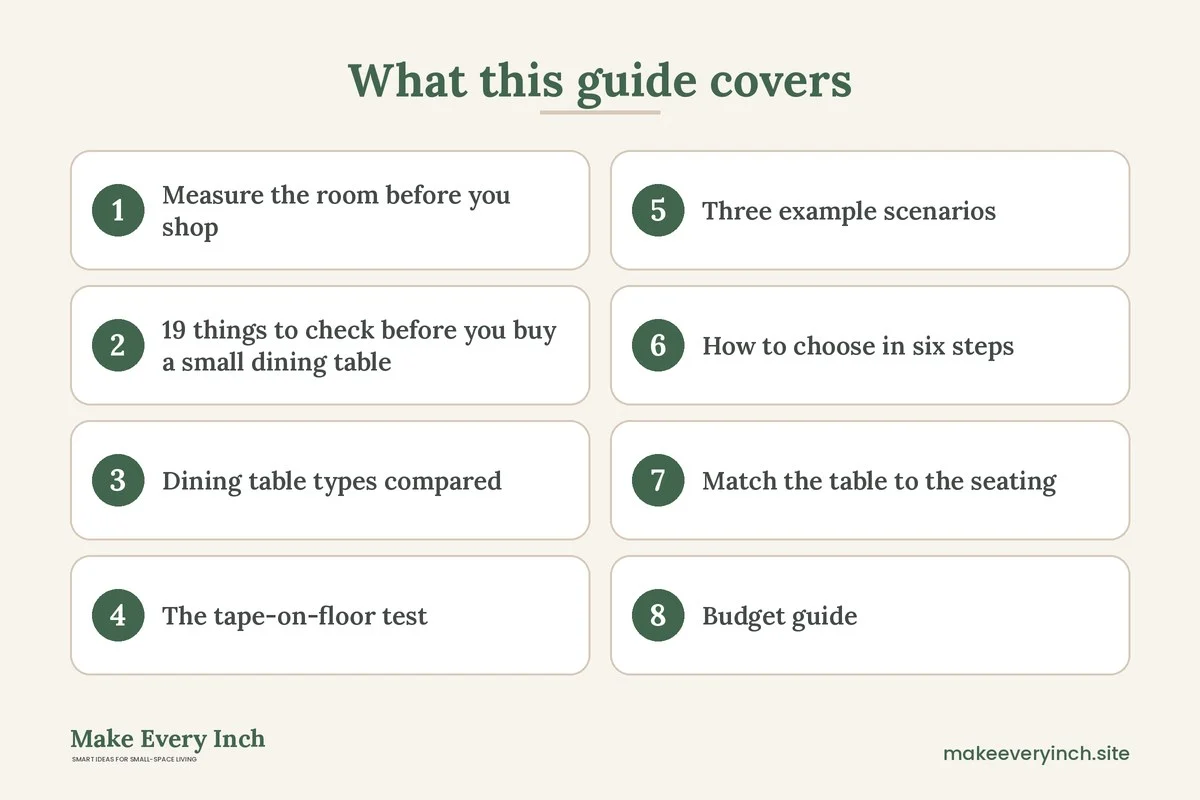
19 things to check before you buy a small dining table
Size and layout
1. Floor footprint
Write down the table’s length and width, then add the chair space on every side. A table that is 30 inches wide and 48 inches long needs a room at least 100 by 78 inches if people sit on all sides with 36 inches of clearance. Use this rough math before you fall in love with a photo.
2. The 24-inch rule for seating
Plan about 24 inches of table edge per person for comfortable elbow room. Twenty inches works for a quick meal, but it feels tight with plates, glasses and a serving dish. A 48-inch table seats two on a long side comfortably, and four only if two sit at the ends.
3. Clearance of 36 inches
Leave about 36 inches between the table edge and the nearest wall or furniture where someone sits and needs to stand up. Thirty inches is a tight minimum for walking behind seated diners, and 44 inches or more is generous. Measure from the table edge, not from the chair, because chairs slide back.
4. Table depth
Depth matters as much as length. A table 30 inches deep fits two plates and a small centerpiece, while a 24-inch depth works only for a counter or a wall-pushed desk-style table. Anything under 28 inches deep makes shared dishes crowd the plates.
5. Table height
Standard dining height is about 28 to 30 inches. Counter height is about 34 to 36 inches and bar height is about 40 to 42 inches, which need taller stools and often feel cramped in rooms with a low ceiling or a nearby pendant light. Leave 10 to 12 inches between the seat and the underside of the tabletop for knees.
Shape and style
6. Round versus rectangular
A round table has no corners to bump, and people can shuffle around it in tight spots. A rectangle uses wall space better and seats more people for the same footprint, and it suits long, narrow rooms. Choose round for a square room with a central position, and rectangular for a hallway-style dining zone.
7. Square and oval shapes
A square table of 30 to 36 inches works in a corner for two to four people. An oval or racetrack shape combines the walkway benefits of round with the seating of a rectangle, because the soft ends free up the corners. Both shapes cost more floor space than a narrow rectangle, so test them with tape.
8. Drop-leaf tables
A drop-leaf table has hinged sides that fold down when not in use, so it shrinks to 10 to 16 inches wide against a wall. Check how the leaves are supported, because swing-out legs, brackets or gate legs vary in stability. Make sure the leaf hinges are metal and the surface is level when the leaves are up.
9. Extendable and butterfly leaf tables
A table with a removable or hidden leaf starts small for daily use and grows for guests. Check where the leaf is stored, how heavy it is and whether you can extend the table by yourself. Mechanisms with a slide rail need to be clean and smooth, and the seam between the leaf and the top should sit flush.
10. Wall-mounted and fold-away tables
A wall-mounted fold-down table is an option for studios and for tiny kitchens, since it disappears when not in use. It needs studs or solid backing, and many rentals do not allow drilling, so check your lease. Plan for the weight rating and for what sits on the table when it is folded up.
Base and stability
11. Pedestal bases
A single pedestal base leaves the corners open, so you can squeeze in an extra chair, and nobody has to straddle a leg. Look for a wide, heavy base, because a narrow pedestal under a large top will rock when someone leans on the edge. A cross-shaped or four-footed pedestal is usually steadier than a single round column.
12. Four-leg tables
Legs at the corners are the most stable arrangement for a rectangular top, but they limit the seat positions. Look for legs that sit inset from the corners by 2 to 4 inches, so a chair can be positioned at the corner. Check that the aprons, which are the rails under the top, do not hit a diner’s thighs.
13. Wobble and joinery
Push the corner of the table sideways and listen for creaks. Solid joints, metal brackets and a thick apron resist racking better than a thin top screwed to four thin legs. Adjustable feet are useful on uneven floors, and felt pads protect the floor.
Materials and construction
14. Tabletop material
Solid wood is durable and repairable, but it can dent and is heavy to move. Veneer on a stable core looks like wood at a lower cost, and laminate resists stains and scratches, though the edge can chip. Glass looks airy in a tiny room, but shows fingerprints, can chip at the edge and needs bumpers if you have children.
15. Finish and edges
A matte or satin finish hides scratches better than a gloss finish, and a rounded edge is kinder to hips and elbows than a sharp corner. Check whether the finish is sealed against water rings, and use coasters and placemats anyway. Dark surfaces show crumbs and dust, and pale surfaces show stains.
16. Weight and moving
A solid wood top with a pedestal base can weigh more than 100 pounds, which matters for stairs, small elevators and later moves. Check whether the legs unscrew, whether the top separates from the base and how the table ships. A lighter table is easier to move, but it also moves when someone leans on it.
Safety, comfort and use
17. Weight rating and tip-over
Look for a stated load capacity, especially on fold-down, glass and drop-leaf tables. A table with a heavy extension leaf can tip if a person leans on the end, so check where the legs sit relative to the leaf. If a tall bar table has a narrow base, anchor it or choose a wider footprint, especially around children.
18. Chair and bench compatibility
Chairs that tuck fully under the table save about 16 to 20 inches of floor space when not in use. A bench on one long side seats more people in a tight room and slides under the table, but offers less back support. Check that aprons and drawer fronts leave enough knee room for your chairs.
19. Cleaning and daily use
A table that works as a desk, a craft table and a dining table needs a surface you can wipe and a finish that resists heat. Check whether joints between leaves, glass panels and edges trap crumbs. A table with a hidden drawer or shelf can reduce clutter, but only if it does not take knee room.
Dining table types compared
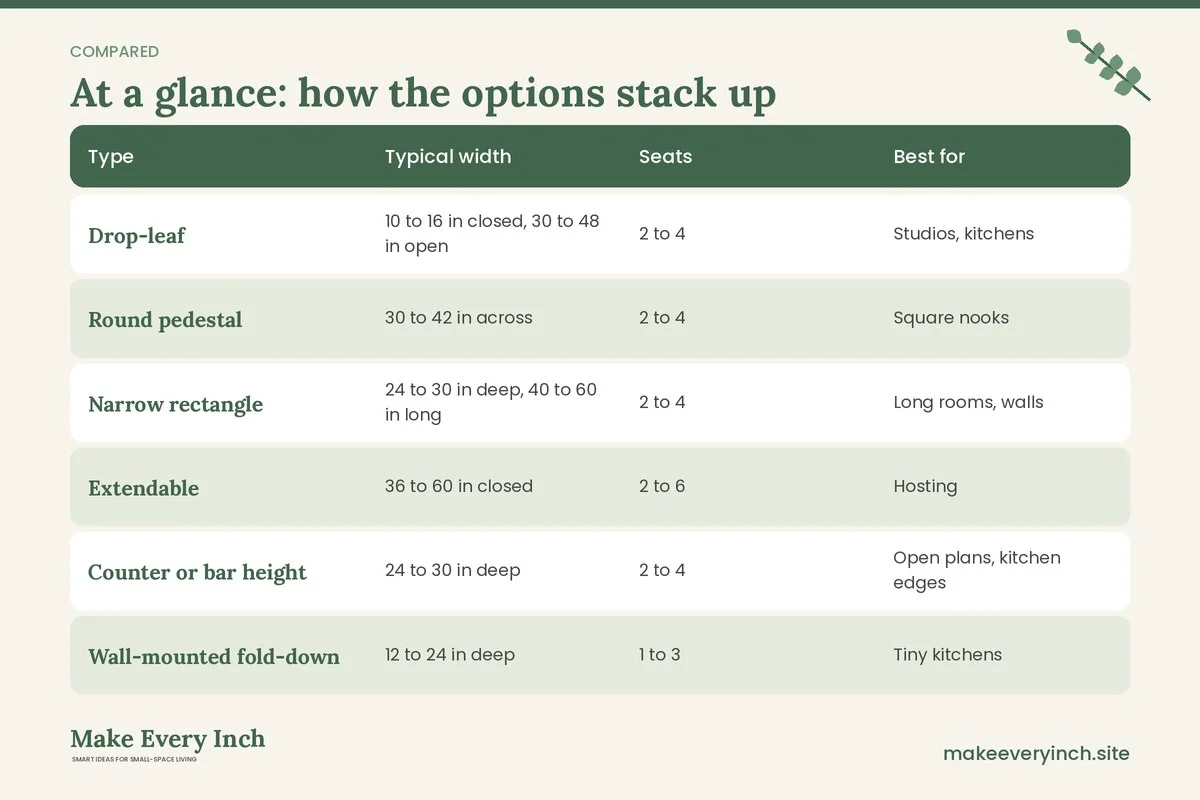
| Type | Typical width | Seats | Best for | Watch for |
|---|---|---|---|---|
| Drop-leaf | 10 to 16 in closed, 30 to 48 in open | 2 to 4 | Studios, kitchens | Leaf support, hinge quality |
| Round pedestal | 30 to 42 in across | 2 to 4 | Square nooks | Base weight, wobble |
| Narrow rectangle | 24 to 30 in deep, 40 to 60 in long | 2 to 4 | Long rooms, walls | Clearance at ends |
| Extendable | 36 to 60 in closed | 2 to 6 | Hosting | Leaf storage, seams |
| Counter or bar height | 24 to 30 in deep | 2 to 4 | Open plans, kitchen edges | Taller stools, tip-over |
| Wall-mounted fold-down | 12 to 24 in deep | 1 to 3 | Tiny kitchens | Wall backing, lease rules |
| Square | 30 to 36 in per side | 2 to 4 | Corners | Corner clearance |
The tape-on-floor test
Before you buy, mark the footprint on the floor. Use painter’s tape for the table size, then add a second outline of tape 24 inches out on each seated side for chairs. Stand up, sit down and walk around the area as if you were carrying a hot dish. Leave the tape down for two days.
If you cannot buy a table that is exactly the size you picked, cut cardboard or paper to match the dimensions and lay it on chairs to see the height. Check the walk path to the fridge, the door and the balcony. If the tape blocks a door swing, shrink the table or turn it a quarter turn.
Three example scenarios
A 9 by 10 foot dining nook for two
Measure the nook, then choose a 30 by 30 inch square or a 32 inch round table. Push one side against the wall, so two chairs sit on opposite sides. A drop-leaf table folds to a narrow console when you need the floor. Two chairs that tuck fully under the table keep the walkway clear.
A studio with a corner table for work and meals
A 24 to 30 inch deep rectangle on a wall, with a bench on one side and a chair on the other, seats two. Keep the height at 28 to 30 inches so it works for laptops. See our small bedroom desk ideas for ways to share a surface for work and meals.
A living-dining room that hosts six
Choose a rectangular extendable table that is 36 inches long closed and seats six when open. Store the leaf behind a sofa or in a closet. Plan for a bench on one side, and keep a clear 36 inches around the open table. For layouts, read about small apartment living room ideas.
How to choose in six steps
1. Measure the room and mark doors, radiators and outlets.
2. Decide the daily seating number and the guest maximum.
3. Pick a shape that suits the room: round for square, rectangle for long.
4. Choose a base that leaves knee and corner room.
5. Check material, finish and load rating for how you really use the table.
6. Tape the footprint on the floor and live with it for two days.
Match the table to the seating
Two people
A 30 inch square, a 32 inch round or a 24 by 36 inch rectangle is plenty. Add a drop-leaf extension for guests. Two people need about 48 inches of tabletop width for plates, glasses and a shared dish.
Four people
Plan for 48 inches of length with 30 inches depth, or a 42 to 48 inch round. A round table of 42 inches seats four, while 36 inches is a squeeze. Use chairs with a narrow seat width of 16 to 18 inches.
Six people
You need about 60 to 72 inches of length for six. In a small room, choose an extendable table, or use a bench on one side. See best storage ottomans for extra seats that store away.
Budget guide
Prices vary widely by region, brand and material, so treat these as hedged ranges. Many small tables in laminate or veneer fall in a low range, often from about $80 to $250. Solid wood and extendable models commonly sit higher, often $300 to $800 or more. Used tables can cost less and often use better wood, but check for wobble and for water damage. Spend where it matters most: the base stability, the finish and the mechanism of any leaf.
Mistakes to avoid
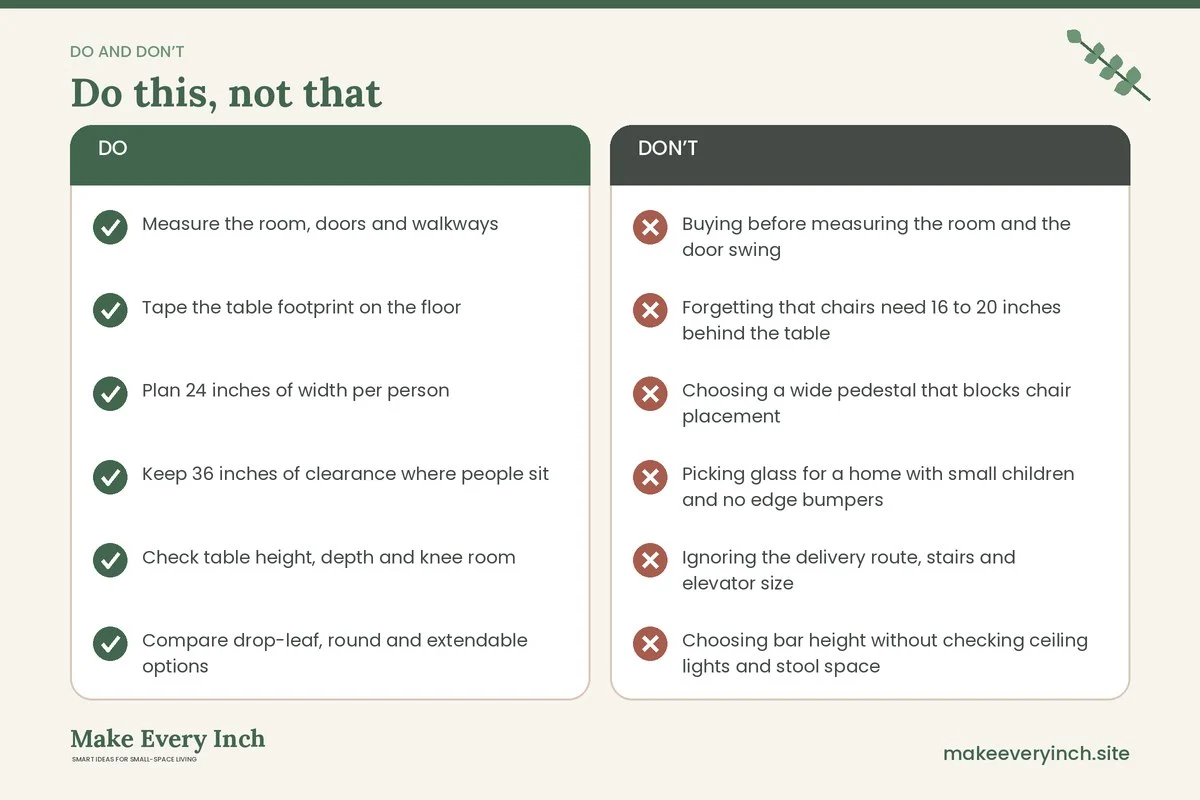
- Buying before measuring the room and the door swing
- Forgetting that chairs need 16 to 20 inches behind the table
- Choosing a wide pedestal that blocks chair placement
- Picking glass for a home with small children and no edge bumpers
- Ignoring the delivery route, stairs and elevator size
- Choosing bar height without checking ceiling lights and stool space
- Trusting a photo for scale instead of the stated dimensions
- Skipping the wobble test on a table you can touch in person
Pre-purchase checklist
- Measure the room, doors and walkways
- Tape the table footprint on the floor
- Plan 24 inches of width per person
- Keep 36 inches of clearance where people sit
- Check table height, depth and knee room
- Compare drop-leaf, round and extendable options
- Check the base for steady, wide feet
- Confirm the load rating and any tip-over notes
- Test the finish for stains and scratches
- Check the delivery route and assembly time
- Ask about return rules for large furniture
Assembly, moving and care
Read the assembly steps before ordering. Heavy tops need two people, and a drop-leaf or extendable mechanism should be tested right after assembly. Tighten the bolts again after a few weeks, because wood moves with the seasons. Move a table by lifting, not by dragging, and carry it on its side if it has fixed legs.
For cleaning, wipe up spills at once and use a soft damp cloth. Use trivets for hot pots, and felt pads under the legs. Oil solid wood once or twice a year if the maker suggests it. Check that screws and leaf hardware stay tight.
FAQ
How big should a small dining table be?
Aim for a footprint that leaves 36 inches of clearance around seated sides. For two people, 30 inches square or 24 by 36 inches works. For four, plan on about 48 by 30 inches or a 42 inch round.
How much space does one person need at a table?
Plan about 24 inches of table edge per person. You can go down to 20 inches for short meals, but it will feel tight with dishes in the middle.
Is a round or rectangular table better for a small space?
Round suits square rooms and tight corners. A rectangle suits long rooms and wall placement. Test both with tape to see which leaves the better walkway.
Are drop-leaf tables stable?
They can be, if the leaf support is solid and the hinges are metal. Check the supports, close the leaf and open it a few times in person if you can.
What height should a dining table be?
Standard is about 28 to 30 inches. Counter height is 34 to 36 inches, and bar height is 40 to 42 inches. Match the stool or chair height to the table.
How much clearance do I need behind chairs?
Plan 36 inches from the table edge to the wall for comfortable use. Thirty inches is a tight minimum, and anything less blocks the path.
Do I need to anchor a tall table?
A tall bar table with a narrow base can tip if someone leans or climbs on it. A wide base, or an anchor where allowed, is safer, especially around children.
How can I fit a dining table in a studio?
Use a wall-pushed rectangle, a drop-leaf table or a wall-mounted fold-down table. Keep chairs that tuck under, and mark the footprint with tape first.
Keep going: Explore our small apartment kitchen ideas, small space storage furniture ideas and best small dressers.
Save this guide for later
Pin the ideas you like to Pinterest so you can come back to them when you plan your space.