How to Choose the Best Rolling Kitchen Carts: 19 Things to Check
Quick answer: The best rolling kitchen carts for a small home are the ones that fit your real clearances, carry the weight you plan to put on them and roll smoothly on your floor. Measure the parking spot and the path, tape the footprint on the floor, check the top material, caster type and weight rating, and keep the cart away from direct stove heat.
Finding the best rolling kitchen carts is less about style and more about matching a small piece of furniture to a very specific job. A cart that is two inches too wide blocks the oven door, a cart with weak casters rattles every dish, and a cart with a delicate top stains the first time a tomato lands on it. This guide teaches you how to choose. It covers measurements, tops, shelves, casters, weight ratings, folding leaves, heat, assembly, cleaning and moving, then gives you a decision table, three example kitchens, a tape-on-floor test, a budget guide, a mistake list and a checklist. For ideas on how to use a cart once you own one, see our small kitchen cart ideas.
Disclosure: this guide is educational, not a product review. The site does not test or rank specific products, so use it to build your own shortlist and compare real listings against the checks below.
Before you shop: define the job
A cart can be a prep surface, a coffee station, extra pantry storage, a bar, a microwave stand or a place to park a stand mixer. Each job pushes the specs in a different direction. Prep work needs a stable, heat-tolerant, wipeable top at counter height. Storage needs shelves with lips and a good weight rating. A bar needs a rail, a bottle rack and a place for glasses. Write down the top three items the cart will carry, then weigh them or estimate the weight. That one note will guide most of the choices below.

19 things to check before you buy
Size and fit
1. Width: 12 to 24 inches
Narrow carts between 12 and 18 inches slide into the gap beside a fridge or a range and still leave a walkway. Carts from 18 to 24 inches give you a real prep surface but need a wider parking spot. Measure the gap at the floor and at counter height, because baseboards, outlets and appliance handles often steal a half inch.
2. Length and depth
Depth is usually the limit in a galley kitchen. A cart that is 16 to 20 inches deep can sit against a wall without crowding a 36-inch aisle, while a deeper one narrows the path. Longer carts hold more but are harder to turn in a tight corner, so check your turning radius too.
3. Height against your counters
Standard kitchen counters are about 36 inches high. A cart that matches that height works as a counter extension and lets you slide items across. A cart a little lower, around 32 to 34 inches, is more comfortable for kneading or chopping. Check your own comfort by measuring your elbow height, since a prep surface that is about 3 to 4 inches below the elbow usually feels right.
4. The parking spot and the working position
Most carts live in two places: tucked away and pulled out for use. Measure both. In the working position you need room to stand beside the cart, open drawers and open the oven or dishwasher if they are close. Allow at least 36 inches of clear walkway around it when it is in use.
5. Door and path clearance
If the cart has to travel from the kitchen to a living room or a balcony, measure every doorway and any threshold on the route. Standard interior doors are often 30 to 32 inches wide, but older homes can be narrower. Check for rugs and door sills that can stop small casters.
Tops and materials
6. Wood tops
Solid wood tops look warm and take light cutting, but they need sealing with food-safe oil and can scratch or darken with water. Butcher-block style tops made of strips of hardwood are often durable but should never sit in standing water. Veneer or particleboard with a wood-look finish is lighter and cheaper, but moisture can make the edges swell, so check how the edge is sealed.
7. Steel and metal tops
Stainless steel tops are easy to wipe and tolerate heat well, though they show fingerprints and scratches. Painted or powder-coated steel frames are stable and light for the weight they carry, but chips in the paint can rust in a damp kitchen. Look for welded or tightly bolted joints, since wobbly frames loosen over time.
8. Stone, marble and quartz tops
Stone-look tops are heavy, which makes a cart more stable but harder to move. Real marble stains from acids such as lemon juice and wine, and it etches easily. Engineered quartz and sintered surfaces resist stains better, and laminate with a stone print is the lightest option. Ask whether the top is solid stone, a thin slab on a board or a printed finish.
9. Edges and lips
A raised lip or rail around the top keeps bottles and bowls from sliding off while you roll the cart. A flat top feels more like a counter and is easier to wipe. Rounded edges are kinder to hips and elbows in a narrow space, while sharp corners are a hazard around children.
Storage and layout
10. Shelves and their spacing
Count the shelves and measure the gaps between them. A gap of 8 to 10 inches suits cookbooks and canned goods, while taller bottles and small appliances need 12 to 14 inches. Open shelves are quick to reach but show clutter. Check whether shelves are fixed or adjustable, since adjustable ones adapt as your needs change.
11. Drawers, cabinets and baskets
A single drawer is useful for utensils and towels, and closed cabinet space hides messy items. Check whether drawers have stops so they do not slide out when you roll the cart, and whether the runners are metal or plastic. Fabric or wire baskets are lighter, but they hold less weight than shelves.
12. Hooks, rails and extras
Side hooks hold towels and utensils, a towel bar saves counter space and a wine or glass rack helps a bar setup. These extras are only useful if they do not widen the footprint beyond your measured gap, so check the width including any side attachments.
Mobility and safety
13. Locking casters
Look for casters that lock, ideally on all four wheels, or at least on two. A cart that rolls while you chop or lean on it is unsafe. Test the lock by pushing the cart sideways, and check that the brake stops both rolling and swiveling when engaged.
14. Caster size and floor type
Larger wheels, about 2 inches or more in diameter, cross thresholds and tile grout lines more easily than tiny ones. Soft rubber or polyurethane wheels are quieter and kinder to hardwood, vinyl and laminate floors, while hard plastic wheels can scratch and rattle. On uneven tile or textured vinyl, larger soft wheels help. Check whether the casters are replaceable if they wear out.
15. Weight rating
A listed capacity usually refers to the total load spread evenly, and individual shelves may have lower limits. Add up what you plan to carry. A stand mixer, a few bowls and a stack of plates can pass 50 pounds quickly. Choose a cart with a rating comfortably above your real load, since a rating tested while stationary does not account for pushing over bumps.
16. Stability and tipping
A top-heavy cart with a narrow base can tip when you lean on it or roll it over a threshold. Wider feet, a lower center of gravity and heavier items on lower shelves all help. Never rely on a cart as a ladder or a step.
Features and care
17. Drop-leaf and folding tops
A drop leaf adds 8 to 14 inches of surface when you need it and folds down to keep the walkway clear. Check how the leaf is supported, either by hinged brackets, a swing-out leg or a locking arm. A leaf supported only by hinges can sag under weight, so test how it holds a heavy bowl. Also check whether the extended footprint still clears doors.
18. Heat, cleaning and assembly
Keep a cart at least a few inches away from a hot range, and never let a plastic, laminate or painted piece touch a hot side panel, since heat can warp, discolor or soften it. Wipeable, sealed surfaces are easier to maintain than open grain or raw wood. Read the assembly steps in advance, since some carts need two people, a mallet or an hour or more of work. Check that the fasteners are standard and that spare screws are included.
19. Bar cart or utility cart
A bar cart usually has a smaller footprint, glass holders and a decorative look, and it often has lower weight capacity. A utility cart is built for heavier loads, work surfaces and cleaning. If you plan a mix of uses, choose a utility build with a styled finish, rather than a decorative bar cart that struggles with real kitchen work.
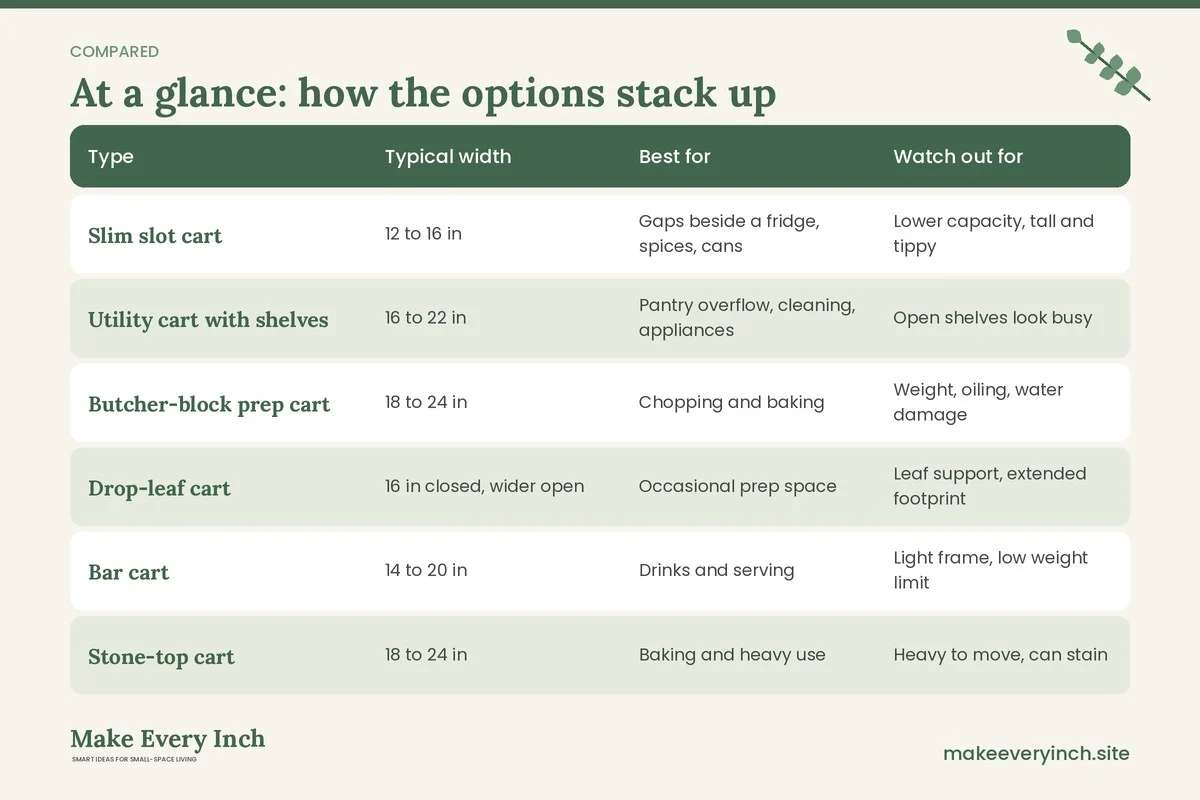
Cart types compared
| Type | Typical width | Best for | Watch out for |
|---|---|---|---|
| Slim slot cart | 12 to 16 in | Gaps beside a fridge, spices, cans | Lower capacity, tall and tippy |
| Utility cart with shelves | 16 to 22 in | Pantry overflow, cleaning, appliances | Open shelves look busy |
| Butcher-block prep cart | 18 to 24 in | Chopping and baking | Weight, oiling, water damage |
| Drop-leaf cart | 16 in closed, wider open | Occasional prep space | Leaf support, extended footprint |
| Bar cart | 14 to 20 in | Drinks and serving | Light frame, low weight limit |
| Stone-top cart | 18 to 24 in | Baking and heavy use | Heavy to move, can stain |
Match the cart to your kitchen: three examples
The galley kitchen with a 38-inch aisle
A renter has a narrow galley with a fridge at one end. A cart 12 to 14 inches wide parked beside the fridge leaves a usable aisle, and a locking caster set keeps it still at the sink. The best fit is a slim utility style with enclosed lower storage and a wipeable top, rolled out only for cooking. See our galley kitchen ideas for layout thinking.
The studio with no counter space
A studio has two feet of counter and a table that doubles as a desk. A drop-leaf cart around 20 inches wide gives a prep surface when open and a coffee station when closed. Look for a top at counter height, a leaf with a locking support and a lower shelf rated for a microwave. Our small apartment kitchen ideas give more context.
The open-plan kitchen that serves guests
An open living and kitchen area has room beside the island. A wider cart of 22 to 24 inches, with soft wheels and a raised lip, works as a serving cart for drinks and snacks, and rolls to the table when needed. Pair it with a compact dining table so the route between them stays clear.
How to test a cart before you buy it
The tape-on-floor test
Use painter’s tape to mark the cart’s footprint at its parking spot, and mark a second rectangle for the working position, including any drop leaf. Leave the tape down for three days and live around it. Open the oven, the dishwasher and the fridge, carry a laundry basket past and make a cup of coffee. If you bump the tape more than once, the cart is too big.
The paper-template test
Cut cardboard to the cart’s width and depth and stand it at counter height on a box. Place your real items on it, such as your mixer and your most used bowls, to see whether the surface works for you. Mark the shelf heights on the wall to check that your tallest bottles and cereal boxes fit.
The in-store or delivery check
When the cart arrives, push it across your own floor before assembling the final pieces if you can. Check that the casters lock, the frame does not twist, the shelves sit level and the top does not rock. Check for chips or dents on arrival, and keep the packaging until you are sure about your return window.
Assembly, moving and cleaning
Assembly
Lay out the parts and count the hardware before you start. Tighten fasteners loosely first, then fully tighten them once the frame is square, and recheck after a week of use. Carts with metal frames and press-fit shelves usually go together faster than those with cam locks and dowels. If you rent, keep the instructions and hardware bag so you can disassemble and reassemble when you move.
Moving the cart
Push rather than pull, and move slowly over thresholds. Remove loose items before crossing a bump, and lock the wheels when you stop. For a stair move, remove shelves and drawers and carry the frame separately.
Cleaning
Wipe wood and stone with a damp cloth and mild soap, and avoid soaking. Oil butcher-block tops periodically with a food-safe oil. Wipe steel with the grain. Clean caster wheels of hair and debris, which can jam the swivel, and check that the screws are tight.
Budget guide
Prices vary widely by size, material and retailer, so treat these as hedged ranges, not quotes.
Lower range
Often under about $100. Expect lighter frames, laminate or particleboard tops and smaller casters. These suit light duty such as a coffee station or a spice cart. Check the weight rating and read how the top is finished.
Middle range
Often roughly $100 to $250. This range commonly brings sturdier frames, better casters, a solid-wood or metal top and drop leaves. It suits daily prep and storage.
Higher range
Often $250 and up. Expect thicker butcher blocks, stone tops, heavier frames and furniture-grade finishes. These are worth it only if you use the cart for heavy daily work.
Mistakes to avoid
- Measuring the floor gap but not the width at counter height
- Ignoring the space needed to open appliance doors
- Trusting a weight rating without adding up the real load
- Choosing tiny hard wheels for a tile or textured floor
- Placing a plastic or laminate cart against a hot range
- Buying a stone or marble top without checking its weight and stain care
- Forgetting the width of side hooks, racks and handles
- Skipping the lock test on the casters
- Overloading the top shelf so the cart tips
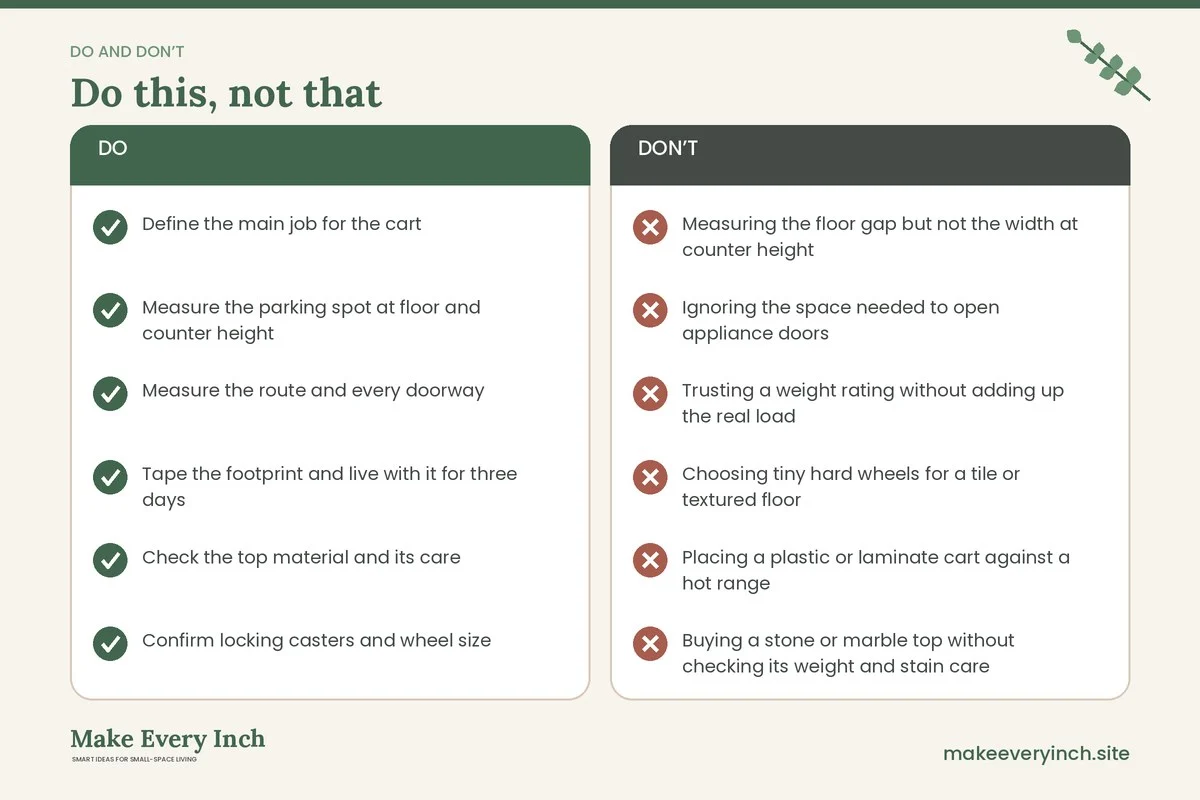
Rolling kitchen cart checklist
- Define the main job for the cart
- Measure the parking spot at floor and counter height
- Measure the route and every doorway
- Tape the footprint and live with it for three days
- Check the top material and its care
- Confirm locking casters and wheel size
- Add up the real load against the weight rating
- Check shelf gaps against your tallest items
- Check drop-leaf support and extended footprint
- Keep a few inches from the range
- Read assembly steps and check hardware
- Confirm the return window
FAQ
How wide should a rolling kitchen cart be?
Most small kitchens suit a cart between 12 and 24 inches wide. Measure the parking spot and leave at least 36 inches of walkway when the cart is in use.
What height should a kitchen cart be?
Many people pick about 34 to 36 inches for a cart that matches counters. A slightly lower cart can be more comfortable for kneading or heavy chopping.
Which top material is best?
It depends on the job. Wood suits chopping with regular oiling, steel tolerates heat and wipes clean, and stone-look tops suit baking but may stain or weigh a lot.
Do I need locking casters?
Yes, for any cart you work at. Look for brakes that stop both rolling and swiveling, and test them by pushing the cart sideways.
How much weight can a cart hold?
It varies by build, and shelves may have lower limits than the total. Add up your real load and choose a rating well above it.
Can I put a cart next to the stove?
Keep some space between a cart and a hot range, especially if it has plastic, laminate or painted parts. Heat can warp or discolor those materials.
What is the difference between a bar cart and a utility cart?
A bar cart is lighter and styled for drinks and serving. A utility cart is built for heavier loads and daily kitchen work.
Are drop-leaf carts worth it?
They are useful when you need extra surface only part of the time. Check the support for the leaf and the extended footprint before you buy.
Keep going: Keep planning with our small kitchen storage ideas, tiny kitchen ideas and small kitchen counter organization.
Save this guide for later
Pin the ideas you like to Pinterest so you can come back to them when you plan your space.