How to Organize a Small Home Room by Room
Quick answer: To organize a small home room by room, work in this order: entryway, kitchen, living room, bathroom, bedroom, closet and then storage extras such as the laundry corner. Start with the busiest, most visible spaces, give each room 1 to 3 hours, sort before you buy anything and finish each room completely before you move on. Most small homes take two to four weekends.
Knowing how to organize a small home room by room matters because the order you work in decides whether the effort sticks. Many people start in the middle, pull everything out of three rooms at once and end the weekend with a bigger mess than they began with. In a small home that mistake is serious, because there is nowhere to park the overflow. A planned sequence solves this. You finish one room, so the home always has at least one working space, and the order is chosen so that each room helps the next. This guide gives you a full plan. It covers how to prepare, the best order and the reasons for it, how long each room takes, a checklist for every room, a schedule table, three example plans for different home sizes, a way to stay on track and a FAQ. For ideas on storage products and layouts, our pillar guide to small space organization ideas is a good companion, and for what to avoid along the way, read small home organization mistakes to avoid.
Prepare before you touch a single room
A little preparation saves hours later. Spend an hour on the following before you begin.
Set up a staging area
Small homes need a spot to hold items in transit. Choose a corner, a spare chair or a section of floor about 3 by 3 feet. Place three boxes or bags there: one to donate, one to throw away or recycle and one for items that belong in another room. The third box is the secret to room-by-room work. When you find a mug in the bedroom, it goes into the box and returns to the kitchen later, so you do not leave the room you are working in.
Gather a basic kit
You need very little: trash bags, a marker and tape for labels, a tape measure, a cloth and cleaner, a notebook and a timer. Resist buying containers at this stage. Our post on small home organization mistakes to avoid explains why buying too early is the most common error.
Pick a time, and protect it
Choose blocks of time that you can finish. A 90-minute block with a clear end beats a vague all-day plan. Put the blocks in a calendar. Most people find that mornings are best for sorting, since decision fatigue grows later in the day.
Set a goal for each room
Write one sentence per room. For example: “The entrance holds shoes, keys and bags with nothing on the floor.” A goal turns a vague wish into a test, and it tells you when you are done.
How to organize a small home room by room: the best order
The sequence below is based on three ideas. First, start with high-traffic spaces where the benefit is felt every day. Second, go from the room with the fewest emotional items to the room with the most. Third, leave the largest personal collections, such as closets and papers, until you have built the sorting habit.
Step 1: Entryway (30 to 60 minutes)
The entry is the first and last space you touch each day, and a small home’s clutter often starts here. It is also small, so it gives you a quick win. Aim for a hook, a tray and a shoe spot per person.
Step 2: Kitchen (2 to 3 hours)
The kitchen is the room with the most daily use and the most duplicate items. Sorting it early frees up space and makes later steps easier, since you eat better and waste less. Work in zones: cooking, prep, cleaning, storage and serving.
Step 3: Living room (1 to 2 hours)
The living room is where overflow from other rooms lands. Once the entrance and kitchen are done, there is less to land here. This room mostly needs surface control, media sorting and a home for blankets, remotes and toys.
Step 4: Bathroom (45 to 90 minutes)
The bathroom is small, and most items in it expire or run out, so decisions are easy. Clear expired products, group the rest by use and set up a spot for towels.
Step 5: Bedroom (1 to 2 hours)
The bedroom comes after the public rooms, since it is where you want to relax, and it will feel better when the rest of the home is calm. Focus on the nightstand, the dresser top, the floor and the under-bed space.
Step 6: Closet and wardrobe (2 to 4 hours)
The closet is the most emotional, and the most time-consuming, space in most homes. By this point you have practiced sorting in four or five rooms and decisions come faster. Plan a longer block and take breaks.
Step 7: Laundry corner, storage and paper (1 to 2 hours)
The final step collects the odds and ends: the laundry area, the cleaning supplies, the paperwork and the miscellaneous drawer. These are the items that lack a home in most small homes. Treat this stage as a last pass that catches the things you set aside in your third box.
Why this order works
Starting at the entrance means that new clutter has a proper landing spot from day one. Starting in the kitchen frees up the most capacity per hour. Placing the closet near the end means you have had time to build momentum, and you can use the lessons about what you own. Another benefit of this order is that it matches the way the home flows: you enter, you cook, you sit, you wash and you sleep.
If your pain point is different, change the order. A person who works from home might begin at the desk, and a parent might begin at the toy zone. The rule is that you finish one room before starting the next, not that you must follow my list exactly.
Time per room at a glance
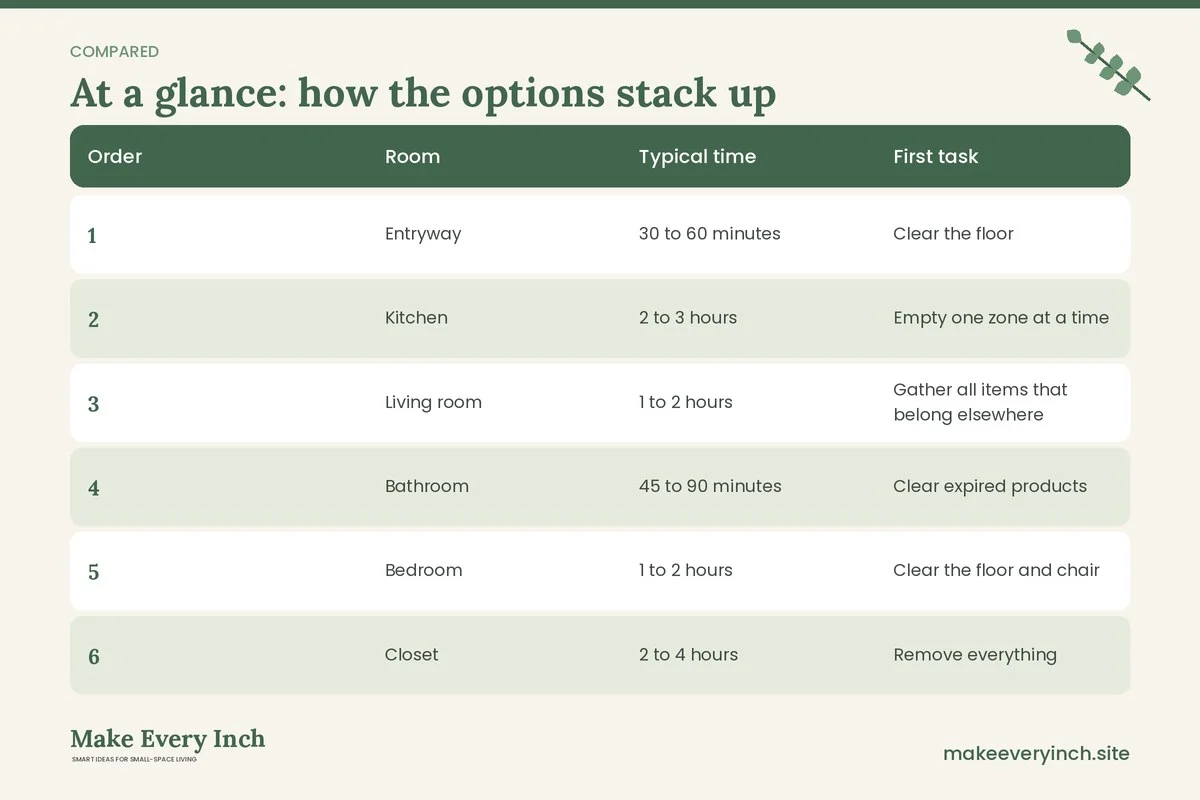
The table below gives rough ranges for a small home of 400 to 900 square feet. Your times will vary with the number of belongings and the number of people in the home.
| Order | Room | Typical time | First task | Done when |
|---|---|---|---|---|
| 1 | Entryway | 30 to 60 minutes | Clear the floor | Every person has a hook and a shoe spot |
| 2 | Kitchen | 2 to 3 hours | Empty one zone at a time | Counters hold only daily items |
| 3 | Living room | 1 to 2 hours | Gather all items that belong elsewhere | Surfaces are clear except for a few items |
| 4 | Bathroom | 45 to 90 minutes | Clear expired products | The sink is empty except for soap |
| 5 | Bedroom | 1 to 2 hours | Clear the floor and chair | Nightstand holds only essentials |
| 6 | Closet | 2 to 4 hours | Remove everything | Every hanger has a purpose |
| 7 | Laundry, storage, paper | 1 to 2 hours | Handle the transit box | No item without a home |
Total for a typical small home is about 8 to 15 hours, spread across two to four weekends or across a few weeks of evenings.
Room-by-room checklists
Use these as working lists. Tick each one as you go.
Entryway checklist
- Take everything off the floor and the hooks.
- Return out-of-season coats and shoes to the closet.
- Keep one pair of shoes per person by the door.
- Install a hook for each person at a height they can reach, with adult hooks around 60 to 65 inches.
- Add a tray or bowl for keys and a small basket for mail.
- Set a rule for sorting mail on the day it arrives.
For more detail, see our guides to small entryway organization, small coat storage ideas and small shoe storage ideas.
Kitchen checklist
- Empty one cabinet or drawer at a time.
- Remove duplicates, broken items and anything unused for a year.
- Group items into zones: cook, prep, clean, bake and serve.
- Store daily items between knee and shoulder height.
- Keep counters for the three or four things you use daily.
- Use the inside of cabinet doors and the wall for light items.
- Check dates in the pantry and group by type.
Our guide to small kitchen organization ideas covers specific products and layouts, and how to organize a small kitchen goes further into the sequence.
Living room checklist
- Collect every item that belongs in another room into the transit box.
- Give media, remotes and chargers a basket.
- Decide where blankets, books and games live.
- Clear the coffee table or side tables to two or three items.
- Use a lidded ottoman or bench for bulky items.
- Check that cables do not cross walkways.
See small living room storage ideas and best storage ottomans for ways to hide things in plain sight.
Bathroom checklist
- Discard expired products, old makeup and empty bottles.
- Sort what remains into daily, weekly and rarely used.
- Keep daily products in easy reach and the rest higher or lower.
- Fold or roll towels to a set number per person.
- Use over-the-toilet or wall storage in place of floor units where possible.
- Check that cleaning products are out of reach of children.
Look at small bathroom organization ideas and best over-the-toilet storage for more.
Bedroom checklist
- Clear the floor, the chair and the dresser top.
- Limit the nightstand to a lamp, a book and a glass.
- Sort the dresser by drawer type: one for underwear, one for tops and so on.
- Use the under-bed space for flat boxes of seasonal items.
- Add a hamper that is easy to use.
- Keep cables tidy and away from the bed.
See small bedroom organization ideas and under-bed storage ideas.
Closet checklist
- Remove everything and sort into keep, donate and unsure.
- Try on anything you doubt.
- Group by type and then by color.
- Use matching hangers to save space.
- Put daily items at eye level and seasonal items above.
- Leave about 20 percent of the rail empty.
Our small closet organization ideas post covers closet hardware and layouts in depth.
Laundry, storage and paper checklist
- Gather cleaning supplies into one caddy.
- Set up a sorting system for laundry, such as two bags or a divided hamper.
- Keep paperwork to an active folder, an archive box and a shred pile.
- Label a single box for batteries, bulbs and tools.
- Make a list of what is stored in any off-site or high shelf storage.
See small laundry room organization for more.
Three example plans
A studio of 400 square feet, done in two weekends
Weekend one covers the entrance, the kitchen and the bathroom, since those take about five hours in total. Weekend two covers the living and sleeping area as one zone, the closet and the miscellaneous box. In a studio the rooms are not separate, so use a floor tape grid in your mind. Treat the bed area, the sofa area and the cooking area as three rooms. The big move is to raise the bed on risers to give 8 to 12 inches below for flat boxes. The total time is about 9 hours.
A one-bedroom of 650 square feet, done in three weekends
Weekend one covers the entrance and kitchen, which take about three to four hours. Weekend two covers the living room, the bathroom and the bedroom. Weekend three covers the closet and paper. This plan leaves a rest day after the heaviest sort. Because the home has distinct rooms, the transit box earns its keep, since items migrate more often. The couple agrees on one rule: each person sorts their own clothes and shares the decision for shared items.
A two-bedroom of 900 square feet with a child, done over four weeks
Evenings of 60 to 90 minutes work better with a child at home. Week one covers the entrance and kitchen. Week two covers the living room and the toy zone, with open baskets at the child’s height. Week three covers the bathrooms and bedrooms. Week four covers closets and paper. Involve the child in sorting toys by choosing a few to keep out, and put the rest in a rotating bin. Anchor any tall furniture in the child’s room to the wall.
How to sort faster in each room
Speed comes from a repeatable routine. Use the same method in every room.
- Empty a single zone. Remove everything from one cabinet, drawer or shelf, and put it on a clear surface.
- Wipe the empty space. A clean surface motivates you.
- Sort into four groups. Keep, donate, discard and relocate.
- Return in order of use. Put back the daily items first and the rare ones last.
- Label if needed. A marker and tape are enough for a first pass.
- Take a photo. A picture of the finished zone is a reference for when drift starts.
Do not start a second zone until the first is finished. Half-finished zones are what make a small home feel worse during an organizing project.
Buying: when and what
Only after a room is sorted should you decide what to buy. Measure the space, count the items per category and choose containers that match. Many rooms need nothing new. When you do need something, choose multipurpose pieces such as a bench with storage or a bed with drawers. Our guides to best beds with storage and small-space storage furniture can help, and cheap storage ideas for apartments covers lower-cost options. If you rent, check the lease before you fix anything to a wall. No-drill storage ideas for renters shows what to use instead.
Safety notes
Anchor tall furniture such as bookcases, wardrobes and shelving units to a wall stud using the hardware supplied, particularly in homes with children or pets. Never drill into walls in a rental without written permission, and check for hidden wiring and pipes before drilling in a home you own. Do not overload shelves beyond their rated weight, and keep heavy items low. Keep electrical outlets, panels and heaters clear. If you paint or refinish a piece while organizing, choose low-VOC products and ventilate the room. Store cleaning products and medicines out of reach of children.
Staying on track
An organized home is a maintained home. After you finish the sequence, use a light routine so the work does not fade.
- Daily: a ten-minute reset, with items returned to their homes.
- Weekly: a five-minute sweep of the transit box and the entrance.
- Monthly: a fifteen-minute check of one room, rotating through the home.
- Seasonally: swap clothes and review what you have not used.
If a room starts to slip, return to its checklist rather than starting again. Because you have already sorted, a refresh usually takes under an hour.
Common questions about sequence
Some people ask whether it is better to do one category across the whole home, such as all clothes, instead of one room at a time. Both methods work. Category sorting suits people with a large amount of one item type, such as books or clothes. Room sorting suits people with limited time, since each room gives a complete, visible result. In a small home, a hybrid works well: use the room order above, but sort clothes and paper by category in the closet stage so that you handle all of them at once.
Another question is how to handle a roommate or partner who does not want to take part. Agree on the shared spaces and leave private spaces alone. Finish the shared rooms first, and a visible improvement often persuades others to join in.
Master checklist
- Set up a staging area with three boxes.
- Gather a simple kit and avoid buying containers.
- Book time blocks in a calendar.
- Write one goal sentence per room.
- Work in order: entry, kitchen, living room, bathroom, bedroom, closet, extras.
- Finish each room before starting the next.
- Sort into keep, donate, discard and relocate.
- Measure before you buy.
- Anchor tall furniture and ask before drilling.
- Take a photo of each finished room.
- Set a daily reset, a weekly sweep and a monthly check.
FAQ
What room should I organize first in a small home?
Start with the entryway, since it is small, high traffic and quick to finish. Then move to the kitchen. If another room causes more daily frustration, begin there instead.
How long does it take to organize a small home?
Most small homes take about 8 to 15 hours in total, spread across two to four weekends or a few weeks of evenings. Closets and paper often take the longest.
Should I organize room by room or by category?
Room by room gives visible results and suits limited time. Category sorting suits large collections. A hybrid, with clothes and paper handled by category, works well in small homes.
Do I need to buy storage before I start?
No. Sort first, measure and count, and then buy only what fits. Many rooms need nothing new. See small home organization mistakes to avoid for why.
What do I do with items that belong in another room?
Place them in a transit box and return them when you finish the room. This keeps you focused and stops you from starting a second job halfway through the first.
How do I keep a small home organized afterward?
Use a ten-minute daily reset, a weekly sweep and a monthly check of one room. A one-in, one-out rule for clothes, mugs and books helps keep the balance.
Keep going: Keep going with our small space organization ideas, the guide to small home organization mistakes to avoid and our list of small apartment decluttering ideas.
Save this guide for later
Pin the ideas you like to Pinterest so you can come back to them when you plan your space.