How to Choose the Best Storage Ottomans: 19 Things to Check
Quick answer: To choose the best storage ottomans, measure the space and the interior volume first, then check the lid style, weight rating, frame construction, upholstery, hinges and how easily it moves. Tape the footprint on the floor, decide whether it will serve as a seat, a coffee table or a footrest, and use the checklist below before you buy.
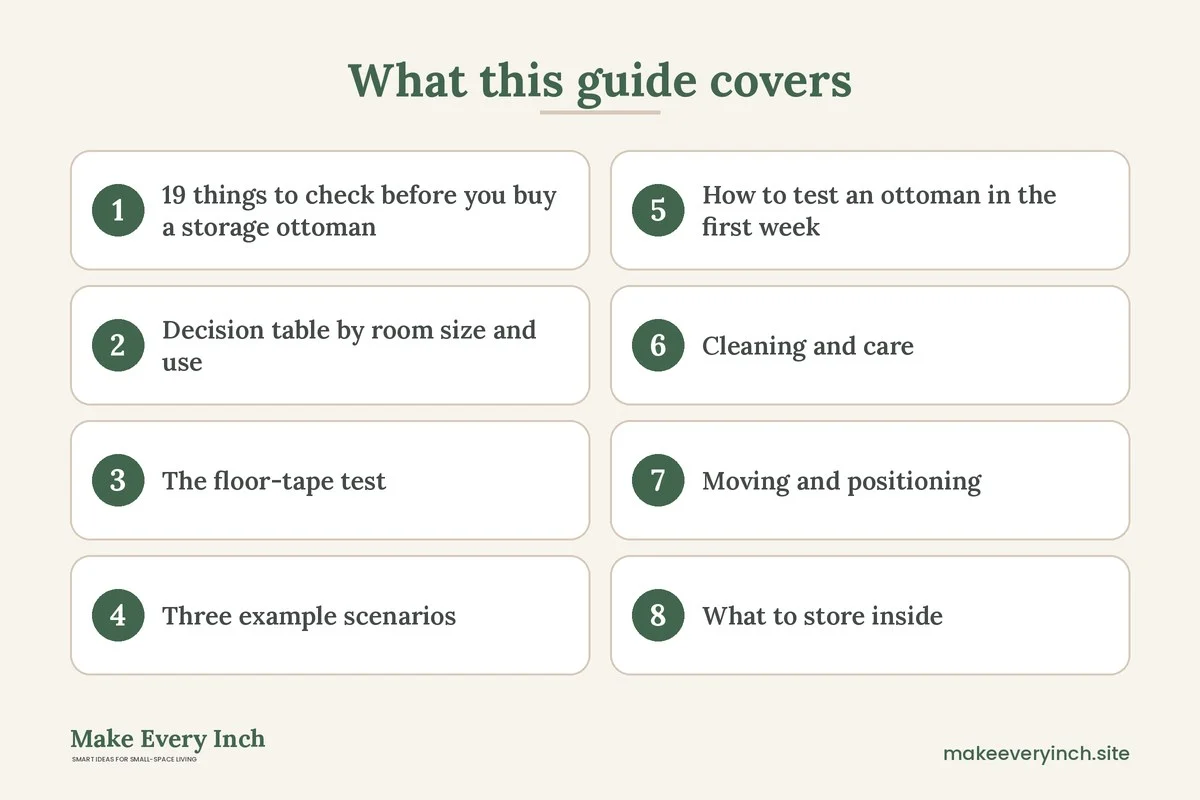
Finding the best storage ottomans for your home is mostly a matter of fit and use, not looks. A storage ottoman can hide blankets, toys, shoes or remote controls, and it can also work as a seat, a footrest or a coffee table, but only if the lid, the frame and the size suit the job. In a small room, one badly chosen piece takes up floor space and delivers little storage. This guide covers 19 checks, a decision table by room size and use, three example scenarios, a floor-tape test, budget ranges, common mistakes, a checklist and an FAQ. To see how an ottoman fits into a wider plan, read our guide to small space storage furniture.
This guide is educational, not a product review. The site does not test or rank specific products, so you will find no brand names or picks here, only the measurements and checks that help you judge any ottoman yourself.
19 things to check before you buy a storage ottoman
1. Decide the main job first
An ottoman that tries to be a coffee table, an extra seat and a toy chest at once usually does all three poorly. Pick the primary job, then treat the others as bonuses. A footrest can be soft and low, a coffee table needs a firm flat top, and a seat needs a sturdy frame.
2. Measure the footprint
Write down the width, depth and height you can spare, including the walking space around it. A common guide for a coffee table is about 14 to 18 inches between it and the sofa. Remember that some ottomans have a lid that opens toward you, so you need clearance for the swing, too.
3. Match the height to your sofa
For use as a footrest or a table, the top should sit within about an inch or two of the sofa seat height, which on many sofas is around 17 to 19 inches. A much taller ottoman makes the room feel crowded and is awkward for the legs. A lower one works well as a table, though it is harder to reach from a deep sofa. See our notes on how to choose sofas for small apartments for seat heights and depths.
4. Calculate interior volume, not exterior size
The outside dimensions overstate the storage. Walls, padding and a base panel can take one to three inches on every side. Measure the inside width, depth and height, and multiply them to get cubic inches. Divide by 1,728 for cubic feet, which makes it easy to compare two ottomans.
5. Pick the lid style
A hinged lid is simple and holds the whole space open, but it needs swing clearance. A lift-off lid is easy to remove and can double as a tray, but it needs somewhere to rest while you dig inside. A flip-top with a tray on the reverse side gives you a table surface, but the cushion side may be thin. Choose the one that matches how often you open it.
6. Check the lid support
Hinged lids that slam shut are a real hazard for small fingers. Look for a lid with a soft-close hinge, a lid stay or a slow-closing support, and check that the hinges are fixed with screws into the frame instead of a staple into thin board. A lid that stays open on its own is much easier to use with full arms.
7. Look at the frame material
Solid wood frames and thick plywood tend to hold their shape for years. Thin particleboard or fiberboard can sag, crack at the corners or loosen around screws. Read the description for the frame material and thickness, and press down on the lid in a showroom if you can. Joints with corner blocks or dowels are a better sign than staples alone.
8. Check the weight rating
Look for a stated rating for the lid or seat, and compare it with how you will use it. A footrest needs very little, an extra seat for an adult needs a much higher rating, and a coffee table that holds a laptop and drinks needs a firm, flat top. If no rating is listed, ask the seller, and assume a soft lid is not made for standing or sitting.
9. Choose the upholstery for your lifestyle
Tightly woven fabrics, performance fabrics and faux leather generally clean up more easily than loose weaves, velvet or linen. If you have pets, avoid loops that catch claws. If you have children, choose a wipeable surface and a color that hides marks. Check for removable covers or for a cleaning code on the label.
10. Check the padding and the lid firmness
Foam gives a firm, even surface. Fiberfill can feel plush but may dent and flatten. For a table, choose a firm lid, and for lounging, choose a softer one. Press on the center and the edges, since poor padding often shows as a hollow in the middle or a sharp edge underneath.
11. Look at the feet and base
Feet raise the base off the floor, which helps airflow and keeps the bottom away from spills. Wood or metal feet should be fixed with proper hardware, not just glued. Check whether the feet have protective pads, as bare feet scratch hardwood. A flat base with felt works well on rugs, while legs look lighter in a small room.
12. Think about the shape
A square or rectangle uses the corners well and holds more. A round ottoman is kinder to knees in a tight walkway and works well in a corner, but it is less efficient to store things in and does not push flush against a wall. A bench shape suits the end of a bed or the entry. Choose the shape that matches your traffic path.
13. Check how it holds up when moved
If you plan to slide it between rooms or into a closet, check the weight when empty. Handles, or a lid that you can lift off, make life easier. Sliding a heavy piece across a floor wears both. Furniture sliders or low-friction pads under the feet protect the floor.
14. Look for ventilation and moisture protection
Blankets and sweaters kept in a closed box can smell stale. Look for a lining that breathes, a few small vent holes or a base that is raised. Avoid storing damp items. If the ottoman will sit in a basement or near a window, a moisture-resistant lining or base helps.
15. Assess assembly
Many ottomans come flat-packed. Check whether it needs tools, how many people it takes and whether the instructions include a parts list. Tighten all the screws again after a few weeks, since upholstered frames can loosen with use. A pre-assembled one costs more but avoids the guesswork.
16. Check the interior features
Dividers, a removable tray or fabric bins keep small items from sinking to the bottom. A simple interior with a smooth lining protects delicate things. If you plan to store books, check that the base is rated for the weight. A low interior with a tray suits remotes and magazines, and a tall one suits bulky throws.
17. Consider modular or nesting options
Two small ottomans that nest or sit together can replace one large coffee table and can be separated for guests. They also make it easier to move around. Nesting designs trade away some storage but offer flexibility in a small living room. For a related idea, see small living room ideas without a coffee table.
18. Check the safety details
Look for rounded corners if you have toddlers, and a lid that does not trap a child. Never let a child hide inside a lidded box. Choose a design with a gap or an air hole, or a lid that cannot latch from the outside. Read the care label for any flame-retardant treatments, if that matters to you.
19. Read the return and warranty terms
Furniture often has a restocking fee or a return window that is short. Check who pays for return shipping, as it can be expensive for a bulky item. Look for a stated warranty on the frame and the hinges, and keep the receipt and the packaging until you are sure about the fit.
Decision table by room size and use
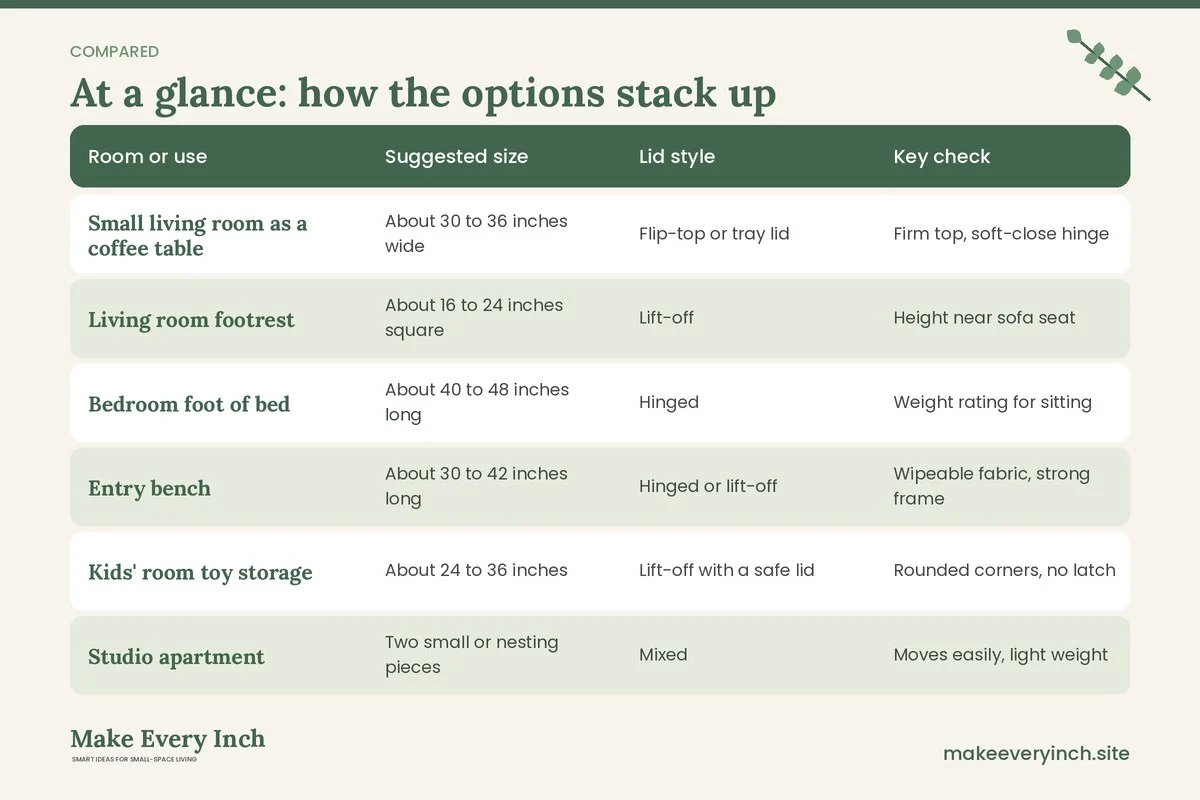
| Room or use | Suggested size | Lid style | Key check |
|---|---|---|---|
| Small living room as a coffee table | About 30 to 36 inches wide | Flip-top or tray lid | Firm top, soft-close hinge |
| Living room footrest | About 16 to 24 inches square | Lift-off | Height near sofa seat |
| Bedroom foot of bed | About 40 to 48 inches long | Hinged | Weight rating for sitting |
| Entry bench | About 30 to 42 inches long | Hinged or lift-off | Wipeable fabric, strong frame |
| Kids’ room toy storage | About 24 to 36 inches | Lift-off with a safe lid | Rounded corners, no latch |
| Studio apartment | Two small or nesting pieces | Mixed | Moves easily, light weight |
The floor-tape test
Before you spend money, mark the footprint of the ottoman on the floor with painter’s tape, using the outside width and depth. Then add a second line to show the open lid, and a third to show the walking space around it. Leave the tape down for two or three days and live with it. Walk the main paths, open a door and sit on the sofa. If you bump the tape often or the lid line blocks something, choose a smaller or a round shape.
You can also cut a cardboard box or a paper template to the height. Place it in front of the sofa and put a book and a cup on it. That shows you whether the height works for reaching and for resting a drink, and it costs nothing.
Three example scenarios
A 10 by 12 foot living room
A small sofa and a chair leave about three feet in front for the table. A rectangular ottoman about 30 inches wide with a tray lid replaces the coffee table, and holds throws and game controllers. The choice that matters most here is a firm top and a soft-close hinge, since the lid opens toward a sofa that is only about 16 inches away.
A studio with a bed at one end
A 40 to 48 inch bench ottoman at the foot of the bed stores spare bedding and out-of-season clothes. It must carry an adult sitting down to put on shoes, so the weight rating and the frame come first. Check that the lid can open fully without hitting the bed frame. Our guide to beds with storage shows how it can complement a bed that already has drawers.
A narrow entry
A slim bench with a lift-off lid holds shoes and bags, and gives a place to sit. A wipeable surface and a base that stays off wet floors matter more than plush padding. If your entry is tight, a round or a small square piece leaves room for the door to swing. See small entryway storage ideas for more combinations.
How to test an ottoman in the first week
Open and close the lid twenty times and listen for squeaks or a lid that drifts. Sit on it if the rating allows, and push on the corners. Fill it with the items you plan to store and check that the lid closes without a bulge. Look for a smell from the lining, loose threads, wobble at the feet and uneven seams. If you find a flaw, report it in the return window and photograph it for the seller.
Cleaning and care
Vacuum the surface with a soft brush every week or two, and treat spills at once by blotting, not rubbing. Follow the cleaning code on the label, as water can stain some fabrics. Rotate the lid or the cushion if it is reversible, to spread wear. Wipe the interior and leave the lid open now and then to air it out. Use a protective spray only if the manufacturer says it is safe for the fabric.
Moving and positioning
Empty the ottoman before moving it, and lift by the frame rather than the lid. Use sliders on hard floors. Keep it away from radiators, vents and direct sun, which fade fabric and dry out the foam. In a small room, push it against the wall when you want extra space, and bring it forward for guests. Our piece on hidden storage ideas has more ways to make furniture work twice.
What to store inside
Soft, light items suit most ottomans: blankets, pillows, board games, spare linens and kids’ toys. Keep heavy items low and in the center. Do not store food, damp items or anything that could attract pests. Label bins so that you can find things fast. Keep the items you use weekly near the top, and the seasonal ones at the bottom. For bedding that you want to keep flat, look at under bed storage ideas.
Budget guide
Prices vary by region, retailer and season, so treat these ranges as rough guides, not facts.
Lower budget
Ottomans in this range are often lighter and use thinner board or foam, and may be flat-packed. They can serve a footrest well. Check the hinge and the weight rating with extra care.
Mid-range
You are more likely to find sturdier frames, better fabrics, soft-close hardware and removable parts. This is a sensible range for a coffee table or an entry bench that gets daily use.
Higher budget
Expect solid wood frames, high-quality upholstery and finishing details. It is worth paying more for hardware and the frame, not for decoration alone. Compare return terms at any price.
Mistakes to avoid
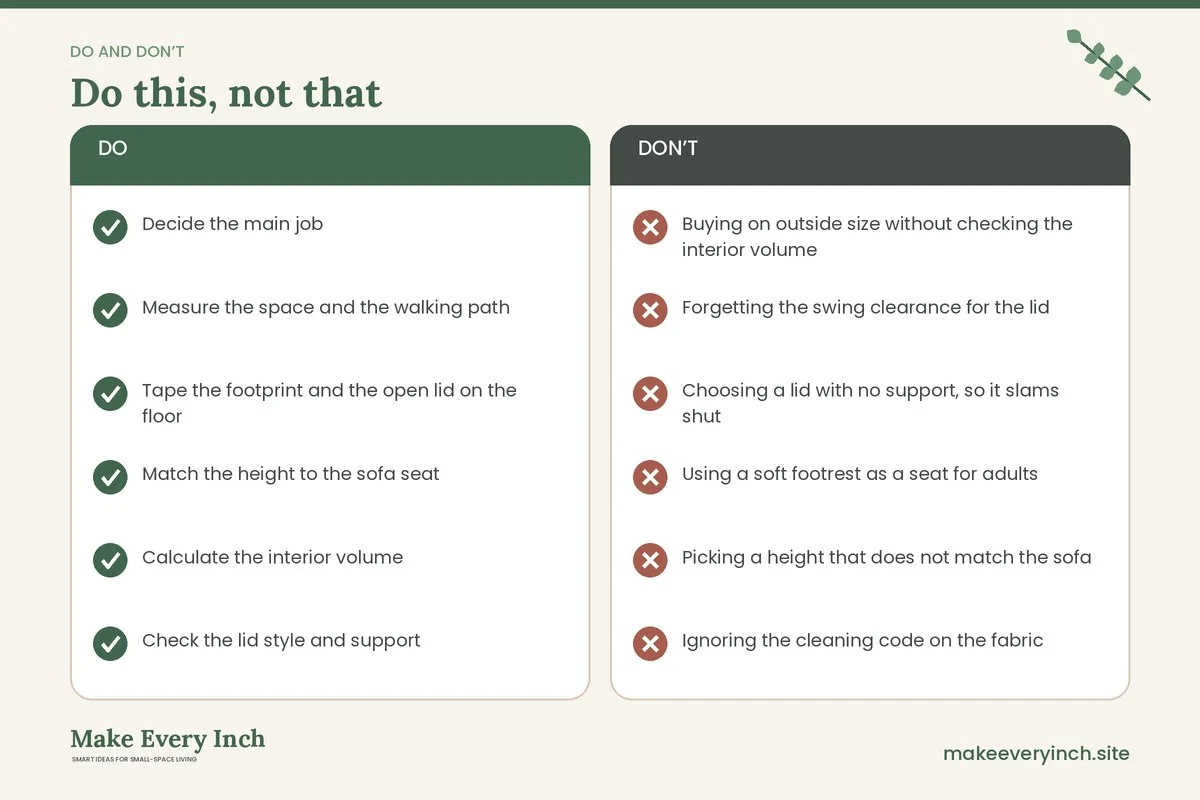
- Buying on outside size without checking the interior volume
- Forgetting the swing clearance for the lid
- Choosing a lid with no support, so it slams shut
- Using a soft footrest as a seat for adults
- Picking a height that does not match the sofa
- Ignoring the cleaning code on the fabric
- Storing damp items in a closed box
- Skipping the floor-tape test
Storage ottoman checklist
- Decide the main job
- Measure the space and the walking path
- Tape the footprint and the open lid on the floor
- Match the height to the sofa seat
- Calculate the interior volume
- Check the lid style and support
- Confirm the frame material and weight rating
- Choose a cleanable upholstery
- Check the feet and floor protection
- Read the assembly notes and tools needed
- Review the safety details for children
- Read the return and warranty terms
FAQ
How big should a storage ottoman be?
It depends on the job. As a coffee table, it is often about 30 to 36 inches wide. As a footrest, a smaller square works. Measure your room and tape the footprint before you decide.
How tall should a storage ottoman be?
For a footrest or a table, aim for a top within an inch or two of your sofa seat height. Many seats sit around 17 to 19 inches high, but measure your own.
Can I sit on a storage ottoman?
Only if the maker states a weight rating for sitting. Soft lids and thin frames are often meant for feet and light items only. Check the rating before you let adults sit.
What is the best lid style?
There is no single best. Hinged lids are convenient, lift-off lids are simple and flip-tops give a table surface. Match the style to the clearance you have and how often you open it.
What fabric is best for a storage ottoman?
Tightly woven fabrics and wipeable coverings are generally easier to clean. Avoid loose weaves if you have pets, and check the care label.
How do I stop the lid from slamming?
Choose a soft-close hinge or a lid stay when you buy. You can sometimes add a lid support later, but the frame must be strong enough to hold the screws.
Is a storage ottoman safe for children?
It can be, with rounded corners and a lid that cannot latch from outside. Never allow children to play inside, and use a slow-closing hinge to protect little fingers.
How do I keep an ottoman from smelling?
Store only clean, dry items, leave the lid open now and then and choose a lining that breathes. A small sachet or a cedar block can help, and a raised base improves airflow.
Keep going: Keep exploring with our small living room storage ideas, small living room furniture ideas and guide to choosing a small-space sofa.
Save this guide for later
Pin the ideas you like to Pinterest so you can come back to them when you plan your space.