How to Choose the Best Small Dressers: 19 Things to Check
Quick answer: The best small dressers fit the wall with room to open drawers, use drawers deep enough for what you fold, have full-extension slides and solid joinery, and come with tip-over anchoring you actually install. Measure the wall, the drawer pull space and the delivery path, tape the footprint on the floor and count your folded clothes before you buy.
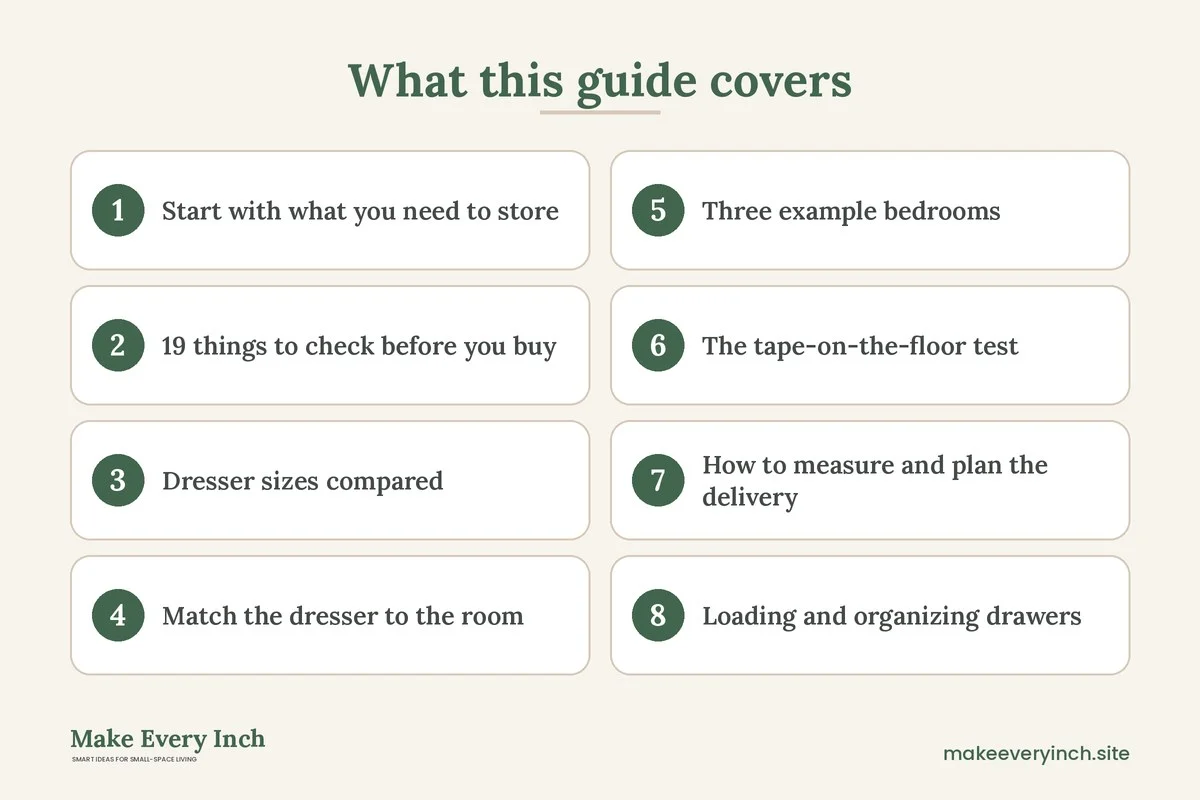
The best small dressers give a bedroom a home for clothes without eating the floor. In a small room, a dresser is often the largest piece after the bed, so a few inches of width or depth change how the whole room works. This guide gives you 19 things to check before you buy, a table that matches sizes to rooms, three example bedrooms, a tape-on-the-floor test, a hedged budget guide, a mistakes list and a checklist. For the wider picture, see our ideas for small bedroom storage.
This guide is educational, not a product review. We do not test or rank specific products, and we name no brands or models, so everything below is about how to judge any dresser you find.
Start with what you need to store
Before you look at a single listing, empty a drawer or two and measure what you really keep. Count folded T-shirts, sweaters, jeans, pajamas, socks and underwear, and decide which of them must live in a dresser and which can hang or go under the bed. A person who hangs most clothes needs far less dresser than someone with no closet.
Then decide how you want to use the top. A dresser that doubles as a nightstand, a TV stand or a vanity has to be the right height and sturdy enough for the load. Write down the job, the items and the room size, and the rest of the choices get easier.
19 things to check before you buy
Dimensions and clearances
1. Width
Most small dressers run roughly 24 to 36 inches wide, while a standard double dresser can be 55 to 60 inches or more. Measure the wall, and leave a few inches on each side so the piece does not look jammed. If the dresser sits between a bed and a door, check that you can still walk past it.
2. Depth
Depth steals floor space more quietly than width. Many dressers are 15 to 20 inches deep, and some are deeper. In a narrow room, even 3 inches of extra depth can block a path, so compare depths carefully and do not rely on width alone.
3. Height
A low, wide dresser gives a long top surface, and a tall, narrow chest fits more drawers on a smaller footprint. Check the height against windows, wall art, sloped ceilings and a TV if you plan to mount one. Counter-height tops, around 30 to 36 inches, are comfortable for standing tasks, and lower tops suit a bench or a mirror.
4. Drawer pull-out space
The footprint is not the full story, since drawers need clearance to open. A drawer that opens 14 to 18 inches into the room needs that space free. Measure from the dresser front to the bed, the closet door or the opposite wall, and make sure you can stand at the drawer and bend or crouch.
Drawers and function
5. Tall versus wide
A tall chest of five or six drawers suits a narrow wall and a small floor plan. A wide, low dresser spreads the load, offers more top space and keeps heavy items low. If the ceiling is low or the wall has a window, wide and low may fit better, and in a small footprint, tall often wins.
6. Drawer count versus drawer depth
More drawers do not always mean more storage. Many drawers are shallow at 4 to 5 inches, which is fine for socks and underwear, and not for bulky sweaters. Check the interior depth of each drawer, not the face height, and match it to what you fold. A mix of two or three shallow drawers plus deeper ones is usually practical.
7. Drawer box construction
A drawer box made of solid wood or plywood and joined with dovetails or tight dowels handles weight better than a thin panel held by staples. Run a hand along the inside, since smooth, sanded edges protect clothes from snags. Thin hardboard bottoms can sag under heavy loads, so look for a bottom panel that sits in a groove.
8. Slides and runners
Side-mounted ball-bearing slides often feel smooth and carry more weight. Undermount slides hide beneath the box and look neat, and wood-on-wood glides are simple and can last if they are waxed. Look for full-extension slides, which let the drawer come all the way out so you can reach the back. Soft-close action prevents slamming, which helps in a shared apartment.
9. Drawer stops and ease of removal
A good drawer has a stop that keeps it from falling out when you pull hard. It should also come out and go back in without a fight, which helps when you move, clean or fix a track. Check how the drawer lifts out, and whether it has a lock or a child-resistant feature.
10. Drawer capacity and weight rating
Some listings state a weight limit per drawer and for the top. Clothes are heavier than they look, and a full drawer of jeans can weigh a lot. Fill drawers evenly, and keep the heaviest items in the lower drawers.
Safety
11. Tip-over risk and anchoring
Tip-over is the main safety risk with any dresser, and children are the most vulnerable. Look for a stated compliance with the current US tip-over standard for clothing storage, and use the anchoring kit that comes with the piece. Fasten it into a wall stud when you can, or use rated anchors for drywall, and do not rely on weight alone. Renters can ask the landlord about small anchor holes, since many accept them for safety.
12. Weight and stability
A heavy dresser is more stable, though it is harder to move and may need two people. Check the weight in the listing, and confirm that the feet sit flat and level. If you plan to put a TV on top, check the maximum load, and anchor the TV as well.
13. Interlocking drawers
Some dressers have a mechanism that allows only one drawer to open at a time. This lowers the chance of pulling out several drawers, which shifts the center of gravity forward and can lead to a tip-over. Treat it as a bonus, and still anchor the piece.
Build and materials
14. Frame and panel materials
Solid wood is strong and can be refinished, but it is heavy and costs more. Plywood is stable and light for its strength. Particleboard and MDF with veneer or laminate are common at lower prices and can look good, though they are heavier than they seem, chip at corners and hold screws less well when you move the piece. Check for a solid back panel and a sturdy top.
15. Finish and indoor air
Composite wood and finishes can release small amounts of formaldehyde and other volatile compounds, especially when new. Look for a stated compliance with US formaldehyde rules for composite wood, such as a TSCA Title VI label, and consider letting a new piece air out in a ventilated room before you load it. Claims of low emissions vary, so treat them as hints and not as proof.
16. Feet, legs and floor protection
Legs give a light, airy look and let you vacuum underneath, while a plinth base is stable and has no gap for lost items. Check the feet for felt pads or rubber tips, and level the piece on uneven floors. On a carpet, low legs can sink, and a base with a wider footprint may hold better.
Delivery and assembly
17. Staircase and doorway delivery
Measure doorways, hallways, stair width, landings and turns on the route, not just the room. A fully assembled dresser can be too large for a tight stairwell, and a flat-pack one gets through more easily. Ask whether the seller will carry it upstairs and whether drawers can be removed to lighten the load. Plan for a door that can come off its hinges.
18. Assembly effort
Flat-pack dressers can take a couple of hours and need a second person for the final standing. Check whether the instructions are clear, whether the back panel is nailed or screwed, and whether the hardware can be tightened again after a move. Keep spare screws in a labeled bag.
19. Style, top surface and daily use
The top will take drinks, jewelry boxes, lamps and phone chargers. A water-resistant finish, a rim or a tray helps, and a flat top without a lip works better as a bench or a desk. Choose pulls that do not snag sleeves, and check that the color suits your floor and walls. For more bedroom ideas, see small bedroom furniture ideas.
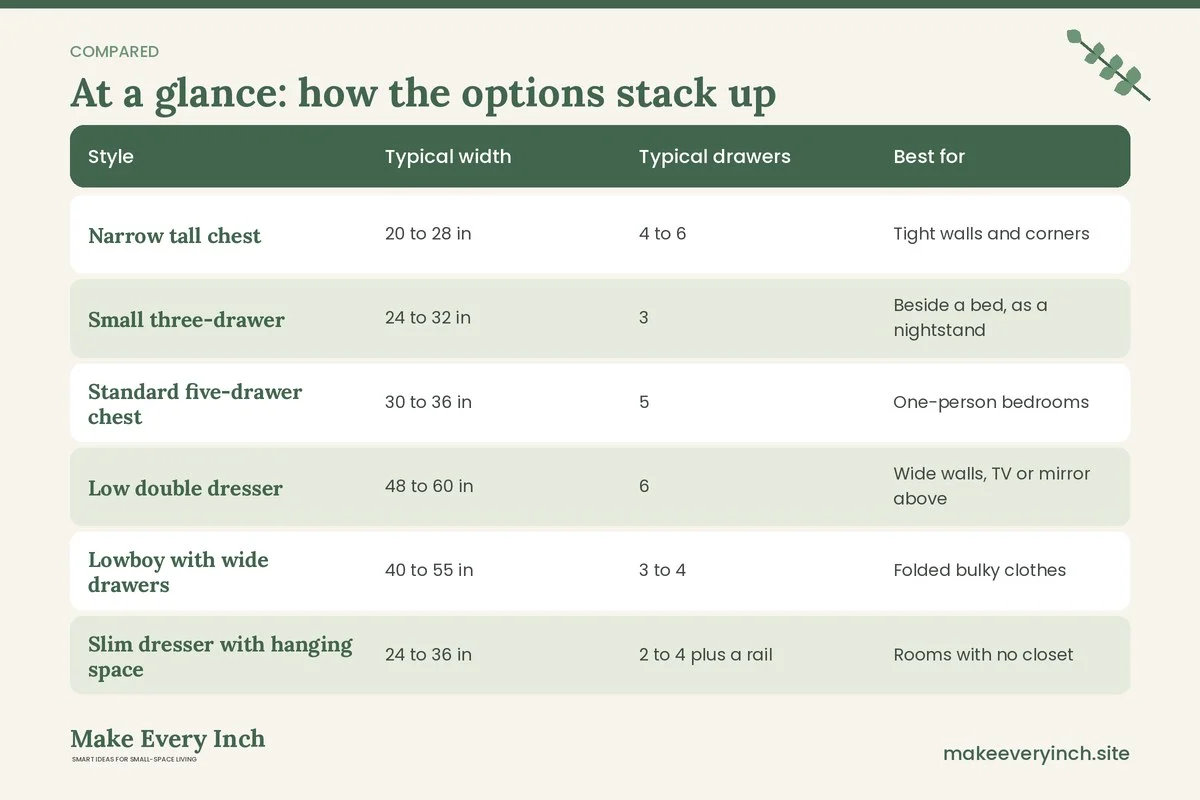
Dresser sizes compared
| Style | Typical width | Typical drawers | Best for | Watch for |
|---|---|---|---|---|
| Narrow tall chest | 20 to 28 in | 4 to 6 | Tight walls and corners | Tip-over risk, so anchor it |
| Small three-drawer | 24 to 32 in | 3 | Beside a bed, as a nightstand | Shallow capacity |
| Standard five-drawer chest | 30 to 36 in | 5 | One-person bedrooms | Depth and height |
| Low double dresser | 48 to 60 in | 6 | Wide walls, TV or mirror above | Floor space and weight |
| Lowboy with wide drawers | 40 to 55 in | 3 to 4 | Folded bulky clothes | Heavy and hard to move |
| Slim dresser with hanging space | 24 to 36 in | 2 to 4 plus a rail | Rooms with no closet | Small interiors |
Match the dresser to the room
| Room situation | Suggested style | Clearance to plan | Main concern |
|---|---|---|---|
| Bedroom under 100 square feet | Narrow tall chest | At least 30 in in front | Tip-over and wall space |
| Bedroom with a window wall | Low dresser under the sill | Height below the sill | Curtains and radiators |
| Studio with a bed in the room | Small chest as a room divider or nightstand | Space to open drawers | Back panel finish |
| Room with no closet | Two chests or a tall chest plus a rail | Space for hangers | Capacity and layout |
| Rental with steep stairs | Flat-pack, or drawers that remove | Stair width and turns | Delivery and assembly |
| Kid’s room | Low, anchored dresser with stops | Clear floor for play | Safety and easy-grip pulls |
Three example bedrooms
A 9-by-10 bedroom with a queen bed
The bed sits against one wall, and one free wall is about 36 inches wide. A narrow chest of five drawers fits, with 16 inches of depth and about 30 inches of clearance in front. The owner folds sweaters in two deeper drawers and uses the top for a lamp and a tray. The chest is anchored to a stud, and the bed slides in beside it. Add under-bed storage ideas for off-season items.
A studio with no closet
Here the dresser has to hold almost everything. Two narrow chests side by side, each 28 inches wide, form a tidy block, with a rail on the wall for hanging clothes. The chests are anchored together and to the wall. The shallow drawers hold socks and underwear, and the deep ones hold jeans and sweaters. See our ideas for bedrooms without a closet.
A kid’s room that has to last
A low, wide three-drawer dresser keeps weight near the floor and gives a surface for books. Pick drawers with stops, rounded edges and easy-grip pulls, and anchor the piece to the wall from day one. As the child grows, the same dresser can take larger clothes, and later it can move to a hallway or a living room.
The tape-on-the-floor test
Before you buy, mark the dresser’s footprint on the floor with painter’s tape, using the width and depth from the listing. Then mark a second outline in front of it for the drawer pull-out space. Stand in the taped area, open the bedroom door, walk past the bed and sit on the edge of the bed. If you hit the tape, size down. Cut a cardboard box to the dresser’s height, or stack boxes to the same height, to see how it looks against the window, the outlets and the wall art. Also confirm that the outlet and the light switch stay reachable.
How to measure and plan the delivery
Measure the room
Write down the wall width, the ceiling height, the heights of windows, baseboards and outlets, and the position of radiators and vents. Measure the baseboard depth too, since a thick baseboard keeps the back of the dresser away from the wall by a small gap, which matters for the anchor strap.
Measure the route
Check every door width, the narrowest point of the stairwell, landings and turns. A flat-pack box can be heavy and tall, so also check how it will pass through an elevator. Ask for the packaged dimensions, and compare them with your route.
Plan the first day
Clear the room, lay a blanket on the floor and have a helper ready. Assemble the dresser where it will stand if it is heavy, and level it. Anchor it on day one, before loading drawers, and wait a day before you fill them so any air from new finishes can settle.
Loading and organizing drawers
Put the heaviest items in the bottom drawers, which lowers the center of gravity. Fold clothes in the file style, standing upright in rows, so you can see everything when you open the drawer. Use dividers for socks and underwear, and use a drawer liner to stop items sliding. Do not overfill a drawer to the point that it jams or bows the bottom panel, and keep delicate items off the bottom of a stack.
Moving and care
Empty the drawers before you move the dresser, and take the drawers out to carry them separately. Tape or tie the empty drawers if you leave them in place, and cover corners with blankets. Dust the top weekly, wipe spills at once and use coasters under cups. Wipe the drawer slides with a dry cloth and add a light lubricant that suits the type of slide if they feel rough. Check the anchor and the screws every few months, since movement can loosen them. In a humid room, leave a little space behind the dresser so air can move.
Budget guide
Prices vary by region, material and size, so treat these as hedged ranges and not as quotes.
Lower range
Flat-pack chests in particleboard or MDF are often found at the lower end. They can work well in a small room when you assemble them carefully, anchor them and avoid moving them often.
Middle range
Plywood construction, better slides, soft-close drawers and sturdier backs usually show up in the middle of the market. This is often the best range for a piece you want to keep for years.
Higher range
Solid wood, dovetail joints, fine finishes and handmade details usually cost more. A higher price can mean longer life, though it does not replace the checks above, so verify the construction and the anchoring in every case. A secondhand solid-wood dresser can be a good value if the drawers slide well and the frame is firm.
Mistakes to avoid
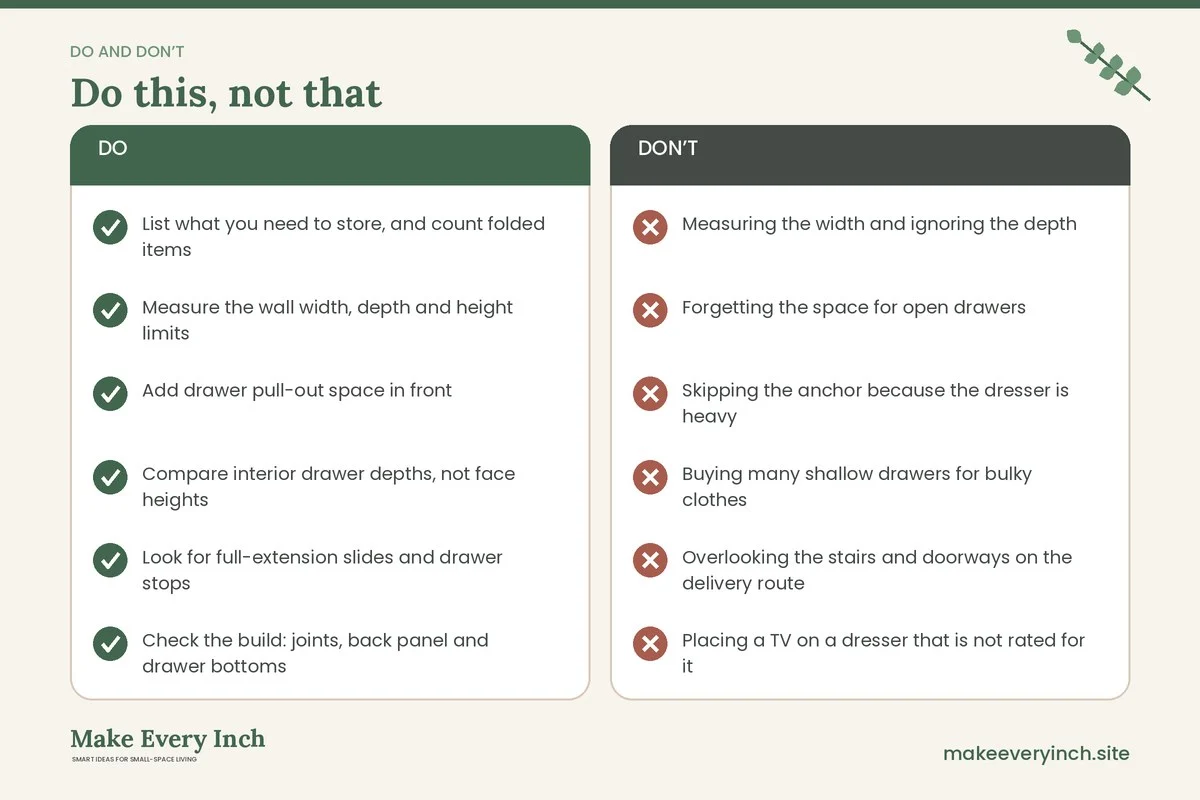
- Measuring the width and ignoring the depth
- Forgetting the space for open drawers
- Skipping the anchor because the dresser is heavy
- Buying many shallow drawers for bulky clothes
- Overlooking the stairs and doorways on the delivery route
- Placing a TV on a dresser that is not rated for it
- Opening several drawers at once on an unanchored piece
- Choosing a finish that has a strong smell and not airing it out
- Ignoring the baseboard gap behind the piece
Small dresser pre-purchase checklist
- List what you need to store, and count folded items
- Measure the wall width, depth and height limits
- Add drawer pull-out space in front
- Compare interior drawer depths, not face heights
- Look for full-extension slides and drawer stops
- Check the build: joints, back panel and drawer bottoms
- Confirm the tip-over compliance and the anchoring kit
- Find studs, or buy rated drywall anchors
- Check the weight rating if a TV is planned
- Review the material and finish information
- Measure doors, stairs and turns along the route
- Tape the footprint on the floor
- Check the assembly time and the return policy
FAQ
What size is a small dresser?
There is no formal size, though many small dressers are about 24 to 36 inches wide and 15 to 20 inches deep. Measure your wall and the space for open drawers before you pick one.
How many drawers do I need?
Count what you fold. Many people do well with four to six drawers in a narrow chest, and fewer if they hang most clothes. Check the interior depth as well as the count.
Do I really need to anchor a dresser?
Yes, anchoring is a sensible safety step for every dresser, especially in homes with children, whatever the weight. Use the supplied kit, and find a stud when you can.
Can I anchor a dresser in a rental?
Many landlords accept small anchor holes for safety, and small holes can be patched at move-out. Ask in writing, and photograph the wall. See our renter-friendly apartment decorating ideas for more low-damage choices.
What is better, a tall or a wide dresser?
A tall chest saves floor space and suits narrow walls. A wide dresser is steadier, has a bigger top and keeps weight low. Choose by wall shape and ceiling height.
Which drawer slides are best?
Full-extension ball-bearing slides are a common choice for heavy loads, and soft-close adds comfort. Undermount slides look clean. Wood glides can be fine if well made and waxed.
Is a particleboard dresser a bad choice?
Not necessarily. It can suit a budget and a small room if it is anchored and not moved often. It handles repeated moves worse than plywood or solid wood, so check the joinery and the back panel.
Can a dresser replace a nightstand?
Yes, a small three-drawer chest beside the bed works as a nightstand with more storage. Check the top height against the mattress and the lamp, and see best beds with storage for another way to add drawers.
Keep going: Keep planning with our guides to small bedroom furniture ideas, small bedroom storage ideas and best storage ottomans.
Save this guide for later
Pin the ideas you like to Pinterest so you can come back to them when you plan your space.