How to Choose the Best Desks for Small Apartments: 19 Things to Check
Quick answer: The best desks for small apartments fit the wall space you have, sit at a comfortable working height of roughly 28 to 30 inches, give you about 40 to 48 inches of width for a laptop setup, and handle cables and storage without crowding the room. Measure, cut a paper template, and match the desk type to how many hours you work each day.
The best desks for small apartments do two jobs: they give you a proper place to work, and they disappear into the room when the day ends. In a studio or one-bedroom, that means choosing between a wall-mounted desk, a secretary desk, a compact writing table, a standing option or a corner unit, and then checking whether the size, height and stability suit your body and your routine. This guide shows how to choose: what to measure, how to set up a screen and chair, what to look for in construction and cable handling, and how to test a desk before you buy. For ideas on where a desk can go, see our guides on small bedroom desk ideas and small bedroom furniture ideas.
This guide is educational, not a product review. The site does not test or rank specific products, so use the checks below to compare any desk you find.
Start with how you work
Be honest about your hours. Someone who answers email for an hour a night needs a very different desk from someone who works eight hours a day with two screens. List what must fit on the surface: a laptop, a monitor, a keyboard, a notebook, a lamp, a printer or a sewing machine. Also decide whether the desk has to share space with meals, a bed or a living room.
Then measure the spot. Note the width and depth of the wall or nook, the height of any window sill, the location of outlets and the swing of doors. Remember that you also need room for a chair, and that the chair needs room to roll back.
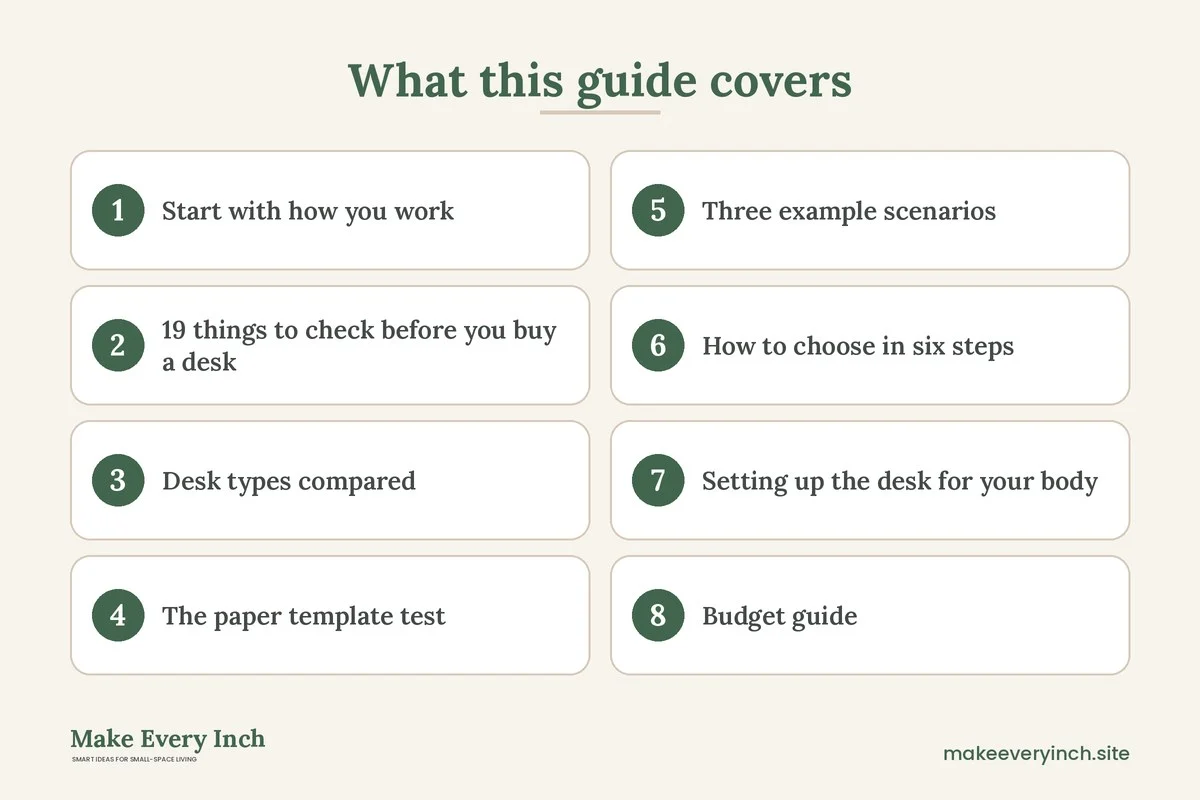
19 things to check before you buy a desk
Size and fit
1. Width for the way you work
For a laptop and a notebook, 36 to 40 inches is workable. For a monitor, keyboard and some paper, 40 to 48 inches is more comfortable. Two monitors or a large drafting area usually need 55 inches or more, which is hard to fit in a small apartment.
2. Depth for screen distance
Depth of 20 to 24 inches suits a laptop. A desktop monitor sits best at an arm’s length away, so aim for 24 to 30 inches deep if you use a full-size display. A shallow desk of under 20 inches is fine for a laptop, but it pushes a monitor too close to your face.
3. Chair clearance
Leave at least 36 inches behind the desk for the chair to move and for you to stand up. In a tight room, 30 inches is a minimum if the chair does not roll much. A chair that tucks fully under the desk can save a lot of room.
4. Knee and leg room
Look at the height of the apron or drawer under the desktop, and at the legs or panels that sit at the sides. You want at least 24 to 27 inches of clear space under the desk for knees, and 20 inches or more between the legs for width. A drawer cabinet on one side is fine, but a center drawer can bump your thighs.
5. Desk height
Most fixed desks sit between 28 and 30 inches high. That suits many people of average height, but a shorter or taller person may need an adjustable chair, a footrest or a height-adjustable desk. Your elbows should rest at about 90 degrees when your hands are on the keyboard.
Types for tight rooms
6. Wall-mounted floating desks
A wall-mounted desk folds up or hangs on brackets, and leaves the floor clear underneath. It needs solid wall backing, studs or heavy-duty anchors, and many leases ban drilling. Check the weight rating, and confirm that the desk will not flex under a monitor.
7. Secretary desks
A secretary desk has a drop-down front that closes to hide the work surface, and often has pigeonholes and shelves inside. It suits people who want to close the office at night. Check that the writing surface is deep enough for a laptop when it is open, and that the hinge supports the weight.
8. Compact writing tables
A slim table with simple legs and one drawer works as a desk and as a console. It is light and easy to move, and it looks at home in a living room. It offers little storage, so plan for a drawer organizer or a nearby shelf.
9. Corner desks
A corner or L-shaped desk makes use of a dead corner and gives two work surfaces. Check which side the return sits on and whether it can be flipped. An L-shaped desk can consume more floor than it seems, so tape the footprint first.
10. Standing and height-adjustable desks
A sit-stand desk lets you change position through the day. Look for a stable frame with a stated weight capacity, a smooth motor or crank and a range that fits your height seated and standing. A small desktop converter that sits on an existing desk is a lower-footprint option, but it raises the keyboard and the screen together.
11. Desks with built-in shelves and hutches
A hutch moves storage up and keeps the surface clear. It also adds weight and a risk of tipping if it is loaded high. Check the shelf depth, the load rating and the anchor points for the wall.
Ergonomics and comfort
12. Monitor distance and height
Place the screen about an arm’s length from your eyes, which is roughly 20 to 30 inches. The top of the screen should sit at or slightly below eye level. A laptop on a stand with a separate keyboard helps your neck, and a desk deep enough for that arrangement is more useful than a wide one.
13. Keyboard and wrist position
The keyboard should sit so your forearms are level, and your wrists are straight. Avoid a desk with a thick front edge that pushes your wrists up. A rounded or beveled edge is more comfortable for long sessions.
14. Chair fit with the desk
A good chair at the wrong height cancels the desk’s benefit. Check that your feet rest flat on the floor, or on a footrest, and that your thighs are roughly level. Armrests should slide under the desk, so confirm the clear height under the apron.
Construction, storage and care
15. Stability and wobble
Press down on the corners and push sideways. A desk with metal braces, a back panel or thick legs will wobble less than a thin top on skinny legs. Wobble gets worse when you type, so look for a rigid frame, especially on a standing desk.
16. Cable management
Check for grommet holes, a cable tray, a back panel with an open slot or a hollow leg. Plan where the power strip will sit, and how far the cord reaches the wall. A raised desk shelf or a clip under the edge keeps cables off the floor and away from the chair wheels.
17. Drawers and storage
A shallow drawer holds pens, chargers and notebooks, while a file drawer needs a deeper cabinet. In a small apartment, a rolling cart under the desk can replace a fixed cabinet. Check the drawer slides, the stops and the tilt behavior when a drawer is open.
18. Materials and finish
Solid wood is durable and repairable, but it is heavy and costs more. Engineered wood with veneer or laminate is lighter and cheaper, and resists wear when well made, though the edges can chip. Glass tops look airy in a small room but show fingerprints and need a safe edge.
19. Assembly, moving and tip-over safety
Many desks come flat-packed, so check the number of parts, the weight of the heaviest box and the tools needed. Heavy hutches, tall shelves and bookcase-style desks should be anchored to a wall where allowed. Keep the box and instructions if you may move within a year.
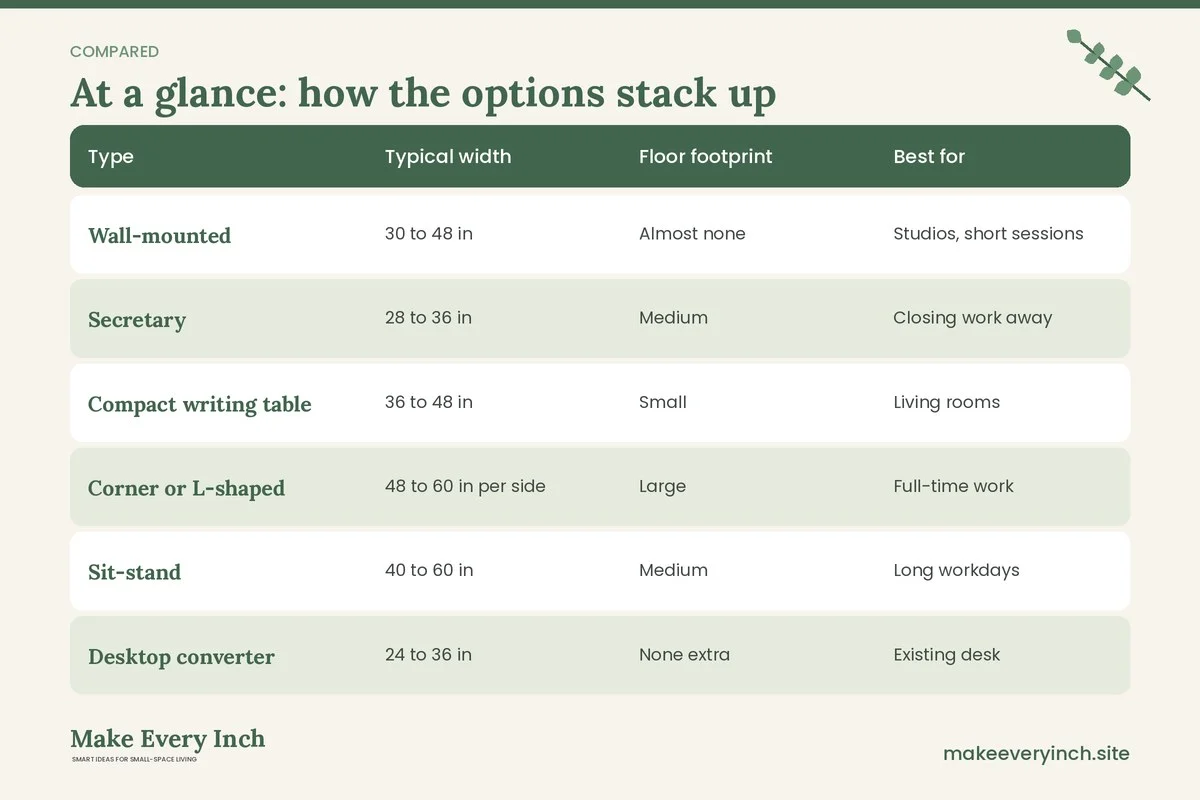
Desk types compared
| Type | Typical width | Floor footprint | Best for | Watch for |
|---|---|---|---|---|
| Wall-mounted | 30 to 48 in | Almost none | Studios, short sessions | Wall backing, weight rating |
| Secretary | 28 to 36 in | Medium | Closing work away | Open depth, hinge strength |
| Compact writing table | 36 to 48 in | Small | Living rooms | Few drawers |
| Corner or L-shaped | 48 to 60 in per side | Large | Full-time work | Floor space, assembly |
| Sit-stand | 40 to 60 in | Medium | Long workdays | Stability, weight capacity |
| Desktop converter | 24 to 36 in | None extra | Existing desk | Height range, wobble |
| Desk with hutch | 40 to 55 in | Medium | Storage-rich setups | Tip-over, anchoring |
The paper template test
Cut a sheet of kraft paper, newspaper or cardboard to the exact width and depth of the desk. Lay it on the floor, or tape it to a table at the right height. Put your chair in front, put the laptop and a notebook on top and sit for a few minutes. Does the surface feel roomy? Can you stand up and push the chair back?
Then tape the desk and chair outline on the floor and live with it for two days. Check the door swing, the path to the window and the reach to the outlet. If the layout feels tight, try a shallower desk, or turn it a quarter turn so you face the room rather than a wall.
Three example scenarios
A studio with a work corner
A 40 inch wide, 22 inch deep wall-mounted or compact desk goes under a window or beside the bed. Pair it with a chair that tucks in and a clip-on lamp. A secretary desk would let you close the work area at night. Read about small bedroom layout ideas before you place it.
A one-bedroom with a daily remote job
Use a desk at least 48 inches wide and 24 to 30 inches deep, with room for a monitor on a riser. A sit-stand model or a desk converter suits long days. Keep the desk away from the bed if you can, so work stays in its own zone. Add a narrow bookshelf for reference material and supplies.
A living room that doubles as an office
A slim writing table behind the sofa or against a wall acts as a console by day. Choose one with a drawer and a finish that matches the room. Hide the laptop and cables in a tray. See small living room furniture ideas for how to keep the room calm.
How to choose in six steps
1. List what has to sit on the desk and how many hours a day you use it.
2. Measure the wall, nook, outlets and door swing.
3. Pick a type: wall-mounted, secretary, writing table, corner or sit-stand.
4. Check the height, depth, knee room and chair fit.
5. Plan for cables and a light.
6. Cut a paper template and test it for two days.
Setting up the desk for your body
Sit with your back against the chair, your feet flat and your elbows at about 90 degrees. Raise or lower the chair until your forearms are level with the desk. If your feet no longer touch the floor, add a footrest. Set the monitor so the top edge is at eye level, about an arm’s length away, with the screen tilted back a little. Keep the keyboard close, and the mouse next to it.
Use a lamp on the side opposite your writing hand to avoid shadows, and angle the screen to avoid glare from a window. Stand up and move around at regular intervals, and stretch your hands and shoulders. A good setup fits your body better than any expensive desk can.
Budget guide
Prices vary widely by region, brand and material, so use these as hedged ranges. Small laminate or engineered-wood desks often fall in the range of $60 to $200. Wood secretary desks, wall-mounted units and larger corner desks commonly sit around $150 to $500. Height-adjustable desks often start at a few hundred dollars and rise with size and motor features. Used desks can be a good value, so check for wobble, water damage and missing hardware. Spend on stability, height fit and cable handling before extras.
Mistakes to avoid
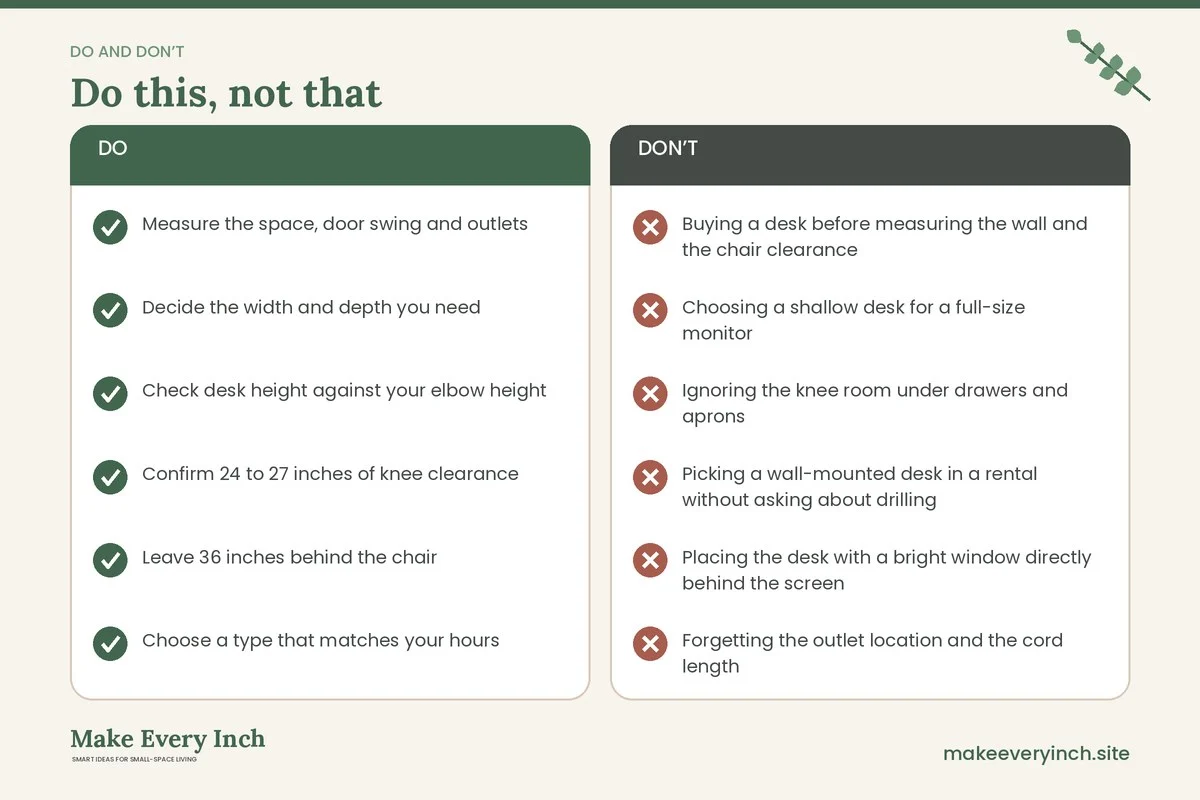
- Buying a desk before measuring the wall and the chair clearance
- Choosing a shallow desk for a full-size monitor
- Ignoring the knee room under drawers and aprons
- Picking a wall-mounted desk in a rental without asking about drilling
- Placing the desk with a bright window directly behind the screen
- Forgetting the outlet location and the cord length
- Stacking heavy items on a hutch with no wall anchor
- Using a dining chair for full workdays
- Skipping the assembly and delivery check on large flat-packs
Pre-purchase checklist
- Measure the space, door swing and outlets
- Decide the width and depth you need
- Check desk height against your elbow height
- Confirm 24 to 27 inches of knee clearance
- Leave 36 inches behind the chair
- Choose a type that matches your hours
- Check the weight rating for monitors and a printer
- Look for cable holes or a tray
- Test the wobble and the drawers
- Plan to anchor tall pieces
- Check the delivery route and return policy
Moving, cleaning and care
Flat-pack desks hold up best if you tighten the screws after the first month and avoid disassembling them more than needed. Photograph the assembly steps before you take a desk apart for a move. Wipe wood and laminate with a soft damp cloth, and avoid harsh cleaners that dull the finish. Use a desk mat to protect the surface from scratches and heat.
Keep cords tied and off the floor so a vacuum or a chair wheel does not catch them. Check wall-mounted brackets every few months, and look at anchors on tall hutches. If a sit-stand desk starts to creak, check the bolts and clean the columns.
FAQ
What size desk is best for a small apartment?
Choose 36 to 48 inches wide and 20 to 24 inches deep for a laptop setup. If you use a full-size monitor, 24 to 30 inches of depth is more comfortable.
What is the right desk height?
Most desks are 28 to 30 inches high. Your elbows should rest at about 90 degrees at the keyboard. An adjustable chair and a footrest fix many height issues.
Are wall-mounted desks strong enough?
They can be if they are mounted on studs or proper anchors and rated for the load. Check the weight rating, and ask your landlord before you drill.
Is a secretary desk good for working from home?
It is good for light work and for hiding the mess. For full-time work, check that the open surface is deep enough for your laptop and keyboard.
How far should the monitor be from my eyes?
About an arm’s length, or 20 to 30 inches. The top of the screen should be at or just below eye level.
Do I need a sit-stand desk?
It is a preference, not a requirement. It helps if you work long hours, but make sure the frame is steady and the height range suits you.
How do I manage cables on a small desk?
Use grommets, a cable tray or clips under the edge. Keep a power strip on the back or under the desk, and leave slack so you can move the desk.
How much space should I leave behind the desk chair?
Plan about 36 inches so you can pull the chair back and stand up. Thirty inches is a tight minimum in a small room.
Keep going: Explore our small bedroom desk ideas, best floor lamps for small rooms and best beds with storage.
Save this guide for later
Pin the ideas you like to Pinterest so you can come back to them when you plan your space.