How to Choose the Best Narrow Bookshelves: 19 Things to Check
Quick answer: The best narrow bookshelves are the right depth for what you own, strong enough that shelves do not sag, and anchored to the wall. Measure the space, check depth against your books, look at shelf span and thickness, choose a back panel that keeps the frame square, and secure the unit to a stud with a tip-over restraint.
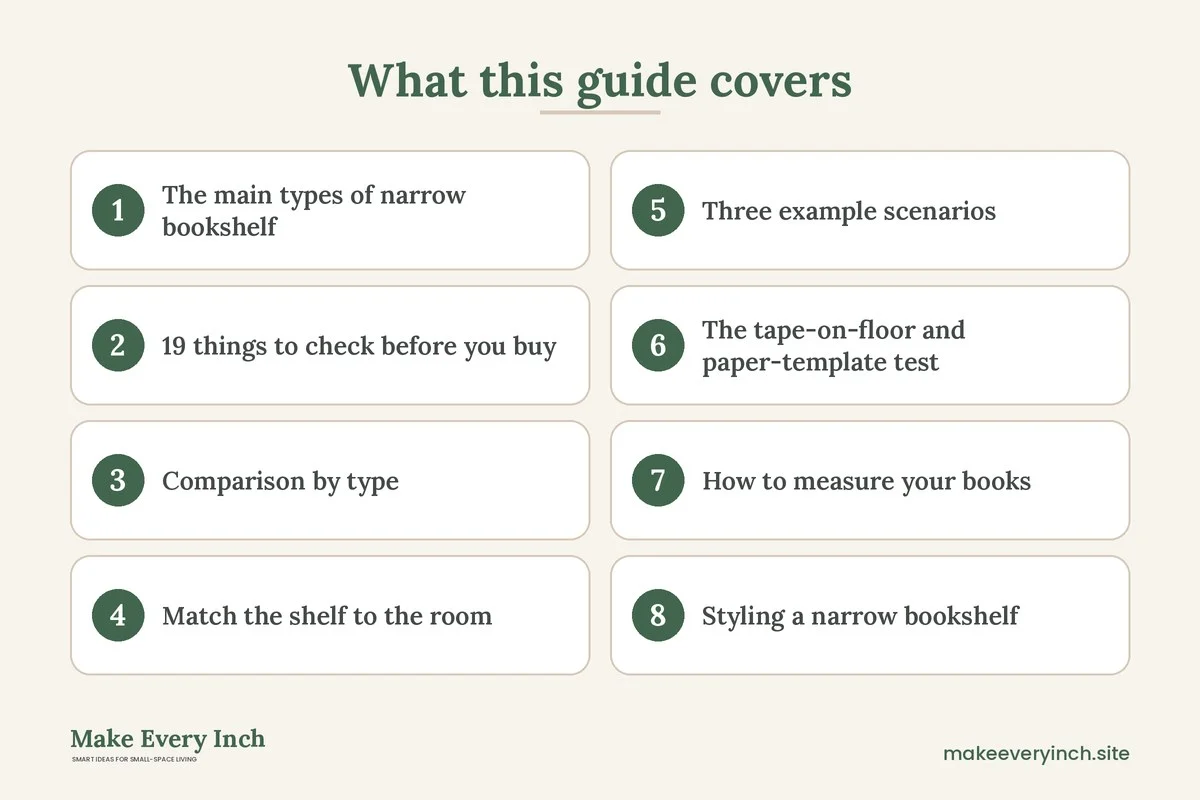
The best narrow bookshelves free up floor space without leaving you with a leaning tower of paperbacks. A shelf that is only 8 to 12 inches deep can fit in a hallway, behind a door or beside a sofa, yet it still has to carry a lot of weight. Paper is heavy, and a tall, slim unit is easy to tip. This guide covers the types, 19 things to check before you buy, a comparison table, three example rooms, a tape-and-paper test, budget ranges, styling tips, mistakes and a checklist. For more ways to build up rather than out, see our guide to vertical storage ideas.
This guide is educational, not a product review. We do not test or rank specific products, so use it to build your own shortlist.
The main types of narrow bookshelf
Freestanding open shelves
A simple frame with open shelves is the most common type. It is easy to move, and it suits books, baskets and display. It relies on its back panel or cross braces for stability.
Ladder shelves
A ladder shelf leans against the wall and gets narrower towards the top. It has a small footprint and good character, but the lean puts load on the wall and the shelf depth is uneven. Check the angle and the stability.
Tall, slim towers
A tower is a very tall, narrow unit with many tiers. It fits tight corners, but the high center of gravity makes anchoring essential.
Cube and cubby units
A cube unit has fixed square openings, which suit books, bins and records. It can be stacked in various ways, but each cube is a fixed height.
Wall-mounted ledges and shelves
A ledge is shallow, often 4 to 6 inches deep, and holds face-out books. It needs drilling, so it suits owners more than renters. Our guide to renter friendly shelving covers no-drill options.
Corner and over-door units
A corner shelf uses wasted space, and a unit that straddles a door or sits beside it makes use of a tight entry. Both usually have a limited weight capacity.
19 things to check before you buy
Fit and size
1. Width, height and the real space
Measure the wall or niche, then subtract baseboards, outlets, switches and radiators. A shelf that is 24 inches wide may not fit a 24-inch gap, because you need a little clearance to slide it in. Leave a half inch or so at the sides.
2. Depth for your books
Most paperbacks are about 4 to 6 inches deep, and many hardbacks and novels sit around 6 to 9 inches. Large art, cookbooks and photo books can reach 10 to 12 inches. A shelf of about 8 to 12 inches deep fits most collections, but measure your tallest and deepest volumes first.
3. Shelf spacing and height
Standard book heights run from about 7 inches for small paperbacks to 11 or 12 inches for large hardbacks. If shelves are fixed, check that the opening fits your tallest book, with a small gap above it. Adjustable shelves solve this, as the next point explains.
4. Clearance for doors, vents and traffic
In a hallway, leave enough room to walk, which is often 30 to 36 inches for comfortable passage. Check door swing, radiators and heating vents, since heat can damage books and finishes. A shelf depth that seems small can still block a door.
5. Baseboards and uneven floors
A baseboard holds the back of a shelf away from the wall, so it may lean slightly. Some units have a cutout, or you can add a spacer. On uneven floors, check for adjustable feet so the shelf does not wobble.
Strength and shelf design
6. Shelf span and sag
Long spans sag under heavy books, especially in thin particleboard. A shelf of about 24 to 30 inches across is a common comfort zone for heavy books, and anything much longer needs thicker material or a center support. Look at the stated thickness and ask about the maximum load.
7. Load per shelf
Find the load rating for each shelf, and add up the weight of your collection. Hardcovers and art books weigh much more than paperbacks. As a rough guide, a full row of books can weigh a few pounds per linear foot or more, and heavier books add to this. Check the rating against what you plan to store.
8. Fixed or adjustable shelves
Adjustable shelves let you reconfigure for tall books or baskets. Check how the supports are held, such as pegs, metal clips or a track, and whether the holes are drilled neatly. Fixed shelves add rigidity, so some strong units use a mix.
9. Back panel and bracing
A back panel keeps a bookshelf square and prevents racking, which is a sideways wobble. A thin hardboard panel works if nailed or glued properly, but a poorly attached one can pull away. Open backs look lighter but depend on cross braces or an X brace.
10. Joints and fasteners
Look at how the shelf is held together. Dowels, cam locks, screws and glue all work, but well-made joints resist wobble for longer. Check that fasteners go into solid material, not just a thin edge, and re-tighten them after a few weeks.
Safety
11. Tip-over anchoring
A tall, slim shelf can tip, especially if shelves at the top are loaded, a child climbs on it or you pull a heavy book from a high shelf. Anchor the unit to a wall stud with the supplied restraint, or buy a strap that is rated for your wall type. Check whether the product includes hardware.
12. Anchoring in a rental
If you cannot drill, ask the landlord whether small holes are allowed, and fill them when you move out. A single anchor hole is much easier to repair than a damaged wall or a tipped shelf. Our guide to no drill storage ideas for renters offers other options.
13. Weight at the base
Put the heaviest books on the lowest shelves, and keep the top light. A low center of gravity makes any unit more stable. A wider foot or base plate also helps.
14. Sharp edges and finishes
Check corners and edges, particularly with children or pets around. Rounded corners are gentler, and a smooth finish is easier to dust. Be cautious about strong chemical smells from new furniture, and air out the room.
Materials and build
15. Solid wood, plywood or engineered wood
Solid wood is strong and repairable but heavier and pricier. Plywood resists sag well, and engineered wood such as particleboard or MDF is affordable but can swell if wet and sag under heavy loads. Metal frames carry loads well, but check the shelves themselves.
16. Finish and moisture
A laminate or painted finish wipes clean, but chips show. Avoid placing shelves near damp walls, windows with condensation or a bathroom. Moisture warps wood and spoils books.
17. Weight of the unit itself
A light shelf is easy to move but can be unstable and may shift when you pull out a book. A heavier unit is steadier but harder to carry. Either way, anchor it.
Daily life
18. Assembly and moving
Read the instructions in advance, as narrow shelves with many parts can take an hour or more. Two people make it easier to stand a tall unit upright. If you will move home, check that the shelf can be disassembled and rebuilt without losing strength. Our guide to small living room furniture ideas has more on choosing pieces that travel.
19. Style and flexibility
Look for a shelf that works beyond books, with room for baskets, plants and a lamp. A neutral finish and a simple form suit many rooms. Think about whether the unit could serve in another room if you move.
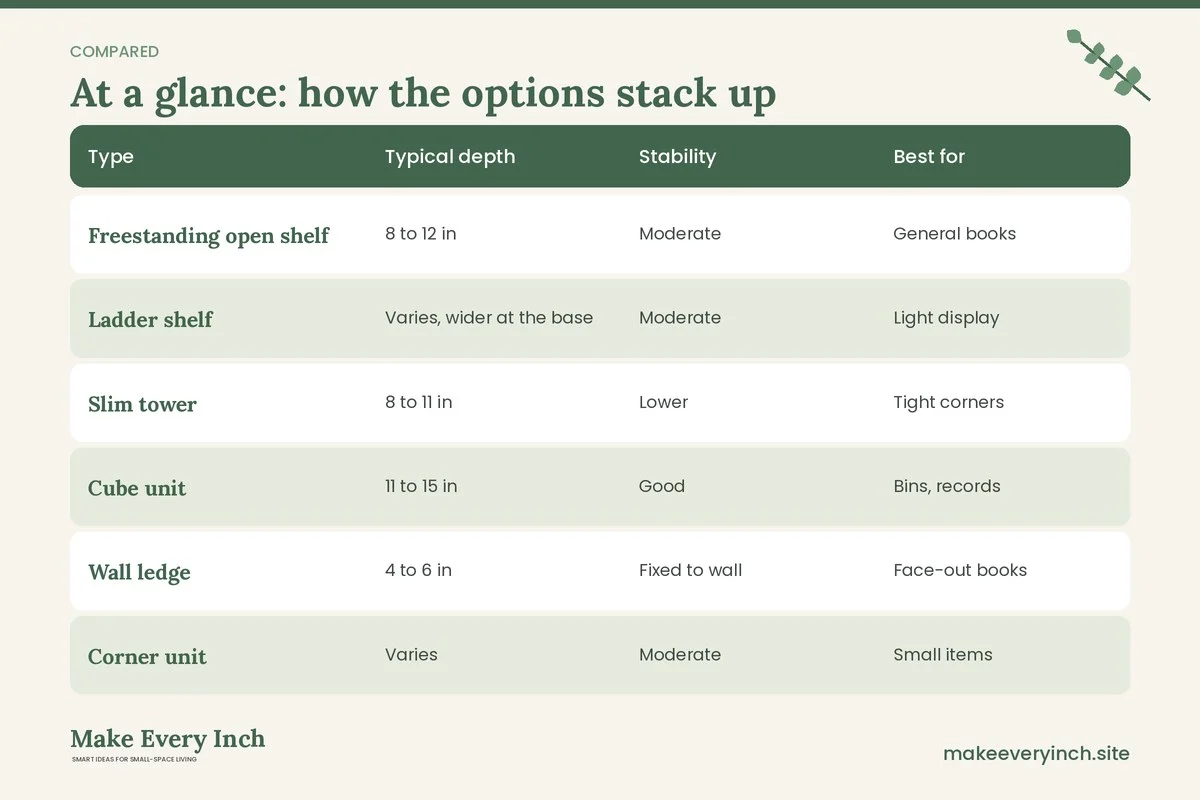
Comparison by type
| Type | Typical depth | Stability | Best for | Anchoring need |
|---|---|---|---|---|
| Freestanding open shelf | 8 to 12 in | Moderate | General books | High |
| Ladder shelf | Varies, wider at the base | Moderate | Light display | Medium |
| Slim tower | 8 to 11 in | Lower | Tight corners | Essential |
| Cube unit | 11 to 15 in | Good | Bins, records | Medium |
| Wall ledge | 4 to 6 in | Fixed to wall | Face-out books | Built in |
| Corner unit | Varies | Moderate | Small items | Medium |
Match the shelf to the room
Small living room
A shelf beside the sofa or against a short wall adds storage without eating the floor. Keep the depth to about 10 inches, and choose a unit that matches the height of nearby furniture. A lamp on top or beside it adds light, and our guide to floor lamps for small rooms covers what to check.
Hallway
A hallway shelf needs the shallowest depth you can use, often 8 to 10 inches, and a clear path of at least 30 inches. Anchor it, and keep the top shelves for light items. See our narrow hallway ideas for layouts.
Home office or desk nook
A slim shelf next to a desk holds reference books and files. Make sure the unit does not crowd the chair. If you are choosing the desk as well, see our guide to the best desks for small apartments.
Three example scenarios
A hallway that is 38 inches wide
A shelf that is 12 inches deep would leave only 26 inches for walking, which feels tight. An 8-inch-deep unit leaves 30 inches, a more comfortable margin. Choose lighter objects for the top, and anchor the unit to the wall.
A one-bedroom with 300 paperbacks
Paperbacks are shallow and light, so an 8-inch-deep shelf with adjustable shelves works. Count your books, measure them in a stack, and divide by the shelf length to see how many shelves you need. A tall unit with six or seven shelves may hold them, but it needs a restraint.
A rental with strict rules
You cannot drill into the wall, so you look for a heavy, low unit with a wide base and a steady frame. Ask the landlord about a single small anchor, or choose a low shelf that cannot tip easily. Keep the heaviest books at the bottom.
The tape-on-floor and paper-template test
Mark the footprint of the shelf on the floor with painter’s tape, using the stated width and depth. Cut a piece of paper or cardboard to the height and width of the shelf, and tape it to the wall.
Step by step
- Tape the shelf’s width and depth on the floor
- Tape a paper outline of its height on the wall
- Walk past it with a laundry basket or a bag, as you normally would
- Open the nearest door and any drawers
- Check outlets, switches and vents behind the outline
- Stand a few feet back and judge how heavy it looks in the room
- Live with the tape for a day or two
How to measure your books
Stack a typical group of books and measure the height of the tallest and the depth of the deepest. Measure the length of a full row of books to see how much shelf you need. Add about 10 to 15 percent for growth. Sort tall books, paperbacks and art volumes into separate groups, so you know where adjustable shelf spacing helps. Weigh a stack on a bathroom scale to estimate load per shelf.
Styling a narrow bookshelf
Place the heaviest and largest items at the bottom, and use baskets for loose items. Leave a few shelves partly empty, so the unit does not feel crowded. Mix books laid flat and upright, and add a plant, a frame or a small lamp. Group books by color or by size for a calmer look. Do not store anything fragile on the top, within reach of a child.
Care and maintenance
Dust shelves with a dry or slightly damp cloth, and keep books out of strong sunlight, which fades spines. Check the tightness of screws every few months, and see whether the shelf boards are bowing. If a shelf starts to sag, rotate it, move heavy books to a lower shelf or add a support. Check the anchor each time you move the unit.
Budget guide
Prices differ by region, size and material, so treat these as hedged ranges and compare locally.
Lower range
Often engineered wood with a thin back panel and adjustable pegs. Good for light loads, with attention to span and anchoring.
Middle range
Often thicker shelves, a better back panel and sturdier joints, or a metal frame. Look for clear load ratings.
Higher range
Often solid wood or plywood, custom sizes or better finishes. Even so, check the depth and the restraint hardware.
A cheaper shelf with an added center support can outperform a pricier one with long, thin shelves, so judge by construction. For more storage planning, see our guide to small living room storage ideas.
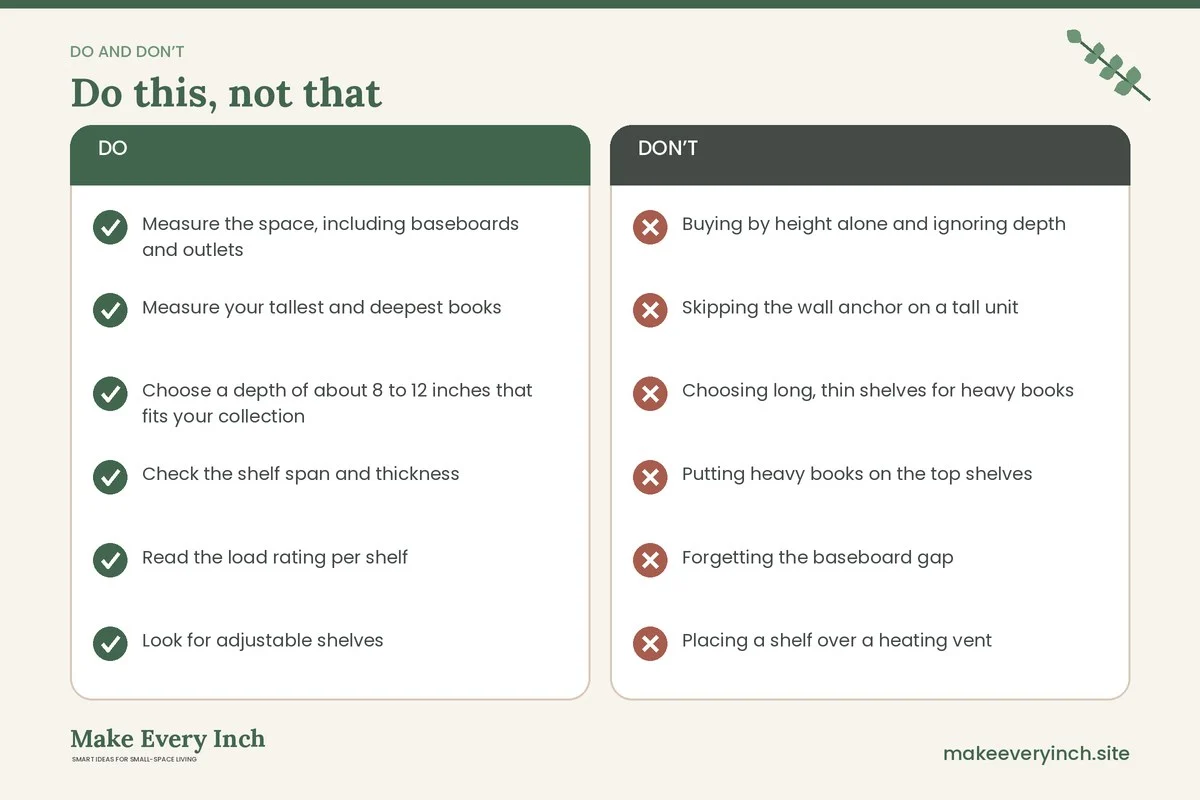
Mistakes to avoid
- Buying by height alone and ignoring depth
- Skipping the wall anchor on a tall unit
- Choosing long, thin shelves for heavy books
- Putting heavy books on the top shelves
- Forgetting the baseboard gap
- Placing a shelf over a heating vent
- Not checking the opening against your tallest books
- Overlooking door swing and walking space
- Ignoring the load rating
Pre-purchase checklist
- Measure the space, including baseboards and outlets
- Measure your tallest and deepest books
- Choose a depth of about 8 to 12 inches that fits your collection
- Check the shelf span and thickness
- Read the load rating per shelf
- Look for adjustable shelves
- Check the back panel and bracing
- Confirm that anchoring hardware is included
- Tape the footprint and the height outline
- Plan assembly and the route into the home
- Read the warranty and return policy
FAQ
How deep should a narrow bookshelf be?
Most are about 8 to 12 inches deep. Paperbacks fit on 6 to 8 inches, and larger books need 10 to 12 inches. Measure your books first.
How long can a shelf be before it sags?
It depends on the material and the load. Spans of about 24 to 30 inches are common for heavy books, and longer ones need thicker boards or a center support.
Do I need to anchor a bookshelf?
For a tall, narrow unit, yes. Anchor it to a wall stud with a rated restraint, and keep heavy items low.
Can I anchor a bookshelf in a rental?
Ask your landlord about a small anchor, and fill the hole at move-out. If you cannot, choose a low, heavy unit.
Is a back panel necessary?
It helps keep the frame square and resists wobble. Open-back units need strong cross bracing.
What is the best material for a bookshelf?
Solid wood and plywood hold up well, while engineered wood is affordable but can sag and swell. A metal frame can also work.
How many books fit on a shelf?
It depends on the thickness of the books. Measure a full row and divide your collection by the length of each shelf.
Can I use a narrow bookshelf for things other than books?
Yes. Baskets, plants and small decor all work, though the load per shelf and anchoring rules still apply.
Keep going: Explore our vertical storage ideas, small living room storage ideas and renter friendly shelving.
Save this guide for later
Pin the ideas you like to Pinterest so you can come back to them when you plan your space.