How to Choose the Best Floor Lamps for Small Rooms: 19 Things to Check
Quick answer: The best floor lamps for small rooms have a small base, the right shape for the job (arc, torchiere or reading), a dimmable warm bulb of about 2700 to 3000 K, a heavy stable base and a cord that reaches the outlet without crossing a walkway. Measure the floor spot, check the weight and bulb limits, and layer the lamp with other light sources.
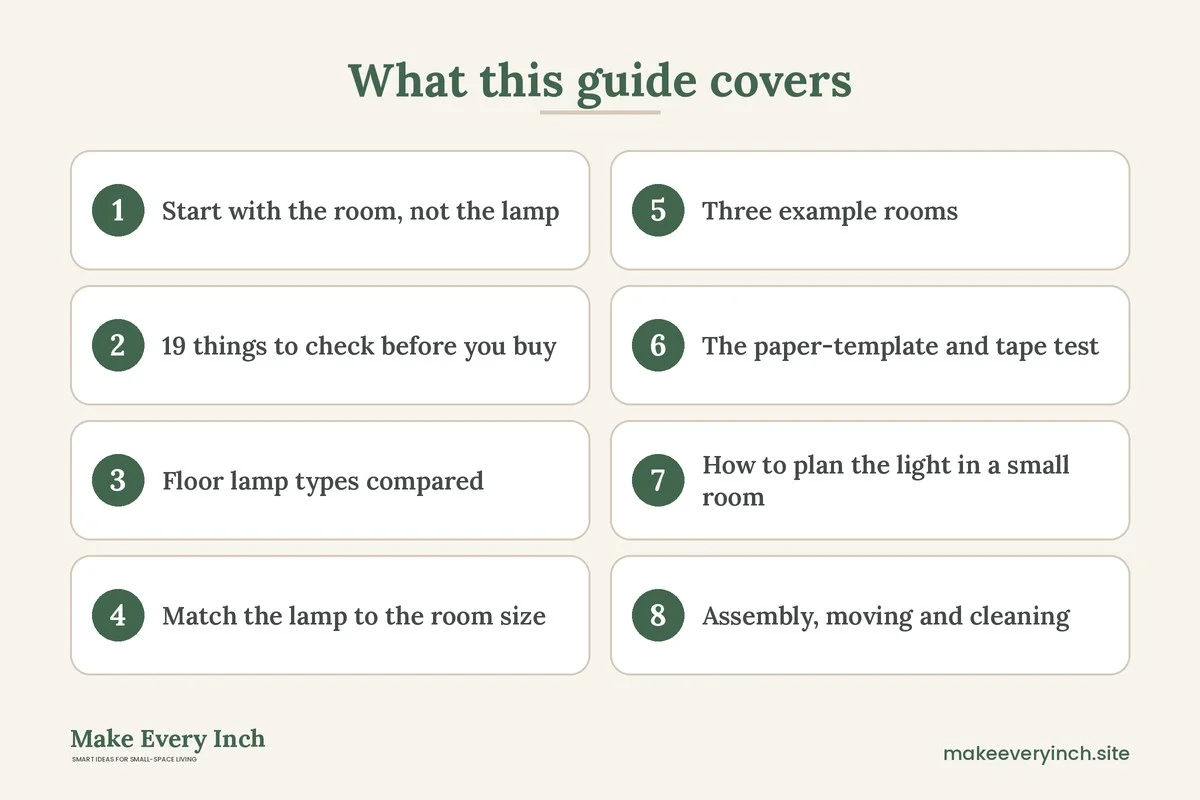
The best floor lamps for small rooms do more than stand in a corner. A good one replaces a harsh ceiling fixture, gives you a reading spot, makes a low ceiling feel taller and takes up less floor than a side table. A bad one tips over, blocks a path, glares in your eyes or leaves half the room dim. This guide gives you 19 things to check before you buy, a size table by room and use, three example rooms, a paper-template test, a hedged budget guide, a list of common mistakes and a pre-purchase checklist. If you are lighting a whole room, pair it with our guide to small living room lighting ideas.
This guide is educational, not a product review. We do not test or rank specific products, and we name no brands or models, so the advice below is about how to judge any lamp you find.
Start with the room, not the lamp
Before you browse, decide what the lamp has to do. Is it the main source of light in a rental with a dim ceiling fixture, a reading light beside a chair, or a soft accent that fills a dark corner? The job decides the shape, the brightness and the switch type, and it stops you from buying a pretty lamp that fails at the one task you needed.
Then walk the room at the time of day when it feels darkest. Note where you sit, where outlets are, where the doors swing and where people walk. A lamp is the one piece of furniture that also needs power, so the outlet position often limits your choices more than the floor space does.
19 things to check before you buy
Size and footprint
1. The base footprint
Measure the floor space you can spare, including the sweep of any base arm. Round bases of 10 to 12 inches suit most corners, while a square or disc base keeps a slim pole steady in a narrow gap beside a sofa. Check the base dimension in the listing, since the shade or arm often looks bigger than the base and hides the real footprint.
2. Total height
Most floor lamps run roughly 55 to 70 inches tall. In a small room with a standard 8-foot ceiling, a lamp near 60 inches reads as a comfortable accent, while a taller one pulls the eye upward. Check that the top clears ceiling fans, sloped ceilings and wall shelves.
3. The shade width and head clearance
A wide shade collides with curtains, wall art and the person who walks past. Measure the shade diameter and leave at least a few inches between it and anything nearby. For a lamp beside a chair, make sure the shade sits above eye level when you are seated, so the bulb does not glare.
4. The arm reach of arc lamps
An arc lamp’s head can hang 3 to 5 feet or more from its base. Measure the horizontal reach and the lowest point of the shade, and then picture it over a sofa or a table. Make sure the heavy base sits where it will not trip anyone, and check that the arc does not swing into a path or a window.
Shape and purpose
5. Choose the right type for the job
An arc lamp throws light over a seat or a table without a ceiling hook. A torchiere sends light up to the ceiling, which fills a room with soft, indirect light. A reading lamp has an adjustable neck and a focused beam. A tripod or a straight-pole lamp with a drum shade is the simplest ambient option. Pick one for the main job and add others later.
6. Think about where light lands
Uplight washes the ceiling and makes a room feel taller. Downlight makes pools of light for tasks. Side light from a drum shade does both a little. In a small room with a low ceiling, avoid a strong uplight only if the ceiling is dark or very close, since a dim, dingy ceiling reflects little.
7. Adjustable necks and heads
A swing arm, a gooseneck or a pivoting head lets one lamp serve a chair and later a desk. Check that joints hold position without drifting, and that the head can angle away from a screen. Stiff, tight joints usually stay put, while loose ones sag over time.
Light quality
8. Lumens, not watts
Watts tell you how much power a bulb uses, and lumens tell you how bright it is. As a rough rule of thumb, a reading light needs about 400 to 800 lumens, and a living room benefits from a combined 1,500 to 3,000 lumens spread across several sources. Check what the lamp can hold, and whether the bulb is included.
9. Color temperature in Kelvin
Kelvin sets the mood. About 2700 K is warm and cozy, 3000 K is a soft white, and 4000 K and above is cool and crisp. Most people prefer 2700 to 3000 K in living rooms and bedrooms. Keep every bulb in one room within a similar range, since mixed temperatures make walls look patchy.
10. Color rendering index
CRI measures how faithfully a bulb shows colors on a scale of 100. A CRI of 80 is acceptable, and 90 or higher makes skin tones, fabrics and food look more natural. It matters most for reading, makeup and craft work. Look for the figure on the bulb box, since lamps often leave it out.
11. Dimming that actually works
Dimming lets one lamp be a reading light and a night light. Check whether the lamp has an inline dimmer, a rotary knob or a touch control, and whether the bulb is rated as dimmable. A non-dimmable LED on a dimmer may flicker or buzz, and a dimmer that is too strong for a low-wattage LED can behave badly, so match the two.
12. Glare control
A bare bulb at eye height is tiring. Look for a shade that fully covers the bulb from a seated viewing angle, or a frosted diffuser. Matte inner surfaces soften light, while a glossy metal inside can create hot spots.
Bulbs and power
13. Bulb base and type
Most US lamps use a medium E26 base, and some use a smaller E12 candelabra base. An integrated LED lamp has no replaceable bulb, so when the module fails you replace the whole lamp. A socket that accepts standard bulbs gives you freedom to change brightness and color temperature later. Look for a lamp that states its maximum bulb wattage on the socket or in the manual.
14. Cord length and placement
Typical cords run about 5 to 8 feet. Measure from the planned spot to the outlet, and add the height of the outlet and any detour around furniture. Never stretch a cord across a walkway or tuck it under a rug, where it can wear and overheat. If the cord is too short, move the lamp or choose another, rather than relying on a long extension chain.
15. The switch type
A foot switch is easy to reach without bending, an in-line switch sits on the cord, a pole switch sits on the stem and a touch or a remote control is handy for hard-to-reach corners. A switch you cannot find in the dark is annoying. If the outlet is behind furniture, consider a smart plug or a remote, as long as it suits the bulb.
Stability and safety
16. Base weight and tip resistance
A tall, slim lamp with a light base tips over when a child, a pet or a vacuum hits it. Prefer a heavy base of metal, stone or weighted steel, with a wide enough stance for its height. Give it a gentle push in a store or after delivery, and place it away from busy paths.
17. Heat, shades and fire safety
Keep any shade clear of the bulb, and never exceed the stated bulb wattage. Halogen bulbs run hot, so a lamp that uses them needs more clearance from curtains, bedding and paper. LED bulbs run much cooler, which helps in tight spaces. Look for a recognized safety listing mark such as UL or ETL on the cord tag or the box, and keep lamps away from bedding and drapes.
Style and materials
18. Shade and body materials
Fabric and linen shades diffuse light and glow warmly, paper shades are light and cheap but dent, glass is easy to wipe but breakable, and metal shades direct light downward. A matte finish hides fingerprints and dust. A lamp with a removable shade is easier to clean and to replace.
19. Layering and how it fits the room
A floor lamp rarely works alone. Combine it with a table lamp, a wall light or a dimmable ceiling light so that no single bulb has to do everything. In a small room, two modest lamps at different heights beat one giant one. See our ideas on renter-friendly lighting for layering without wiring.
Floor lamp types compared
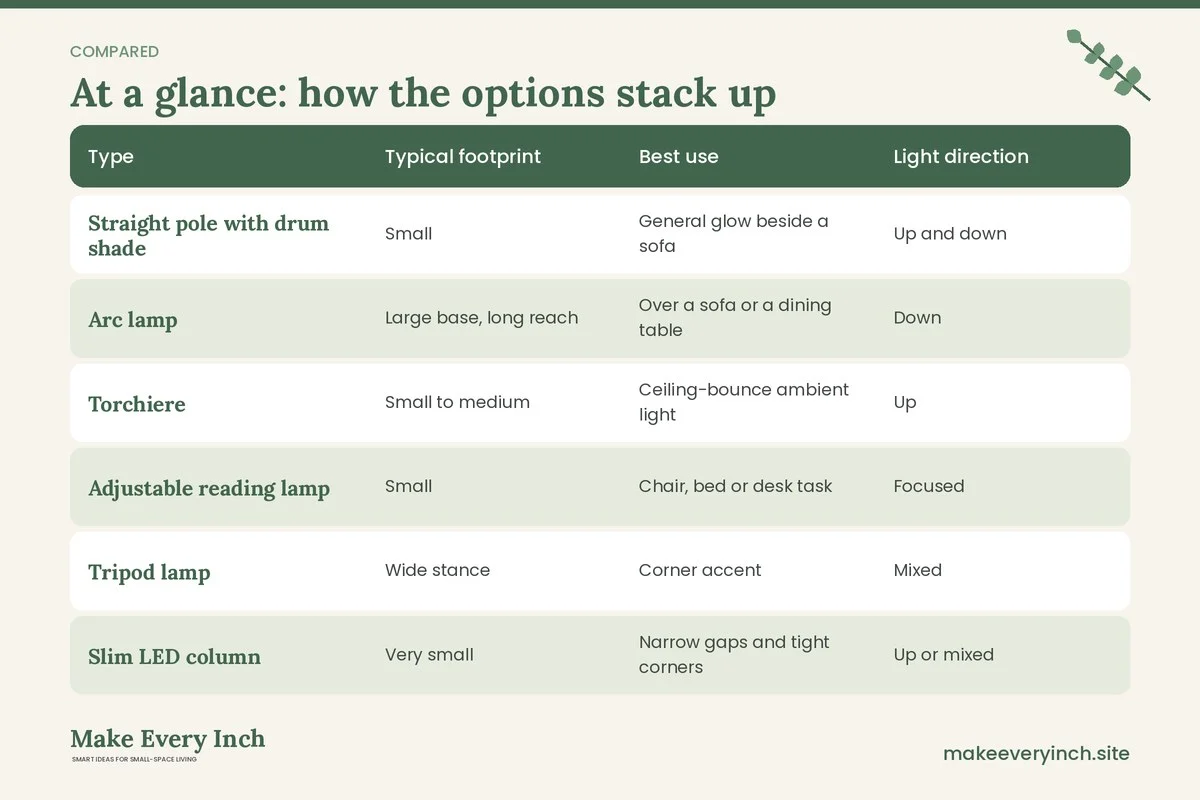
| Type | Typical footprint | Best use | Light direction | Watch for |
|---|---|---|---|---|
| Straight pole with drum shade | Small | General glow beside a sofa | Up and down | Tipping if the base is light |
| Arc lamp | Large base, long reach | Over a sofa or a dining table | Down | Heavy base and clearance |
| Torchiere | Small to medium | Ceiling-bounce ambient light | Up | Heat from the bulb and dark ceilings |
| Adjustable reading lamp | Small | Chair, bed or desk task | Focused | Joints that drift |
| Tripod lamp | Wide stance | Corner accent | Mixed | Legs that catch feet |
| Slim LED column | Very small | Narrow gaps and tight corners | Up or mixed | Integrated LEDs you cannot replace |
| Multi-head lamp | Medium | Flexible light for different seats | Adjustable | Visual clutter and cord weight |
Match the lamp to the room size
| Room situation | Suggested lamp | Footprint to allow | Light goal |
|---|---|---|---|
| Small bedroom, nightstand space is tight | Slim reading lamp | About 10 inches square | 400 to 800 lumens, warm and dimmable |
| Compact living room with one dim ceiling light | Pole lamp with a drum shade, or a torchiere | About 12 inches round | Ambient glow, 2700 to 3000 K |
| Narrow reading nook | Adjustable arm lamp | About 10 to 12 inches | Task light with glare control |
| Studio apartment with a sleeping zone | Two lamps at different heights | One per zone | Separate moods for work and rest |
| Corner behind a sofa | Arc lamp | A heavy base on the free side | Light over the seat without a table |
Three example rooms
A studio with one harsh ceiling light
In a studio the ceiling fixture is flat and bright, and it makes the room feel like an office. The better plan is a torchiere or a pole lamp with a dimmable warm bulb in the corner farthest from the door, plus a slim reading lamp by the bed. Turn off the ceiling light in the evening. Two modest lamps at different heights usually feel calmer than one tall one.
A narrow living room with a sofa along one wall
The gap beside the sofa is only about 14 inches wide, and an arc base would block it. A slim column or a pole lamp with a round 10-inch base fits in the gap and lights the seat. Run the cord along the baseboard to the outlet, and use a clip to hold it. Check the lamp’s weight so it does not tip when someone sits down next to it. For more layouts, see narrow living room ideas.
A bedroom with no room for nightstand lamps
When the bed fills the room and there is no table, a floor reading lamp beside the headboard saves the day. Choose a low-profile base so it slides in beside the bed, a neck that bends over the pillow and a warm, dimmable bulb. Keep it clear of bedding and curtains, and choose a switch you can reach from the bed. Our guide to small bedroom lighting ideas shows more ways to light a tight sleeping area.
The paper-template and tape test
Before you order, cut a piece of paper or cardboard to the size of the base, and tape it to the floor where the lamp will stand. Then mark the shade or the arm’s reach with painter’s tape, using a string or a broom handle to represent the pole. Walk through the room, sit in each seat and open every door and drawer. If you bump the tape or lose a path, the lamp is too big. Repeat the test with the plug end, and measure the cord path to the outlet along the wall, not in a straight line.
How to plan the light in a small room
Build in three layers
Start with ambient light that fills the room, such as a torchiere or a ceiling light on a dimmer. Add task light for reading and work, and then accent light for mood, such as a small lamp that washes a wall or a plant. Putting these on separate switches or dimmers lets you reshape the room through the day.
Place lamps in corners and at heights
Corner lamps push light onto two walls and make the room feel wider. Spread lamps around the room rather than clustering them, and vary heights, with a floor lamp on one side and a table lamp on the other. This triangle of light is more even and less glaring.
Use bulbs to tune the result
You can change the mood with a bulb swap alone. A warmer bulb softens a stark room, and a bulb with a higher CRI makes fabrics look better. Keep a few spare bulbs of the same base and temperature, so a burned-out bulb does not leave you with a mismatched one.
Assembly, moving and cleaning
Most floor lamps arrive in pieces. Lay out the parts, check the hardware count against the manual and tighten the joints by hand first, then with the tool provided. Wobble comes from a loose threaded stem or a missing washer, so fix it before you put the shade on. Leave the plastic off the cord only when you are sure of the plug and polarity.
To move a lamp, unplug it, take off the shade and carry it by the base. A tall lamp dragged on its base can bend the stem. Wrap the shade in paper and keep it in a box for a move. For cleaning, dust the shade with a lint roller or a soft brush, wipe glass or metal with a damp cloth and let it dry fully, and never get the socket wet. Let bulbs cool completely before you handle them.
Budget guide
Prices vary widely by region, size and material, so treat these as hedged ranges and not as quotes.
Lower range
Simple pole and tripod lamps in light metal or plastic often sit at the lower end of the market. They can work well if you check the base weight and the bulb limit. Expect to buy a better bulb separately.
Middle range
Heavier bases, adjustable necks, dimmers built in and fabric shades tend to appear in the middle of the market. This range often gives the best mix of stability and flexibility for small rooms.
Higher range
Solid metal, stone or glass components, better finishes and refined switches usually cost more. Spending more does not guarantee better light or safety, so use the checks in this guide to compare any lamp, whatever it costs.
Mistakes to avoid
- Buying for looks without measuring the floor spot
- Choosing a light base on a tall pole
- Ignoring the maximum bulb wattage
- Mixing warm and cool bulbs in one room
- Running the cord across a walkway or under a rug
- Using a non-dimmable bulb on a dimmer
- Relying on a single lamp for every task
- Placing a lamp too close to curtains or bedding
- Buying an integrated LED lamp without checking whether it can be repaired

Floor lamp pre-purchase checklist
- Define the job: ambient, task or accent
- Measure the floor footprint and the shade or arm reach
- Check the ceiling height and any fan or slope
- Measure the cord path to the outlet
- Confirm the maximum bulb wattage and base type
- Choose 2700 to 3000 K for living spaces
- Look for a CRI of 90 or higher for reading
- Confirm dimming support for bulb and switch
- Check the base weight and tip resistance
- Look for a recognized safety listing mark
- Test the footprint with paper and tape
- Check the return policy and assembly time
FAQ
What size floor lamp is best for a small room?
Look for a base of about 10 to 12 inches across and a height near 55 to 65 inches, then confirm the shade does not hit furniture or walls. Test the footprint with paper and tape first.
How many lumens do I need in a small living room?
As a rough guide, aim for about 1,500 to 3,000 lumens in total across several sources, with 400 to 800 lumens for a reading spot. Dimmers let you adjust within that range.
Is an arc lamp good for a small room?
It can be, because it lights a seat or a table without a ceiling fixture. It needs a heavy base and open space for the arm, so measure the reach and the base before you commit.
What color temperature is best for a floor lamp?
Most people choose 2700 to 3000 K for living rooms and bedrooms, which gives a warm and soft look. Choose a cooler bulb only for a work or craft corner.
Do I need a dimmable floor lamp?
It is very helpful in a small room that serves several purposes. Check that both the bulb and the switch support dimming so they work together without flicker.
Are LED floor lamps safe?
LED bulbs run cooler than halogen, which lowers the heat risk. Still look for a recognized safety listing mark, respect the wattage rating and keep the lamp clear of fabric.
How do I stop a floor lamp from tipping?
Choose a heavy, wide base, put the lamp out of the main path and keep the cord from creating a trip point. Avoid placing a tall lamp where it can be hit by a door.
Can a floor lamp replace a ceiling light?
In many rentals, yes. Two or three lamps on different levels, with warm dimmable bulbs, can give softer and more flexible light than one overhead fixture. Our guide to dark apartment ideas shows how to build that layering.
Keep going: Keep planning with our guides to small living room lighting ideas, renter-friendly lighting ideas and best narrow bookshelves.
Save this guide for later
Pin the ideas you like to Pinterest so you can come back to them when you plan your space.