25 Small Space Organization Ideas for Every Room in Your Home
Quick answer: The best small space organization ideas follow four steps: edit what you own, give every category one home, store vertically with shelves, hooks and tall units, and use hidden spots such as under the bed, behind doors and inside furniture. Label, reset daily and apply a one-in, one-out rule.
Small space organization ideas work because small homes punish disorganization faster than large ones. In a 600 square foot apartment, one pile of mail, one open box and one overflowing basket change how the whole home feels. The good news is that small spaces also respond quickly: a weekend of editing, zoning and storing can transform a home. This guide gives you a simple four-step system, 25 ideas, a room-by-room plan, a comparison table of storage types, three example homes and a checklist. It also links to our deeper guides on each room, such as small bedroom storage ideas, small kitchen storage ideas, small living room storage ideas and tiny bathroom storage ideas.
The four-step system
Step 1: Edit
No storage system can beat a home that holds too much. Start by removing what you do not use, need or love. Use three boxes labelled keep, donate and throw away, and make quick decisions. Ask whether you have used the item in the last year, whether it has a place and whether it still fits your life. Be most ruthless with duplicates, broken items and things kept out of guilt.
Step 2: Zone
Group what remains by what you do with it: cook, sleep, work, relax, clean, store. Give each category one home. When everything has a home, you spend less time looking and less time putting away.
Step 3: Contain
Use bins, baskets, drawer dividers and shelves to keep each category together. Choose containers after you know what you have, and measure the space first. Label them so everyone in the home knows where things go.
Step 4: Maintain
Choose a daily reset of ten minutes and a monthly check. Apply a one-in, one-out rule so new items do not pile up. A system that takes a minute to maintain will last, and a system that needs a full day will fail.
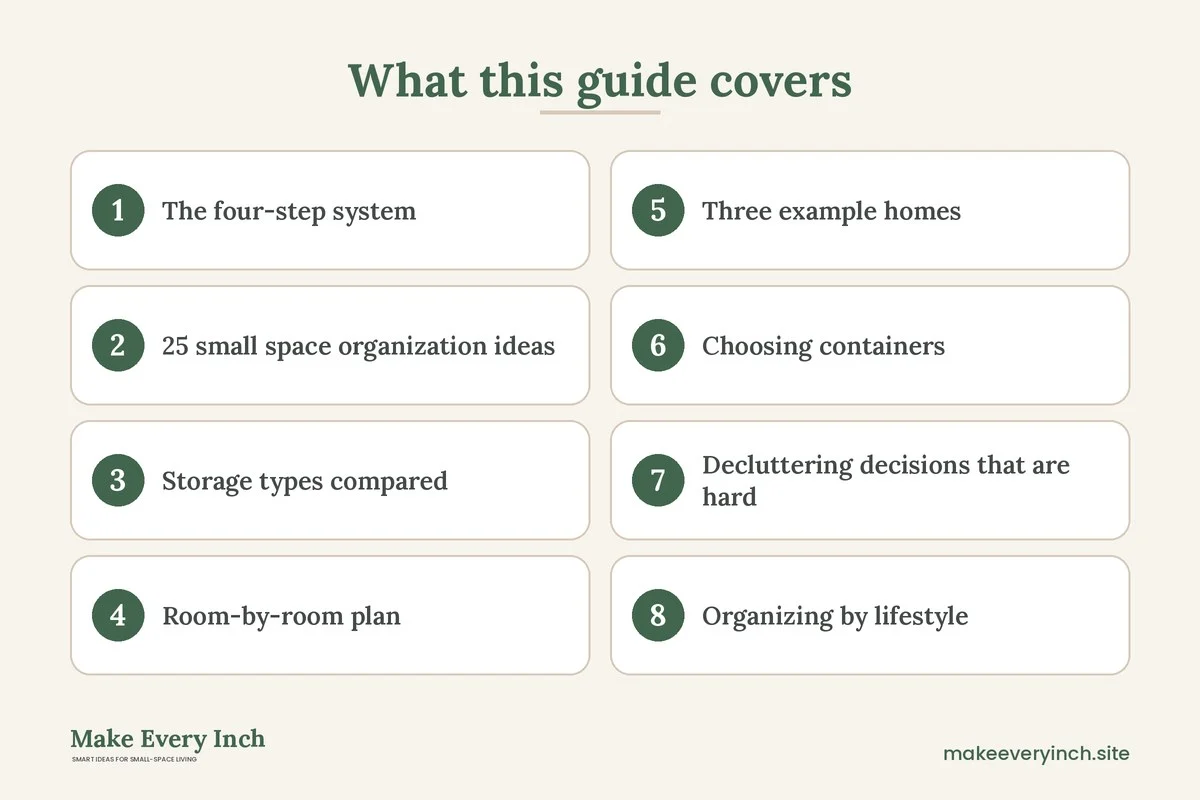
25 small space organization ideas
Vertical storage
1. Use tall, narrow shelves
A bookcase 10 to 12 inches deep and six feet tall gives more storage than a wide, short unit. Anchor it to the wall.
2. Hang wall shelves
Floating shelves and picture ledges add storage above eye level and keep the floor open.
3. Use over-the-door organizers
Clear pockets on the back of a door hold shoes, cleaning supplies, toiletries and accessories.
4. Hang hooks everywhere
Hooks hold bags, coats, robes, towels and keys. A row of hooks beats a bulky rack.
5. Use a pegboard
A pegboard works in a kitchen, a closet or a craft corner. Rearrange the pieces as your needs change.
Hidden storage
6. Use the space under the bed
Low bins or rolling drawers store off-season clothes, shoes and linens. See under bed storage ideas.
7. Use storage ottomans and benches
A bench in the entry or a trunk at the foot of the bed holds blankets, shoes and games.
8. Use furniture with built-in storage
Beds with drawers, coffee tables with shelves and sofas with storage chests all add hidden space.
9. Use the space behind the sofa
A slim console or a low shelf behind the sofa holds books and baskets.
10. Use the space above the cabinets
Baskets on top of kitchen cabinets hold rarely used items. Use matching baskets so it looks tidy.
Closet and wardrobe
11. Add a second rod
A double hang rod doubles the space for shirts and skirts. See small closet organization ideas.
12. Use slim hangers
Slim velvet hangers save about a third of the rod space.
13. Use shelf dividers
Dividers keep stacks of sweaters from falling over.
Kitchen and bathroom
14. Use a tiered shelf in the cabinet
A shelf riser makes two layers from one, and lets you see everything.
15. Use a lazy susan
A turntable in a corner cabinet saves digging.
16. Use a tray at the sink
A tray corrals daily items so the counter stays clear. See small kitchen counter organization.
17. Use a shower caddy and hooks
Vertical storage keeps the tub clear and speeds cleaning. See small bathroom organization ideas.
Daily habits
18. Create a drop zone
A hook, a tray and a small shelf near the door keep keys, mail and bags from spreading across the home.
19. Use a one-in, one-out rule
When you bring in something new, remove something old. It prevents slow clutter growth.
20. Label bins and shelves
Labels help everyone put things back and save time looking.
21. Reset every night
Ten minutes of putting things back keeps the home calm.
22. Use clear containers
Clear bins show their contents at a glance.
23. Keep surfaces nearly bare
Leave a few decor items and put the rest away. Bare surfaces make small rooms look larger.
24. Rotate seasonal items
Store off-season items in a high or low place and swap twice a year.
25. Take photos of full shelves
A photo lets you see the system and spot clutter creeping back.
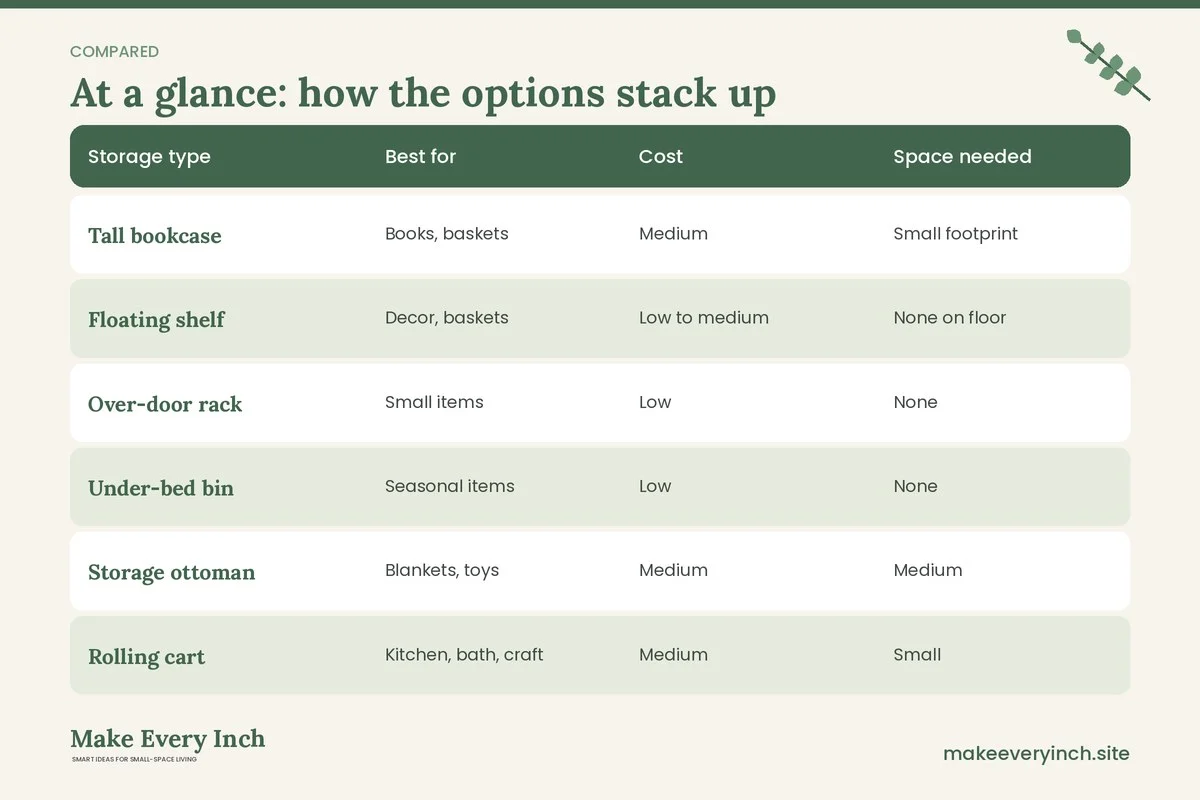
Storage types compared
| Storage type | Best for | Cost | Space needed | Drilling |
|---|---|---|---|---|
| Tall bookcase | Books, baskets | Medium | Small footprint | Anchor to wall |
| Floating shelf | Decor, baskets | Low to medium | None on floor | Yes |
| Over-door rack | Small items | Low | None | No |
| Under-bed bin | Seasonal items | Low | None | No |
| Storage ottoman | Blankets, toys | Medium | Medium | No |
| Rolling cart | Kitchen, bath, craft | Medium | Small | No |
| Pegboard | Tools, kitchen, craft | Medium | None | Yes or adhesive |
Room-by-room plan
Entryway
Add hooks, a tray and a narrow bench. Use a shoe rack, a basket for hats and gloves and a mirror. Keep only the current season in the entry.
Living room
Use a media console with doors, a storage ottoman and baskets. Keep remotes and chargers in a tray. See small living room ideas.
Kitchen
Use shelf risers, drawer dividers, hooks and a cart. Group by task: baking, coffee, cooking. See small kitchen ideas.
Bedroom
Use under-bed storage, a double rod and a nightstand with a drawer. See small bedroom ideas.
Bathroom
Use a tray, hooks and a ladder shelf. Keep only daily items out. See small bathroom ideas.
Three example homes
A 450 square foot studio
Use a bed with drawers, a tall bookcase as a divider, hooks near the door and a rolling cart in the kitchen. Keep clothing to what fits the closet and the bed storage.
A 650 square foot one-bedroom
Give each room a zone: drop zone at the entry, work corner in the living room and a closet system in the bedroom. Store seasonal items under the bed.
A 900 square foot shared apartment
Give each person a shelf, a bin and a hook. Label the shared pantry and the bathroom shelf, and set a weekly reset day.
Choosing containers
Choose containers last, not first. Measure the shelf and the item, then buy bins that fit with a finger of space on each side. Use a consistent color or material for the visible ones so the room looks calm. Choose clear containers for items you need to see, and opaque ones for visual clutter. Make sure lids are easy to open with one hand or the container will not be used. Select durable materials such as plastic, metal and sealed wicker, and avoid flimsy cardboard for anything heavy.
Decluttering decisions that are hard
Sentimental items
Keep the best, photograph the rest. Choose a single memory box and let it hold the limit.
“Just in case” items
Ask what you would do if you needed it. If you could borrow it or buy it cheaply, release it.
Gifts
A gift has done its job when it was given. You can thank the giver and let it go.
Unfinished projects
Decide whether you will finish the project this month. If not, donate the supplies.
Duplicates
Keep the best and donate the rest. Too many of the same item take space and attention.
Organizing by lifestyle
For renters
Choose storage that moves with you: freestanding shelves, carts, over-door organizers and adhesive hooks used within the lease. Keep a photo of each wall before you hang anything, and keep the original hardware. Pick pieces that work in many rooms so they follow you to the next home.
For families
Give each person a bin, a hook and a shelf, at a height they can use. Use a family command center near the door for the calendar, keys and mail. Rotate toys, so only a small amount is out, and keep the rest in a closed bin on a high shelf.
For couples and roommates
Divide shared spaces into zones, with a label for each person where needed. Agree on one shelf in the pantry and one in the bathroom for each. Hold a ten-minute reset together once a week.
For people who work from home
Give your work a corner and a closing routine. Keep papers in a vertical file, cords in a box and supplies in a drawer. At the end of the day, put the work in a bin or a cabinet so the room can become a living room again.
A home for the things people forget
Some categories escape organization because they have no obvious home. Batteries, light bulbs, tape, scissors and a small tool kit need one box in a hall closet. Paperwork needs a file box with sections for bills, taxes and warranties. Chargers and cables need a drawer with dividers or a small box. Gift wrap and cards fit in a flat bin under the bed. Cleaning supplies need a caddy that can move from room to room. Giving each of these a home takes an hour and prevents hours of searching later.
Small habits with a big payoff
The ten-minute reset
Set a timer each evening and return things to their homes. Because you do it every day, the work stays small.
The landing strip
At the door, put a hook, a tray and a basket. When you come in, drop the keys, hang the bag and put the mail in the basket. Sort the mail once a week.
The weekly check
On a fixed day, look at each zone for a minute. Fix what has drifted, restock what is low and note what needs replacing. A small habit prevents a big clean-up.
The seasonal swap
Twice a year, swap clothes, bedding and decor. Take the time to donate what you did not use. This keeps storage from filling with things you no longer need.
How to organize when you have no time
Pick one small area, such as one drawer, one shelf or one corner, and set a timer for fifteen minutes. Empty it, sort it, wipe it and put back only what belongs. Stop when the timer ends. One small win a day adds up to a whole home in a month. If you have a free hour, tackle the area that annoys you most, since the reward will motivate you to keep going.
Making storage look good
Storage can be part of the decor. Choose baskets in natural fibers, boxes in a matching color and shelves in the same wood tone. Place heavier, darker items at the bottom and lighter ones at the top. Leave some empty space on each shelf, since gaps make a shelf look curated. Display a few objects you love and hide the rest. A tidy, simple look will make the space feel larger and calmer.
Common problems and fixes
“I have too much stuff for the space”
Edit more, and choose what matters most. Store seasonal items off-site or at a friend’s place if you must.
“The family won’t use the system”
Make it easy. Put bins where things are used, label with pictures for children and keep the rules short.
“Things end up on the floor”
Add hooks, a basket or a shelf at the point where things land.
“The closet is a mess”
Take everything out, sort and return in categories. Add a second rod, shelf dividers and bins.
“I keep buying organizers”
Stop buying until you finish editing. Often you need fewer containers than you think.
A weekend plan to organize a small home
Friday evening
Walk through each room with a notebook and list the three biggest problems. Gather boxes, bags, a marker and a measuring tape. Set a goal, such as clearing the entry and one closet.
Saturday
Edit one room at a time, beginning with the one that annoys you most. Empty, sort, clean and put back only what belongs. Take donations to the car at once so they do not sit in the hall.
Sunday
Buy only what you now know you need, set up bins and labels, and install hooks and shelves. Do the final reset, take photos and plan the ten-minute habit you will do each night.
One more tip: review your system with fresh eyes
After a month, look at the system as a guest would. Notice what is hard to find, what is hard to put back and what has crept onto a surface. Ask the people who share the space what slows them down. Change one thing at a time, such as a label, a bin size or a hook height, and give it a week before changing another. Small adjustments based on real use make a system last far longer than a perfect plan made on paper.
All our organization guides
This guide is the hub for our organization series. Go deeper on the area that needs the most help:
- Under bed storage ideas
- Small closet organization ideas
- Small laundry room organization
- Small entryway organization
- Vertical storage ideas
- Hidden storage ideas
- Small apartment decluttering ideas
- Small space storage furniture
- Organization ideas for renters
- No drill storage ideas for renters
- Small bathroom organization ideas
- Small kitchen organization ideas
- Small bedroom organization ideas
Budget guide
Under $50
Use boxes you already have, a few hooks and a label maker. Edit first so you buy less.
About $150
Add a tall bookcase, a few clear bins and an over-door organizer.
$400 and up
Add a bed with drawers, a storage ottoman and a closet system. Choose pieces that serve more than one job.
Mistakes to avoid
- Buying bins before editing
- Choosing deep shelves that hide things
- Using containers that do not fit
- Keeping items you do not use
- Leaving the system without labels
- Letting the drop zone grow
- Ignoring the floor and the back of doors
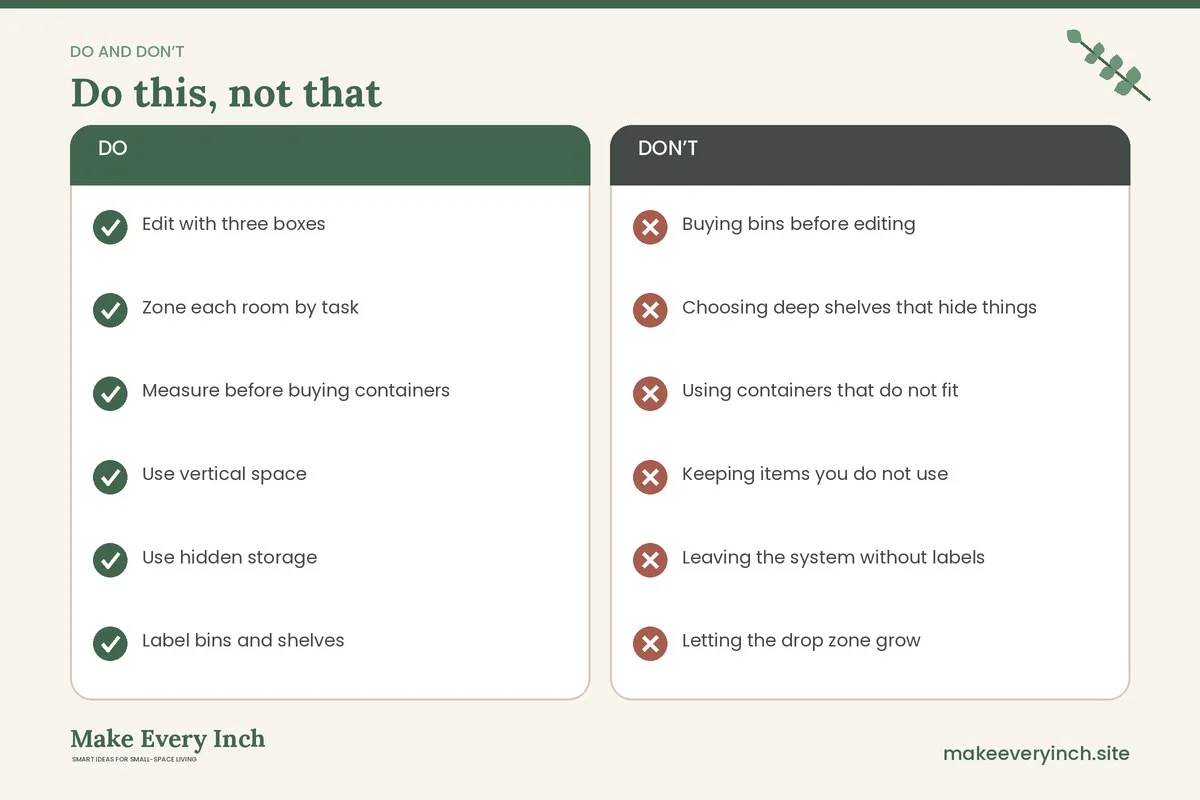
Checklist
- Edit with three boxes
- Zone each room by task
- Measure before buying containers
- Use vertical space
- Use hidden storage
- Label bins and shelves
- Create a drop zone
- Apply one-in, one-out
- Reset daily
- Review monthly
FAQ
How do I organize a small space on a budget?
Edit first, use boxes and hooks you already have and add shelves slowly.
What is the best storage for a small apartment?
Vertical shelves, under-bed bins, storage furniture and over-the-door organizers.
How do I organize without drilling?
Use freestanding shelves, over-door organizers, tension poles and carts.
How often should I declutter?
A quick reset daily and a deeper edit each season.
How do I stop clutter from coming back?
Use one-in, one-out, a drop zone and a daily reset.
What should I store under the bed?
Off-season clothes, shoes, linens and items you rarely use, in low bins.
How do I make a small room look organized?
Keep surfaces bare, use matching containers and hide small items in closed storage.
Where do I start?
Start with the room that bothers you most and work through the four steps.
Keep going: Explore our small bedroom storage ideas, small kitchen storage ideas and small living room storage ideas.
Save this guide for later
Pin the ideas you like to Pinterest so you can come back to them when you plan your space.