Small Closet Ideas for Couples
Quick answer: The best small closet ideas for couples start with a fair split of space, then add structure. Divide the closet vertically or into zones, give each person a rod, a drawer unit and a shelf, move bulky or seasonal items to a second storage spot, and agree on a few simple rules. Measure the closet, count each person’s hanging and folded items, and size each share by need, not by habit.
Small closet ideas for couples have to solve a problem that a single person never faces, which is that two sets of clothes, two routines and two opinions share one box. One person owns more shirts and the other owns longer coats. One folds, the other hangs. One gets dressed at six in the morning in the dark, and the other wants everything in view. Without a plan, the closet becomes a quiet source of friction, and one person’s things slowly spread across the other’s side. This guide shows how to divide a shared closet fairly and practically. It covers a closet audit, split zones, the vertical divide, drawers, second-closet alternatives, fair-space rules, a table, three example closets, a weekly routine, mistakes and a checklist. For the wider topic, read our pillar guide on small closet ideas, the practical post on small closet organization ideas and the layout-focused guide to small bedroom ideas for couples. If your closet has no shelving at all, our companion post on how to organize a closet with no built-in shelves covers the structure.
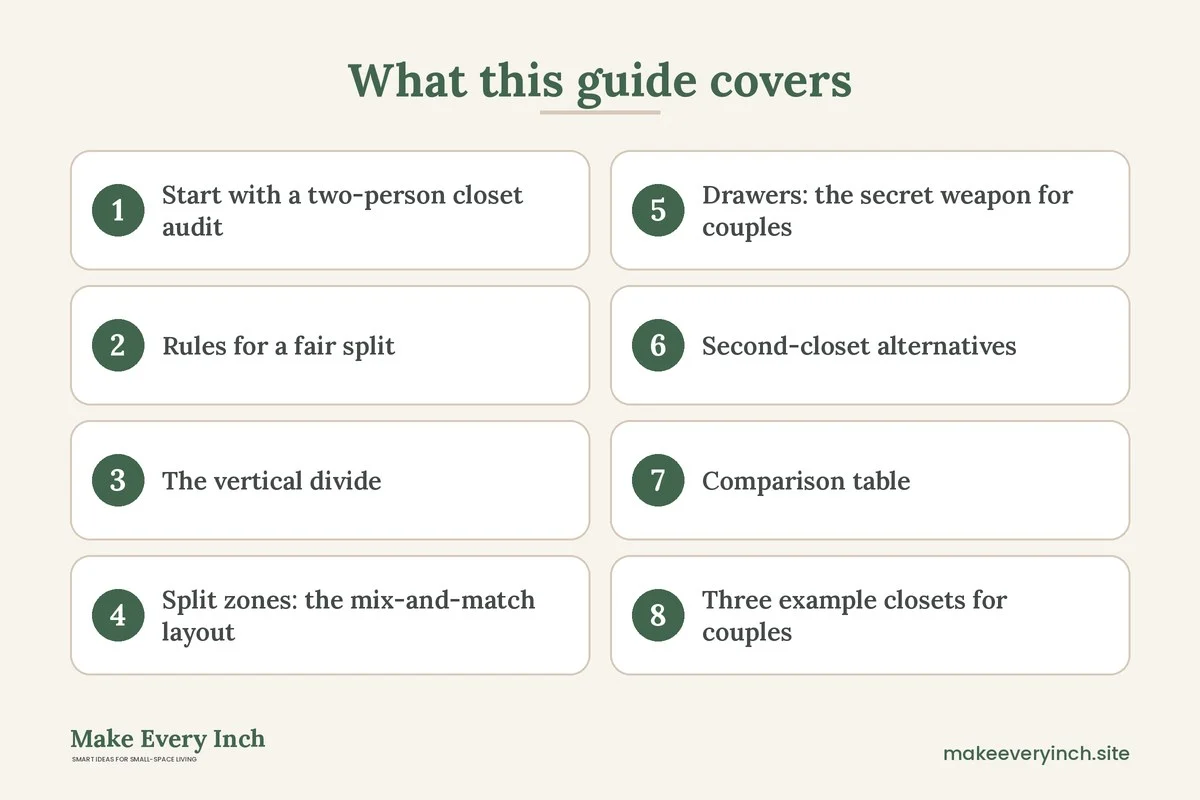
Start with a two-person closet audit
Fairness begins with numbers. Before moving anything, each person empties their share onto the bed and counts. Use a simple tally on paper or in a phone note.
- Hanging items: shirts, dresses, trousers, jackets and coats, counted separately for short and long garments.
- Folded items: knits, tees, jeans, sleepwear and gym clothes.
- Shoes and bags: pairs of shoes and number of bags.
- Accessories: belts, ties, scarves, hats and jewelry boxes.
- Seasonal and occasional items: formal wear, winter coats, luggage and sports gear.
Then measure the closet: width, depth, height, rod position, door clearance and any shelf or light fixture. A typical bedroom closet is 48 to 72 inches wide and 24 to 30 inches deep. A rod typically gives you about one inch of width per three to four hanging items, depending on the thickness of the clothes. A closet 60 inches wide, with a single rod, holds roughly 40 to 50 items, so it can often handle two people only if both limit the hanging load.
Compare the two tallies. Seldom do both people need the same share, so a fair split follows need, not a 50-50 line down the middle. A person with long dresses and coats needs more height, while a person with folded knits and jeans needs more shelf and drawer room. The audit gives both of you facts, and makes the discussion calmer.
Rules for a fair split
Agree on a few simple rules, and write them down if that helps. The rules matter more than the furniture, because they keep the system from drifting.
- Split by need and then by volume. Allocate space according to what each person actually wears, not equal inches.
- Trade space for space. If one person takes more hanging room, the other gets more drawer or shelf room.
- Keep a neutral zone. Reserve one shelf, bin or drawer for shared items, such as luggage, spare bedding or a laundry bag.
- Use the one-in, one-out rule. When a new item arrives, an old item leaves. This works for each share.
- Respect the border. Nobody moves into the other’s zone without asking. If you need more, you talk about it.
- Review every season. Twice a year, swap seasonal clothes and re-check the split. Needs change with jobs, hobbies and weather.
- Make the first-come rule explicit. The person who gets dressed first in the morning might take the zone nearest the door, so they do not disturb the other.
These rules sound simple, but they reduce the daily micro-conflicts that make couples say they hate sharing a closet.
The vertical divide: two sides, two rods
A vertical divide splits the closet into left and right halves. It is the easiest layout to understand, and works well in a closet 48 to 72 inches wide.
- Mark the center. Measure the width, find the midpoint and mark it with painter’s tape on the floor and wall.
- Adjust for need. If one person has fewer hanging items, shift the line toward them, giving the other more room.
- Use a divider. A vertical panel, a hanging divider or a tension rod stood on end makes the line visible. Even a strip of fabric on the rod does the job.
- Choose different hangers. One person uses wood, the other uses slim velvet hangers. The change in color or type shows where one share ends and the other begins.
- Keep the door side for the first-up person. This avoids wrestling over the shared doorway at dawn.
A vertical divide works best when each side has its own rod. If the closet has a single long rod, you can still split it by hanging a clear divider. If you must share one rod, group clothes by person on the left and right, and add a small label.
When the divide should be horizontal instead
If your closet is narrow but tall, a horizontal split can use space better. Install a second rod, such as a tension rod or a freestanding double rail, so one person has the upper rod and the other the lower rod. The upper rod suits the taller person, or the person who wears shorter garments, while the lower rod suits the person with lighter clothes. A lower rod is also easier to reach for children’s clothes. Check the rod rating, and keep the load light on tension rods.
Split zones: the mix-and-match layout
Many couples find that a hybrid layout works best. You use a vertical divide for the hanging space and a horizontal split for shelves and drawers.
- Left zone: Person A’s hanging rod, a shoe shelf and a drawer unit.
- Right zone: Person B’s hanging rod, a bin or shelf and a drawer unit.
- Top shelf or platform: shared items, such as luggage and spare bedding, in lidded bins. Use a stable platform and keep the contents light.
- Door: two over-the-door racks, one on each side, or a single rack with a divider.
- Floor center: a shared hamper or laundry bag, kept tidy.
A hybrid layout also helps with rhythm. Each person gets everything within arm’s reach, so nobody crosses the other’s area to dress. It makes a morning routine run smoothly in a closet only three feet wide.
Drawers: the secret weapon for couples
Drawers do more for a shared closet than any other single addition. A drawer holds a defined amount, which prevents spreading, and a closed drawer hides clutter. Each person should have at least two drawers: one for underwear and socks, one for folded tees and sleepwear.
- Freestanding drawer towers: plastic, fabric or wooden stacks, 12 to 16 inches wide, fit under a short rod or on the floor. Check the weight rating, and anchor tall stacks to the wall, with permission if you rent. Never let a child climb the drawers.
- Under-rod drawer units: units about 30 to 36 inches high slide beneath a hanging rod, using space that is otherwise empty.
- A dresser outside the closet: a narrow dresser in the bedroom takes the folded clothes and frees the closet for hanging. See our guide to the best small dressers.
- Drawer dividers: adjustable dividers keep socks, underwear and belts in order. They also mark each person’s half of a shared drawer if you have to share.
- Color-coded bins: one color per person makes it obvious whose bin is whose.
Soft bins, baskets and rolling carts are good alternatives when a dresser will not fit. If you need to keep a drawer unit stable, keep the heavy clothes at the bottom, close drawers when not in use, and avoid opening several at once on a tall stack.
Second-closet alternatives
Sometimes a closet is too small for two people, and no clever layout fixes that. The answer is to move part of the wardrobe somewhere else. Consider these options.
A freestanding garment rack
A rack in the bedroom corner can hold one person’s daily outfits or seasonal pieces. Choose a sturdy frame with a wide base. Check the load rating, and put heavy items low. A rack looks neat when it holds a limited collection and sits in a corner away from the bed. If your rack stands near a heater or radiator, keep a clear gap so the clothes do not overheat.
A wardrobe or armoire
A freestanding wardrobe offers a closed space with its own hanging rod. It suits a rental, because it does not require building work. Measure the door swing and the room first. Anchor tall wardrobes to the wall if you can, because they tip easily, especially when a door is open and loaded with items.
Under-bed storage
Flat boxes or rolling drawers under the bed hold off-season clothes, shoes and spare bedding. Choose boxes with lids that keep dust out, and label each one by person and season. See our guide to under-bed storage ideas.
A hall or entry closet
If your home has a coat closet, borrow a section for heavy coats, luggage and sports gear. This frees the bedroom closet for everyday clothes.
A wall rail or hooks
A wall-mounted rail is an option if you own the place or have permission to drill. A freestanding or over-the-door hook works as a no-drill option for the next day’s outfit and a robe.
Off-site seasonal storage
Some couples keep formal wear or winter coats at a relative’s home or in a storage unit. Only use this if you have a clear label and an inventory, so nothing is forgotten.
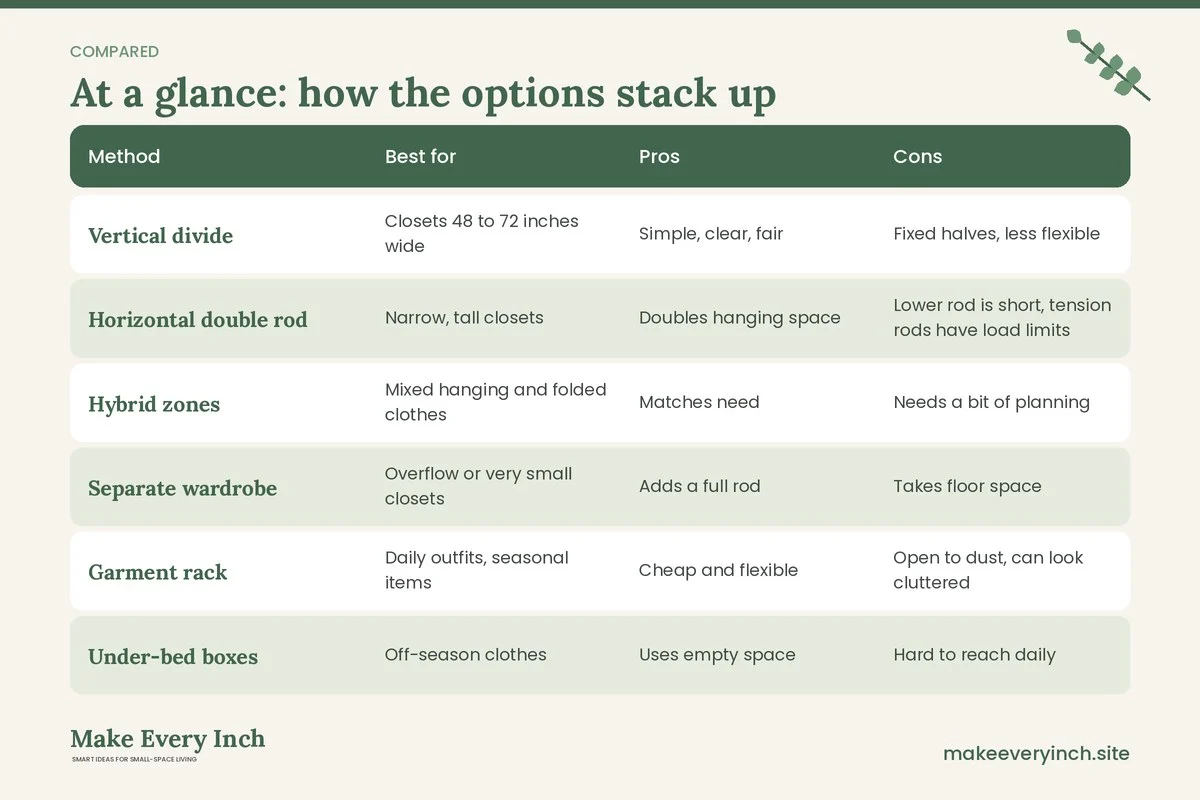
Comparison table: ways to split a small closet
| Method | Best for | Pros | Cons |
|---|---|---|---|
| Vertical divide | Closets 48 to 72 inches wide | Simple, clear, fair | Fixed halves, less flexible |
| Horizontal double rod | Narrow, tall closets | Doubles hanging space | Lower rod is short, tension rods have load limits |
| Hybrid zones | Mixed hanging and folded clothes | Matches need | Needs a bit of planning |
| Separate wardrobe | Overflow or very small closets | Adds a full rod | Takes floor space |
| Garment rack | Daily outfits, seasonal items | Cheap and flexible | Open to dust, can look cluttered |
| Under-bed boxes | Off-season clothes | Uses empty space | Hard to reach daily |
| Shared dresser | Folded clothes | Frees the closet | Needs bedroom floor space |
Three example closets for couples
A 4-foot reach-in closet with one rod
The closet is 48 inches wide and 24 inches deep. Person A has 18 hanging items and Person B has 24. Divide the rod at 20 inches for A and 28 inches for B. Add a freestanding drawer tower of 12 inches wide on the floor at the left, and hang a six-tier fabric stack at the right for sweaters. Add a second short rod on B’s side for folded trousers, if the wall allows a tension rod. The top, above the rod, takes shared lidded bins if a stable platform is available. Move bulky coats to a rack in the hall.
A 6-foot closet with two doors
A 72-inch closet gives each person 36 inches. Install two rods, one on each side, with a divider panel in the middle. On the left, Person A has a rod and a three-drawer unit on the floor. On the right, Person B has a rod, a shoe shelf and a set of bins. A shelf or platform across the top holds shared luggage. The two doors help, because each person opens only their own side. This layout feels fair at a glance, and it is easy to maintain.
A 3-foot closet in a tiny bedroom
A closet only 36 inches wide cannot hold two wardrobes. Use it for hanging clothes, with Person A on the top rod and Person B on the lower rod, and keep every folded item in a dresser or under-bed boxes. A hall rack takes coats and one person’s off-season clothes. This is a case where the second-closet alternatives matter more than the closet itself. Our guide to small bedroom storage ideas covers more options for the rest of the room, and small bedroom ideas without a closet helps if your closet is too small to count.
Morning routine and flow
A closet shared by two people also has to work as a place where two people move. Keep these points in mind.
- Avoid traffic jams. Allow a clear 24 to 30 inches in front of the closet so both can reach their sides.
- Stage outfits. Hang tomorrow’s outfit on the door hook to cut down the number of times you open the closet.
- Light the space. A small battery or low-heat light helps whoever dresses in the dark. Keep bulbs away from clothes and use only fixtures rated for closets.
- Keep a mirror outside. A mirror on the wall or the door lets one person check an outfit while the other is in the closet.
- Use a hamper outside the closet. A laundry basket in the bedroom or bathroom stops the closet from becoming a dumping ground.
Maintenance: a weekly and seasonal habit
A shared system only lasts if both people take part in maintaining it.
- Weekly: put back stray items, empty the hamper and straighten the shoes. It takes five minutes.
- Monthly: check each share for items that you have not worn. Donate or move them.
- Seasonally: swap clothes, wash and dry everything before storing and rotate the boxes under the bed.
- Yearly: repeat the audit. Compare it with the last one and adjust the split if needs have changed.
When storing wool or silk, use breathable covers and cedar blocks or lavender. Avoid mothballs, since the chemicals are strong, and they can be harmful if swallowed or inhaled, especially by children and pets. Keep any scented product out of reach.
Safety notes for shared closets
Shared closets often carry more weight than a single person’s, so check these points.
- Weight limits. Every rod and shelf has a limit. Two people’s winter coats add up quickly, so spread the load and consider a floor rack for the heaviest items.
- Anchoring. Tall drawer units, wardrobes and shelves can tip. Anchor them to the wall with permission, and place heavy items low.
- Children. If kids live with you, keep drawers closed, keep tall furniture anchored and store small items, cords and chemicals out of reach.
- Heat and light. Keep clothes at a distance from bulbs, radiators and heaters. A crowded closet should never block a vent.
- No drilling without permission. If you rent, ask in writing before putting any screw in a wall, and choose no-drill options when in doubt.
Mistakes couples make
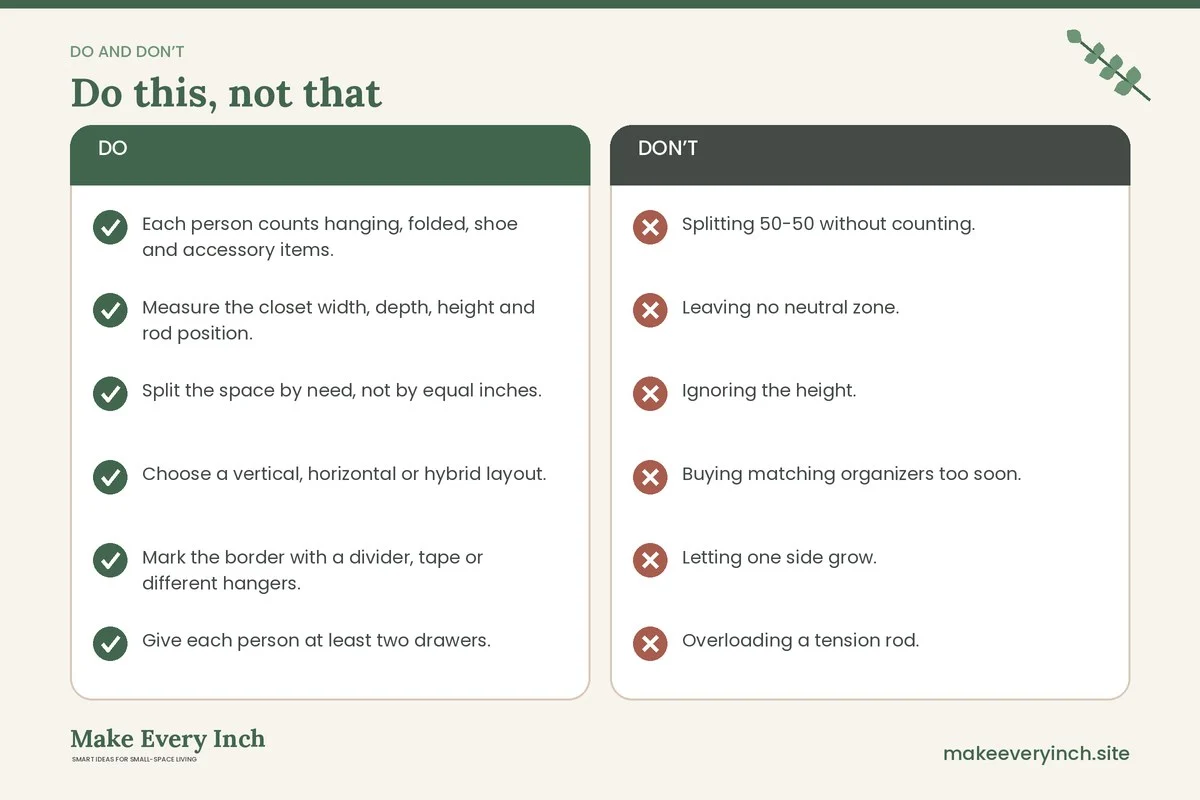
- Splitting 50-50 without counting. One person ends up cramped. Use the audit.
- Leaving no neutral zone. Shared items then creep into one person’s share.
- Ignoring the height. A tall person needs a higher rod, and a shorter person may want a lower one.
- Buying matching organizers too soon. Count first, then buy.
- Letting one side grow. Without a one-in, one-out rule, the border moves.
- Overloading a tension rod. A rod that holds one person’s shirts may fail with two people’s coats.
- Forgetting the door. A rack that blocks the door cancels the closet.
- Not talking about it. A quick chat after the first month saves months of quiet annoyance.
Looking beyond the closet
A closet is only part of a bedroom’s storage. A bed with drawers, a narrow chest and wall hooks all help. For ideas on beds, see best beds with storage, and for room-wide ideas read our guides to small bedroom storage ideas, vertical storage ideas and small space organization ideas. If you share more than a bedroom, small home organization ideas that actually last offers a framework for the whole home.
Checklist for couples
- Each person counts hanging, folded, shoe and accessory items.
- Measure the closet width, depth, height and rod position.
- Split the space by need, not by equal inches.
- Choose a vertical, horizontal or hybrid layout.
- Mark the border with a divider, tape or different hangers.
- Give each person at least two drawers.
- Reserve one shared zone for luggage and spares.
- Move seasonal and bulky items to a second spot.
- Check weight limits of every rod and shelf.
- Anchor tall units, with permission if you rent.
- Agree on the one-in, one-out rule.
- Schedule a seasonal review.
FAQ
How do we divide a small closet fairly?
Count each person’s items first, then divide by need rather than equal inches. Trade hanging space for drawer or shelf space where needed.
Should each person get half of the closet?
Not always. A half-and-half split is a fine starting point, but adjust the line for the person with longer garments or more hanging items.
What if the closet is too small for two people?
Move part of the wardrobe elsewhere, with a garment rack, a wardrobe, under-bed boxes, a dresser or a hall closet. A shared dresser takes folded clothes out of the closet.
How many drawers does each person need?
Two is a good minimum, one for underwear and socks and one for tees and sleepwear. Add more if you fold a lot.
How do we stop one person’s stuff from spreading?
Mark the border, use the one-in, one-out rule and review the split each season. A neutral zone for shared items also helps.
Are tension rods safe in a shared closet?
They work for light loads and need a check on the rating. Do not use them for heavy coats, and recheck them regularly.
Is it okay to anchor a dresser in a rental?
Ask your landlord first. If drilling is not allowed, choose a low unit, put heavy items low and keep the unit snug against the wall.
Keep going: Keep going with our small closet ideas pillar, the guide to how to organize a closet with no built-in shelves and our post on small bedroom ideas for couples.
Save this guide for later
Pin the ideas you like to Pinterest so you can come back to them when you plan your space.