15 Nightstand Alternatives for Small Bedrooms
Quick answer: The best nightstand alternatives small bedrooms can use are a narrow wall shelf, a clamp-on or headboard shelf, a stacked stool or small cart, a slim ladder shelf, a bench at the foot of the bed, a window ledge and a drawer under the bed. Choose a surface that sits 2 to 4 inches below the top of your mattress, can hold a lamp, a phone and a glass, and leaves at least 24 inches of walkway beside the bed.
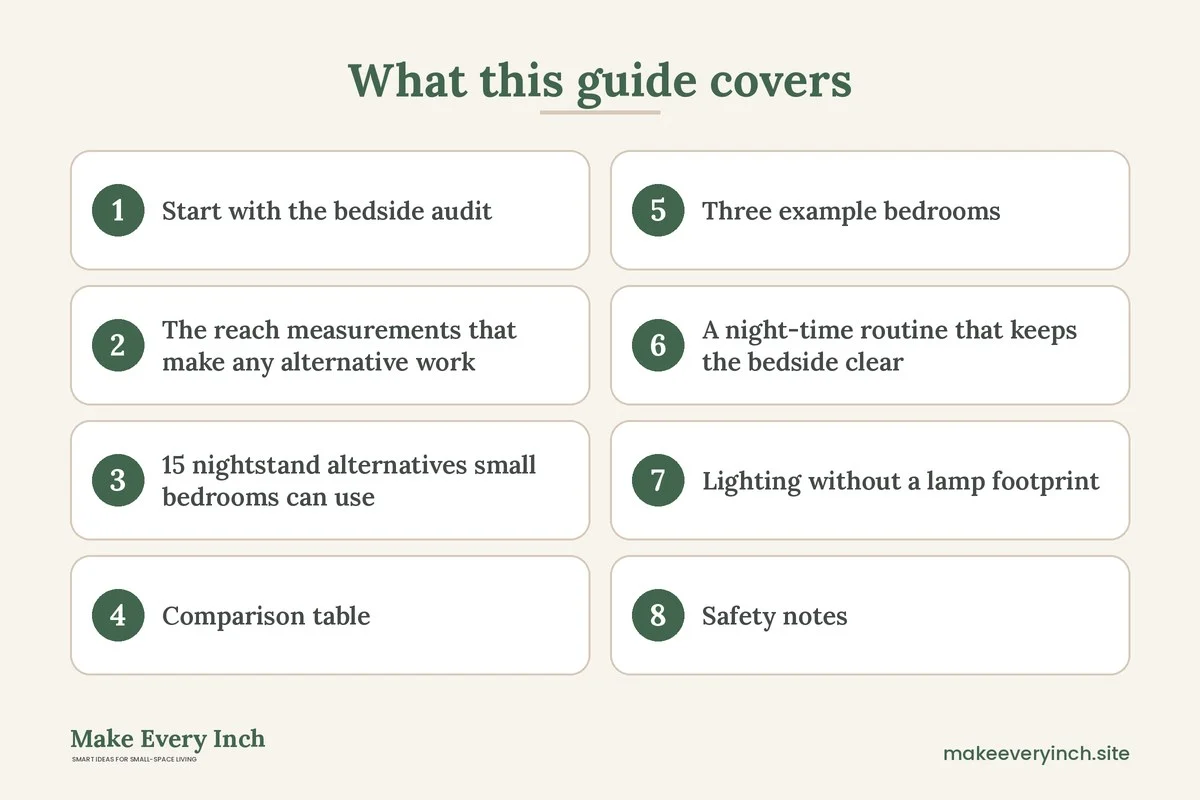
Nightstand alternatives small bedrooms depend on start with one honest question: what do you actually reach for in the dark? A standard nightstand is often 18 to 24 inches wide and just as deep, and in a room where the bed already fills most of the floor, two of them can swallow 4 feet of wall for the sake of a lamp and a phone charger. This guide approaches the problem as a set of small jobs rather than a single piece of furniture. It covers the bedside audit, the reach measurements that make any surface comfortable, 15 alternatives, a comparison table, three example bedrooms, a night-time routine, safety notes and a checklist. For the wider topic, read our main guide on small bedroom ideas, and for the surfaces beyond the bed see our post on small space side table alternatives and the companion guide to small bedroom closet organization ideas.
Start with the bedside audit
Before you remove a nightstand or buy a replacement, spend three nights noticing what you touch from bed. Most people find the list is shorter than the clutter on their current table. Typical items are a phone and charger, a light or lamp switch, a glass of water, glasses or contacts, a book or e-reader, an alarm, lip balm or hand cream, and sometimes medication or a hearing aid case. Write the list down. Next to each item, note whether you need it every night, sometimes or almost never.
The every-night items decide the surface you need. A phone, a light and a glass require roughly a 10 by 14 inch footprint, which is much smaller than a full nightstand. Anything you use only occasionally, such as a tissue box, extra pillows, a spare blanket or a stack of books, can live elsewhere. Moving those items into a drawer under the bed, a basket or a closet shelf is the quickest way to shrink what the bedside has to carry. If you use the table to hold medication, treat that as a safe-storage question too. Keep medicines out of reach of children and pets, and use a lidded container on a surface that cannot be knocked over.
Also notice which side of the bed you sleep on and which hand you use. A right-handed sleeper on the left side of a bed will reach across their body for a table on the right, which feels awkward at 3 a.m. Place the surface on the side where the reaching hand naturally falls.
The reach measurements that make any alternative work
A nightstand works because it sits at the right height and distance. Any alternative should copy those numbers, not the furniture look. Use these ranges as starting points and adjust to your body and your bed.
- Height: the top of the surface should sit about 4 inches below to 2 inches above the top of the mattress. Many mattresses sit 20 to 28 inches from the floor with a frame, so a surface between 18 and 30 inches usually works. Measure your own bed rather than assuming.
- Distance from the sleeper: keep the surface within 12 to 20 inches of the edge of the bed, or about a forearm length from where your shoulder rests.
- Depth: 8 to 12 inches is enough for a phone, a small lamp and a glass. Anything deeper begins to steal walkway.
- Walkway: leave at least 24 inches of clear floor beside the bed where you walk, and 30 inches if two people share the room or if anyone uses a mobility aid.
- Lamp light: a lamp or wall light should have its switch within arm’s reach, and the bulb should sit below eye level when you are lying down, so it does not glare.
- Outlet distance: a charging cable usually reaches 3 to 6 feet. If the outlet is far from the bedside, choose a surface that sits near it, or use a cord cover along the baseboard rather than a long exposed cable.
Mark the spot with painter’s tape on the wall and floor before you buy anything. Lie down, reach with your eyes closed and see whether your hand lands on the tape square. This simple test saves returns.
15 nightstand alternatives small bedrooms can use
1. A narrow floating wall shelf
A wall shelf 8 to 10 inches deep and 18 to 30 inches wide gives you a bedside surface with no legs and no floor footprint. Mount it at the mattress height range above and 4 to 6 inches in from the bed edge, so you do not hit your head when you sit up. Because it holds weight on the wall, check the lease first, and never drill without permission. If drilling is allowed, locate studs, or use anchors rated for the load, and keep to a modest weight such as a lamp, a book and a glass. A shelf that projects at head height is a risk for anyone who might sit up fast, so round the corners and keep it lower than shoulder height when seated.
2. A picture ledge used as a mini bedside
A ledge 3 to 4 inches deep holds a phone, a small light, a plant or a framed card. It is not deep enough for a glass of water to feel stable, so pair it with a coaster or put the glass on the floor-level option below. It suits very tight rooms where even an 8 inch shelf is too bulky.
3. A clamp-on or headboard-hung shelf
Some beds and headboards have a flat top rail, and some frames accept an add-on tray or shelf that hooks or clamps without any drilling. Check that the clamp matches the thickness of your rail, and test it with a light load first. This idea moves the surface onto the bed itself, so it travels with you when you move and is friendly to renters.
4. A bookcase headboard
A shallow bookcase headboard, 6 to 10 inches deep, can hold your reading, a lamp and a charger on its shelves and turns the wall behind the bed into storage. It works well in rooms where there is no wall space on either side of the bed. Tall and heavy units must be anchored to the wall with the hardware that comes with them, and only with permission, because a bookcase behind a sleeping person can tip. If you cannot anchor, choose a lower, lighter option or a headboard that rests on the bed frame.
5. A stacked stool or small round side stool
A stool 12 to 14 inches across and about as tall as the mattress is the simplest swap. It tucks half under the edge of the bed when not needed, and it can double as a seat for putting on shoes. Pick one with a flat top, so a lamp stays stable, and rounded edges for night-time bumps.
6. A slim ladder shelf
A leaning ladder shelf is 10 to 14 inches deep at the base and about 5 feet tall. It gives you three or four tiers for a lamp, a book and a basket. It leans against the wall without any drilling, which suits rentals, but a leaning unit needs a stable base and, where allowed, a small anchor so it cannot slide or tip. Do not place it where a child or a pet could climb it.
7. A small rolling cart
A cart that is 12 to 16 inches wide can roll out of a corner when you need it, then park against the wall during the day. It holds a lamp on top and a basket or two below. Lock the wheels or choose a cart with a lip so items do not slide off, and make sure the cord from any lamp is not stretched across the floor.
8. A bench or trunk at the foot of the bed
If the only free wall is at the foot of the bed, move the bedside there for the things you do not need at 3 a.m. A bench holds a folded blanket, a bag or tomorrow’s clothes, and a lidded trunk stores extra bedding. It is not a replacement for a lamp and a phone, so pair it with a clip light or a wall plug light near the pillow.
9. A window ledge or deep sill
If the head of the bed sits under a window, a deep sill of 4 inches or more can serve as a ledge. Do not place anything on a sill that could fall in heat or cold, and keep cords away from blinds, which are a hazard for children and pets. Avoid a sill that sits above a radiator, since heat can damage some objects and electronics.
10. A drawer or low box under the bed
A shallow rolling drawer stores the overflow so the bedside stays clean. A lidded box slid under the bed keeps a spare charger, a book or a first-aid kit out of sight. Raise the bed frame on risers if it is low, but keep to the weight and height limits printed by the maker, and do not stack unstable supports.
11. A wall-mounted bracket or hook for a lamp
Moving the lamp to the wall frees the surface for other things. A plug-in wall sconce with a switch needs no hardwiring, and a hook can hold a small hanging pouch for glasses and a remote. Follow electrical safety rules: keep the cord tidy, do not overload the outlet and never run a cord under a rug. Hardwiring a light is a job for a licensed electrician, and for a renter it needs the landlord’s permission.
12. A hanging bedside pouch or caddy
A fabric organizer that tucks under the mattress or hangs from the bed frame holds a phone, a remote and glasses. It has no footprint at all. Choose a stiff-sided style so it does not sag, and keep it away from the bed edges where a child or pet could get tangled.
13. A small bedside tray on a dresser
If a dresser stands within reach of the bed, a tray on top of it can act as the nightstand. This works when the dresser is within 20 inches of the mattress edge, and it allows a lamp, a charger and a glass to share the space with the rest of the room.
14. A narrow console or slim table at the head of the bed
If you have 4 to 6 inches behind the headboard, a slim console, 8 to 10 inches deep, can sit between the wall and the bed. It uses the dead space and spans the full width of the bed, so both sleepers can reach it. Make sure it is pushed flush to the wall and that cords drop straight behind it, away from the mattress.
15. A shared piece instead of two
Two nightstands take two footprints. One shared piece at the head, such as a bookcase headboard, a wall-length shelf or a console, can replace both and leaves more floor. If you share the bed, give each person a clearly labeled zone on it so there is no daily argument.
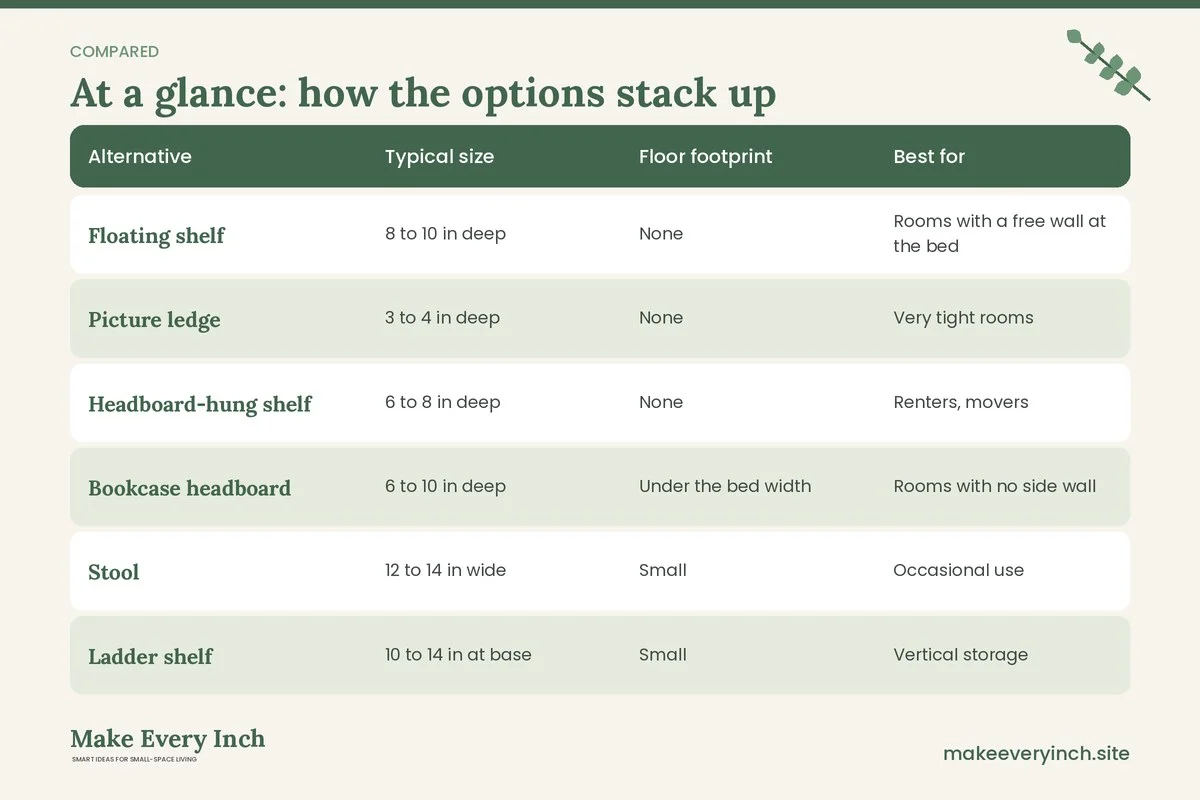
Comparison table: choosing by room and need
| Alternative | Typical size | Floor footprint | Best for | Watch out for |
|---|---|---|---|---|
| Floating shelf | 8 to 10 in deep | None | Rooms with a free wall at the bed | Wall permission, stud finding, weight limit |
| Picture ledge | 3 to 4 in deep | None | Very tight rooms | Cannot hold a glass safely |
| Headboard-hung shelf | 6 to 8 in deep | None | Renters, movers | Fit to rail, load limit |
| Bookcase headboard | 6 to 10 in deep | Under the bed width | Rooms with no side wall | Tip risk, needs anchoring |
| Stool | 12 to 14 in wide | Small | Occasional use | Stability, rounded edges |
| Ladder shelf | 10 to 14 in at base | Small | Vertical storage | Tip risk, child climbing |
| Rolling cart | 12 to 16 in wide | Small, movable | Flexible rooms | Locking wheels, cords |
| Bench or trunk | 14 to 18 in deep | Moderate | Foot of the bed | Not within night reach |
| Window sill | 4 in deep or more | None | Bed under a window | Heat, blinds, cords |
| Under-bed drawer | Under 10 in tall | None | Overflow | Weight and height limits |
| Wall sconce | Plug-in | None | Freeing surface space | Cord safety, outlet load |
| Hanging pouch | Soft | None | Phones, remotes | Sagging, entanglement |
| Dresser tray | Varies | None extra | Rooms with a dresser nearby | Distance from the bed |
| Slim console | 8 to 10 in deep | Behind the bed | Shared beds | Flush fit, cord routing |
Three example bedrooms
A 9 by 10 foot room with the bed in the corner
The bed sits with one long side against the wall, leaving one open side and about 30 inches of walkway on it. A nightstand on the open side would reduce that walkway to about 10 inches, which is too tight. Instead, a floating shelf on the wall at the head of the bed holds a small lamp, a phone and a glass, 22 inches above the floor, and a hanging pouch on the open side of the frame holds glasses and a remote. A shallow drawer under the bed stores the overflow. The walkway stays clear and the floor keeps its visual space.
A rental where drilling is not allowed
The lease forbids nails, so every idea must lean, clamp or sit. A ladder shelf leans against the wall at the head, with a rubber pad at the base and a lamp on the second tier at mattress height. A small round stool sits at the other side and tucks beneath the bed edge. A cord cover runs along the baseboard to the nearest outlet. Everything leaves with the tenant at move-out. See our guide to renter friendly bedroom storage ideas and the broader plan for small bedroom ideas for renters for more no-drill options.
A couple sharing a double bed in a narrow room
A narrow room has only 24 inches beside the bed on each side. A slim shelf-style headboard, 8 inches deep, spans the width of the bed and holds a lamp at each end, a charger strip at the center and room for books. The shared surface replaces two nightstands, and a bench at the foot stores clothes for the next day. The couple divides the shelf into two halves and agrees on a rule for what lives there. For more couple-specific layouts, read small bedroom ideas for couples.
A night-time routine that keeps the bedside clear
A small surface stays useful only if it is reset every day. Try a 60-second routine. Put the glass in the kitchen each morning, move books you are not reading to the shelf, place the charger cable back in a tidy coil and wipe the surface. Do the same in the evening in reverse. If a surface fills up during the week, the answer is not a bigger table but a quick check of which items you have not used in three nights. Move them to storage.
Lighting without a lamp footprint
Lamps are the biggest space users on a nightstand. Options that use less floor include a plug-in wall sconce, a clip-on reading light, a headboard-mounted light and a small battery-powered touch light. Check that any battery light uses a secure battery compartment, which matters in homes with small children and pets, because button batteries are dangerous if swallowed. For more lighting ideas, see small bedroom lighting ideas.
Safety notes
- Anchoring: any tall or top-heavy piece, such as a ladder shelf, a bookcase headboard or a narrow tower, should be anchored to the wall using the maker’s hardware, and only where your lease allows it. If you cannot anchor, choose something low.
- Wall mounting: never drill without permission. Use the right anchors for the wall type and keep within the weight rating of both the shelf and the fixing.
- Electrical: do not run cords under rugs, across walkways or through bed frames. Do not overload an outlet or power strip. Keep chargers away from bedding, which can trap heat. Do not use a damaged cord.
- Candles and heat: avoid open flames on a bedside, and keep any heater at a safe distance from fabric.
- Children and pets: keep small items, medicine, batteries and cords out of reach. Check that nothing can be pulled off the surface onto a sleeper.
- Night-time bumps: choose rounded corners, and place the surface where you will not strike your shins or toes in the dark. A low glow strip along the baseboard can help, provided it is a safe low-voltage type.
Common mistakes
- Choosing by looks, not reach. A beautiful surface that sits 8 inches too high or too far away will end up unused.
- Matching the tall pair. A nightstand does not have to match the other one. Two different heights can work if the tops are within an inch or two of each other.
- Forgetting the outlet. Plan the cord route before you buy.
- Keeping too much. The surface is for the every-night items only.
- Blocking the walkway. Leave at least 24 inches where you walk.
- Skipping the lease check. Ask in writing before any drilling or adhesive on painted walls.
Checklist before you buy
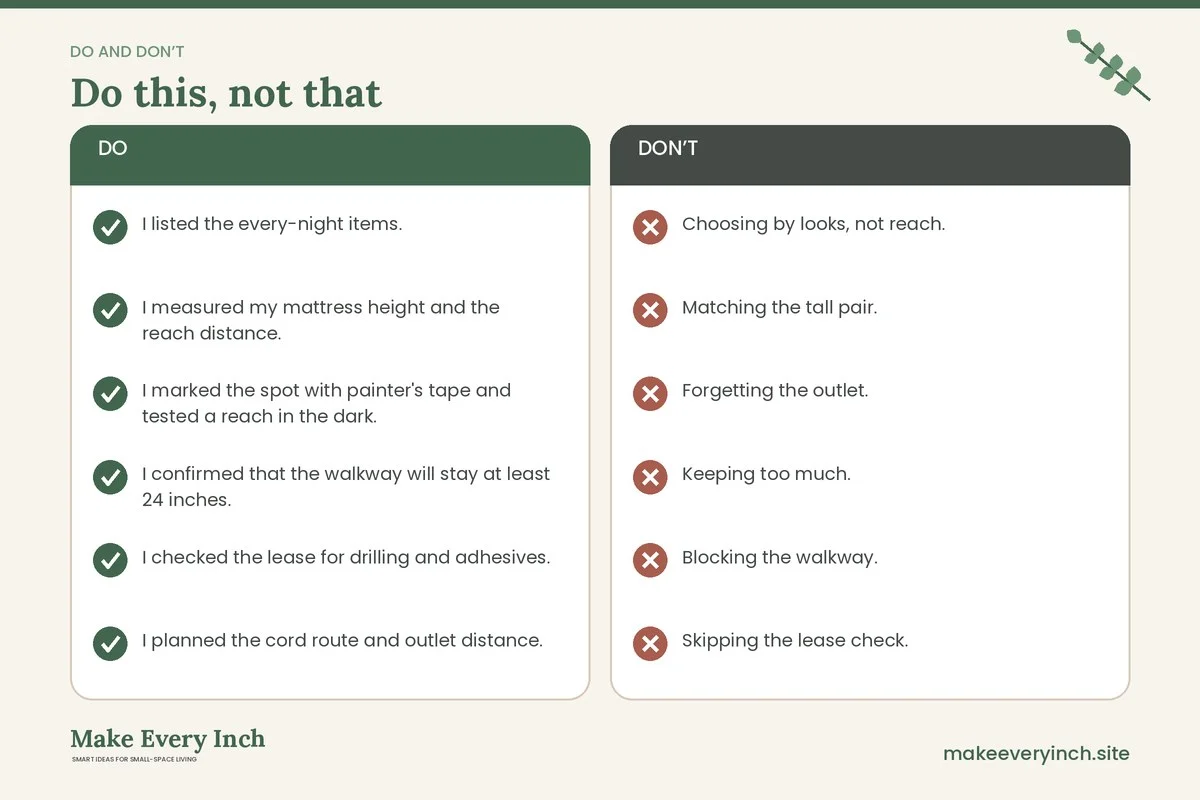
- I listed the every-night items.
- I measured my mattress height and the reach distance.
- I marked the spot with painter’s tape and tested a reach in the dark.
- I confirmed that the walkway will stay at least 24 inches.
- I checked the lease for drilling and adhesives.
- I planned the cord route and outlet distance.
- I chose anchoring or a low, stable piece.
- I decided where overflow items will live.
- I set a daily reset routine.
Frequently asked questions
What can I use instead of a nightstand? A floating shelf, a stool, a ladder shelf, a bookcase headboard, a rolling cart, a window ledge, a hanging pouch or a dresser tray can all work. Pick the one that fits your reach measurements and walls.
How high should a nightstand alternative be? Aim for a top that sits a few inches below to a couple of inches above the mattress top, typically 18 to 30 inches from the floor, then adjust for your bed.
Can I go without a bedside surface at all? Yes, if you use a clip-on light, a hanging pouch and a charger placed on the headboard or under the pillow-side frame. Keep a glass in a stable spot, and keep medicine safely stored.
What is best for a rental? Leaning, clamping and hanging options such as a ladder shelf, a stool, a pouch and a clamp-on tray, because they need no drilling. Check the lease for adhesives.
How do I stop a small surface from getting cluttered? Limit it to three or four every-night items, keep a basket or drawer for overflow and do a one-minute reset daily.
Is a headboard shelf safe? A shallow, low shelf is fine when it is fixed correctly and not overloaded. Avoid heavy items above a sleeper’s head.
Keep going: Keep going with our main guide to small bedroom ideas, plan the rest of the room with small bedroom storage ideas, and add better bedside light with small bedroom lighting ideas.
Save this guide for later
Pin the ideas you like to Pinterest so you can come back to them when you plan your space.