Renter-Friendly Small Space Upgrades That Make a Difference
Quick answer: The renter-friendly small space upgrades that make a difference most are the ones that change light, surfaces and floor space without touching the building: better bulbs and plug-in lighting, a rug that anchors the room, window treatments on tension rods, a mirror leaned against a wall, and furniture that stores things. Rank each idea by impact and effort, check your lease, photograph the room first, and choose only upgrades you can take with you or undo in an afternoon.
Renter-friendly small space upgrades that make a difference are not the same as a long wish list. In a small rental you have limited square footage, limited time and a lease that restricts what you can change, so every upgrade has to earn its place. Some changes transform a room in an hour, such as swapping a harsh bulb for a warm one. Others take a weekend and barely register once finished. This guide ranks upgrades by how much they change the room against how much effort and risk they involve, and it keeps only the ones that are reversible or portable. It covers the lease check, the impact and effort scoring method, a ranked list of 16 upgrades, a comparison table, three example rooms, a sensible order of work, safety notes and a checklist. For the wider picture, see our main guide to renter-friendly apartment decorating ideas, and for storage that needs no holes, read no-drill storage ideas for renters.
Start with the lease and a set of photos
Every upgrade in this guide assumes you have read your lease. Look for clauses on nails and screws, adhesives, paint, wallpaper, window coverings, light fixtures and flooring. Some leases ban anything stuck to a wall. Others allow small nail holes or even painting with written approval. If a clause is unclear, ask your landlord or property manager, and ask in writing so you have a record. Never drill, cut or remove fixtures without permission, even when an upgrade seems minor.
Next, document the place as it is. Photograph each room in daylight, including the walls, floors, window frames, light fixtures, cabinet doors and any existing marks or scuffs. Take a few wide shots and a few close ones, and keep the files with the date. If your move-in inspection form is still around, compare it with your photos and note any differences. This record protects your security deposit. If a dispute ever comes up over a mark that was already there, you have evidence. Repeat the photos when you move out.
Finally, keep every box, instruction sheet and bag of original hardware from items that replace something in the unit, such as a shower head or a light shade. Then you can restore the original in minutes when you leave.
How to rank an upgrade: impact, effort and reversibility
Before you buy anything, score each idea on three simple questions. This turns a vague urge to improve the place into a short, sensible list.
- Impact: how much will the room look, feel or function differently? Rate it 1 to 5. Light, floor and storage changes usually score high. Small decorative objects usually score low.
- Effort: how much time, money and skill does it take? Rate it 1 to 5, where 1 is a five-minute job and 5 is a full weekend or a big purchase.
- Reversibility and portability: can you undo it in an afternoon, or take it with you, without damage? This is a pass or fail test in a rental. If an upgrade leaves a mark, it needs permission first.
Divide impact by effort. Anything with a high result, such as a 5 for impact and a 1 or 2 for effort, goes to the top of the list. Anything with a low result goes to the bottom, even if it looks appealing in a photo. Anything that fails the reversibility test is dropped or taken to your landlord. The list below follows this logic, from the highest return to the lowest.
16 renter-friendly small space upgrades, ranked
Tier one: high impact, low effort
1. Swap the bulbs for warm, consistent light
Many rentals come with mismatched bulbs, from cool white to yellow, and the room feels uneven. Replace them with bulbs of the same color temperature, usually around 2700 kelvin for living areas and bedrooms, and a little cooler for kitchens and bathrooms. Check the maximum wattage printed on each fixture and never exceed it. Keep the original bulbs in a labeled box, and put them back at move-out if your lease requires it. This is often the fastest way to change the mood of a room.
2. Add plug-in lighting at different heights
Overhead lights flatten a small room. A table lamp, a floor lamp and a small plug-in wall light with a cord cover add layers and fill dark corners. Aim for at least three light sources in the main room at different heights. Use a plug-in sconce only if the lease permits fixing it to the wall, otherwise use a clamp light, a table lamp or a floor lamp. See our post on renter-friendly lighting ideas for more options.
3. Lay a rug that fits the room
A rug is one of the biggest visual changes you can make because it covers a lot of floor and defines a zone. In a small room, choose a rug large enough for the front legs of the sofa and the main chair to sit on it. A common starting size for a small living room is about 5 by 8 feet, though you should measure your own floor. Use a thin non-slip pad to hold it in place, and check that the pad is safe for your flooring type, since some rubber backings can mark vinyl or finished wood. Lift the rug at move-out to confirm the floor beneath is unchanged.
4. Lean a large mirror
A tall mirror leaned against a wall bounces light and adds depth, and it needs no hanging hardware. Place it opposite a window or beside a lamp so it reflects something worth doubling. A leaning mirror is heavy and can tip, so choose one with a stable base angle, put a non-slip strip under the bottom edge, and anchor it to the wall only with permission. Keep it away from walkways and children.
5. Declutter surfaces and give things homes
This costs nothing and often delivers the highest return of all. Clear every flat surface, then put back only what you use daily and a few items you love. Everything else goes into a box, a bin or a drawer. A small room looks calm when surfaces are clear. Our guide to small apartment decluttering ideas walks through a method.
Tier two: high impact, medium effort
6. Curtains on a tension rod or an existing rod
Windows are a major visual feature, and bare or bent blinds make a room look unfinished. Hang curtains on an existing rod, or use a tension rod inside the window frame. Mount the rod high and wide when the lease allows it, or hang the panels as close to the ceiling as the frame permits to make the walls feel taller. Choose lined or light-filtering fabric depending on privacy. Do not hang heavy curtains on a tension rod, and check the rod’s weight rating.
7. Peel-and-stick or removable surfaces in small doses
Removable wallpaper, tile decals and cabinet films can change a backsplash, a shelf back or a wall panel. Use them in small areas and test a hidden patch first, because adhesion and residue vary by surface and age of paint. Never apply them to wet, textured, unsealed or freshly painted walls, and get written permission first. Document the surface with photos, and remove slowly with gentle warmth at move-out. For the full story, see our post on security-deposit-safe apartment upgrades.
8. Furniture that stores things
A bed with drawers, a bench with a lid or a storage ottoman gives you hidden space without extra pieces. Choose items that replace something you already need instead of adding something new. See our guides to the best beds with storage and the best storage ottomans. Measure your door and stairs before ordering anything large.
9. A room divider that is not a wall
In a studio, a bookcase, a folding screen or a hanging curtain on a ceiling-free track can separate sleeping from living. A freestanding divider needs no fixings. Our post on DIY room divider ideas for studio apartments covers options. Anchor tall units, as described in the safety section below.
10. Swap the cabinet hardware, and keep the originals
New knobs and pulls are a classic, low-cost transformation for kitchens and bathrooms. If your lease allows it, unscrew the originals, store them in a labeled bag, and fit new ones that use the same screw spacing. Take a photo of each cabinet before you start. Put the originals back on moving day. If the lease does not allow it, skip this one.
Tier three: medium impact, low effort
11. Textiles that add color and softness
Pillows, throws and bedding add color and texture with no commitment. Choose a limited palette of two or three colors, and repeat them across the room. Textiles also soften sound, which helps in small, hard-surfaced rooms.
12. Plants, real or faux
A few plants add life and height. Choose plants suited to your light, and use saucers to protect floors and sills. If you have pets, check that your plants are safe for them before buying.
13. A tray or two to group small things
A tray on a coffee table, a dresser or a counter turns scattered objects into a deliberate arrangement. It is portable and requires no fixings.
14. A shower curtain and liner refresh
A clean, simple curtain makes a rental bathroom look tidy. It hangs on the existing rod and goes with you when you move. See our guide to renter-friendly bathroom upgrades.
Tier four: lower impact, higher effort
15. Temporary shelving built from freestanding units
A freestanding bookcase has a high impact when it replaces clutter, but it takes time to plan and assemble. It earns a place lower on the list only because the other ideas are quicker. Look at our post on renter-friendly shelving for options that avoid drilling.
16. A statement piece you will keep
One good chair, lamp or rug, bought carefully, pays off for years because it moves with you. It takes more thought and a bigger purchase than the earlier items, so leave it until you have done the cheap, quick changes and know what the room really needs.
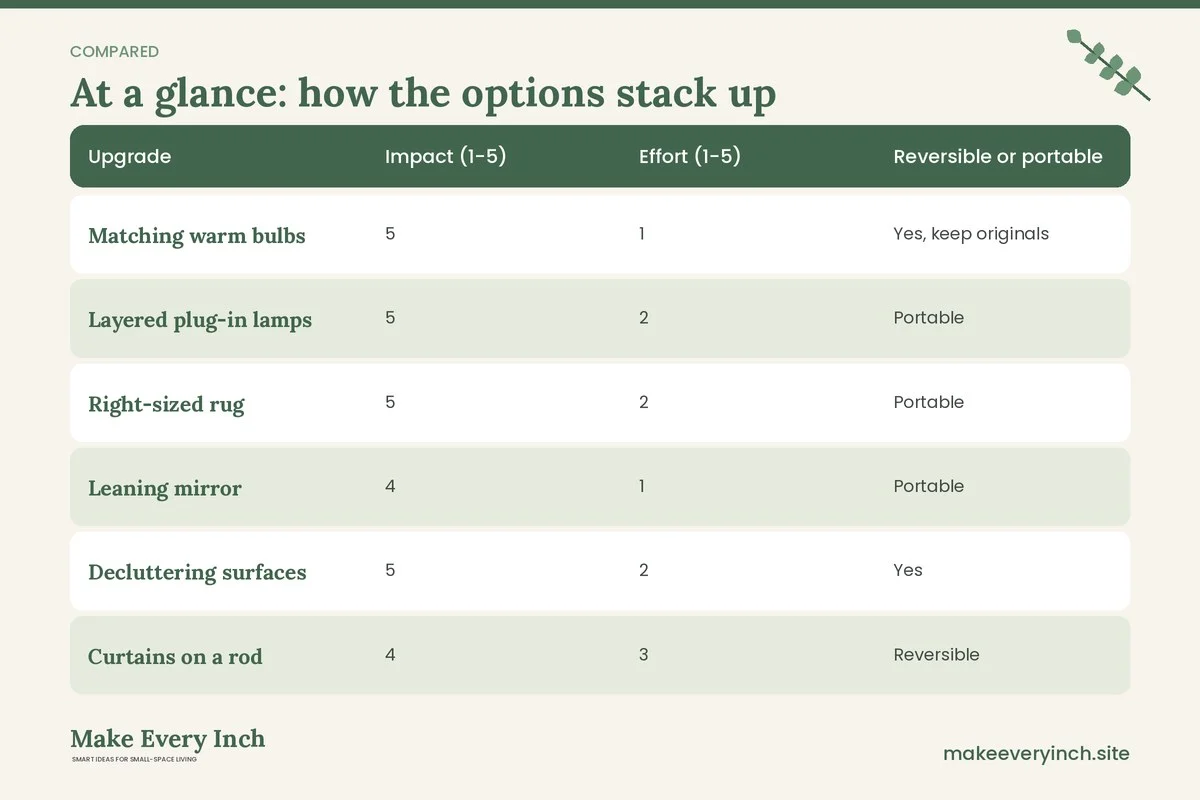
Comparison table: impact against effort
The table below summarizes the ranking. Scores are rough guides for a typical small rental, so adjust them for your own space.
| Upgrade | Impact (1-5) | Effort (1-5) | Reversible or portable | Needs permission? |
|---|---|---|---|---|
| Matching warm bulbs | 5 | 1 | Yes, keep originals | Rarely |
| Layered plug-in lamps | 5 | 2 | Portable | No |
| Right-sized rug | 5 | 2 | Portable | No |
| Leaning mirror | 4 | 1 | Portable | No, if freestanding |
| Decluttering surfaces | 5 | 2 | Yes | No |
| Curtains on a rod | 4 | 3 | Reversible | Sometimes |
| Removable wallpaper or decals | 4 | 3 | Reversible with care | Yes |
| Storage furniture | 4 | 3 | Portable | No |
| Room divider | 3 | 3 | Portable | No |
| Cabinet hardware swap | 3 | 3 | Reversible | Yes |
| Textiles | 3 | 1 | Portable | No |
| Plants | 3 | 1 | Portable | No |
| Trays and groupings | 2 | 1 | Portable | No |
| Shower curtain refresh | 2 | 1 | Portable | No |
| Freestanding shelving | 3 | 3 | Portable | No |
| Statement piece | 3 | 4 | Portable | No |
Three example rooms
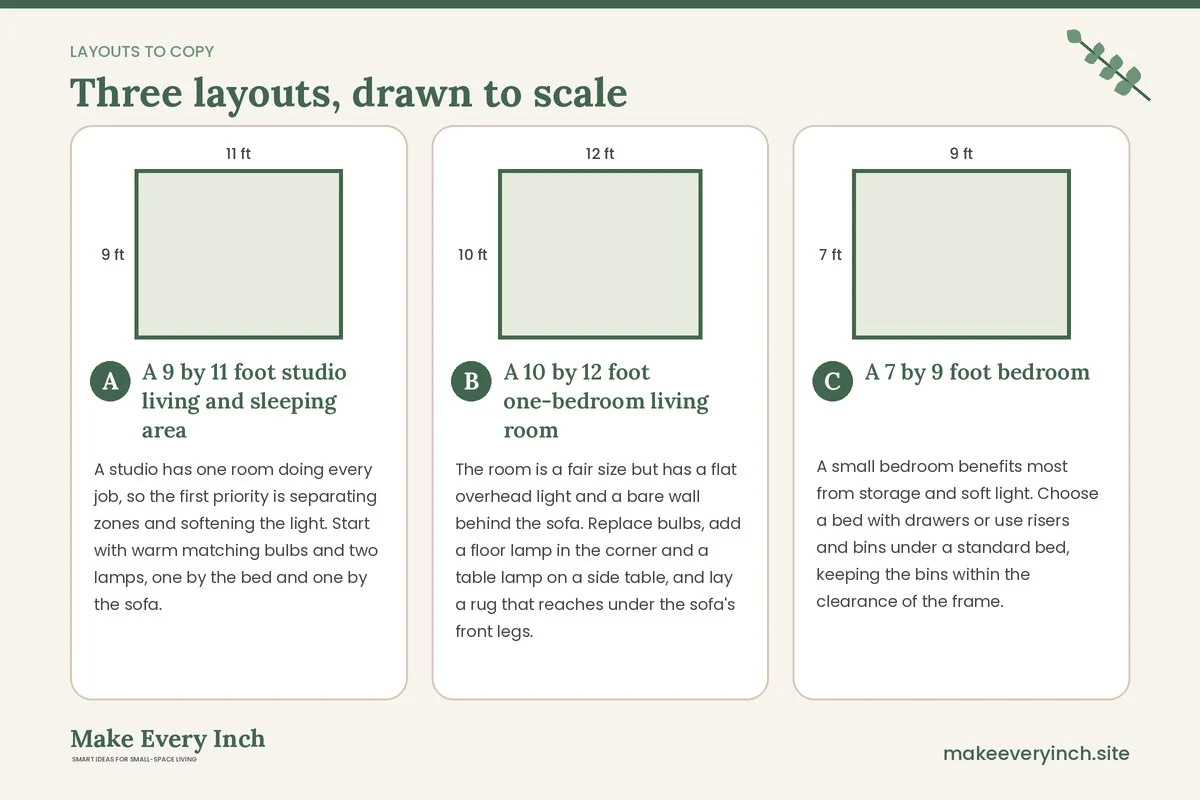
A 9 by 11 foot studio living and sleeping area
A studio has one room doing every job, so the first priority is separating zones and softening the light. Start with warm matching bulbs and two lamps, one by the bed and one by the sofa. Add a 5 by 8 foot rug under the seating area to define the living zone. Use a low bookcase as a divider between bed and sofa, and anchor it if the lease allows or keep it short enough to be stable. Hang curtains from the top of the window frame to lift the eye. A leaning mirror opposite the window doubles the daylight. The whole plan is portable except for the curtain rod, which uses the existing hardware.
A 10 by 12 foot one-bedroom living room
The room is a fair size but has a flat overhead light and a bare wall behind the sofa. Replace bulbs, add a floor lamp in the corner and a table lamp on a side table, and lay a rug that reaches under the sofa’s front legs. Lean a large piece of art on a console behind or beside the sofa instead of hanging it. Add storage with a lidded bench or ottoman for blankets and remotes. Use a tray on the coffee table to group the remote, a candle and a plant. These changes cost little, take an afternoon, and leave the walls untouched.
A 7 by 9 foot bedroom
A small bedroom benefits most from storage and soft light. Choose a bed with drawers or use risers and bins under a standard bed, keeping the bins within the clearance of the frame. Add a pair of plug-in or clamp lights at the head of the bed, and warm bulbs overhead. Hang curtains high and wide, and choose a lighter color that makes the walls feel further away. Keep the floor clear except for a small rug at the bedside. A mirror leaned on the inside of a closet door or against a wall adds depth. Our post on small bedroom ideas for renters goes further.
A sensible order of work
Doing things in the wrong order wastes effort. Follow this sequence in a new rental or a tired one.
- Week one: photograph everything, read the lease, clear the surfaces and swap bulbs. These steps cost little and tell you how the room feels with light and space.
- Week two: add lamps and a rug. Live with them for a few days before deciding what else is missing.
- Week three: deal with windows and textiles. Choose curtains and bedding that suit the new light and rug.
- Week four: add storage furniture and a divider if the layout calls for them.
- Later: add the statement piece, the shelf or the removable surface, once you know what the space needs.
This order lets you judge each step before you spend on the next, and it avoids buying furniture before you know the lighting and rug.
Safety notes you should not skip
Small upgrades still carry risks, and a rental is not the place to cut corners.
- Anchor tall furniture. Bookcases, dressers and tall shelves can tip, especially with children or pets. Use the anti-tip kit supplied with the item and ask your landlord before drilling into a wall. If drilling is not allowed, choose lower pieces, put heavier items on the bottom shelves, and consider furniture straps that use adhesive only where the manufacturer says it is suitable. Never rely on adhesive alone for heavy or tall units.
- Respect electrical limits. Do not daisy-chain extension cords or power strips. Use a surge-protected strip with a rated capacity above your total load. Keep cords away from rugs, doorways and heat. Check bulb wattage ratings on every fixture.
- Never modify wiring. Hardwired fixtures belong to the landlord. Do not remove, rewire or replace them. A plug-in lamp is the safe alternative.
- Ventilate when using paint, glue or sealants. If your landlord approves a painted change, choose a low-VOC product, open windows, and follow the label’s drying times. Keep pets and children away from fresh fumes.
- Mind the weight on adhesives. Every adhesive hook and strip has a weight limit. Stay well under it, apply to clean, dry, suitable surfaces, and remove slowly. Do not use them above beds, cots or seating.
- Keep exits and walkways clear. Furniture should never block a door, a window you may need in an emergency or a smoke alarm.
Protecting your security deposit
The best way to get your deposit back is to leave no trace and have proof. Photograph before you start and again when you finish. Keep a folder with the lease clauses, emails granting permission and the dated photos. Use gentle removal methods, such as warmth for adhesives and a soft cloth for residue. Replace any original items you took down, and return the unit as clean as you found it. If you made an agreed alteration, such as a painted wall, get the agreement in writing, including who will restore it at move-out. Read our guide to security-deposit-safe apartment upgrades for more.
Upgrades to take with you
Think of the best upgrades as a kit that follows you from rental to rental. Lamps, rugs, mirrors, curtains, textiles, storage furniture and plants all move easily. When choosing, pick neutral shapes that work in many rooms, and measure them so you know what fits. Avoid anything cut or fitted to one specific room. If you can pack it in an afternoon, it is a real renter upgrade. For ideas on spending less, read our post on budget renter upgrades.
Common mistakes to avoid
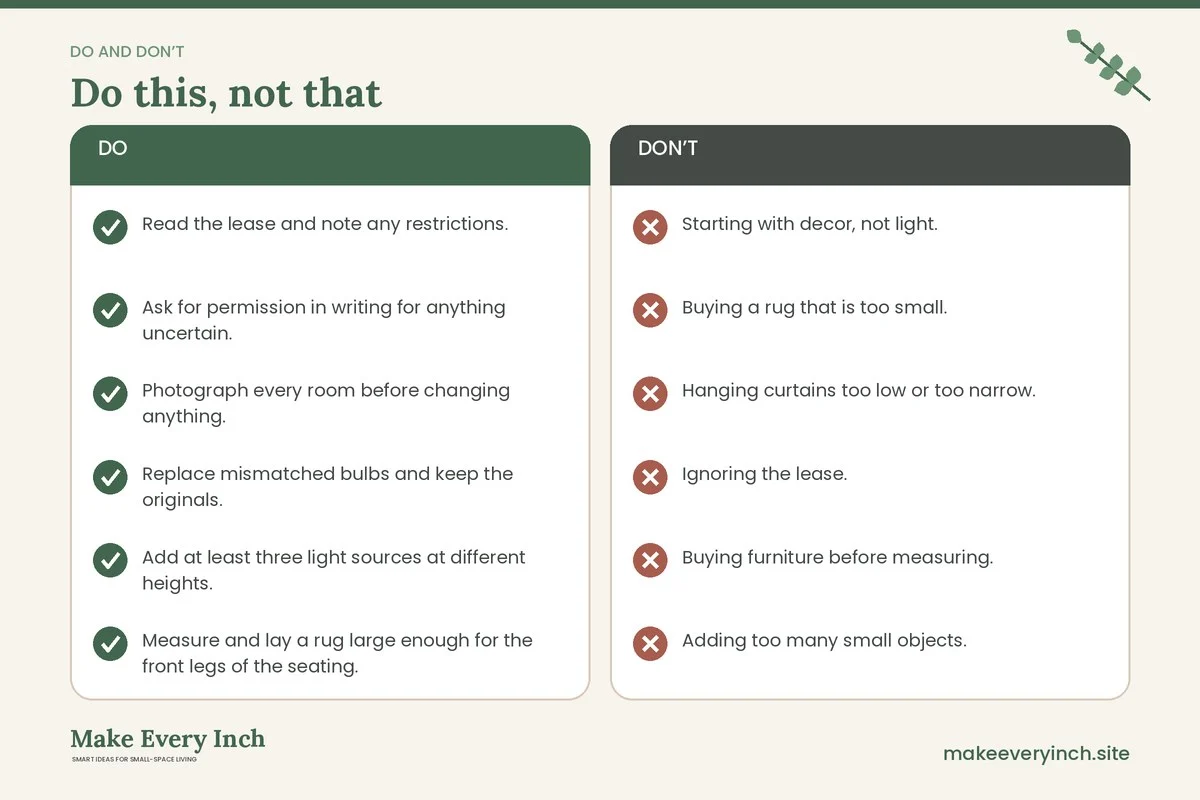
- Starting with decor, not light. Pretty objects cannot fix a dim, uneven room. Light first, then objects.
- Buying a rug that is too small. A small rug looks like a mat floating in the room. Measure and use tape to test the size.
- Hanging curtains too low or too narrow. Short, narrow panels make a window and a wall look smaller.
- Ignoring the lease. A cheap change can become an expensive deduction.
- Buying furniture before measuring. Check doorways, stairs and the room itself.
- Adding too many small objects. Clutter undoes the work of every upgrade above.
- Skipping the photos. Without proof you cannot defend your deposit.
Renter upgrade checklist
- Read the lease and note any restrictions.
- Ask for permission in writing for anything uncertain.
- Photograph every room before changing anything.
- Replace mismatched bulbs and keep the originals.
- Add at least three light sources at different heights.
- Measure and lay a rug large enough for the front legs of the seating.
- Lean a mirror opposite a window or lamp.
- Clear surfaces and give each item a home.
- Hang curtains on existing hardware or a tension rod within its weight rating.
- Choose storage furniture that replaces something you need.
- Anchor or stabilize tall pieces, with permission.
- Keep cords, strips and wattage within safe limits.
- Test any adhesive in a hidden spot first.
- Store original hardware in labeled bags.
- Repeat the photos before you move out.
FAQ
What is the single most effective upgrade for a small rental?
For most rooms it is lighting. Matching warm bulbs and two or three lamps at different heights change how the whole room looks and feels, and none of it needs permission or tools.
Can I do these upgrades if my lease forbids nails?
Yes. Lamps, rugs, mirrors leaned on a wall, freestanding furniture, textiles, plants and tension-rod curtains need no nails. Check the lease for anything that attaches to a surface, and ask permission before using adhesives.
Are adhesive strips and removable wallpaper really safe for walls?
They are designed to be removable, but results depend on the paint, the wall texture, the age of the surface and the weight. Always test a hidden area, stay under the weight limit and ask your landlord first. Remove slowly and gently.
How do I decide which upgrade to do first?
Score each idea for impact and effort, and start with the high-impact, low-effort ones. Light, decluttering and a rug are almost always the best first steps.
Should I spend money on a rental I might leave?
Spend on things that move with you. Lamps, rugs, mirrors, storage furniture and textiles are portable, so they keep their value. Avoid spending on anything fitted to the unit that you cannot take.
How do I protect my deposit while upgrading?
Photograph the unit before and after, keep written permission for any change, keep original items, and use gentle removal methods. A dated folder of proof is your best protection.
Can I make a small rental look bigger without painting?
Yes. Use light colors in textiles, hang curtains high, lean a mirror opposite a window, keep floors and surfaces clear, and use furniture with visible legs. Layered light also makes corners recede.
Keep going: Keep going with our renter-friendly storage ideas for small apartments, our guide to renter-friendly wall decor ideas and our tips for small apartment decor under 100.
Save this guide for later
Pin the ideas you like to Pinterest so you can come back to them when you plan your space.