Small Space Side Table Alternatives: 16 Ideas That Save Floor Room
Quick answer: The best small space side table alternatives put a surface within a forearm’s reach of where you sit without adding another leg to the floor. Good options include a C-shaped table, a stool or pouf with a tray, a stack of books or a wall shelf, a clip-on or bedside shelf, a bookcase end, a laddered or rolling cart and a sofa-arm tray. Aim for a top 1 to 3 inches below the arm height, within 16 to 24 inches of the seat, and anchor anything tall or wall-mounted.
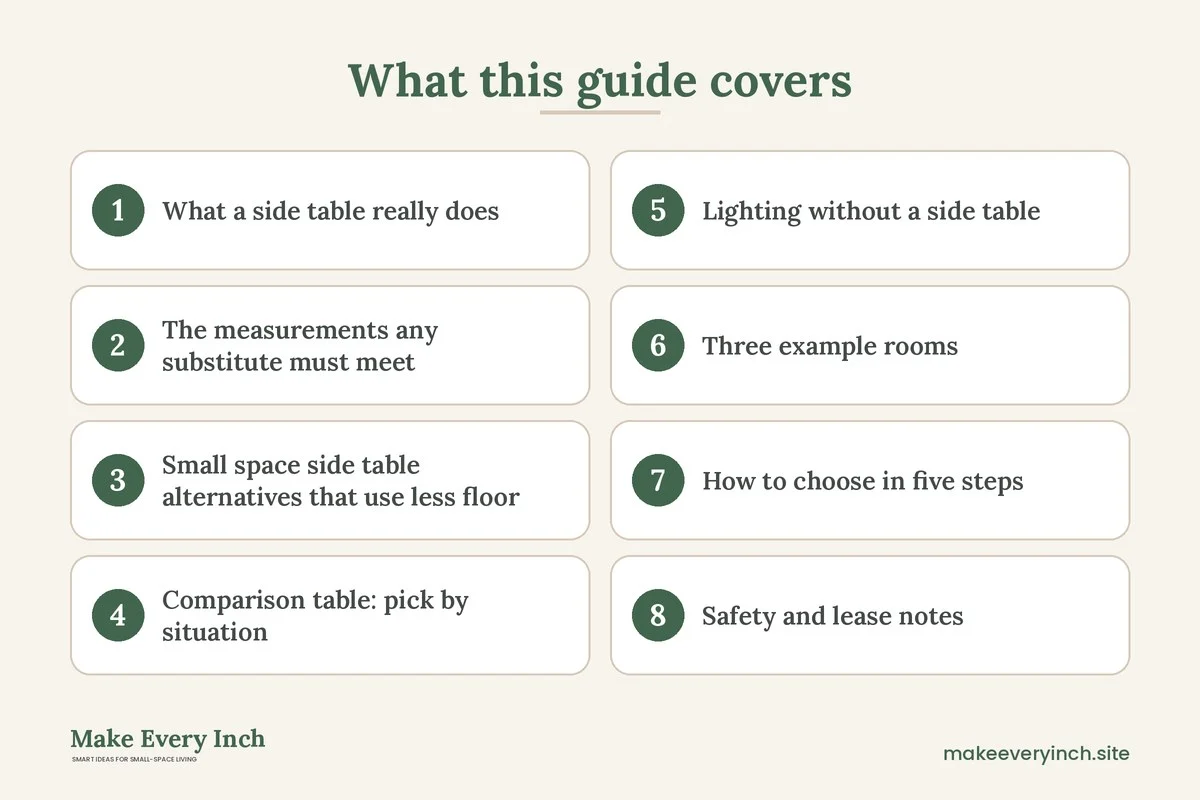
Small space side table alternatives are worth hunting for because a side table is one of the easiest pieces to get wrong in a compact room. It is small, but it has legs, a base and a footprint that often sits right where a path, a drawer or a door needs to swing. The surface it offers is useful, but you may be able to get the same convenience from a piece that uses less floor, goes up the wall, tucks beneath the sofa or does a second job. This guide covers when you need a side table at all, the measurements any substitute must meet, 16 alternatives for the sofa, the bed and the reading chair, a comparison table, three example rooms, safety and lease notes, and a checklist. For the full furniture picture, see the pillar guide to the best furniture for small apartments. If you are choosing a larger central piece, our sibling post on the best coffee tables for small living rooms covers that.
What a side table really does
Before replacing a side table, name its jobs. Most side tables do four things: they hold a drink, they hold a light, they hold small items such as a phone, a remote or a book, and they define the end of a seat. The last job is less obvious. A side table fills the awkward gap beside a sofa or chair and gives the seating group a finished edge. If you remove the table, you lose the place for the mug and you may also lose a little visual order.
So an alternative has to meet the practical needs. It should be stable enough to hold a drink without a wobble, high enough to reach without bending and close enough to use without leaning. It should also take care of the light, either by holding a small lamp or by letting you move the lamp to a wall, a shelf or the floor. Finally, it should not create a new problem, such as a cord across the walkway or a surface that cannot hold weight.
The measurements any substitute must meet
Numbers make the difference between a surface that works and one that is an annoyance. These are typical ranges, so adjust them to your own seat and arms.
- Height beside a sofa: roughly level with the sofa arm, or 1 to 3 inches lower. For many sofas that falls between 20 and 26 inches.
- Height beside a chair or a low lounge seat: about 18 to 24 inches. A very low chair may need a lower surface.
- Height beside a bed: roughly 1 to 4 inches below the top of the mattress, or level with it, usually between 22 and 30 inches from the floor depending on the mattress.
- Reach distance: 16 to 24 inches from the seat edge or the person’s shoulder to the near edge of the surface. Closer than 14 inches and you may hit a knee. Farther than 26 inches means leaning.
- Surface size: 10 to 14 inches wide holds a mug and a phone. 14 to 18 inches holds a lamp base and a book. 18 to 22 inches holds a laptop.
- Walkway beside the surface: about 30 inches for a main path and 24 inches for a side path.
- Distance from a wall outlet: within cord reach, without a cable across the floor.
Mark the position with painter’s tape and sit in the seat for ten minutes with a mug in your hand. If you can reach the tape without twisting, the placement is right. If you cannot, move it closer or change the surface.
Small space side table alternatives that use less floor
Surfaces that attach to the furniture
1. A C-shaped table
A C-shaped table has a base that slides beneath the sofa or the bed and a top that extends over your lap. It places the top where you need it and takes almost no floor space of its own. Choose one with a base thin enough to clear the sofa legs, and check that the sofa has at least 4 to 6 inches of clearance beneath. The weighted base keeps it from tipping, though a heavy load at the edge can still tilt it. It suits laptop use and snacks on a sofa or a bed, and it can park against the wall when not needed.
2. A tray with an arm rest
A flat tray that rests across a wide sofa arm holds a mug and a phone. Look for one with a lip and a non-slip underside. It only works if the arm is flat and wide, usually at least 5 to 6 inches across. Do not put heavy objects or hot liquids on a tray unless the sofa arm is stable, and remove it when not used.
3. A clip-on or hook-on shelf
Some small shelves clip to a bed frame, a sofa arm or a headboard rail. They are removable and need no tools. Check the clamp opening against the thickness of your furniture, and respect the stated weight limit. They hold a book and a glass, but not a lamp. Test the grip on the frame before you set a drink on it.
4. A bedside caddy or organizer
A fabric caddy that slides between the mattress and the frame or hooks onto a side rail holds a phone, a remote and a book. It uses no floor space at all. It does not give you a flat surface for a glass, so pair it with a tray that sits on the nightstand, a shelf or the bed itself. See our small bedroom ideas for more compact bedroom plans.
Surfaces that go up the wall
5. A floating shelf
A floating shelf mounted at seat or bed height gives a surface with no legs. A shelf of 8 to 10 inches deep holds a lamp and a mug. A wall-mounted shelf must be fastened into studs or rated anchors, and the load limit depends on both the bracket and the wall. Do not assume a shelf will hold what the packaging says unless it is in a stud, and do not drill into a rental wall without written permission from the landlord. Check for pipes and wires before you drill. For other options, see our guide to no-drill storage ideas for renters.
6. A picture ledge
A narrow ledge, 3 to 4 inches deep, holds frames and a small candle. It does not suit a mug, but it can take a phone and a few books. It is a quiet way to add display space beside a chair.
7. A wall-mounted fold-down table
A small drop-leaf table that folds against the wall gives a surface only when you need it. The advantage is that the floor stays clear. The risks are in the hinge and the load. Folding mechanisms can pinch fingers, so keep hands clear when closing, and check the manufacturer’s weight rating. The wall must have a stud or suitable anchor behind the table. Only install it where your lease allows holes in the wall.
8. A pegboard or rail with a shelf
A rail or pegboard with a small shelf lets you change the layout. It suits a studio or a bedroom wall. Use the right anchors, and keep the shelf load low because the leverage on a rail can be significant.
Surfaces that double as something else
9. A stool or pouf with a tray
A stool beside the sofa holds a tray and a mug. When a guest arrives, the stool becomes a seat. Choose a stool at about the height of the sofa arm. A pouf is softer but less stable, so add a firm tray with a lip.
10. A stack of books or a small crate
A neat stack of books topped with a small tray, or a wooden crate turned on its side, makes a very low-cost surface. It is flexible, and you can change it when you like. A stack is not stable under a hot or full cup, so use a base that does not tilt and keep heavy objects off it.
11. A bookcase or low shelf at the end of the seat
A bookcase at the end of the sofa has a top that works as a side surface and shelves for storage below. Choose a model of a height near the sofa arm. A narrow bookcase of 10 to 12 inches deep fits where a side table would. Tall bookcases must be anchored to the wall with the right hardware, and in a rental you should get permission or choose a lower unit that cannot tip. Our guide to hidden storage ideas has more ideas along the same line.
12. A storage ottoman at the end of the sofa
An ottoman can stand beside the sofa end, and a firm tray makes it a table. It hides blankets or remotes inside, and it can sit at the foot of the sofa as a footrest when you need one. See the best storage ottomans for what to look for.
Surfaces that move
13. A rolling cart
A narrow cart with wheels acts as a side table, a tea cart and a small storage unit. Pull it to the sofa when you need it and roll it to the wall when you do not. Choose locking casters and a cart with a lip on each shelf. Do not stack heavy items on the top shelf of a tall cart, because a top-heavy cart can tip.
14. A nesting set
Nesting tables slide together into one small block and spread out when you need more tops. The smaller tables are lower, so check that the height fits your arm. Nesting sets are particularly useful when you have occasional guests, because each person can have a surface.
15. A folding tray table
A tray on a folding stand is the original small-space surface. It stores flat behind a door or beside a bookcase and opens in seconds. The stand’s leg lock should click firmly, and the folding joint can pinch fingers, so keep hands clear when you open and close it.
16. A lap desk or a bed tray
A lap tray with a cushion or short legs gives a firm surface wherever you sit. It suits breakfast, a laptop or a drawing pad. Store it flat next to the bed or behind the sofa so it is easy to reach. It does not replace a lamp surface, so pair it with a wall light or a clamp lamp where your lease allows.
Comparison table: pick by situation
The table compares common alternatives. The footprint column shows roughly how much floor space each takes up. Use it to narrow the choice, then check the product details.
| Alternative | Best beside | Footprint | Holds a lamp | Main trade-off |
|---|---|---|---|---|
| C-shaped table | Sofa or bed | Very small | Small lamp, if the base is weighted | Needs clearance under the furniture |
| Floating shelf | Bed or chair | None | Yes | Needs studs and permission |
| Stool with tray | Sofa or chair | Small | Small lamp | Less stable if the tray is loose |
| Rolling cart | Sofa or bed | Small to medium | Yes | Can roll or tip if loaded high |
| Nesting set | Sofa | Medium when open | Yes | Smaller tables are low |
| Bookcase end | Sofa or bed | Medium | Yes | Must be anchored if tall |
| Clip-on shelf | Bed or sofa | None | No | Weight limit and clamp fit |
| Fold-down wall table | Wall near a chair | None when folded | Light only | Hinge and wall load |
| Storage ottoman | Sofa end | Medium | Light only | Needs a firm tray |
| Folding tray table | Anywhere | Small | No | Stand joint pinch points |

Lighting without a side table
A side table often holds the lamp, and removing it means finding a new home for the light. The room still needs light at seat level, so choose among these approaches.
- Wall-mounted or plug-in sconce: a plug-in sconce hangs on a hook and plugs into an outlet. It needs no drilling, though the cord should be neatly secured. Check the lease before using adhesive hooks on any wall.
- Floor lamp with an arc or slim base: it takes about 10 to 12 inches of floor. Choose a stable base, particularly in a home with children or pets.
- Clamp lamp on a shelf or a bed frame: it uses no surface, though you must check that the clamp holds firmly.
- Rechargeable table lamp: it sits on any small surface and has no cord. Place it where a knock cannot send it to the floor.
- String or strip lights: low-wattage lights that run along the back of a shelf or behind the sofa, as long as they are rated for indoor use and do not touch fabric for long periods.
Whatever you choose, route cords along walls, not across walkways. Do not overload a power strip, and follow the instructions on any plug-in light.
Three example rooms
A 10 by 12 foot living room with a two-seat sofa
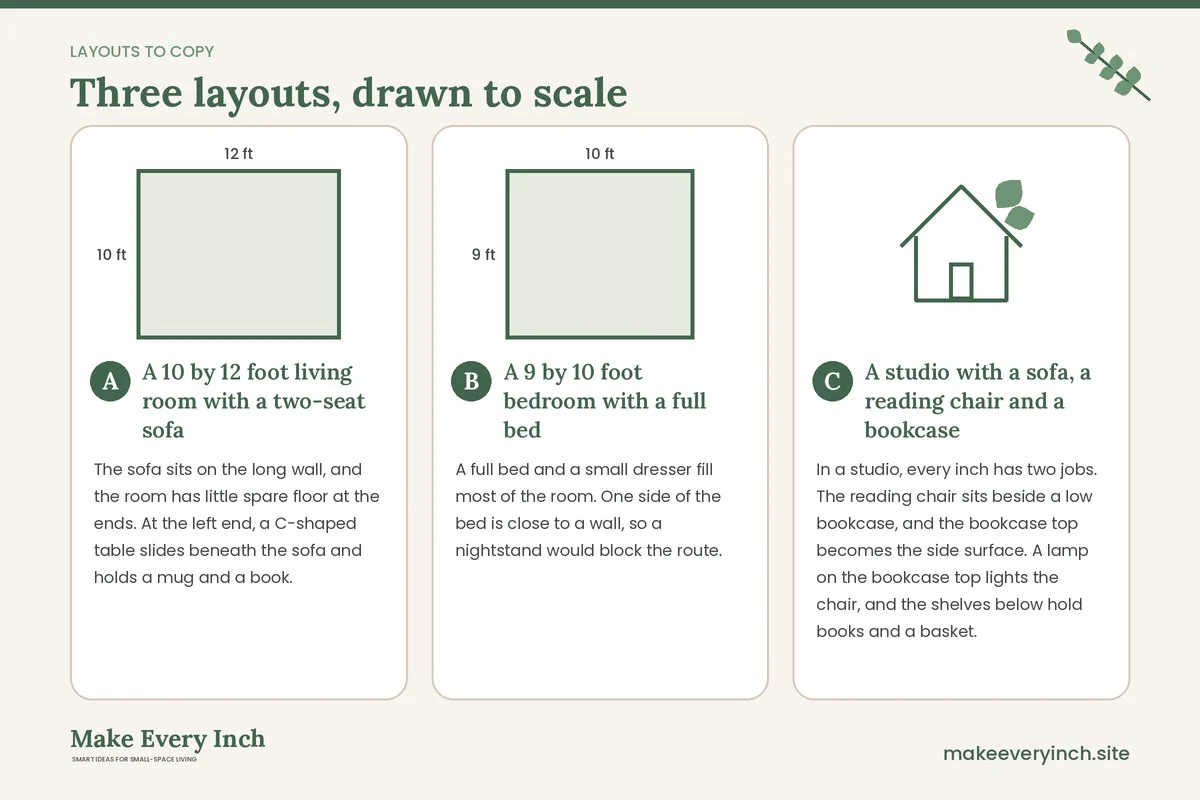
The sofa sits on the long wall, and the room has little spare floor at the ends. At the left end, a C-shaped table slides beneath the sofa and holds a mug and a book. At the right end, a stool with a tray works as a side table and a seat for a guest. A plug-in sconce above the stool lights the right end. The walkway stays at about 30 inches, and the tray stores flat behind the sofa. This room uses almost no floor space for surfaces at all.
A 9 by 10 foot bedroom with a full bed
A full bed and a small dresser fill most of the room. One side of the bed is close to a wall, so a nightstand would block the route. A floating shelf at mattress height on that wall holds a small lamp and a book, and the bedside caddy holds the phone and the remote. On the open side of the bed, a narrow nesting table pulls out for a tray breakfast and tucks beneath the dresser during the day. Shelf mounting needs a stud and the landlord’s consent. If the lease bans holes, use a clip-on shelf and a floor lamp. Our guide to the best beds with storage shows another way to reduce bedside clutter.
A studio with a sofa, a reading chair and a bookcase
In a studio, every inch has two jobs. The reading chair sits beside a low bookcase, and the bookcase top becomes the side surface. A lamp on the bookcase top lights the chair, and the shelves below hold books and a basket. The sofa has a rolling cart at its end, parked at the wall when the floor is needed. For layout ideas, see our studio apartment ideas and the post on small living room layout ideas.
How to choose in five steps
1. List the jobs. Write what you set down: a drink, a phone, a light, a book, a laptop.
2. Measure the seat. Note the height of the sofa arm or the mattress, and the reach distance.
3. Pick the lowest-footprint option that does the jobs. Wall-mounted or attached surfaces take the least floor, while carts and stools offer the most flexibility.
4. Check the rules. Read the lease about drilling and adhesive, and read the weight rating of any shelf or clamp.
5. Test for a week. Use painter’s tape, a temporary tray or a box to model the new surface, then buy or build the final version.
Safety and lease notes
A smaller surface is only a good choice if it is safe.
- Anchor tall furniture. A bookcase, a tall cart or a ladder shelf can tip, especially with children or pets nearby. Anchor tall pieces to a wall stud with the right hardware, but only with your landlord’s permission. If you cannot anchor, choose a low unit.
- Wall-mounted shelves and tables. Find a stud, use fasteners rated for the load, and keep to the manufacturer’s limit. Do not rely on plastic anchors for heavy loads. Check for hidden pipes and wires before drilling.
- Never drill without permission. Many leases forbid holes in walls. Ask in writing, or use freestanding and clamp options instead.
- Folding mechanisms. Hinges, drop leaves and folding stands create pinch points. Keep fingers clear, lock the mechanism before use and keep children away.
- Liquids and electronics. Do not put a cup next to a laptop or a charger on an unstable tray. A tipped drink can damage electronics and create a shock risk.
- Cords and lamps. Keep cords out of walkways, and do not put a lamp on a surface that is easy to knock. Use a bulb with a wattage suitable for the lamp, and keep fabric away from hot bulbs.
- Floors. Add felt or rubber feet to stools, carts and tables so they do not scratch a rental floor.
Common mistakes
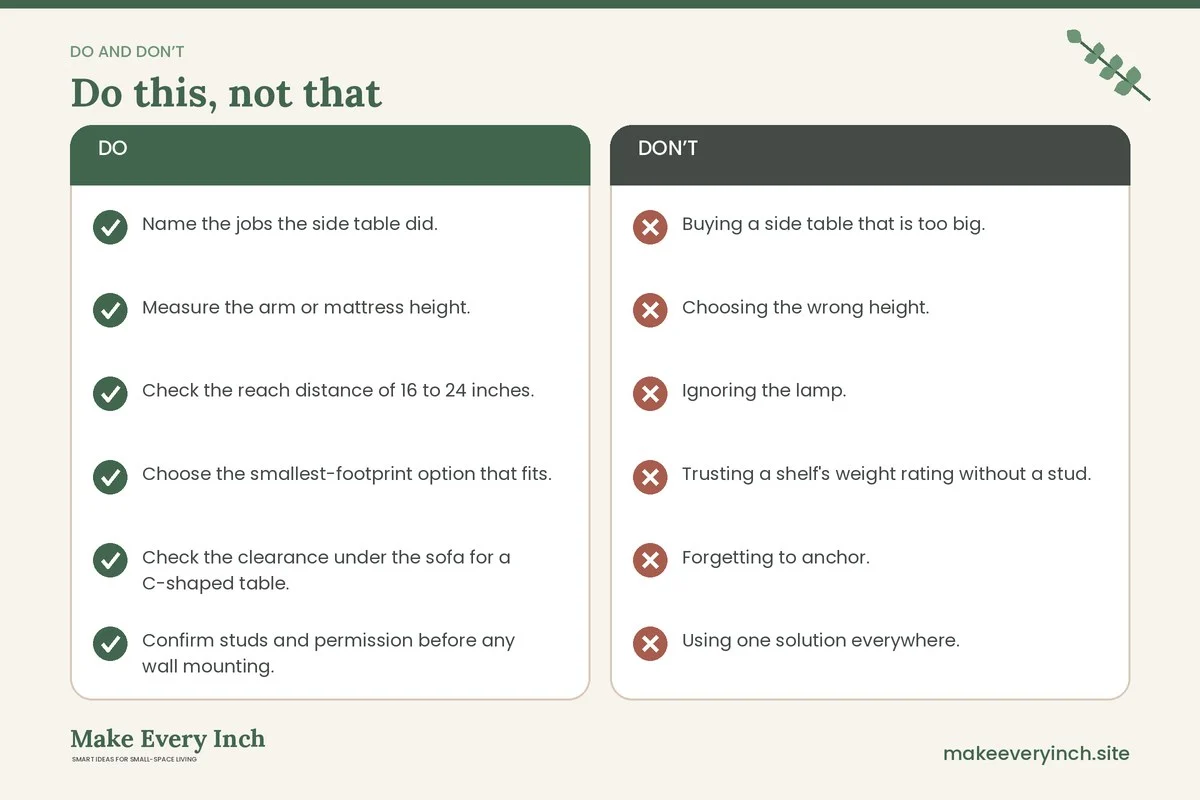
- Buying a side table that is too big. A table that crowds the sofa end usually falls short. Check that it fits the gap and the walkway.
- Choosing the wrong height. A surface well below the arm is awkward, and one far above is worse.
- Ignoring the lamp. A side table often holds the light, so plan a new home for it before removing the table.
- Trusting a shelf’s weight rating without a stud. The rating applies to a correct installation, not to a loose one.
- Forgetting to anchor. A tall bookcase beside a sofa may tip if a child climbs it.
- Using one solution everywhere. A bedroom, a living room and a studio need different surfaces. Pick by seat, not by trend.
- Skipping a tray. A stack of books, a pouf or a crate needs a firm tray to be safe for a drink.
Keeping the surfaces tidy
Small surfaces fill up fast. A few habits keep them useful.
- Limit each surface to three objects: a drink, a light or book, and one small item.
- Keep a basket nearby for remotes, chargers and notes.
- Clear surfaces each evening. A two-minute reset keeps the room calm.
- Rotate trays to the kitchen once a day so cups do not accumulate.
- Use coasters or a mat on wood tops to prevent rings.
For more systems that keep a small room tidy, read our guide to small space organization ideas.
Checklist
- Name the jobs the side table did.
- Measure the arm or mattress height.
- Check the reach distance of 16 to 24 inches.
- Choose the smallest-footprint option that fits.
- Check the clearance under the sofa for a C-shaped table.
- Confirm studs and permission before any wall mounting.
- Anchor tall furniture or choose a low unit.
- Find a new home for the lamp.
- Route cords away from walkways.
- Add felt feet to protect floors.
- Add a firm tray to any stool, pouf or crate.
- Keep a basket for small items.
- Plan a nightly two-minute reset.
FAQ
What can I use instead of a side table?
A C-shaped table, a stool with a tray, a floating shelf, a bookcase end, a rolling cart or a nesting set are all common options. Pick the one that matches your height, your reach and your lease rules.
How high should a side table alternative be?
Roughly level with the sofa arm or 1 to 3 inches lower. Beside a bed, aim for about the mattress height. Small adjustments are normal, so test with a tray first.
Can I use a stack of books as a side table?
Yes, for light use. Keep it tidy, put a firm tray on top and keep hot drinks away from an uneven stack. A crate or a small stool is more stable.
What is the best option for a rental with no drilling?
Freestanding and clamp-based options, such as a C-shaped table, a stool with a tray, a rolling cart or a clip-on shelf, need no holes. Read our guide to no-drill storage ideas for renters for more.
Are wall-mounted shelves safe beside a bed?
They can be if they are fixed into a stud, rated for the load and approved by the landlord. Keep heavy objects off them, and do not hang anything over the pillow that could fall in the night.
How do I light a seat without a side table?
Use a plug-in sconce, a slim floor lamp, a clamp lamp or a rechargeable lamp. Keep cords tidy and out of walkways.
Do I need to anchor a small bookcase?
Anchor any bookcase that is tall or top heavy, especially with children or pets. If the lease does not allow holes, choose a low unit that is stable on its own.
Keep going: Keep planning with our best coffee tables for small living rooms, small living room ideas and best furniture for small apartments.
Save this guide for later
Pin the ideas you like to Pinterest so you can come back to them when you plan your space.