15 Small Bedroom Ideas for Couples Who Share One Bed and One Room
Quick answer: The best small bedroom ideas for couples give each person an equal side of the bed with 24 to 30 inches of floor, their own nightstand or shelf within arm’s reach, one personal drawer or bin, and a light they can control alone. Share the big storage (closet, dresser, under-bed bins) by splitting it into labeled halves, and plan around whoever wakes first or sleeps last.
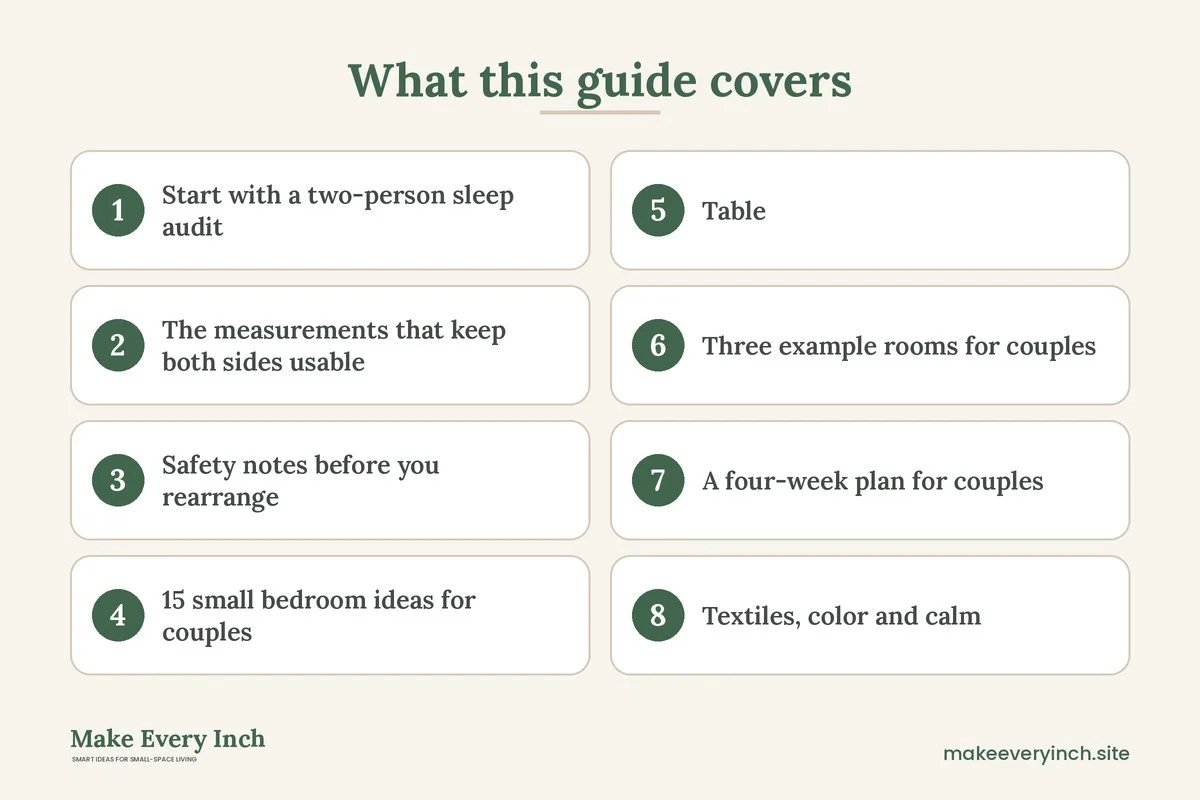
Small bedroom ideas for couples are different from ideas for one person, because every decision has to work twice. Two people need two ways to get out of bed, two places for a phone and a glass of water, two sets of clothes and, very often, two different bedtimes. In a bedroom of 10 by 11 feet, a standard queen bed already takes up about 60 by 80 inches of floor, so the margins are tight and fairness matters. This is a bedroom guide, not a living room guide: it deals with sleep, getting dressed, quiet mornings and late nights, not with sofas and entertaining. Below you will find a habits audit, the measurements that keep both sides of the bed usable, 15 ideas, a table, three example rooms, a four-week plan, a checklist and an FAQ. For the full overview, start with our parent guide to small bedroom ideas, and if you rent, read the companion guide on small bedroom ideas for renters.
Start with a two-person sleep audit
Before you move a single piece of furniture, spend one week noticing how each of you actually uses the bedroom. Write a short list for each person. Include what time you go to bed, what time you get up, what you reach for at night, what you read or watch before sleep and what you do in the first ten minutes after waking. Most couples discover that the two lists are less alike than they assumed.
The overlap tells you what to share. Typical shared items are a charging area, a spare blanket, a laundry hamper and a bookshelf. The differences tell you what each person needs privately: a lamp, a tablet, a water glass, an eye mask, a medication box, a favorite lotion. A side of the bed that matches the person who sleeps on it is a side that stays tidy.
Next, decide who sleeps where, and make it official. If one of you gets up earlier, give that person the side closer to the door so the alarm does not wake the other. If one of you gets up at night more often, give that person the side with the clearest path to the bathroom. If one person likes a window, a cooler breeze or a wall to lean against, that preference decides the other side. Writing it down sounds silly, but it prevents the daily low-level negotiation that makes a small room feel crowded.
The measurements that keep both sides usable
Two people sharing a small bedroom need numbers more than inspiration. These ranges keep the room comfortable for two adults. They are approximate and depend on your bed, your bodies and your habits, so tape them out and test them.
- Floor beside each side of the bed: aim for 24 to 30 inches so you can stand, dress and make the bed. A path of 18 to 20 inches is the practical minimum on one side, usually the wall side if you push the bed against a wall.
- Foot of the bed: 24 to 30 inches in front of a dresser or closet door so drawers open fully. A swinging closet door needs its full arc or you should consider a sliding or curtain replacement.
- Nightstand width: 12 to 18 inches fits a small lamp, a phone and a glass. Wider than 20 inches in a tiny room often costs you the side path.
- Nightstand height: within 2 inches of the top of the mattress, usually 22 to 28 inches, so your hand lands on it without reaching up or down.
- Bed size: a full bed is about 54 inches wide and a queen is about 60 inches. In a 10 foot wide room, a queen against one wall leaves roughly 60 inches for the other side, which is tight for two nightstands. A full leaves more floor, but only if you both sleep comfortably in it.
- Door swing: keep the door’s arc clear. A door that hits the bed, even slightly, will annoy whoever gets up second.
Mark the bed, nightstands and dresser on the floor with painter’s tape. Then both of you walk the room at night, with the lights off, as you would on a normal evening. If either of you bumps a corner, adjust before you buy anything. For more layout math, see our guide to small bedroom layout ideas.
Safety notes before you rearrange
Tall furniture can tip, especially in a room where two people reach into drawers and climb past each other in the dark. Anchor dressers, tall bookcases and wardrobes to the wall studs with the straps or brackets supplied, and keep the heaviest drawers at the bottom. If you rent, use anchoring methods the lease allows, and ask your landlord in writing if you are unsure.
Check your cords too. Place power strips and chargers where nobody steps on them, do not run cords under rugs and do not overload a single outlet with heaters, chargers and lamps. Use any extension product within its rated limit. If you add a heater, a fan or a humidifier, keep it clear of bedding and curtains. If you paint to refresh the room, choose a low-VOC paint if you can, open the windows, run a fan and let the room air out for several days before you sleep there.
15 small bedroom ideas for couples
Two sides of the bed
1. Treat both sides as equal
Do not let one side become the “good” side. Give both sides a path of similar width, a surface and a light. If the bed is against a wall, the wall-side person has to climb over, so consider moving the bed out by a few inches or choosing a side that rotates who gets the wall every few months.
2. Float the bed away from the wall if you can
Pulling the bed 24 inches from one wall is often possible even in a small room, and it removes the “climbing” problem. It also lets you place a slim shelf or a nightstand on that side. If the room is too narrow, put the bed in the corner and use wall-mounted shelves for the wall-side person.
3. Center the bed on the main wall
A bed centered under a window or on the long wall looks balanced and gives two matching sides. Place the headboard in the middle of the wall, with a nightstand on each side. This is the classic arrangement for a reason: it is fair, and it is easy to read.
Two nightstands, in small ways
4. A slim pair
Choose two narrow nightstands, around 12 to 16 inches wide, with one drawer each. A drawer hides the items that make a bedside look cluttered: tissues, lotion, a medication box, earplugs. Matching or coordinating pieces make a small room look calm.
5. A nightstand and a floating shelf
If one side has less floor, replace that nightstand with a floating shelf at mattress height. A shelf of 8 to 10 inches deep holds a lamp, a glass and a book without sticking out. Wall anchors are needed, so check the lease first or choose a freestanding alternative. See no-drill storage ideas for renters for options.
6. A bed with built-in side shelves
Some headboards have built-in ledges or shelves on both sides. They keep the footprint small and give each person a spot. Look for a headboard with an integrated outlet or a cable gap if you charge devices at night. For beds with drawers or lift-up storage, see our list of the best beds with storage.
7. A bench or stool at the foot, not a third nightstand
A narrow bench at the foot of the bed gives you a place to sit while dressing and a spot to drop tomorrow’s clothes. It does not take bedside floor, which is the scarce resource. Choose one that is 14 to 16 inches deep.
Shared storage, divided fairly
8. Split the closet in halves
Divide the hanging rod down the middle, with a shelf divider or a different color of hangers on each side. Give each person the same rod length, even if one has more clothes, and let the extra clothes live in a bin. Equal halves prevent resentment, and they make the closet feel less like a puzzle. If you have no closet at all, read our guide to small bedroom ideas without a closet.
9. A dresser with two drawers each
A six-drawer dresser gives each person three, or a mix of a long drawer and a short one. Label the drawers or use drawer dividers. A tall chest takes less floor than a wide dresser; anchor it to the wall. For options, see our roundup of small dressers.
10. Under-bed bins, one set each
Use a different color of bin for each person: one for off-season clothes, one for shoes, one for spare bedding. Under-bed storage is most useful for items you only need a few times a year. Measure the clearance between the floor and the bed frame before you buy, and read our guide to under-bed storage ideas.
11. Hooks, over-door racks and a shared laundry spot
A pair of hooks on the back of the door, one for each person, replaces the chair that becomes a clothes pile. An over-door rack handles belts, scarves and bags. A narrow hamper, or two, near the door keeps laundry from spreading. For more ideas, see small bedroom storage ideas.
Sleep schedules and shared light
12. A light each, not one overhead
Give each person a small lamp or a clip-on reading light. One person can read while the other sleeps. Choose warm light, around 2700 kelvin or lower, and a dimmer if possible. Avoid a bright overhead light at night. For more, read small bedroom lighting ideas.
13. A wake-up plan for the early riser
If one of you wakes early, put the clothes they need in the closet or dresser nearest the door, keep a small lamp on their side and set the alarm to a vibration or a quiet tone. Keep one outfit ready on a hook. The late sleeper stays undisturbed, and the early riser stops tiptoeing around the room.
14. A night path with a low glow
Add a plug-in night light or a motion-sensor strip near the floor on the path to the bathroom. The light should be dim and warm, not blue or white. Place it so it does not shine in the sleeper’s eyes.
15. Blackout curtains and a soft rug on both sides
Blackout curtains help the late sleeper when the other wakes with the sun, and a small rug on each side of the bed, or one runner, gives warm feet a place to land. Hang the curtain rod high and wide so the window looks larger. For a rental, tension rods and removable hooks are an option.
Table: matching each need to a solution
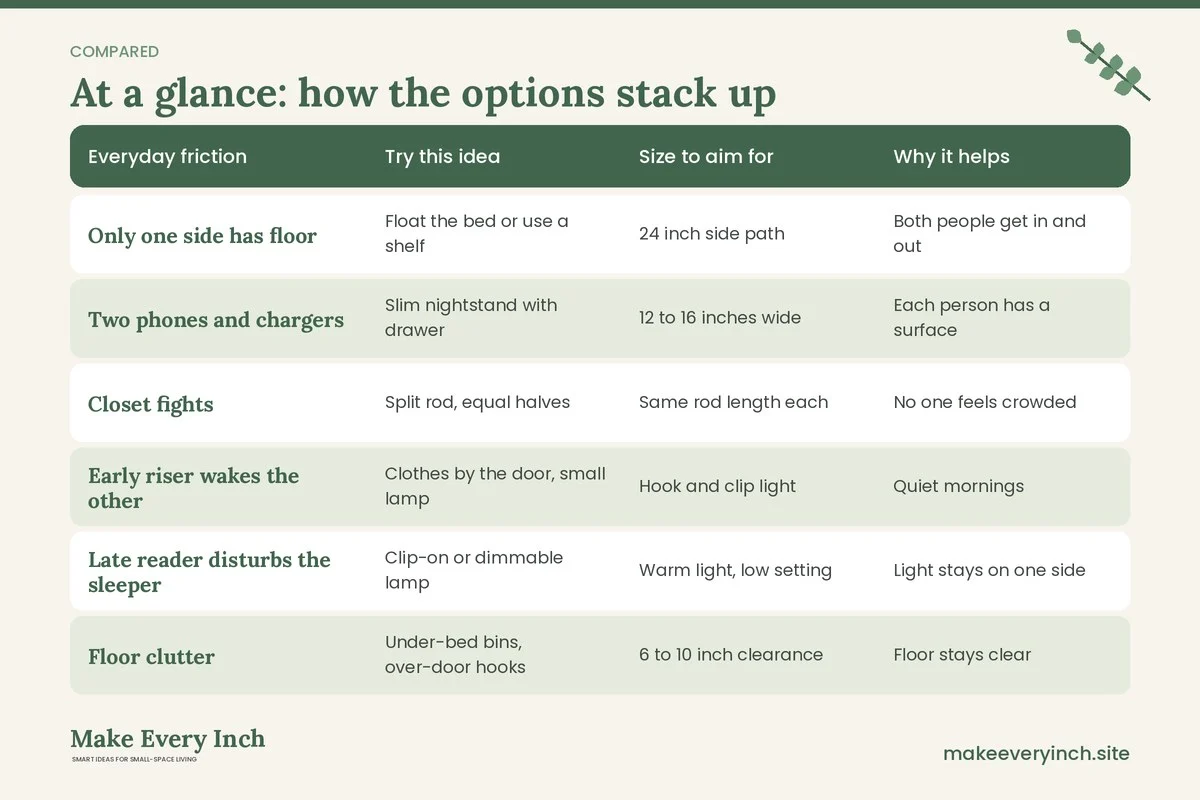
Use this table as a quick filter. Match your biggest friction point to the idea that handles it, then check the measurement.
| Everyday friction | Try this idea | Size to aim for | Why it helps |
|---|---|---|---|
| Only one side has floor | Float the bed or use a shelf | 24 inch side path | Both people get in and out |
| Two phones and chargers | Slim nightstand with drawer | 12 to 16 inches wide | Each person has a surface |
| Closet fights | Split rod, equal halves | Same rod length each | No one feels crowded |
| Early riser wakes the other | Clothes by the door, small lamp | Hook and clip light | Quiet mornings |
| Late reader disturbs the sleeper | Clip-on or dimmable lamp | Warm light, low setting | Light stays on one side |
| Floor clutter | Under-bed bins, over-door hooks | 6 to 10 inch clearance | Floor stays clear |
| Cold feet at night | Rug on each side | 2 by 4 feet each | Soft landing in the dark |
| Too much bedding | Lidded bin at the foot of the bed | 14 to 16 inches deep | Spare blankets out of sight |
Three example rooms for couples
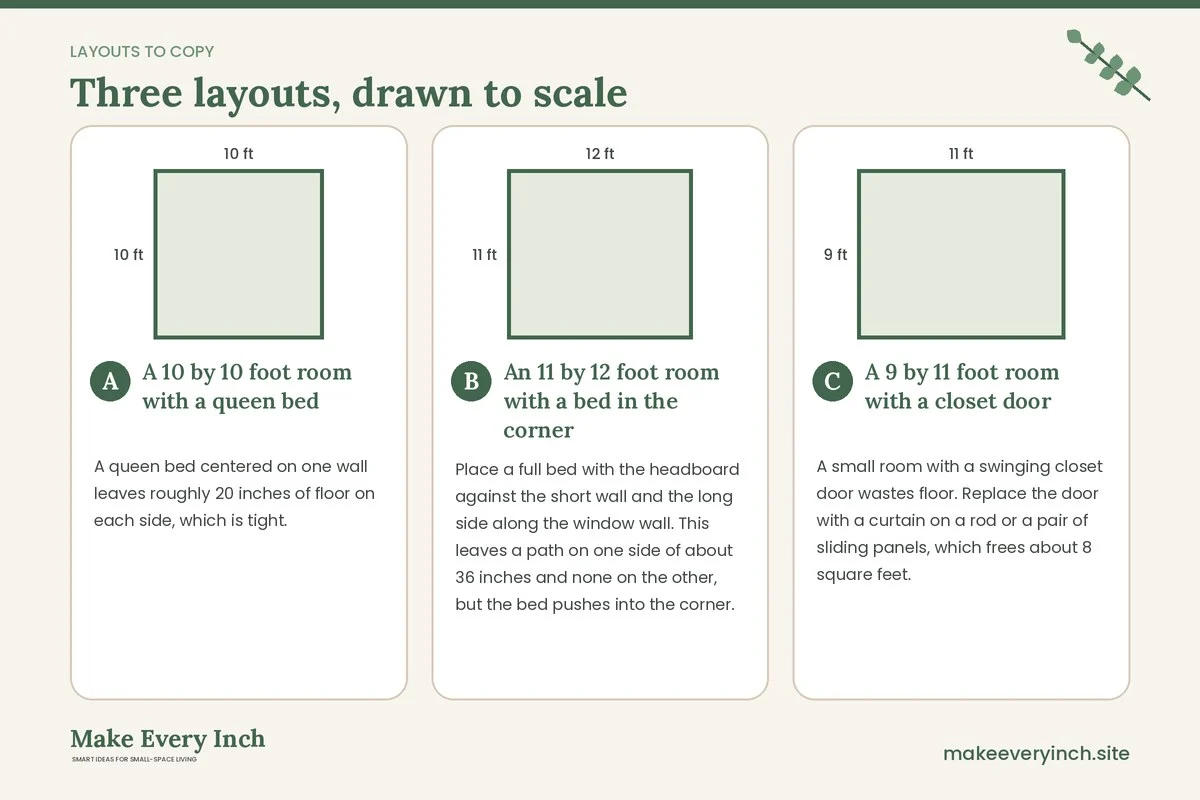
A 10 by 10 foot room with a queen bed
A queen bed centered on one wall leaves roughly 20 inches of floor on each side, which is tight. Slide the bed to be centered, use two 12 inch wall shelves instead of nightstands and hang a pair of small lamps from wall hooks or clip them on the headboard. A narrow chest of drawers at the foot of the bed holds three drawers each. A slim over-door rack and a pair of hooks handle the rest. The room is not generous, but each person has the same space, and the floor stays open.
An 11 by 12 foot room with a bed in the corner
Place a full bed with the headboard against the short wall and the long side along the window wall. This leaves a path on one side of about 36 inches and none on the other, but the bed pushes into the corner. In this case, the person who sleeps against the wall is the one who goes to bed last and wakes up last. Put one nightstand on the open side and a wall shelf on the wall side. A tall dresser against the opposite wall, anchored with straps, gives each person two drawers. The tradeoff is climbing, which you can ease with a firm mattress and a low bed frame.
A 9 by 11 foot room with a closet door
A small room with a swinging closet door wastes floor. Replace the door with a curtain on a rod or a pair of sliding panels, which frees about 8 square feet. Add a queen bed centered on the long wall and a nightstand on each side, each 12 inches wide. A bench at the foot holds the day’s clothes, and under-bed bins hold seasonal items. If you rent, check the lease before you remove any door, and store it safely so you can put it back at move-out.
A four-week plan for couples
Do not try to fix everything in one weekend. Spread the work, and keep the bed usable the whole time.
Week 1: audit and measure
Write both habit lists, decide who sleeps where and tape the footprint of the bed and every piece of furniture on the floor. Walk the room at night. Note what bumps, blocks or wakes you. Clear one surface, such as a chair or a dresser top, and see how much calmer it feels.
Week 2: declutter and divide
Go through the closet and dressers together. Each person sorts their own items into keep, donate and storage. Split the rod and drawers into halves. Remove anything you have not used in a year. For a structured method, see small bedroom organization ideas.
Week 3: bedside and lighting
Set up the nightstands or shelves, add a lamp each and place a night light. Agree on a bedside rule: only a few items live there, and everything else goes elsewhere. Test the lighting at the real bedtimes.
Week 4: finish and review
Add textiles, such as a rug, curtains or a throw each. Add the bench, the hooks and the under-bed bins. Review the plan: what still annoys you? Adjust one thing, and leave the rest alone for a month before changing anything else.
Textiles, color and calm
A shared bedroom needs a palette both people can rest in. Choose two or three calm colors and repeat them in the bedding, curtains and rug. Pale walls and one deeper accent keep the room feeling larger. Use a duvet that suits both sleepers, or two lighter blankets if you run at different temperatures. Many couples find two single duvets on one bed solve the cover tug-of-war, and the bed still looks tidy with a throw across the foot.
Mirrors can help, but position them with care. A mirror opposite a window brightens the room, but a mirror facing the bed can feel unsettling to some sleepers. A leaning mirror near the closet door works for dressing without taking wall space.
Mistakes couples make
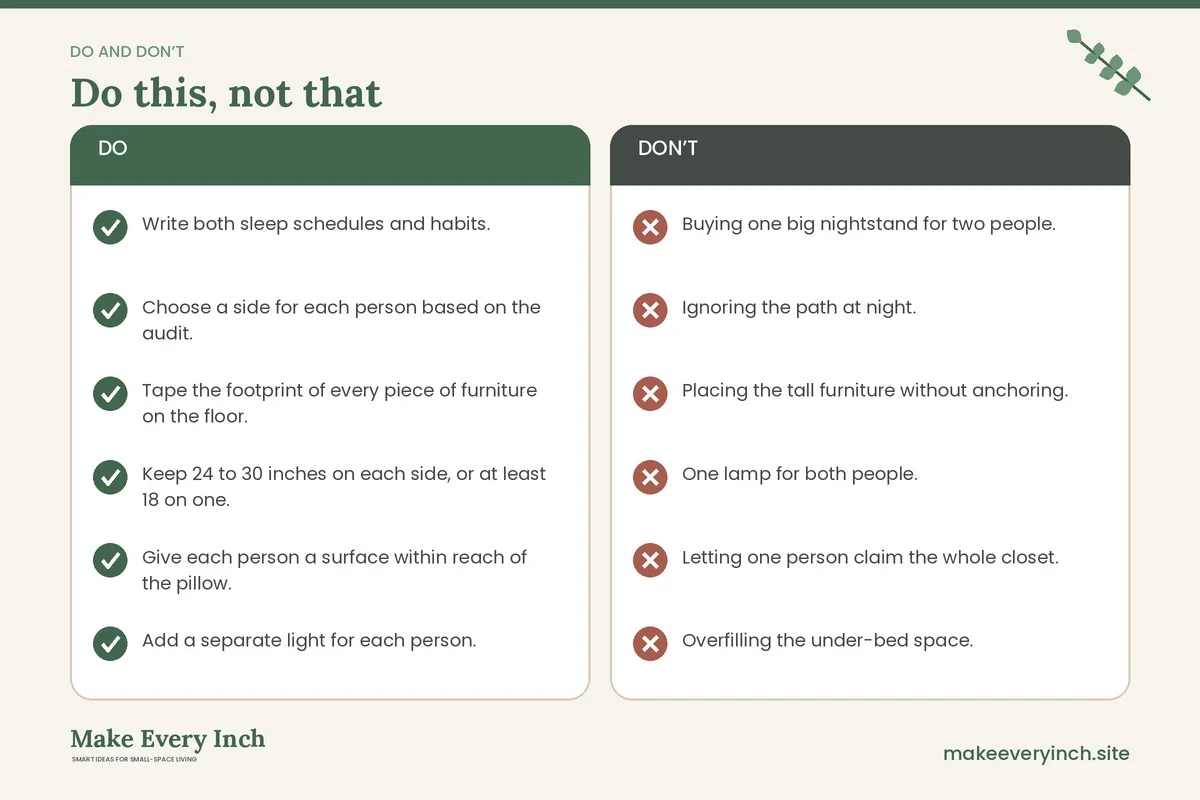
- Buying one big nightstand for two people. It makes one person lean across the other and leaves no private place for things.
- Ignoring the path at night. A plan that looks good at noon can fail in the dark. Walk it with the lights off.
- Placing the tall furniture without anchoring. Dressers and bookshelves must be secured, especially in a shared room.
- One lamp for both people. The reader and the sleeper always lose, and you end up arguing over the switch.
- Letting one person claim the whole closet. Divide it fairly at the start, and the rest of the decisions get easier.
- Overfilling the under-bed space. Cramming bins until they scrape the floor makes them hard to pull out. Leave breathing room.
- Forgetting the door swing. A door that hits the bed or a dresser will be a daily irritation.
Couple’s bedroom checklist
- Write both sleep schedules and habits.
- Choose a side for each person based on the audit.
- Tape the footprint of every piece of furniture on the floor.
- Keep 24 to 30 inches on each side, or at least 18 on one.
- Give each person a surface within reach of the pillow.
- Add a separate light for each person.
- Split the closet and the dresser into labeled halves.
- Use under-bed bins, one color each.
- Anchor every tall piece to the wall.
- Check cords, power strips and heaters.
- Add a soft night path to the bathroom.
- Pick two or three calm colors for textiles.
- Review the plan after a month.
FAQ
What size bed is best for a small bedroom for two?
A queen is the common choice for couples, but in a very small room a full may leave better paths on both sides. Measure the room, tape the bed footprint and decide. If you sleep comfortably only in a queen, plan the rest of the room around it.
Do we both need a nightstand?
Not always. A nightstand, a floating shelf or a built-in headboard ledge can serve the same job. Each person needs a surface within reach of the pillow, a place for a glass and a phone and a way to light a book.
How do we handle different sleep schedules?
Give the early riser the side nearest the door, put their clothes close to the exit, use warm, dim reading lights and block light with curtains. Quiet alarms and a clip-on lamp keep the other person asleep.
How do we divide the closet fairly?
Split the rod into equal halves and give each person the same shelf and drawer space. Extra clothes go in under-bed bins. Reassess each season.
Can we use bunk-style or loft solutions as a couple?
Loft beds are usually for single sleepers and may not suit adults sharing one bed, so check weight limits and ceiling height. For most couples, a standard bed with storage underneath is a safer choice.
Is it safe to put the bed under a window?
It can work, but check for drafts, curtains and cords. Keep curtain cords out of reach and make sure the window opens without hitting the headboard. A cold window can make one side of the bed uncomfortable in winter.
What if the room is too small for two nightstands?
Use one nightstand and one wall shelf, or choose a headboard with built-in shelves. You can also use a slim cart that rolls away. Our guide to small bedroom furniture ideas has more options.
Keep going: Keep planning with our guide to small bedroom ideas with a queen bed, our tips for small bedroom makeover ideas and our ideas for vertical storage.
Save this guide for later
Pin the ideas you like to Pinterest so you can come back to them when you plan your space.