18 Small Laundry Room Storage Ideas by Zone, Height and Reach
Quick answer: Good small laundry room storage works by zone and by height: heavy and hazardous items low or latched, daily items at chest height, light items up high. Anchor tall units, keep the dryer vent and machine fronts clear, store chemicals out of reach of children and pets, and use freestanding or no-drill fittings unless your lease allows drilling.
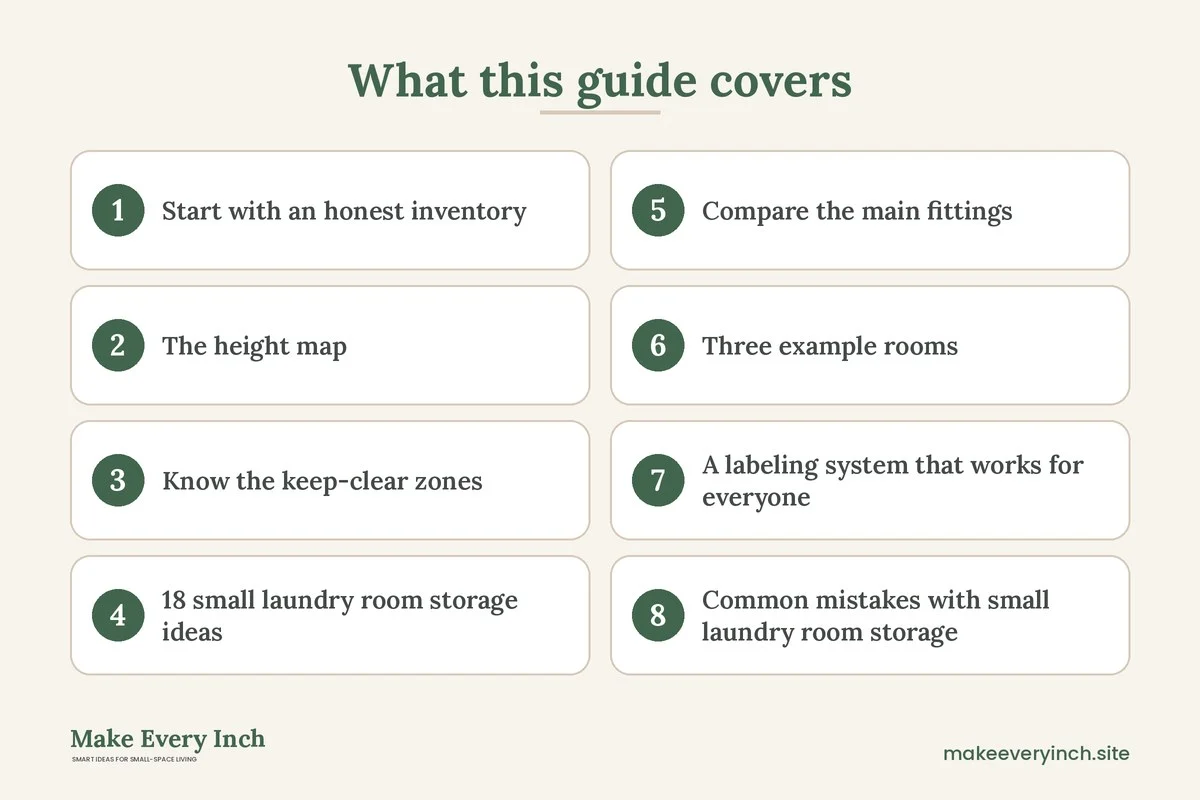
Small laundry room storage has one rule that most room guides skip: everything stored there is either heavy, wet, hot, sharp or chemical. Detergent jugs weigh a lot, a dryer shakes the wall beside it, lint is flammable, and a bottle of bleach is a hazard if a toddler or a curious cat can reach it. So the question is not only where things fit. It is also which shelf is safe for which item, and how you reach it when your arms are full of laundry. This guide organizes small laundry room storage by zone, height and reach. It covers a quick inventory, the height map, 18 ideas, a fit table, three example rooms, a labeling system, mistakes and a checklist. For the layout side of the topic, read our pillar guide to small laundry room ideas, the companion on small laundry area ideas for apartments and the wider guide to small laundry room organization.
Start with an honest inventory
Lay everything that lives in or near the laundry area on a bed or table. You will usually find the same groups: cleaning products, stain removers, softener and dryer sheets, a lint bin, a sewing kit, spare hangers, clothespins, a mop and a broom, light bulbs, batteries, and a handful of things that have nothing to do with laundry. Sort them into four piles.
- Daily: detergent, softener, stain remover and the lint bin. These need the easiest reach.
- Weekly or monthly: bleach alternatives, descaler, spare sponges, dryer balls and the iron.
- Occasional: sewing supplies, seasonal blankets, spare bulbs, and bulky bags.
- Not laundry: everything else. Move it to its real home, since a small room cannot hold guests.
Check every product label while you sort. Throw away containers with no label, anything leaking and anything past its safe date, following local disposal rules for chemicals. Do not pour products together or into unlabeled bottles. The pile that remains is your real storage need, and it is usually smaller than the clutter suggested.
The height map
Think of the wall as four bands, each with a job. These heights are loose guides for an average adult, so adjust them to your own height and to your manual.
- Floor to about 18 inches: heavy, stable and non-hazardous. A full jug of detergent, a basket, a stack of towels, a folding drying rack. If children or pets live in the home, chemicals do not belong in this band unless the cabinet has a latch.
- About 18 to 36 inches: tools you grab with one hand. A slim cart, a lint bin, a short shelf, a hook for a lint brush. This is the best band for weekly supplies in a household with no small children.
- About 36 to 60 inches: chest height. Daily items, a folding surface and the controls. Keep this band uncrowded, because you work in it.
- About 60 inches and up: light, rarely used or hazardous. Spare bulbs, seasonal items, and, in a home with children or pets, a latched box of chemicals. Use a step stool, never a chair or a machine, to reach it.
In a home with small children, the safest plan moves all chemicals to the upper band or into a cabinet with a child-resistant latch. Keep them in their original labeled containers, never in food or drink bottles, and never store cleaners next to each other in a way that tempts mixing. Never combine bleach with ammonia or acids, since the fumes can be dangerous. If the room has no door that closes, a latch on a cabinet is the best option.
Know the keep-clear zones
Some spots must stay empty no matter how tempting the space looks.
- The dryer vent and exhaust path. Do not stack boxes or baskets against it.
- The back and sides of machines. Follow the manual’s clearance guidance, since machines need air and room for hoses.
- The front of the machine and the door swing. A basket in the swing zone becomes a trip hazard.
- The shutoff valves. You should reach them without moving anything.
- The electrical panel and outlets. Keep access clear, and do not run cords from outlets into baskets or under mats.
- The top of a vibrating machine. Loose bottles and boxes can fall during a spin cycle. If the manual allows items on top, use a non-slip mat and keep them light.
18 small laundry room storage ideas
Wall and shelf ideas
1. A freestanding shelf that straddles the machines
A rack with legs on either side of a washer and dryer uses the dead space above without touching the wall. Choose a rack with a solid top, wide feet and a height that leaves room for the machine lid. Check that it does not touch the machine, because a rack that rattles against a vibrating unit will loosen and wander. Anchor it to the wall if the lease allows.
2. Short wall shelves with anchors
If you own the home or have written permission, short shelves screwed into studs keep weight off the floor. Use fittings rated for the load, find studs rather than relying on plastic anchors in drywall, and check for pipes and wires before you drill. In a rental, skip this idea and read our guide to renter-friendly shelving ideas without drilling.
3. A narrow tall shelf in a dead corner
A narrow shelving unit, about 8 to 12 inches deep, fits a corner beside the machines. Choose one with a wide base, and anchor it to the wall if you can, since tall units tip when a shelf is pulled out or a child climbs. For small flats, see our list of the best narrow bookshelves, which also work for towels and boxes.
4. Floating-style shelf with a no-drill system
Some adhesive systems hold very light items. Check the weight limit on the packaging, test on a hidden patch, and avoid putting them near the heat and steam of a dryer. Use them for light items such as baskets of dryer balls, not for jugs.
5. A rail with S-hooks
A rail above the folding area holds scissors, a lint brush, a small bag for clothespins and a squeegee. A tension-based rail works without drilling. Keep the rail clear of the vent.
Door and cabinet ideas
6. An over-the-door rack
A rack over the door holds the iron board flat and a few baskets of small items. Check that the door still closes, and keep it away from the dryer’s heat. See our guide to small closet door storage ideas for more fittings that suit doors.
7. A latched cabinet for chemicals
A small cabinet with a child-resistant latch is the best home for detergent, bleach alternatives and stain removers. Set it in the upper band, fixed or anchored so it cannot be pulled over. Store products upright, in original containers, with the caps on tight.
8. Inside-cabinet organizers
Slide-out trays or small bins inside a cabinet keep bottles from tipping. A shallow tray under liquid products catches drips, and it is easy to wipe.
9. A pull-out gap shelf
A slim sliding unit fits a gap of about 6 inches between machine and wall, if the manual allows that gap to be used. Keep light items only, and never block the vent or hoses. It rolls out to reach bottles and tucks away.
Floor and cart ideas
10. A rolling cart for the weekly set
A cart with three tiers holds the weekly supplies. The top tier is for the lint bin and the tray, the middle for stain remover, and the bottom for dryer balls. Choose wheels that lock, and park it clear of the vent and the door swing. Keep chemicals in a lidded box on the top tier only if there are no children or pets.
11. A hamper with sorting sections
A hamper with sections or three separate bins removes one task from laundry day. Light, stackable bins can be carried to a shared room. Choose a lid if the room is visible.
12. A drying rack that folds flat
A folding rack stands in the bathroom or the hallway and goes into a gap between the wall and a cabinet when not in use. Look for a rack with a stable base and a weight rating, and avoid placing it where it blocks the exit or a heater.
13. A basket under a folding counter
A counter over the washer, if allowed, makes a folding surface, with baskets below for clean clothes ready to go. If the machine is a front loader, check the manual before using the top for a counter, and keep the board away from the vent.
Small-item ideas
14. A magnet strip for metal tools
A strip on a metal side panel holds scissors, bobby pins and a seam ripper. Use it only if the machine’s manual does not forbid magnets, and keep it away from the control panel.
15. A jar-and-bin system for pocket finds
A lidded jar for coins and small items, plus a small bin for lint, keeps the washer filter clear and the floor clean.
16. A clothespin and hanger caddy
A small hanging bag or a bin holds clothespins and spare hangers. Keep hangers on a rod in the closet rather than loose on the floor.
17. Labeled clear bins
Clear bins with large labels show contents at a glance. Label the front, not the top, so you can read them when the bins are stacked. Our guide to small space organization ideas explains how labels cut clutter in any small room.
18. A step stool that tucks away
A foldable step stool is a safety tool. It lets you reach the upper band without climbing on the machine or a chair. Store it flat beside the shelf.
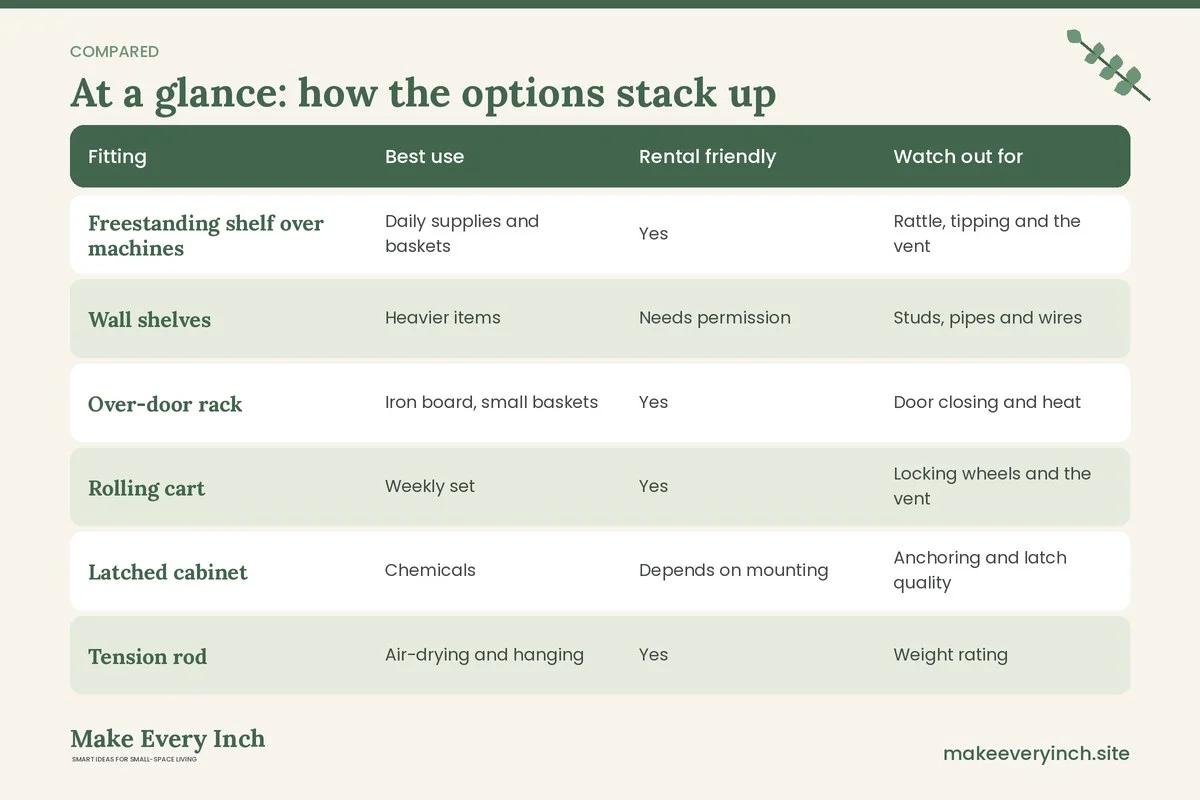
Compare the main fittings
| Fitting | Best use | Rental friendly | Watch out for | |
|---|---|---|---|---|
| Freestanding shelf over machines | Daily supplies and baskets | Yes | Rattle, tipping and the vent | |
| Wall shelves | Heavier items | Needs permission | Studs, pipes and wires | |
| Over-door rack | Iron board, small baskets | Yes | Door closing and heat | |
| Rolling cart | Weekly set | Yes | Locking wheels and the vent | |
| Latched cabinet | Chemicals | Depends on mounting | Anchoring and latch quality | |
| Tension rod | Air-drying and hanging | Yes | Weight rating | |
| Slim gap unit | Light items in a narrow gap | Yes | Manual clearance rules |
Three example rooms
Example 1: A closet laundry with no wall to drill
The closet is about 30 inches wide and holds a stacked unit. The renter adds a freestanding rack on legs that straddles the machines and is lined with a mat on the top shelf. A tension rod across the closet holds a few hangers. The over-door rack holds an iron board and a lint bin. Chemicals go into a latched box on the highest shelf, reached with a step stool. The renter keeps the doors open during every dry cycle, and keeps the floor clear in front of the machines. The result is a tidy closet that still lets the machines breathe.
Example 2: A basement corner with a washer and a utility sink
A shared basement corner has a washer, a dryer and a utility sink. The household anchors a narrow tall shelf to the wall with permission and keeps it away from the water heater. Heavy detergent sits on the bottom shelf, in a plastic tray in case of leaks. Chemicals sit in a cabinet with a latch. A drying rack folds behind the shelf. A stool is stored beside the sink. The floor is damp in winter, so everything near the floor sits on feet or on a raised tray. The owner checks the shutoff valve each season.
Example 3: A hallway alcove in a rental with a child
A rental has a stacked unit in a hallway alcove. Because there is a toddler, nothing hazardous goes below shoulder height. A latched cabinet, fixed with adhesive-free tension brackets or with permission, holds all products. A rolling cart holds clean laundry baskets and tucks away at night. A curtain hides the machines, and the household has labeled bins for each person. The parents keep a rule: no bottles on the floor, ever, and every cap goes back on.
A labeling system that works for everyone
Labels turn a private system into a shared one. Use large, plain words. Add the day or the load type if several people use the room: lights, darks, towels, delicates. Label the shelf edge as well as the bin, so people return items to the right spot. Put hazard words on any container that might be mistaken for food, such as a spray bottle. Keep a copy of the product’s safety information if the label is small, and keep the original packaging or a photo of it.
A small whiteboard or a note on the cabinet door for the household’s rules helps too. Include the water shutoff location, the vent cleaning date and a reminder not to mix products. Keep the rules short enough to read at a glance.
Common mistakes with small laundry room storage
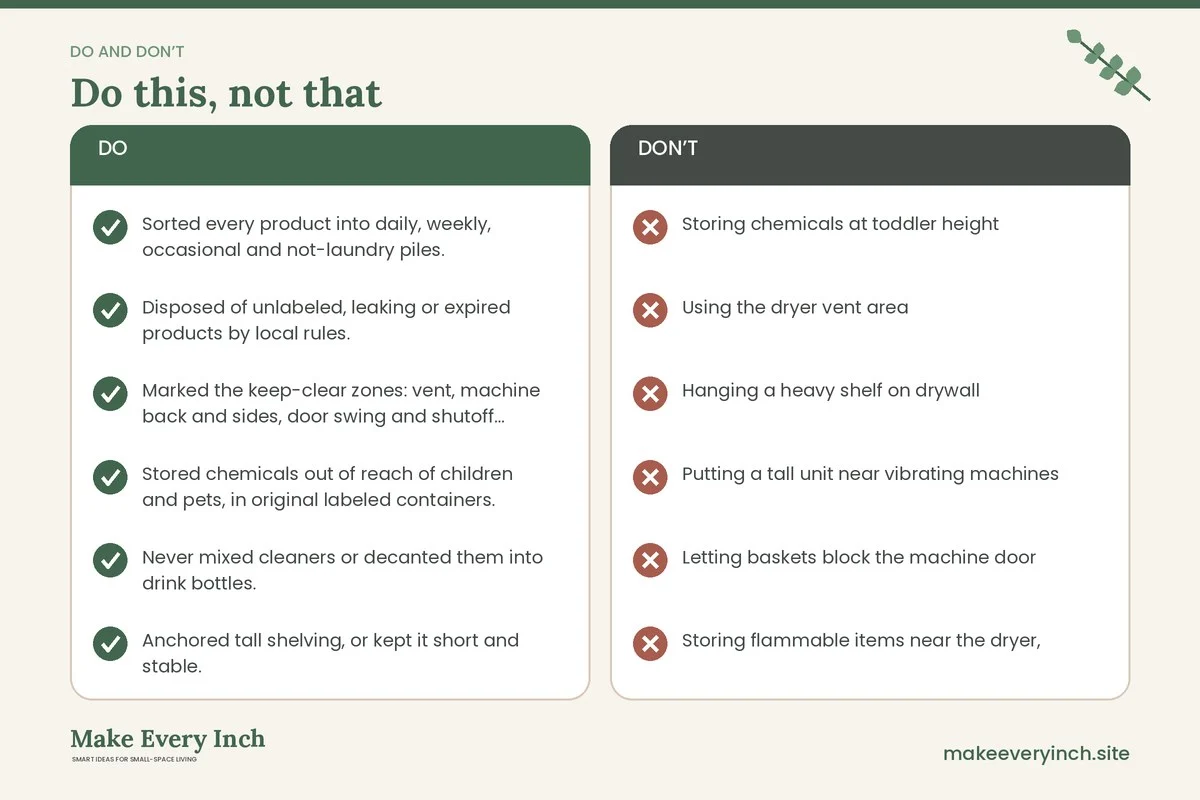
- Storing chemicals at toddler height or in containers that look like drinks.
- Using the dryer vent area as a shelf.
- Hanging a heavy shelf on drywall without anchors or studs.
- Putting a tall unit near vibrating machines without anchoring it.
- Letting baskets block the machine door or the shutoff valves.
- Storing flammable items near the dryer, such as spray cans, rags with oil or solvents.
- Overfilling shelves above the machines, which can fall during a spin cycle.
- Skipping the manual and the lease. Both set limits that matter more than any tip in a blog.
- Buying before measuring. A shelf that is an inch too wide is useless.
Small laundry room storage on a budget
Start with what you own. Baskets, jars and boxes from elsewhere in the home do the same job as products bought for the purpose, as long as they are sturdy and have lids. Spend on safety first, which means a latch, a step stool and a stable, level shelf. Compare choices in our guides to budget small space ideas and no drill storage ideas for renters. Prices vary by region and store, so set a limit before you shop. Measure twice and check the return policy.
Checklist
- Sorted every product into daily, weekly, occasional and not-laundry piles.
- Disposed of unlabeled, leaking or expired products by local rules.
- Marked the keep-clear zones: vent, machine back and sides, door swing and shutoff valves.
- Stored chemicals out of reach of children and pets, in original labeled containers.
- Never mixed cleaners or decanted them into drink bottles.
- Anchored tall shelving, or kept it short and stable.
- Confirmed lease permission before any drilling.
- Checked the appliance manual for clearances and for items on top of machines.
- Kept the outlets accessible, and used no extension cords.
- Added a step stool for the upper band.
- Labeled bins and shelves in plain words.
FAQ
What is the safest place to store laundry detergent?
In its original container, closed, in a cabinet that children and pets cannot open, away from heat and from the dryer. A latch on the cabinet is a simple and effective safeguard.
Can I put a shelf above my washer and dryer?
Often yes, but check the manual and the lease. Leave room to open the lid or door, keep the vent clear and make sure the shelf is level and stable. A freestanding rack avoids drilling, and an anchored shelf is safer if you are allowed to fix it to the wall.
How do I store laundry supplies without a cabinet?
Use a lidded box on a high shelf, a latched bin or a rolling cart, depending on your home. If children or pets live with you, choose the high, closed option.
Should I keep a fire extinguisher in the laundry room?
Many households find it sensible, but follow the building’s rules and fire guidance. Keep it within reach but not behind the dryer, and check its date. Ask your landlord or local fire service for guidance.
What can I store on top of a dryer?
Only what the manual allows, and only light, stable items that do not block vents, cover controls or fall during use. Avoid anything flammable, and keep the top clear when the dryer is running if the manual advises it.
How do I make a tiny laundry room feel less cluttered?
Reduce what lives there, store by zone and height, use lidded containers and keep the floor clear. The less you see, the larger the room feels. Our guide to hidden storage ideas has more ways to tuck things away.
Keep going: Plan the whole space with our pillar guide to small laundry room ideas, see how to fit a hookup into a rental in small laundry area ideas for apartments, and carry the system through the home with small space organization ideas.
Save this guide for later
Pin the ideas you like to Pinterest so you can come back to them when you plan your space.