21 Small Shoe Storage Ideas for Tiny Entries and Closets
Quick answer: The best small shoe storage ideas match the rack to the number of pairs you wear weekly. Use a tilted or slim cabinet in the entry for daily pairs, over-door racks and under-bed boxes for the rest, a boot tray for wet shoes and one bench for sitting. Count pairs first, keep only a working set at the door and let shoes dry before you store them.
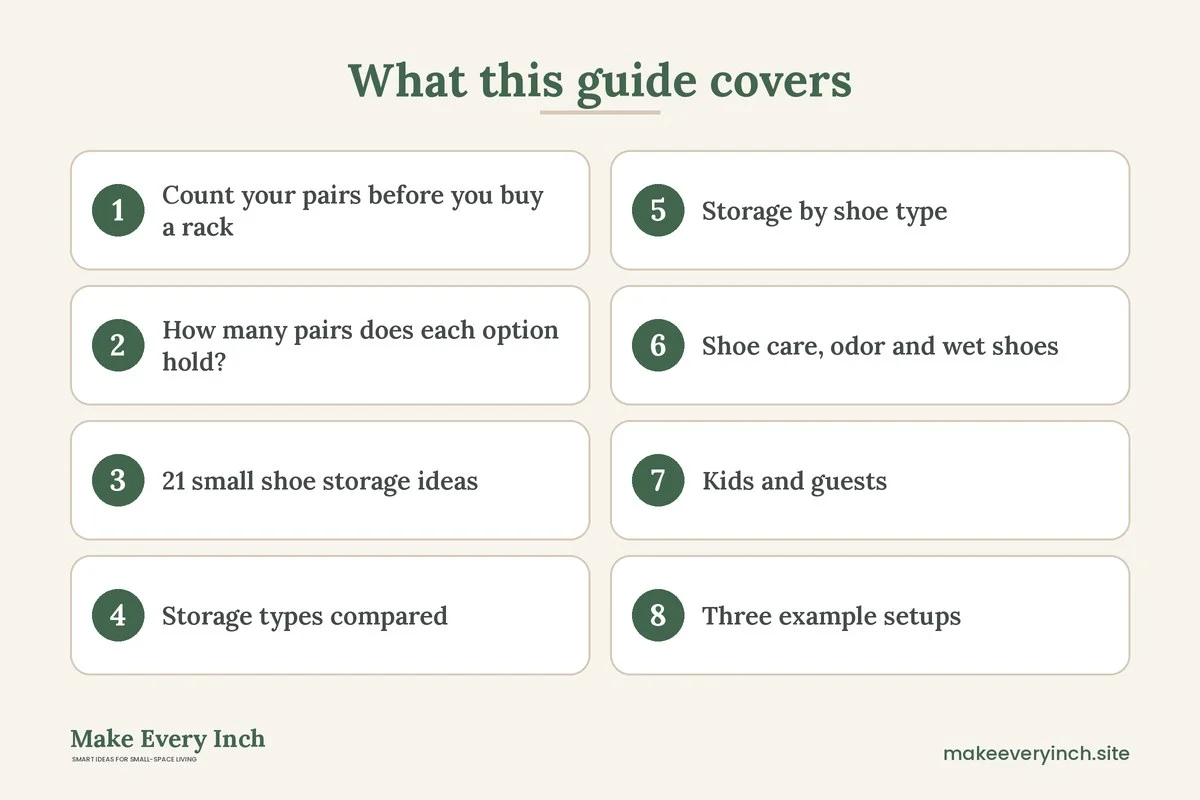
Small shoe storage ideas start with a number, because most shoe clutter is a counting problem rather than a furniture problem. A pair of adult sneakers needs about 4 by 11 inches of floor if stored flat and far less on a tilted shelf, so a rack that looks tiny can hold more than a pile ever will. This guide shows how to count your pairs, how many each type of rack really holds, 21 storage ideas for tiny entries and closets, a comparison table, advice for sneakers, heels, boots and sandals, tips for shoe care, odor and wet shoes, plans for kids and guests, three example setups and a checklist. For the surrounding space, see our guide to small entryway storage.
Count your pairs before you buy a rack
Sort every pair you own into four piles: worn weekly, worn seasonally, worn for occasions and worn never. Most people find that they wear four to six pairs most of the time, so those are the pairs that deserve a spot at the door. Seasonal and occasion pairs belong in a closet, a box or under the bed. Pairs you never wear can be donated, which is the cheapest storage upgrade available.
Next, measure the space. Note the width, depth and height of the entry floor, closet floor, the back of the door and the gap under the bed. A standard adult shoe is about 10 to 12 inches long and 4 to 5 inches wide, and a men’s size 12 can run close to 13 inches. Allow 12 inches of depth for a flat rack, 8 to 10 inches for a tilted one and about 14 inches for boots and high-tops.
How many pairs does each option hold?
Use these rough numbers as a planning guide. A 3-tier flat rack about 27 inches wide holds around 9 pairs, three per shelf. A 4-tier rack of the same width holds about 12. A slim tilted cabinet with 2 or 3 flip-down drawers, about 24 inches wide and 7 to 9 inches deep, holds 6 to 12 pairs. An over-door organizer with 12 pockets holds 12 pairs of flats and sneakers, though bulky shoes may need two pockets. A stackable cube set with six cubes holds 6 to 12 pairs, depending on whether you stack toe to heel. A stretch of under-bed space 18 inches wide holds about 3 to 4 pairs per box.
Real capacity is lower than the label says, because stiff boots, big sneakers and chunky soles do not fit the neat standard. Subtract about 20 percent from the manufacturer’s count when you plan, and buy one tier more than you think you need.
21 small shoe storage ideas
Entry and floor storage
1. A tilted shoe cabinet
A tilted cabinet has flip-down doors that hold shoes at an angle, so it needs only 7 to 9 inches of depth. It hides the shoes behind a closed front, which keeps a tiny entry calm. Check the weight rating, and anchor tall units to the wall if the lease allows or use a tip-over strap.
2. A slim open rack
An open rack, 3 or 4 tiers, is the cheapest option and lets damp shoes dry. Choose metal or bamboo with slats, which let air through. A rack about 10 inches deep fits behind a door or along a wall in a hallway-style entry.
3. A bench with cubbies
A bench 16 to 18 inches high gives you a place to sit while you put on shoes, and the space below holds 4 to 8 pairs. Choose open cubbies so air can circulate, or add a basket on one end for slippers. Test the seat with your weight before you rely on it.
4. Stackable shoe cubes
Cubes let you build a unit to fit your space, and you can add one cube when the collection grows. Stack no higher than 3 cubes without wall anchoring. Place the heaviest shoes on the bottom, and use a rubber mat on top if you use it as a perch.
5. A boot tray under a console
A rubber boot tray with a raised edge, about 30 by 15 inches, holds wet shoes and catches melting snow. Place it beside the door, with boots upright or tilted against the wall. Wipe it down weekly and rinse it monthly.
6. A ladder shoe shelf
A leaning ladder shelf holds shoes on rails and uses almost no floor. It works in a narrow hallway where a deeper rack will not fit. Check that the base is stable on slippery floors, and place a rubber pad underneath.
Over-door and wall storage
7. An over-door pocket organizer
Choose a metal-framed or sturdy fabric organizer with 12 or more pockets, and measure the door thickness first. Most hang over a standard 1 and 3/4 inch door, and some need a gap that a tight door cannot give. Put sneakers and flats in the pockets, and leave heavy boots out.
8. An over-door hook and rack combo
A rack with hooks and rails holds a few pairs and a bag or a jacket. It suits a rental, since it leaves no marks. Add a felt strip behind it to stop the door from scratching.
9. Wall-mounted shoe shelves
Narrow wall shelves, 5 to 7 inches deep, hold shoes in a tilted or toe-out position at about eye height. Use wall anchors rated for the load, and keep to the lease. In a rental without drilling, a leaning shelf or a freestanding rack is better. See no drill storage ideas for renters for options.
10. A pegboard with shoe pegs
A pegboard hangs on adhesive hooks or leans, and holds shoes on pegs by the heel. It works for sneakers and flats only, and it keeps the floor clear. Space pegs 4 inches apart so shoes do not bump.
Closet storage
11. Hanging shoe shelves
Fabric shelves that hang from a closet rod use the empty air under the clothes. A 6-shelf unit holds about 6 to 12 pairs. Use it where the rod has at least 30 inches of clearance below.
12. A closet shoe rack with a second level
A two-level rack, often called a shoe stacker, doubles floor capacity by lifting one shoe over another. Choose a version with adjustable height so high heels and boots fit. Add a mat under it so the floor stays clean.
13. Shelf dividers or clear risers
Risers on an existing shelf let you place one shoe above the other. They suit flats, sandals and loafers on a shelf at head height. Match risers to the shelf depth to avoid overhang.
14. A rolling shoe cart
A cart on casters, around 10 inches wide, slides into a gap beside a hanging rod or a dresser. Lock the wheels when you load it. It is a good option for narrow closets and a hallway pinch point.
Under-bed and hidden storage
15. Under-bed shoe boxes
Clear boxes with lids, about 6 inches high, protect shoes from dust and hold 3 or 4 pairs. Choose boxes with a hinged front or a drawer side, so you can pull out one pair without lifting the lid. See our under bed storage ideas for height measurements.
16. A rolling under-bed tray
A shallow tray on wheels holds 4 to 6 pairs of sandals and flats, and it slides in and out. Check the gap under the bed first, since many beds have only 6 to 8 inches. Add a thin cloth cover to keep dust off.
17. A shoe ottoman or storage bench
An ottoman with a hinged top hides 4 to 6 pairs, and doubles as a seat or a footrest. It suits a living room that opens straight onto the door. Check that the lid has a soft-close or a stay-open hinge.
18. A bed frame with drawers
A platform bed with drawers turns the space under the mattress into a shoe store. Use drawer dividers to keep pairs from sliding together. Keep only out-of-season shoes here, so you do not need to open the drawer every day.
Specialty and small-footprint ideas
19. A boot shaper rack
Boots lose their shape if they slump in a closet. Use boot shapers, or rolled magazines, and store tall boots upright on a rack with a tall slot. A hanging boot organizer on a closet rod saves floor.
20. A heel hanger
Clip-on hangers let you hang heels by the strap or heel on a rod, and they suit narrow closets. Do not hang stiff leather by the strap if it stretches. Use it for sandals and flats with firm straps.
21. A guest and kids basket
A basket or a low bin by the door holds slippers for guests and small shoes for children. Keep it open, so children can use it themselves. See small coat storage ideas for the matching coat side of the entry.
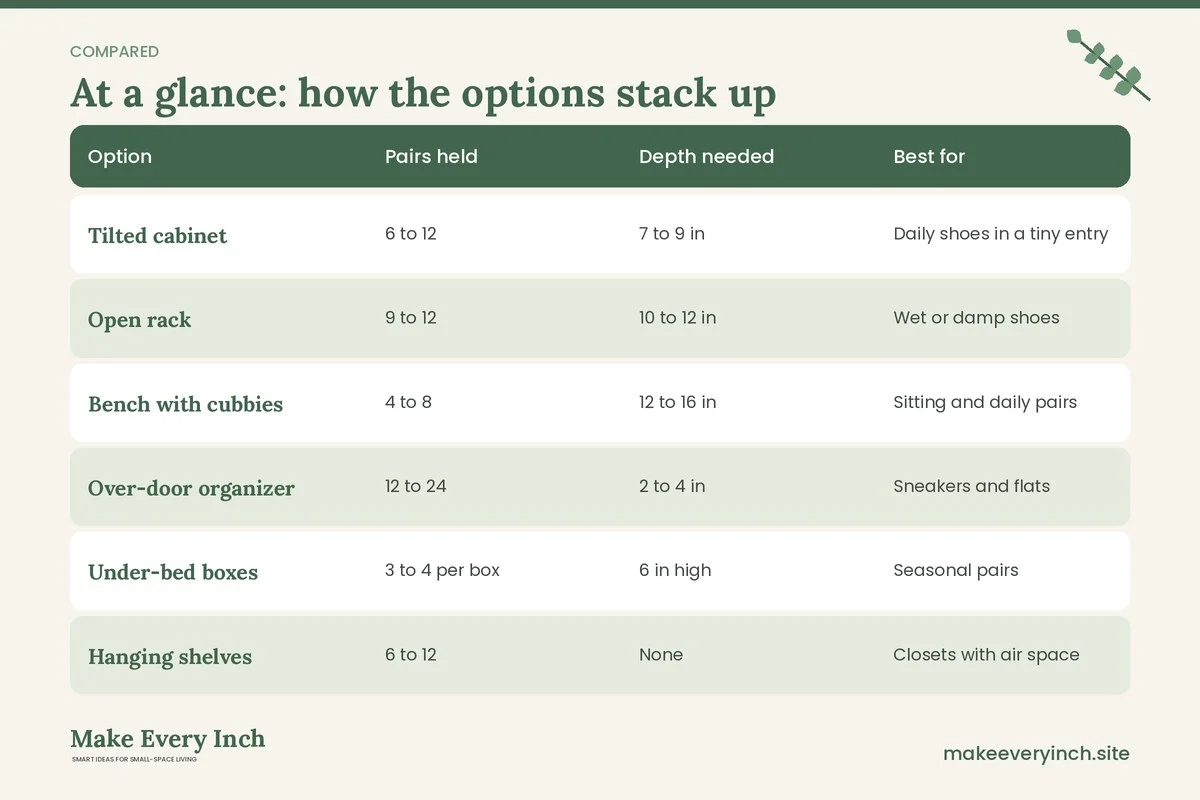
Storage types compared
| Option | Pairs held | Depth needed | Best for | Rental friendly |
|---|---|---|---|---|
| Tilted cabinet | 6 to 12 | 7 to 9 in | Daily shoes in a tiny entry | Yes |
| Open rack | 9 to 12 | 10 to 12 in | Wet or damp shoes | Yes |
| Bench with cubbies | 4 to 8 | 12 to 16 in | Sitting and daily pairs | Yes |
| Over-door organizer | 12 to 24 | 2 to 4 in | Sneakers and flats | Yes |
| Under-bed boxes | 3 to 4 per box | 6 in high | Seasonal pairs | Yes |
| Hanging shelves | 6 to 12 | None | Closets with air space | Yes |
| Wall shelves | 4 to 8 | 5 to 7 in | Narrow walls | Check the lease |
Storage by shoe type
Sneakers
Sneakers are bulky but forgiving, and they go well in cubes, racks and over-door pockets. Loosen the laces and pull the tongue forward so they air out. Stack no more than two high, and never leave them toe to toe, which creases the toe box.
Heels
Heels need support for the heel and the arch. Store them on a tilted shelf, a two-level rack or shelf risers. Keep the pairs apart, so stilettos do not scratch each other. Put a shoe bag around delicate or suede heels.
Boots
Boots are the hardest because of their height. Use boot shapers, store them upright in a tall rack, or lay them on their sides in a bin. Hang tall boots from clips only if they are soft and not heavy. Keep ankle boots on a rack with the other shoes.
Sandals and flip-flops
Sandals are light and flat, so a pocket organizer, a basket or an under-bed tray suits them. Wipe the footbeds before storing them for the winter, and keep leather sandals out of damp areas.
Shoe care, odor and wet shoes
Shoes need to dry fully before you store them. Take out the insoles and loosen the laces so air gets in, and let wet shoes dry at room temperature for 24 hours. Never place wet shoes next to a radiator or a heater, which can crack leather and weaken glue. Stuff damp shoes with crumpled paper, and replace it after a couple of hours when it has absorbed moisture.
For odor, rotate shoes so you do not wear the same pair two days in a row. Sprinkle a little baking soda in each shoe overnight and tap it out in the morning. Cedar inserts absorb moisture and add a mild scent, and sachets of activated charcoal work as an unscented alternative. Wash washable insoles, and vacuum the shoe rack monthly.
For wet shoes at the door, use a boot tray or a rubber mat with a lip, and wipe the soles at the door. Keep a towel on a hook for muddy paws and boots. If you share the entry with a pet, keep shoes off the floor in a closed cabinet.
Kids and guests
Children put on shoes best when the storage is low and open. Use a low bench, a bin at floor level or a hook for each child at their height. Give each child one spot, and put the pair they wear every day there. Sort out grown-out shoes every season, so the small ones do not take over the rack.
For guests, keep a basket of slippers or clean socks, and a tray for outdoor shoes. Many hosts ask guests to remove shoes, and a visible, tidy spot makes this easy. If you have no entry, place a bench or a rack just inside the door. See tiny foyer ideas for more.
Three example setups
The 3 by 4 foot entry
A slim tilted cabinet holds 8 pairs, a rubber boot tray sits beside it and a bench on the other wall gives a seat and a basket for guests. Hooks above hold coats and bags. Keep the daily set to six pairs, and store the rest in a closet.
The apartment with a coat closet only
Use the floor of the closet for a two-level rack, hang a pocket organizer on the closet door and place a boot tray inside the entry. This holds about 20 pairs without any furniture in the main room. Add a small mat outside the closet to catch dirt.
The studio with no entry at all
Place a bench or an ottoman just inside the door for 4 to 6 pairs, put a boot tray beside it and move seasonal shoes into under-bed boxes. A rug marks the zone. See no entryway apartment ideas.
A simple method to organize your shoes
Step 1: Edit
Pull out every pair, try them on and donate those that hurt or that you have not worn in a year. Keep the ones that fit and that you like.
Step 2: Clean
Wipe soles, brush off suede and remove insoles to dry. Cleaning before storage keeps odor away.
Step 3: Group and place
Place daily pairs at the door, seasonal pairs in the closet and rare pairs under the bed. Put the most-used shoes at waist height.
Step 4: Label and review
Label boxes on the short end. Every season, swap pairs and recheck the count against capacity.
Budget guide
Under $40
An open rack, a rubber boot tray and a few under-bed boxes.
About $120
A tilted cabinet or a bench with cubbies and an over-door organizer.
$300 and up
A custom-fit shoe bench, a storage bed or an ottoman, and a full closet system.
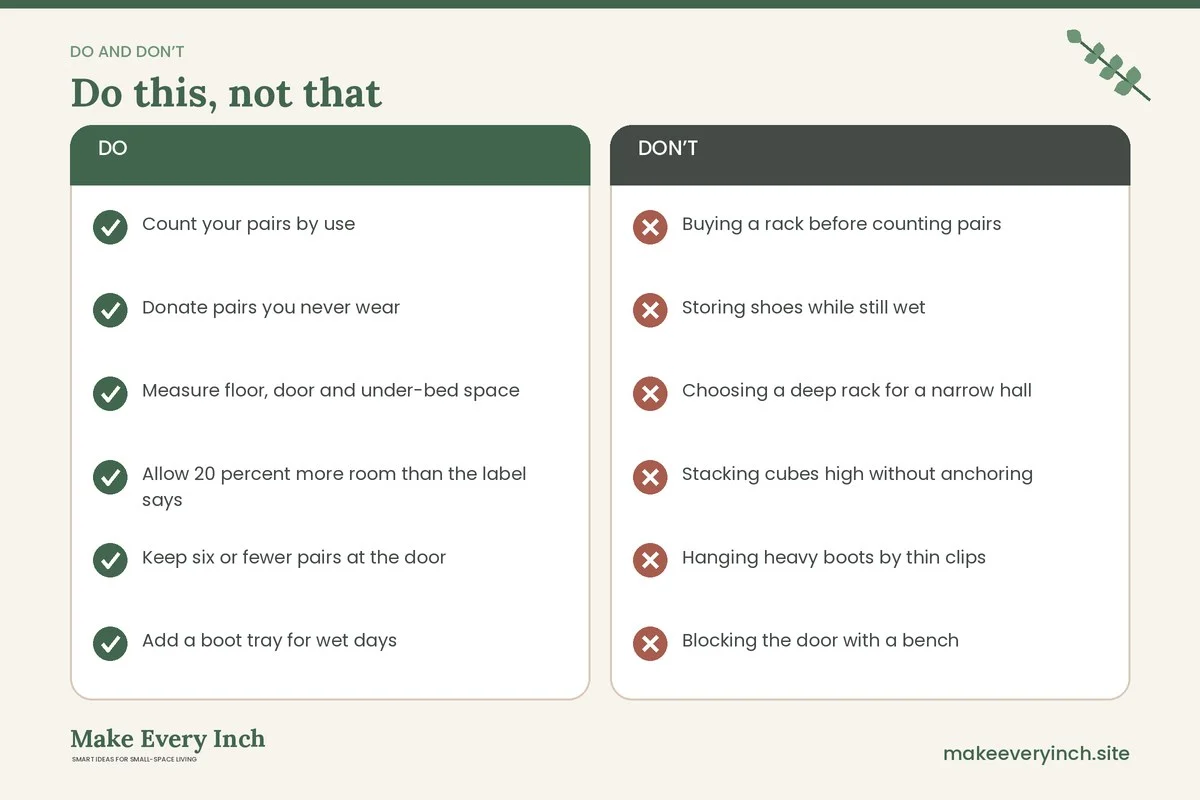
Mistakes to avoid
- Buying a rack before counting pairs
- Storing shoes while still wet
- Choosing a deep rack for a narrow hall
- Stacking cubes high without anchoring
- Hanging heavy boots by thin clips
- Blocking the door with a bench
- Keeping shoes you never wear
- Ignoring the weight rating of over-door racks
Shoe storage checklist
- Count your pairs by use
- Donate pairs you never wear
- Measure floor, door and under-bed space
- Allow 20 percent more room than the label says
- Keep six or fewer pairs at the door
- Add a boot tray for wet days
- Let shoes dry before storing
- Add cedar or baking soda for odor
- Give kids a low spot
- Add a guest basket
- Review every season
FAQ
How many pairs of shoes can a small shoe rack hold?
A 3-tier rack about 27 inches wide holds about 9 pairs, and a 4-tier rack holds about 12. Plan on fewer for boots and large sneakers.
What is the best shoe storage for a tiny entry?
A tilted cabinet, 7 to 9 inches deep, or a slim open rack. Both hold several pairs in a very small footprint.
How do I store shoes with no closet?
Use a bench with cubbies, an ottoman, under-bed boxes or an over-door organizer. These work in any rental.
How do I stop shoes from smelling?
Dry them fully, rotate pairs, use baking soda or cedar inserts and wash insoles when they are washable.
Where should I put wet shoes?
On a rubber boot tray near the door, away from heaters, and with insoles out so they can dry.
Can I store shoes under the bed?
Yes, in boxes about 6 inches high or on a rolling tray. Measure the gap under the bed first.
How should I store boots?
Upright with shapers in a tall rack, or on their sides in a bin if space is tight.
How do I organize shoes for kids?
Use a low open bin or bench at child height, give each child one spot and sort out small pairs each season.
Keep going: Keep going with small entryway storage, small coat storage ideas and small entryway ideas.
Save this guide for later
Pin the ideas you like to Pinterest so you can come back to them when you plan your space.