Small Space Curtain Ideas to Add Height: 14 Ways to Look Taller
Quick answer: To make a small space curtain add height, mount the rod close to the ceiling or crown molding, hang the panels so they just brush or lightly touch the floor, choose a fabric that falls in long vertical folds, and keep the color close to the wall. The eye follows the vertical lines upward, so the ceiling reads as higher than it is.
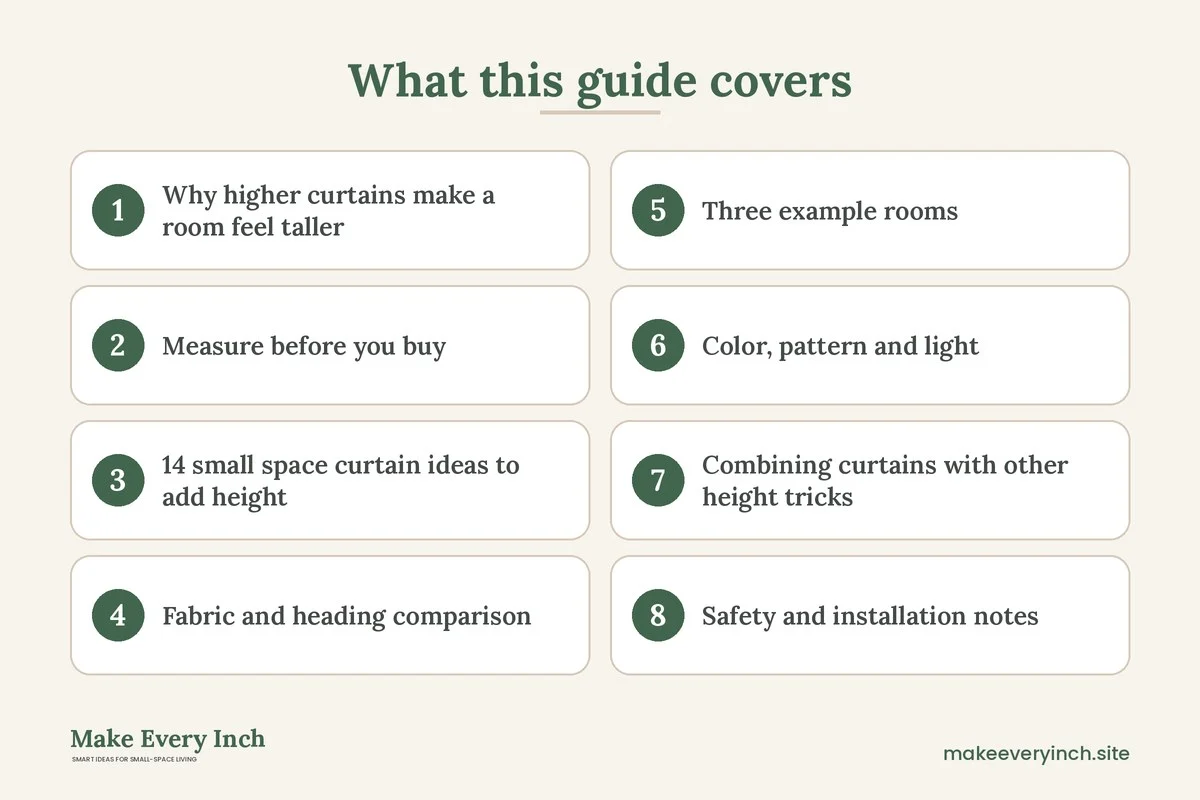
A small space curtain add height trick is one of the simplest ways to change how a room feels, and it needs no construction. Most small rooms are not short on floor area as much as they are short on the sense of air above it, and standard curtains hung at the top of the window frame make the problem worse by stopping the eye at the window. Hanging them higher and longer does the opposite. This guide explains the logic, how to measure for rod height, panel length and width, 14 ideas, a comparison table of fabrics and headings, three example rooms, color rules, light and privacy notes, safety steps and a checklist. For the full hub, read our guide to small room decor ideas, and pair this post with our companion on small room rug ideas that define zones, because the floor and the window do complementary work.
Why higher curtains make a room feel taller
The eye reads a room by following lines. A rod set right above the window frame creates a horizontal stripe at that height, and the viewer reads that stripe as the top of the room’s useful space. A rod set much higher, close to the ceiling, pushes the stripe up and puts a long vertical line between it and the floor. That line draws the eye up the whole wall.
Length matters just as much. Panels that stop at the sill create another horizontal cut, while panels that reach the floor make one continuous drop. The effect is a stretch, and the room feels taller even though the ceiling has not moved.
Finally, wide panels that cover the wall on each side of the window let the glass appear larger. A larger window usually reads as a more generous room. None of this removes the fact that the ceiling is a fixed height, but together these choices can change how the room is perceived. The effect varies with the room, the fabric and the light, so treat it as a design tendency, not a guaranteed result.
Measure before you buy
Good curtains start with a tape measure, and a few inches matter. Measure at least twice, and write the numbers down.
- Ceiling height: measure from the floor to the ceiling at the window wall. Some floors and ceilings are not level, so measure at both sides of the window.
- Window width and height: note the outside of the frame, not just the glass.
- Rod height: a common starting range is 4 to 6 inches above the window frame, or just below the crown molding or the ceiling if the space is short. If the gap between the frame and the ceiling is small, place the rod closer to the ceiling than the frame.
- Rod width: the rod should extend about 6 to 12 inches past each side of the window frame so the panels can stack against the wall and leave the glass clear when open.
- Panel length: measure from the planned rod position to the floor. For a floor-skimming look, subtract about half an inch to an inch. For a slight puddle, add 1 to 2 inches, though puddles collect dust and may catch under feet in a small room.
- Panel width: the combined panel width should be about 1.5 to 2.5 times the rod width for fullness, depending on the fabric and heading.
- Wall clearance: check for radiators, vents, switches and outlets that curtains might cover. Curtains should not cover a heater or touch a hot surface.
If the ceiling is under 8 feet, it is wise to be conservative: put the rod high, but not so high that the hardware looks squashed against the ceiling. Hold the rod up with a friend and look from across the room before you mark any holes.
14 small space curtain ideas to add height
Rod placement ideas
1. Hang the rod just below the ceiling
Mount the rod 2 to 4 inches below the ceiling or the crown molding. The panels appear to start at the top of the wall, so the whole wall becomes a single tall surface. This is the most direct way to make a small space curtain add height, and it works with either a standard rod or a ceiling track.
2. Use a ceiling-mounted track
A track fixed to the ceiling lets the fabric drop from the very top. It looks seamless, and it gives the most height for the fewest visible parts. Track installation can be complex, so check the ceiling material and the weight rating, and ask before drilling in a rental.
3. Extend the rod beyond the window
A rod 12 to 18 inches wider than the frame on each side lets the panels sit against the wall. The glass looks wider and taller, and the light enters fully. This helps in a room with a small window that you want to look larger.
4. Use a no-drill tension rod in a recess
A tension rod fits inside a window recess or an alcove without any holes. Place it near the top of the recess and hang a light curtain from it. Tension rods only hold lightweight fabric, and an overloaded rod can fall, so follow the weight rating and choose a sheer or thin panel. See our guide to renter friendly window treatment ideas for more no-drill options.
Length and fullness ideas
5. Floor-skimming panels
Hang the panels so they hover about half an inch above the floor, or just kiss it. The clean line is easy to vacuum around, and the panels look tailored. If you have a rug nearby, make sure the curtain does not catch on the rug edge.
6. Extra-long panels for a low window
If the window sits low on the wall, a long panel from the ceiling to the floor can make it feel part of a taller composition. Hem tape or a simple adjustment can shorten a panel, so buy longer than you need if the length is uncertain, and hem to fit.
7. A full curtain on a short wall
In a narrow room, a pair of full-length panels at each end of the window wall can make a tight room feel formal and tall. Avoid heavy fabrics here, which can make a small room feel crowded.
8. Double rods with a sheer layer
A sheer panel on the inner rod and a heavier panel on the outer rod gives you light control, privacy and depth. Both panels should hang at the same height, from the top of the wall to the floor, so the vertical lines stay consistent. Be careful with weight on a rod that is mounted into a rental wall.
Fabric, color and pattern ideas
9. Match the curtain color to the wall
When the curtain and the wall are the same or close in color, the fabric melts into the room and the wall looks like one tall plane. This works well with pale tones. It also reduces the visual clutter around the window.
10. Use vertical stripes
A vertical stripe in a thin line pulls the eye upward. Choose a subtle, tone-on-tone stripe in a small room, because a bold one can look busy. Hang the stripes straight, and check that they line up across panels.
11. Pick a light, flowing fabric
Linen-look weaves, cotton blends and light voile fall in long folds and add softness without bulk. Heavy velvet can look rich, but in a very small room it can take up visual space. Choose according to your priorities, and consider lining for light control.
12. Add a high contrast on purpose
If a pale wall feels flat, a deeper curtain can add drama. A dark panel hung high and full-length still adds height if the lines are long and the rod is close to the ceiling. Keep the rest of the palette simple. For palette inspiration, look at our post on studio apartment color schemes.
Heading and hardware ideas
13. Choose a pleat or tab-free heading
A pinch pleat, a pencil pleat or a simple rod-pocket heading all hide the rod and give the fabric clean vertical folds. Clip rings are easy to install, but they can show a small gap at the top. Avoid headings that stack many folds near the top, because bulky stacking can make the top look heavy.
14. Pick slim, unobtrusive hardware
A thin rod in the wall color or a slim metal finish keeps the focus on the fabric. Oversized finials and thick poles take up space. A recessed track disappears entirely.
Fabric and heading comparison
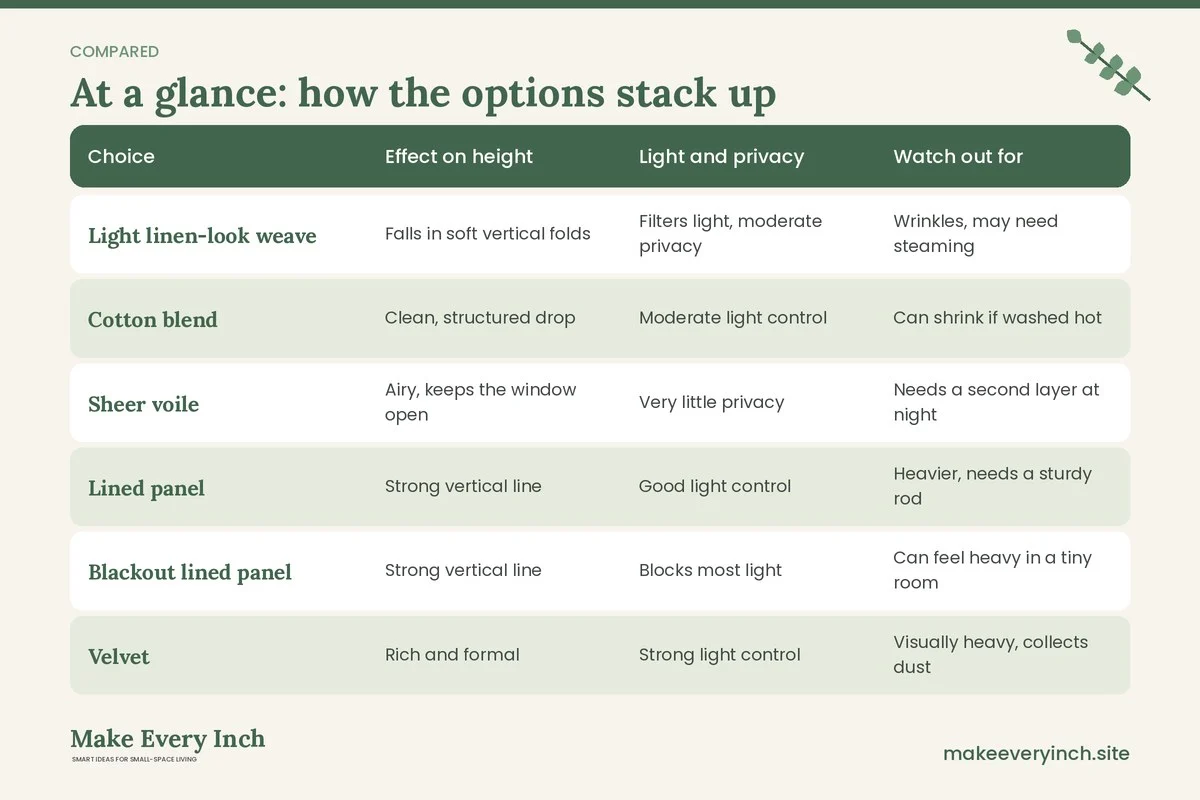
The table below compares common choices for small rooms. Use it to narrow your shortlist before you shop, and always check the label for fire safety and care.
| Choice | Effect on height | Light and privacy | Watch out for |
|---|---|---|---|
| Light linen-look weave | Falls in soft vertical folds | Filters light, moderate privacy | Wrinkles, may need steaming |
| Cotton blend | Clean, structured drop | Moderate light control | Can shrink if washed hot |
| Sheer voile | Airy, keeps the window open | Very little privacy | Needs a second layer at night |
| Lined panel | Strong vertical line | Good light control | Heavier, needs a sturdy rod |
| Blackout lined panel | Strong vertical line | Blocks most light | Can feel heavy in a tiny room |
| Velvet | Rich and formal | Strong light control | Visually heavy, collects dust |
| Pinch pleat heading | Neat vertical folds | Depends on fabric | Needs a rod rated for the weight |
| Rod pocket heading | Gathered at the top | Depends on fabric | Harder to slide |
| Clip rings | Easy to install and change | Depends on fabric | Gaps can show at the top |
Three example rooms
A rental living room with an 8 foot ceiling
The window sits about 18 inches below the ceiling and the wall is white. The renter hangs a no-drill tension rod inside the recess, close to the top, with two light linen-look panels. The panels hang in a pale shade close to the wall, so the wall looks like one plane. Because the rod is a tension rod, nothing is drilled, and the lease stays intact. The panels reach almost to the floor, with a half inch of clearance. A rug sits nearby but does not touch the hem. The room feels taller, and the renter can take everything when they move. Our guide to small living room ideas shows how to plan the rest of this room.
A small bedroom with a low sloping ceiling
The window is small and set into a sloped wall. A curtain on a traverse track runs along the high wall beside the window, and a short sheer layer covers the glass. The track runs along the highest part of the wall so the fabric falls from the tallest point. The panel does not need to reach the floor, and a clean hem above the furniture avoids contact with a headboard. See our post on small bedroom ideas with low ceilings for a fuller plan. Before choosing blackout fabric, think about whether you want morning light, since blocking all light can make a small room feel closed.
A studio with a wall of windows
A studio has a long run of windows with narrow wall sections between them. The owner mounts one continuous rod close to the ceiling, spanning the whole wall, and hangs a series of identical panels. The panels link the windows into one tall feature and draw attention away from the mixed window sizes. A sheer layer stays up all day for privacy, and the heavy layer closes at night to separate the sleeping area from the living space. For more on dividing the space, see our guide to studio apartment layout ideas that create zones.
Color, pattern and light
Color changes how tall a curtain looks. Pale tones close to the wall tend to recede and make the wall appear continuous, while deeper tones draw attention to the window. In a very small room, the quiet option usually works better, but if the room feels bland, one bold panel pair can be the focal point.
Light affects the effect too. A sheer panel next to a bright window glows in the daytime and fades at night, and a lined panel looks richer when the room is lit. Where the window faces direct sun, some fabrics fade over time, so a lining or a lighter weave may last longer. Light also decides privacy. If people can see in at night, you may need a second layer, a lined panel or a blind. For fixtures, our guide to small dining room lighting ideas explains how to light the evenings.
Pattern should be gentle in a small room. Large bold prints can overwhelm, and a small scale or a tone-on-tone weave is easier to live with. If your walls are already patterned, choose plain curtains.
Combining curtains with other height tricks
Curtains work best when the rest of the room supports the vertical line.
- Hang art vertically. Tall frames and stacked pictures continue the upward line. Our post on renter friendly wall decor ideas shows how to hang them without damage.
- Use tall, slim furniture. A narrow bookcase or a tall plant stand echoes the curtain. See our guide to furniture that makes small rooms feel bigger.
- Raise the light source. Wall sconces and uplights wash the ceiling and make it look higher. See our post on renter friendly lighting ideas.
- Paint or cover the ceiling light. A light ceiling bounces the light and feels higher. If you repaint, use a low-VOC paint, open windows and run a fan, and ask for the landlord’s permission in a rental.
- Keep the sill clear. Clutter at the window stops the eye. Move the plants and the stacks of books.
Our overall approach to a small room is covered in apartment decorating styles, which can help you choose a style that suits tall, simple curtains.
Safety and installation notes
Curtains look light, but wet or heavy fabric on a long rod puts real load on the wall. Take these precautions.
- Never drill without permission. In a rental, ask the landlord before putting any hole in a wall, frame or ceiling. If the answer is no, use a tension rod or a freestanding option.
- Use the right anchors. Find studs where you can, and use anchors suited to the wall material when you cannot. Check the weight rating of the rod, the brackets and the anchors, and stay well under the limit. Heavy lined curtains need strong support.
- Check what is behind the wall. Before you drill, look for pipes, wires and cable runs. Use a detector, and avoid areas near switches and outlets.
- Mind cords. Corded blinds and long loops are a strangulation risk for young children and pets. Keep all cords out of reach, use cordless products where possible and follow the maker’s safety guidance. Do not place a crib, bed or climbable furniture near a window with cords.
- Keep fabric away from heat. Do not let curtains touch or cover radiators, heaters, stoves or hot lamp bulbs. Hang curtains clear of any heat source, and follow the clearance advice in the appliance manual.
- Keep fabric off bulbs. A lamp near a curtain should have a bulb that stays cool, and the fabric should not touch the shade or the bulb. Check the maximum wattage on the lamp, and do not exceed it.
- Do not overload sockets. If you add a plug-in light near the window, avoid chaining extension strips and keep cords tidy and away from the hem.
- Use ladders safely. Use a stable stepladder, keep three points of contact and ask a friend to hold it. Do not stand on a chair or a stack of books.
- Check labels. Look for fire safety information and cleaning instructions before you buy, especially for bedrooms.
Mistakes to avoid
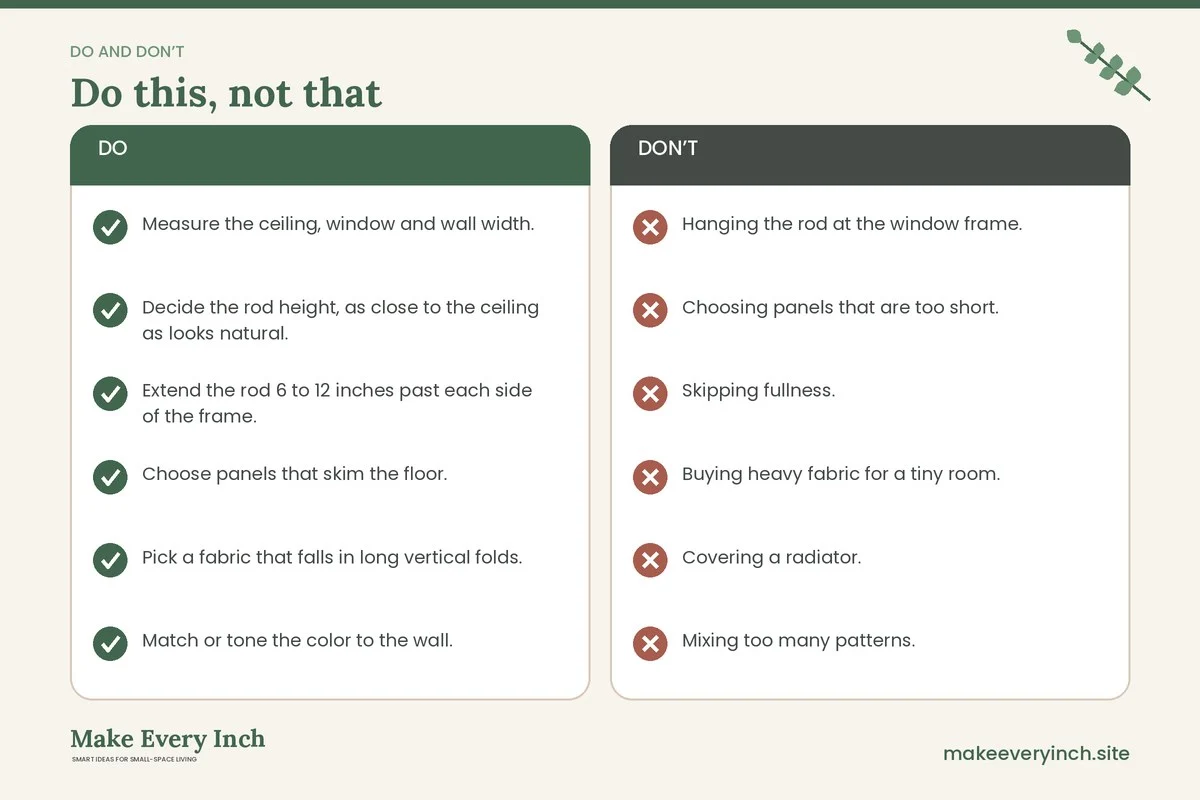
- Hanging the rod at the window frame. It cuts the wall in half. Go higher.
- Choosing panels that are too short. Half-length curtains look like they shrank. Measure to the floor.
- Skipping fullness. A flat, tight panel looks cheap and does not make folds. Choose a panel width that is at least about 1.5 times the rod width.
- Buying heavy fabric for a tiny room. Heavy drapery can eat floor space visually. Pick a lighter weave.
- Covering a radiator. Long curtains over heaters block heat and can be a fire risk. Measure and shorten, or use a different treatment.
- Mixing too many patterns. The window should calm the room, not compete with it.
- Forgetting the hem. A hem that drags will gather dust. Measure twice and hem if needed.
- Ignoring storage. If your windowsill holds clutter, the curtains cannot help. See our guide to small space organization ideas for ways to clear the area.
Budget approach
You can improve a room without replacing everything. Start with the rod, because moving it higher costs little and changes the look the most. If the existing curtains are too short, extend them with a band of matching fabric at the top or hem, or look for longer panels second-hand. Use clip rings so you can adjust the height later. Our post on budget small space ideas has other ways to stretch a modest allowance.
Curtain height checklist
- Measure the ceiling, window and wall width.
- Decide the rod height, as close to the ceiling as looks natural.
- Extend the rod 6 to 12 inches past each side of the frame.
- Choose panels that skim the floor.
- Pick a fabric that falls in long vertical folds.
- Match or tone the color to the wall.
- Check the weight rating on the rod and anchors.
- Ask permission before drilling or using adhesives.
- Keep curtains away from heaters and hot bulbs.
- Keep cords out of reach of children and pets.
FAQ
How high above the window should I hang the curtain rod?
A common starting range is 4 to 6 inches above the window frame, and in a small room it can be higher, up to just below the ceiling or the crown molding. Stand back and check the look before you mark the wall.
Should curtains touch the floor in a small room?
Floor-length curtains make the room look taller, and many people choose panels that hover about half an inch above the floor so they are easier to clean. Avoid long puddles, which collect dust and can catch under feet.
Can I add height without drilling?
Yes. A tension rod in a recess, an adhesive-free track or a freestanding rod can work. Keep fabrics light, follow the weight rating and check the lease.
What color curtains make a ceiling look higher?
Pale colors close to the wall color usually create a continuous plane, and a thin vertical stripe also pulls the eye up. Dark curtains hung high and full-length can work too, but they tend to feel heavier.
Are sheer curtains enough for a small room?
They add height and light, but little privacy. Many people layer a sheer with a heavier panel or a blind for evenings.
How wide should the curtain panels be?
Combined panel width of about 1.5 to 2.5 times the rod width gives a full look with soft folds. Fabric type and heading affect the ideal ratio.
Are blackout curtains a good idea in a small bedroom?
They help with sleep for some people, but they can make a small room feel enclosed during the day. A blackout layer behind a lighter front panel lets you choose.
Do I need to keep curtains away from lamps?
Yes. Keep fabric clear of hot bulbs and shades, never exceed the maximum bulb wattage printed on the lamp, and keep the cord away from the hem.
Keep going: Keep planning with our small bedroom ideas, small living room lighting ideas and small room rug ideas to define zones.
Save this guide for later
Pin the ideas you like to Pinterest so you can come back to them when you plan your space.