19 Small Coat Storage Ideas Without a Coat Closet
Quick answer: The best small coat storage ideas are wall hooks set 6 to 8 inches apart at 60 to 66 inches high, a freestanding rack with a tray beneath it, an over-door rack, a second rod in a nearby closet and a rolling garment rail for the heavy season. Screw hooks into studs for puffers and wet wool, use adhesive hooks only for light jackets, and move off-season coats out of the entry.
Small coat storage ideas matter most in homes that were built without a coat closet, which describes many apartments, older cottages and open-plan houses. A family of four can own a dozen coats between them, and a single heavy puffer takes more room than a week of shirts. When there is nowhere to put them, coats end up over chairs, on the sofa arm and in a heap by the door. This guide covers the numbers that decide whether a system works, 19 specific ideas, a comparison table, three example homes, a step-by-step method, a seasonal rotation plan, budgets, mistakes and a checklist. If your whole entry is the problem, our guide to small entryway ideas covers the bigger picture.
Know your numbers before you buy anything
Coat storage fails for dull reasons: hooks too close together, hooks too low, or a rack that tips over when it holds five coats on one side. A few measurements prevent all three.
How much does one coat need?
A light jacket or trench takes about 3 to 4 inches of horizontal space on a hook. A down puffer is bulkier and wants 5 to 6 inches, and a long wool overcoat hangs 40 to 50 inches from the shoulder, so it needs a hook high enough to keep the hem off the floor. Count the coats your household wears in the coldest month, add two for guests, and you have your capacity target.
Capacity per linear foot
Use these working figures when you compare options.
- A single row of hooks at 6 inch spacing holds 2 coats per foot.
- A double row, with a high row and a staggered low row, holds 3 to 4 coats per foot, though they overlap.
- A closet rod with slim hangers holds 8 to 10 thin jackets per foot, or 4 to 5 winter coats.
- A freestanding rack with 6 to 8 pegs holds 6 to 8 coats in a footprint of about 18 inches square.
- A rolling garment rail 36 to 48 inches wide holds 12 to 20 hangers, depending on how bulky the coats are.
Hook rules: spacing, height and load
Hooks are the cheapest and most flexible answer, so they are worth getting right.
Spacing
Set hooks 6 to 8 inches apart, center to center. At 4 inches, adjacent coats fight for the same space, and you spend every morning pulling one out from under another. For puffers, use 8 inches.
Height
Mount adult hooks with the top edge at 60 to 66 inches from the floor, which keeps a mid-length coat clear of the ground. For children under about 8, drop a lower rail to 40 to 48 inches so they can hang their own coats. A shared rail with two heights saves the argument about who hangs what.
Load
A heavy wool coat weighs 4 to 6 pounds. A wet one can weigh a third more. Add a bag hanging on the same hook and you can easily pass 10 pounds. Screw into a wall stud or use a toggle anchor rated for 50 pounds or more for anything that carries daily weight. Adhesive hooks rated for 3 to 5 pounds suit scarves, hats and a light jacket, and nothing else.
19 small coat storage ideas
Wall hooks and rails
1. A hook rail on a board
Mount a 1 by 4 inch pine board or a ready-made hook rail across two studs, with hooks every 6 to 8 inches. The board spreads the load, so even a plasterboard wall with a stud on each end carries the weight of a full family. A 36 inch board gives you four to five hooks.
2. A staggered double row
Place hooks in two rows, one at 66 inches and one at 54 inches, offset so no hook sits directly beneath another. Coats overlap, but each one hangs free, and capacity roughly doubles on the same wall width. This is the best answer when you have 3 feet of wall for six coats.
3. Peg rails in the Shaker style
A wooden peg rail with turned pegs, mounted at 60 to 66 inches, looks calm and holds a surprising amount. The pegs are 3 to 4 inches long, long enough for a coat and a scarf, and short enough that the rail does not stick out into a narrow passage.
4. Single hooks for guests
Mount three or four plain hooks on a side wall or the back of an open door for guests. A visitor does not want to dig through your coats, and a labeled zone makes the choice obvious. Keep the hooks empty in daily use so they are ready.
5. Adhesive hooks for a rental
If the lease bans screws, use heavy-duty adhesive hooks rated for the weight you will hang, and use them for light jackets only. Clean the wall with rubbing alcohol, press for 30 seconds, and wait an hour before loading. Photograph the wall first, so you can show its condition at move-out. For more options, see our guide to no drill storage ideas for renters.
Racks and stands
6. A freestanding coat tree
A pole rack with a heavy base needs no wall at all and moves with you. Look for a base at least 16 inches wide and weighing a few pounds, with hooks on at least two levels. Hang the heaviest coat on the lowest, nearest hook so the stand does not tip.
7. A rack with a tray base
Choose a rack with a shoe tray or a boot mat built into the base. The tray catches drips from wet coats and keeps puddles off the floor. It takes the same footprint, and you can wipe it down in seconds. For shoes, see small shoe storage ideas.
8. A leaning ladder rack
A slim wooden ladder leaned against the wall, with S hooks on the rungs, holds coats at different heights without any fixing. It works in a hallway because it is only 4 to 5 inches deep at the base. Check that the rubber feet grip, and keep the load balanced.
9. A slim wall mounted shelf with hooks
A shelf above a row of hooks holds hats, gloves and a basket, and the hooks below hold coats. A combined unit 30 to 36 inches wide is a complete coat zone in a single footprint. Choose one with a shelf at least 6 inches deep.
Doors and closets
10. An over-door rack
An over-door hook rack hangs from the top of a door and needs no tools. Check that the door still closes, since racks with a thick hook can scratch the frame. Choose a rack with 5 to 6 hooks rated for at least 20 pounds, and pad the top with felt.
11. Closet rod hacks
If the nearest closet already has a rod, add a second one. A double hang rod set at 42 inches and 80 inches doubles the capacity for short items, and a cascading hanger or a hanger with tiers adds more. Use slim velvet hangers for jackets, and keep bulky coats on the top rod. For help with the whole closet, see small closet organization ideas.
12. Borrow a bedroom closet
If you have no coat closet, assign the end of a bedroom closet to coats. Install a short rod or a row of hooks on the inside wall, and keep it for guests and seasonal items. It is not as quick as a hook by the door, but it frees the entry. Our guide to small bedroom ideas without a closet covers the opposite problem.
13. A tension rod in an alcove
A tension rod rated for 50 pounds or more, fitted across a nook between 30 and 48 inches wide, makes a hanging space with no screws. Add a curtain on a second rod and you have a hidden coat closet. Test the rod with the heaviest coat before you trust it.
Rails and rolling storage
14. A garment rack as a coat closet
A rolling garment rail, 36 to 48 inches wide, is a complete closet in a corner. Put a curtain or a sheet in front, or a simple fabric cover, and it looks planned rather than temporary. Choose a rail with a bottom shelf, which holds boots and a bin of gloves.
15. A wall mounted rail on brackets
A rail of steel or wood pipe on two brackets, at 66 inches, holds hangers instead of hooks. It is cleaner than hooks for a lot of coats, and the hangers keep shoulders in shape. Space the brackets no more than 36 inches apart, and screw both into studs.
16. A bench with hooks above
A bench 14 to 16 inches deep with a row of hooks above it lets you sit to put on boots. Storage under the seat holds hats, mittens and umbrellas, and it is a good fit for a narrow hall. See small entryway storage for more combinations.
Handling the awkward items
17. Bulky puffers
A puffer wants a wide hanger and a roomy spot, because crushed down loses loft. Hang it on a broad, contoured hanger, and do not pack it behind other coats. In the off season, store it in a breathable cotton bag, not a vacuum bag, which compresses the fill and can damage it over time.
18. Wet coats
A wet coat on a closet rod breeds mildew and smells. Give it a hook or a rack in open air with a tray beneath, and let it dry for several hours before it goes into the closet. A boot tray under the rack, with a layer of pebbles or a tray liner, keeps the floor safe. A wall mounted drying hook near a radiator works well, but keep wool and down well clear of the heat.
19. A seasonal swap bin
Keep only the coats in current use at the door. Move off-season coats into a labeled under-bed box, a wardrobe top shelf or a garment bag at the back of a closet. The entry then holds half as many coats, and every system on this list works better. See under bed storage ideas for boxes that fit.
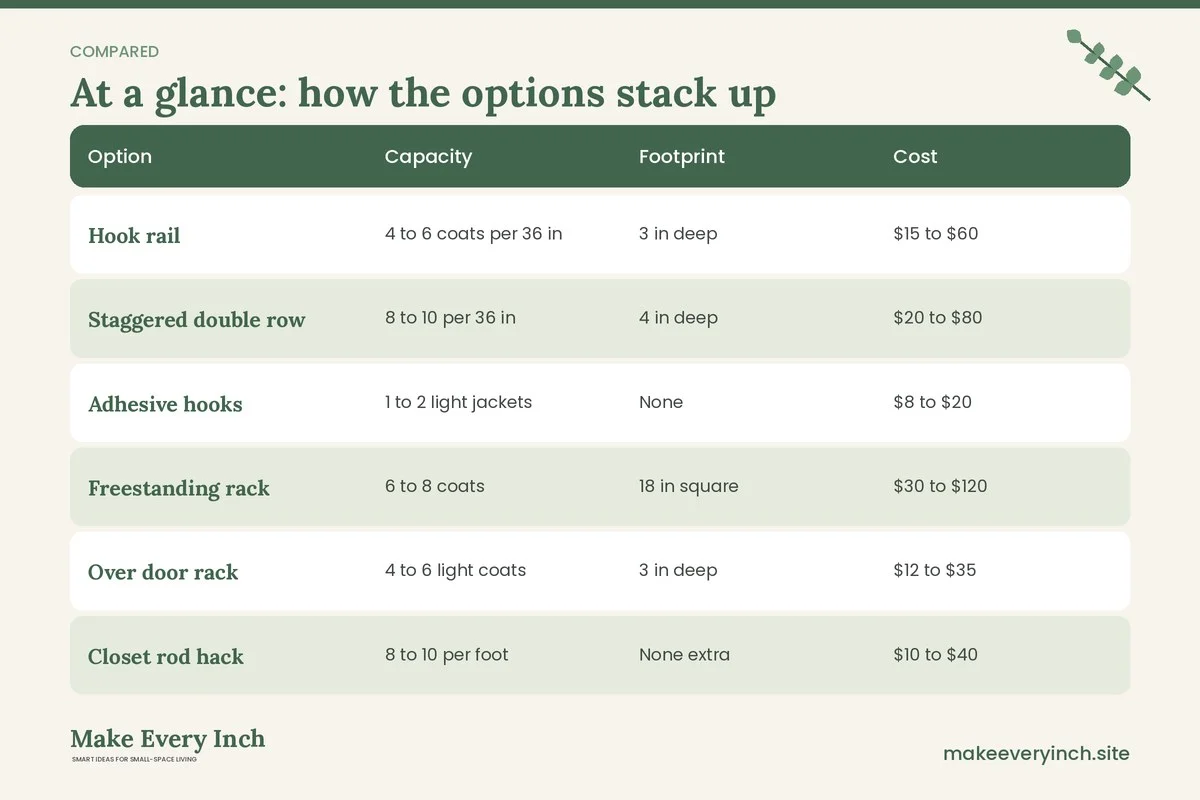
Coat storage options compared
| Option | Capacity | Footprint | Cost | Needs drilling |
|---|---|---|---|---|
| Hook rail | 4 to 6 coats per 36 in | 3 in deep | $15 to $60 | Yes |
| Staggered double row | 8 to 10 per 36 in | 4 in deep | $20 to $80 | Yes |
| Adhesive hooks | 1 to 2 light jackets | None | $8 to $20 | No |
| Freestanding rack | 6 to 8 coats | 18 in square | $30 to $120 | No |
| Over door rack | 4 to 6 light coats | 3 in deep | $12 to $35 | No |
| Closet rod hack | 8 to 10 per foot | None extra | $10 to $40 | Sometimes |
| Rolling garment rail | 12 to 20 hangers | 16 by 40 in | $40 to $150 | No |
| Wall rail with hangers | 6 to 10 coats | 14 in deep | $40 to $120 | Yes |
Three example homes
A 520 square foot studio with no entry
A renter has a front door that opens into the room and a 30 inch wall beside it. She cannot drill, so she places a freestanding rack with a tray base in the corner, and hangs two adhesive hooks for scarves and a tote. A rolling garment rail behind the sofa holds the off-season coats, with a curtain in front. Total cost is around $120, and everything leaves with her. Our guide to no entryway apartment ideas shows how to define the zone.
A narrow rowhouse hall
A family of four has a hall 36 inches wide. A hook rail on a board sticks out only 3 inches and leaves the hall usable, and a a staggered double row for eight coats, and a shelf above for hats. A slim bench is too deep, so a 10 inch shoe shelf sits below. Children’s hooks run along a lower rail at 44 inches. See narrow hallway ideas for more tips.
A small house with a family mudroom corner
A 4 by 5 foot corner by the back door has no closet. A bench 15 inches deep with cubbies, a hook rail above and a boot tray under the bench handle daily use. A tension rod above the bench, loaded with seasonal coats on hangers, hides behind a curtain. Total cost about $250, and the kids can reach their own hooks.
A step-by-step method to set up a coat zone
Step 1. Count and sort
Pull every coat from every closet. Sort into daily, seasonal, occasional and donate. Most households wear three or four coats in rotation, and the rest can go elsewhere. Donate coats that do not fit or that you have not worn in two winters.
Step 2. Measure the wall
Measure the available width and height, and mark the studs with a stud finder. Pick the wall closest to the door, since coats should live where you take them off. Mark the hook positions with painter’s tape, and check spacing against your capacity target.
Step 3. Choose the system
Use the table above. If you can drill, a hook rail on studs is the best value. If you cannot, pair a freestanding rack with a rail in a nearby closet.
Step 4. Install and test
Use wall anchors or screws into studs. Hang a loaded bag, around 15 pounds, from each hook for a minute before you trust it. Check the rack for tipping by hanging the heaviest coat on one side.
Step 5. Add the wet zone
Place a tray, mat or a boot tray under the hooks, and a small bin for gloves and hats. Keep a towel hook nearby for drying a dog or wiping a stroller.
Seasonal rotation
Rotate twice a year. In late spring, wash or dry-clean heavy coats, check pockets, and store them clean, since stains and body oils attract moths. Store wool in breathable cotton bags with cedar blocks or lavender sachets. Keep down in a loose cotton bag, not a vacuum seal. In early fall, bring out the heavy coats, air them for a day and return the light jackets to storage. Photographing your storage bins and listing their contents on the lid makes the swap quick.
Planning for guests
A small home does not need a guest closet, but it needs a plan. Reserve two or three hooks near the door for visitors, and clear them before a party. For a big gathering, roll the garment rail out from the corner, or lay coats on a bed in a room with the door closed. Offer to hang each coat on a hanger, which takes the load off your own hooks and keeps the pile from spreading.
Budget guide
Under $40
A set of three to five screw-in hooks, an over-door rack or a few adhesive hooks and a rubber boot tray.
About $100
A hook rail on a board, a freestanding rack with a tray and a set of slim hangers.
$200 and up
A bench with hooks and cubbies, a rolling garment rail with a cover and a wall mounted rail with a shelf.
Mistakes to avoid
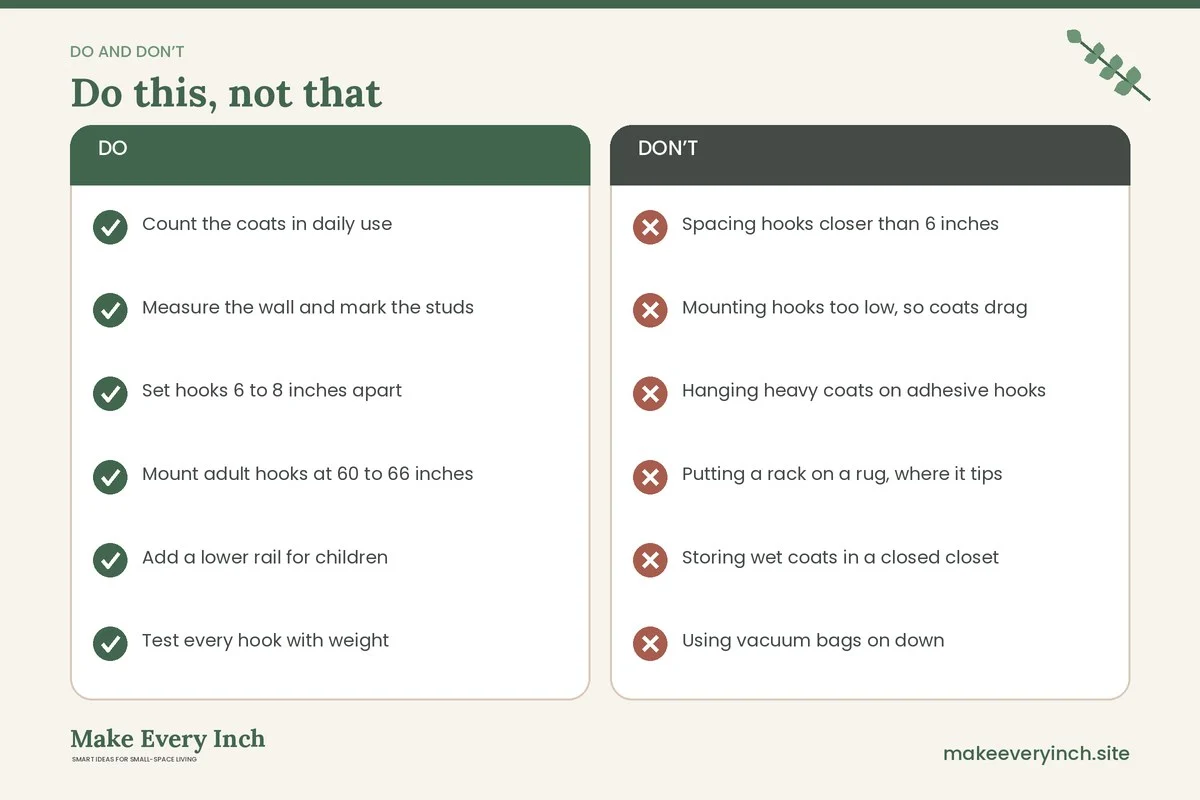
- Spacing hooks closer than 6 inches
- Mounting hooks too low, so coats drag
- Hanging heavy coats on adhesive hooks
- Putting a rack on a rug, where it tips
- Storing wet coats in a closed closet
- Using vacuum bags on down
- Keeping every coat at the door all year
- Forgetting guests
Coat storage checklist
- Count the coats in daily use
- Measure the wall and mark the studs
- Set hooks 6 to 8 inches apart
- Mount adult hooks at 60 to 66 inches
- Add a lower rail for children
- Test every hook with weight
- Add a tray for wet coats
- Reserve hooks for guests
- Store off-season coats elsewhere
- Photograph the wall before and after if you rent
FAQ
How many coat hooks do I need?
Plan one hook for each person’s main coat, plus two for guests and one for a spare. A family of four therefore needs seven hooks, in a rail about 4 feet long at 8 inch spacing.
How high should coat hooks be?
Mount adult hooks at 60 to 66 inches from the floor to the top edge. For young children, mount a separate rail at 40 to 48 inches so they can reach it.
What is the best coat storage when there is no closet?
A hook rail screwed into studs is the best value, and a freestanding rack with a tray is the best option for renters. Add a rolling garment rail for the heavy season.
Can adhesive hooks hold a winter coat?
Most cannot, since a wool coat weighs 4 to 6 pounds and a puffer is bulky. Use adhesive hooks for light jackets and scarves, and screw anything heavy into a stud.
How do I store bulky puffer coats in a small space?
Hang a puffer on a wide hanger in the season, and store it in a loose cotton bag off season. Do not compress it in a vacuum bag, which can damage the insulation.
Where do wet coats go?
Hang them on a hook or a rack with a tray beneath, in open air, until they dry. Do not put a wet coat in a closed closet, where it will smell and may mildew.
How can I store coats for guests in a small apartment?
Keep two or three hooks free by the door, and use a rolling rail or a bed in a spare room for a party. Hang coats on hangers, not on piles.
Is a coat rack or wall hooks better for a small entry?
Wall hooks use less floor and hold more per foot. A rack suits renters and rooms where the wall is not available, and it needs about 18 inches of floor space.
Keep going: Explore our small entryway storage ideas, tiny foyer ideas and small shoe storage ideas.
Save this guide for later
Pin the ideas you like to Pinterest so you can come back to them when you plan your space.