Small Kitchen Appliances Worth the Space
Quick answer: Small kitchen appliances worth the space are the ones you use at least weekly, that replace more than one tool, and that have a home which does not block your prep area. Score each candidate on use frequency, footprint, versatility and storage, keep only the top scorers, and never overload an outlet, run a heat appliance near a wall or cover vents.
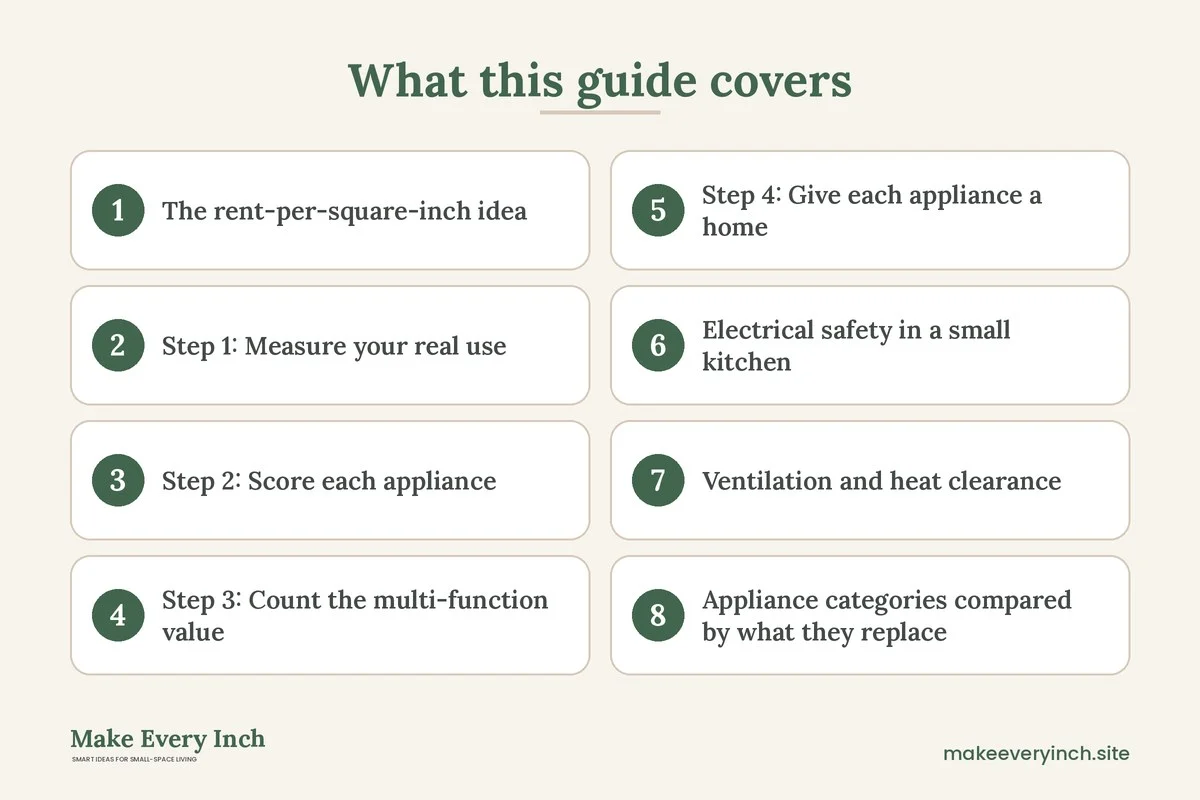
Small kitchen appliances worth the space are rarely the ones that look best on a wish list. In a small kitchen every appliance pays rent in square inches, and the rent comes due every day, whether you use the machine or not. A bread maker used twice a year can take the same cabinet shelf as a kettle used twice a day. This guide gives you a decision framework instead of a shopping list: how to measure your real use, how to score footprint and storage, which kinds of multi-function appliances tend to earn their keep, how to plan where each one lives and how to keep the room safe with electrical and ventilation basics. You will find a scoring table, a category comparison, three example kitchens, a checklist and an FAQ. For the full overview, read our pillar guide to small kitchen ideas, and pair this post with small kitchen storage ideas and small kitchen organization ideas.
The rent-per-square-inch idea
Think of your kitchen as having a fixed budget of space. A typical small kitchen might have only 3 to 6 feet of usable counter, a couple of cabinets and a few drawers. Each appliance spends part of that budget in one of three ways:
- Counter space, which is the most valuable because it is where you prep, plate and cook.
- Cabinet or shelf space, which is cheaper but still limited, and heavy appliances stored high or low can be awkward to lift.
- Outlet and cord space, which is limited in older kitchens and often overlooked.
An appliance that lives on the counter costs the most, so it should be used the most. An appliance in a cabinet costs less, but only if you can reach it without moving three other things. The goal is not to own fewer appliances for the sake of it. The goal is to own the ones that earn their space, and to get rid of those that do not.
Step 1: Measure your real use
Most people overestimate how often they will use a new appliance, and underestimate what they already own. Spend two weeks making a simple tally.
1. List every small appliance you own or are thinking of buying, including those in the back of cabinets.
2. Mark each use on a note stuck inside a cabinet door or on your phone.
3. Count meals, not days. An appliance used for breakfast every day is different from one used for a big batch cook every month.
4. Note what you reached for instead. If you keep using a pan when the specialty machine sits there, the machine is a candidate to go.
At the end, sort items into four groups:
- Daily: used almost every day.
- Weekly: used at least once a week.
- Monthly: used once or twice a month.
- Rarely: used a few times a year or never.
A good starting rule is that anything daily can live on the counter, anything weekly can live in an easy-to-reach cabinet and anything monthly or rarer should be stored out of the way or removed from the kitchen.
Step 2: Score each appliance
Use a simple 1 to 3 score on four questions. Higher is better, and the total tells you where it ranks.
Use frequency
- 3: daily or near daily
- 2: weekly
- 1: monthly or less
Footprint
Measure the width, depth and height. Include the space needed to open a lid or door, and the clearance for heat and steam.
- 3: small and tidy, easily stored
- 2: medium, needs a dedicated spot
- 1: large, bulky or awkward to lift
Versatility
- 3: replaces two or more tools or tasks
- 2: does one job very well and replaces a manual method
- 1: does one job you could do with a pan, pot or knife
Storage ease
- 3: has a permanent, convenient home
- 2: fits in a cabinet but needs shuffling
- 1: has no home, so it migrates across the counter
Add the four scores. An appliance with 10 to 12 points usually earns its space. Eight to nine is a maybe, where one change (a better home, or using it more) could tip it. Seven or below is a candidate to donate, sell or send to storage.
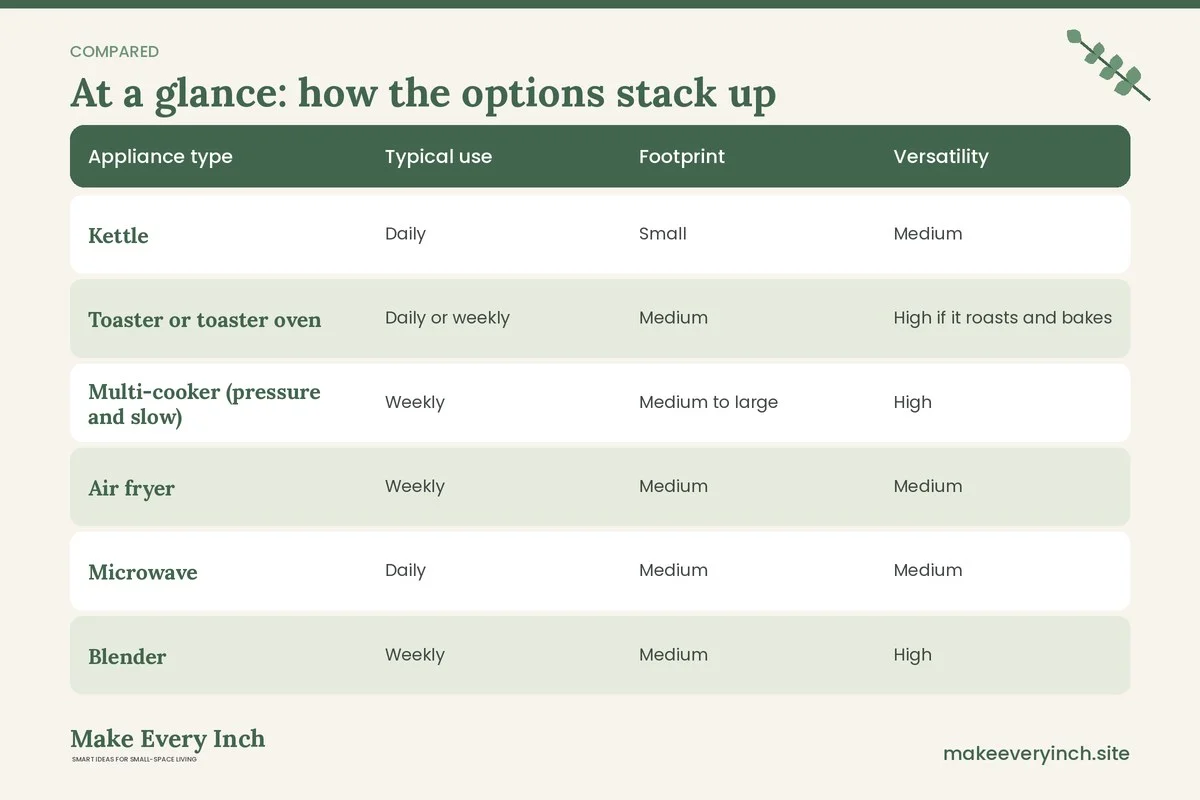
| Appliance type | Typical use | Footprint | Versatility | Storage | Likely verdict |
|---|---|---|---|---|---|
| Kettle | Daily | Small | Medium | Counter or shelf | Keep if you drink hot drinks often |
| Toaster or toaster oven | Daily or weekly | Medium | High if it roasts and bakes | Counter | Keep one, choose by what you cook |
| Multi-cooker (pressure and slow) | Weekly | Medium to large | High | Cabinet or counter | Keep if you batch cook |
| Air fryer | Weekly | Medium | Medium | Cabinet | Keep if it replaces an oven for small meals |
| Microwave | Daily | Medium | Medium | Counter, shelf or built-in | Keep one, consider mounting |
| Blender | Weekly | Medium | High | Cabinet | Keep if you make sauces and drinks |
| Immersion blender | Weekly | Very small | High | Drawer | Often a better fit than a full blender |
| Stand mixer | Monthly | Large and heavy | Medium | Hard to store | Question it unless you bake often |
| Food processor | Monthly | Medium to large | High | Cabinet | Keep if you chop and shred often |
| Coffee maker | Daily | Medium | Low | Counter | Keep one, choose the type you really use |
| Rice cooker | Weekly | Medium | Medium | Cabinet | Keep if you cook grains weekly |
| Bread maker | Rarely | Large | Low | Cabinet | Usually skip |
| Ice cream maker | Rarely | Large | Low | Cabinet | Usually skip |
| Juicer | Rarely | Large | Low | Cabinet | Usually skip |
These verdicts are starting points. A person who bakes every weekend may find a stand mixer essential, and a person who never cooks grains may find a rice cooker redundant. The scoring method exists so that you decide, not the table.
Step 3: Count the multi-function value
Multi-function does not always mean better. A machine that does ten things but does none of them well costs space for nothing. Before you accept a multi-function claim, ask:
- Do I currently do those tasks? Pressure cooking, slow cooking, sautéing and steaming in one pot is useful if you do at least two of them.
- Does it replace something I will remove? The value comes from removing the tools it replaces. If you keep the old slow cooker and add a multi-cooker, you have increased clutter.
- Can it be cleaned easily? Many parts, seals and lids can be a chore. If cleaning is a pain, you will use it less.
- Does it come with accessories? Many attachments need storage. Count the accessories in your footprint.
- Is it one appliance or a base with many parts? A base with a dozen add-ons needs more storage than it seems.
Some combinations tend to be efficient in small kitchens:
- A toaster oven that bakes, broils and air-fries can take the place of a full oven for small meals and a separate toaster.
- A multi-cooker can replace a slow cooker, a rice cooker and a steamer if you use those functions.
- An immersion blender with attachments can replace a full-size blender and a small chopper.
- A kettle with temperature settings can serve tea, coffee and baby feeding needs.
Step 4: Give each appliance a home
An appliance without a home becomes counter clutter. Decide where each one lives before you buy.
The counter tier
Reserve counter space for only the appliances you use daily. A common limit for a small kitchen is two or three. Keep them together in one zone, ideally near an outlet and not in the main prep area. If your counter is already limited, our guide to small kitchen ideas with limited counter space shows how to find space.
The cabinet tier
Weekly appliances should sit at waist to shoulder height, where you can lift them without strain. Heavy items such as multi-cookers should go on a low-to-middle shelf, not above your head. Use a shelf riser to double the space inside a cabinet, and see small kitchen cabinet organization ideas.
The drawer tier
Small items such as an immersion blender, a hand mixer or a milk frother fit in a deep drawer. See small kitchen drawer organization ideas.
The off-kitchen tier
Monthly and rare items can live in a hall closet, under the bed or on a high shelf. Keep a note of where they are. See under-bed storage ideas and small closet organization ideas.
The cart or shelf tier
A rolling cart can act as an appliance station that rolls out when needed and parks when not. See best rolling kitchen carts and small kitchen cart ideas. Make sure a cart is stable and that cords do not stretch across walkways.
The vertical tier
A wall shelf or a mounted rail can hold lightweight items. In a rental, do not drill without written permission. Choose freestanding options instead, such as the ideas in no-drill storage ideas for renters.
Electrical safety in a small kitchen
Kitchen appliances draw a lot of power, and small kitchens tend to cram them near each other. Take these precautions.
- Know your circuit. Heat appliances such as toasters, kettles, toaster ovens, air fryers, multi-cookers and microwaves can draw a lot of current. Check the wattage label on each, and avoid running several high-wattage items on the same circuit at once. If a breaker trips, you are asking too much of that circuit.
- Plug high-wattage appliances directly into a wall outlet. Avoid daisy-chaining power strips or extension cords. If you must use a strip, choose one rated for the load and with a built-in breaker, and do not plug a strip into another strip.
- Keep cords short, tidy and away from heat. Do not let a cord dangle over a hot burner, hang over the edge of a counter where a child can pull it or run under a rug.
- Keep water away. Do not use an appliance with a wet hand or while standing in water. Unplug and dry before cleaning, unless the manual says otherwise.
- Look for GFCI protection. Outlets near sinks should have ground fault protection. If yours do not, ask a qualified electrician to assess, or ask your landlord.
- Check for damage. Frayed cords, scorch marks or warm plugs mean stop using the appliance. Replace it or have it repaired by a qualified person.
- Unplug when not in use, especially appliances that heat, as a habit and to save power.
- Do not modify outlets or wiring yourself unless you are qualified. In a rental, report problems to the landlord.
Ventilation and heat clearance
Cooking appliances produce heat, steam and sometimes smoke. In a small kitchen those build up faster.
- Follow the clearance in the manual. Many heat appliances need several inches of open space on the back, sides and top. Do not push a toaster oven or air fryer flush against a wall or under a low cabinet. Heat can discolor or damage cabinets, and steam can peel laminate.
- Do not cover vents. Never put a towel or a tray over the vents on a microwave, air fryer or toaster oven.
- Use the range hood or a window fan. Turn it on when you cook, particularly with gas appliances, which release combustion products. If you have no hood, open a window and consider a fan.
- Move steam away from cabinets. A rice cooker or a multi-cooker venting steam under an upper cabinet can damage it over time. Pull the appliance out before you use it, or place it where steam goes into open air.
- Keep flammables clear. Paper towels, oven mitts and curtains should not sit near heating surfaces.
- Use smoke and carbon monoxide alarms, and test them regularly, especially if you use gas.
- Never run charcoal or fuel-burning portable appliances indoors.
For wider layout context, see small kitchen layout ideas for better workflow.
Appliance categories compared by what they replace
Sometimes the best way to decide is to ask which job you need done, then choose the single best tool.
| Job to do | Possible tool | What it can replace | Space cost | Consider if |
|---|---|---|---|---|
| Hot drinks | Kettle | A pot on the stove | Low | You make several cups daily |
| Toast and small bakes | Toaster oven | Toaster and a full oven for small items | Medium | You rarely cook for a crowd |
| Batch cooking | Multi-cooker | Slow cooker, rice cooker, steamer | Medium to large | You meal prep weekly |
| Quick reheating | Microwave | Pan reheating | Medium | You reheat often |
| Sauces and soups | Immersion blender | Blender, masher | Very low | You blend in the pot |
| Smoothies | Blender | Hand whisking | Medium | You blend several times a week |
| Baking | Hand mixer | Stand mixer | Low | You bake occasionally |
| Chopping | Knife and board | Food processor | Very low | You chop small amounts |
Three example kitchens
Example 1: the one-person studio
A studio kitchen has 30 inches of counter beside the sink and one outlet. The owner scores appliances and keeps a kettle, a toaster oven that also air fries and a microwave on a shelf above the fridge. A small immersion blender lives in a drawer. The stand mixer and juicer go to a friend with more space. The counter stays clear for prep, and only two appliances sit out. For more on this kind of layout, see tiny kitchen ideas.
Example 2: the couple who meal prep
A couple in a galley kitchen cooks big batches on Sundays. They keep a multi-cooker in a lower cabinet, a coffee maker and a kettle on a small corner of the counter and a blender on a cart that rolls to the end of the galley when needed. The rice cooker, slow cooker and steamer are donated because the multi-cooker does all three jobs. A shelf riser doubles their cabinet space. See galley kitchen ideas.
Example 3: the family in an apartment with no pantry
A family of four has no pantry and few cabinets. They put a rolling cart beside the fridge with the toaster, the air fryer and a coffee maker on top, and tubs of dry goods below. They keep a clear 12-inch zone on the main counter for prep. The less-used food processor lives in a hall closet. For more ideas, read small kitchen ideas with no pantry and small kitchen pantry ideas.
Questions to ask before you buy anything
1. What will I stop doing, or stop owning, if I buy this? If the answer is nothing, pause.
2. Where will it live? Measure the spot and include clearance.
3. How often will I use it, realistically? Use your tally.
4. Does it replace more than one tool? Be honest about what you will remove.
5. Can I lift it? Heavy appliances stored on high shelves are a strain.
6. Does it need a dedicated outlet or a lot of power? Check your circuit.
7. How easy is it to clean? Fewer crevices are better.
8. Can I borrow, rent or share first? Try before you commit, if you can.
9. Is there a no-appliance alternative? A pan, a knife or a manual tool might be enough.
10. What is the warranty and repair plan? A repairable appliance is less wasteful.
The one-in, one-out rule
A small kitchen stays functional when the number of appliances stays fixed. Set a limit, such as one counter appliance per person plus one shared item, and enforce it. When you add something, something else leaves. Donate or sell the old one, or recycle it through an electronics collection point. A gift counts as an addition, so decide in advance what you will do with a duplicate.
Cleaning and care in a small space
Appliances that are easy to clean get used. Wipe the exterior after each use, empty crumb trays often and wash removable parts according to the manual. Grease and steam build up on cabinet fronts, so wipe them regularly. Descale kettles and coffee makers as the manual suggests. Store appliances clean and dry, with cords wrapped loosely, not tight, to avoid damage. Keep the manuals, or a photo of them, in a folder so you can look up clearance and cleaning advice when needed.
Common mistakes
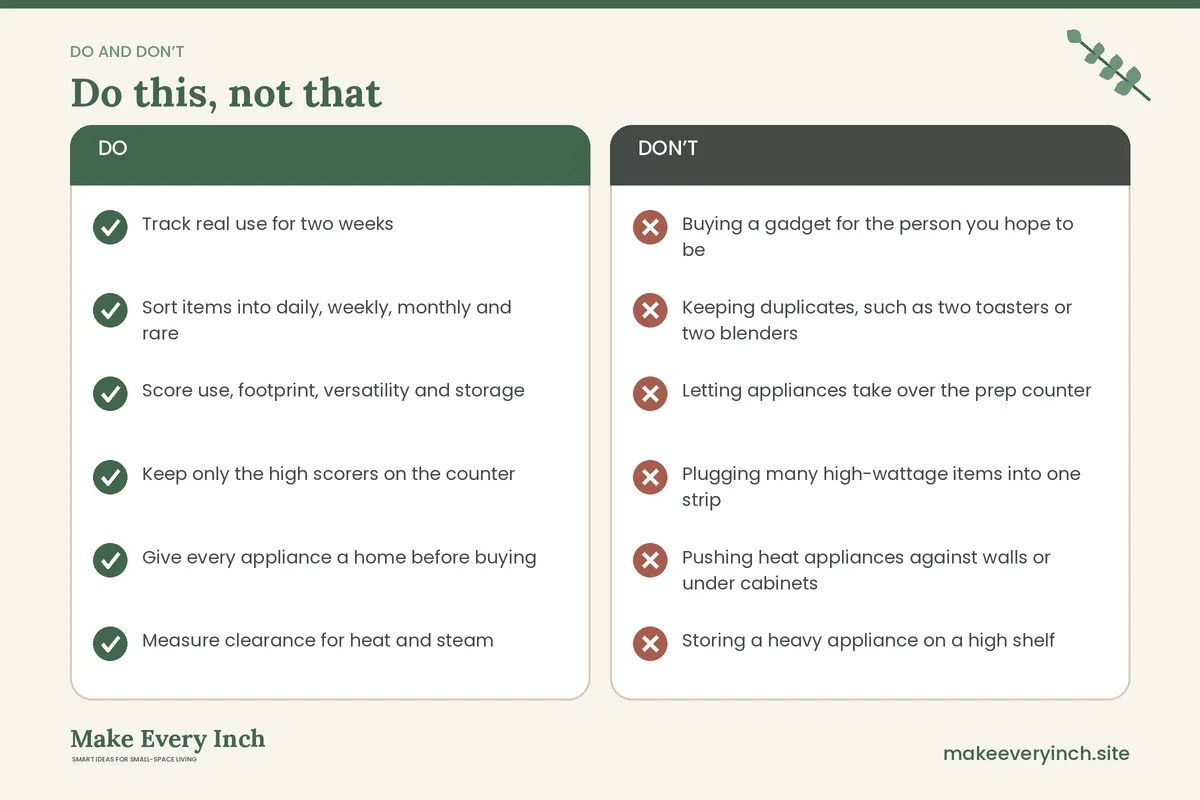
- Buying a gadget for the person you hope to be
- Keeping duplicates, such as two toasters or two blenders
- Letting appliances take over the prep counter
- Plugging many high-wattage items into one strip
- Pushing heat appliances against walls or under cabinets
- Storing a heavy appliance on a high shelf
- Forgetting accessories and attachments when planning storage
- Ignoring the cleaning effort
- Not checking local guidance on appliances in a rental
Appliance decision checklist
- Track real use for two weeks
- Sort items into daily, weekly, monthly and rare
- Score use, footprint, versatility and storage
- Keep only the high scorers on the counter
- Give every appliance a home before buying
- Measure clearance for heat and steam
- Check wattage and avoid overloading a circuit
- Avoid extension cords and daisy chains
- Keep cords away from heat, water and edges
- Run the range hood or open a window when cooking
- Remove duplicates and set a one-in, one-out rule
- Ask your landlord before changing wiring or fixtures
FAQ
Which small kitchen appliances are worth keeping in a tiny kitchen?
Those you use daily or weekly and that replace other tools, such as a kettle, a toaster oven, a multi-cooker or an immersion blender. Your own use decides, so track it for two weeks.
How many appliances should stay on the counter?
Two or three is a common limit in a small kitchen, and only those used daily. Everything else is better stored in a cabinet, drawer or cart.
Is a multi-cooker worth the space?
It can be if you cook batches regularly and it replaces a slow cooker, a rice cooker or a steamer. If you add it without removing anything, it just adds clutter.
Is a stand mixer worth it in a small kitchen?
Only if you bake often. They are heavy and hard to store, and a hand mixer or manual methods often do the job for occasional baking.
Can I use an extension cord for a kitchen appliance?
Avoid it for high-wattage appliances. Plug them into a wall outlet, and if you must use a strip, choose one rated for the load and never daisy-chain.
How much space should I leave around a toaster oven or air fryer?
Follow the manual, since many require several inches on the back, sides and top. Never push these against a wall or under a low cabinet.
Where can I store appliances I rarely use?
In a hall closet, under a bed, on a high shelf or in a labelled bin, or consider lending or selling them. See small space storage furniture for ideas.
What should I do if my breaker trips when I cook?
Stop running so many high-wattage appliances at once, and spread use over time. If it keeps happening, ask a qualified electrician or your landlord to check the circuit.
How do I decide between two similar appliances?
Use the score: pick the one that is used more often, has a smaller footprint, replaces more tools and has a convenient home. Then remove the other.
Keep going: Keep going with our small kitchen ideas pillar, the guide to small kitchen color ideas that feel bright and the small kitchen counter organization post.
Save this guide for later
Pin the ideas you like to Pinterest so you can come back to them when you plan your space.