21 Dark Apartment Ideas: How to Brighten or Embrace a Dim Space
Quick answer: The best dark apartment ideas come in two directions. To brighten, layer three light sources (ambient, task, accent) at about 2700K, add mirrors opposite windows, use sheer curtains, paint or cover surfaces in warm light colors and choose glossy finishes. To embrace the dimness, commit to deep colors, warm low lamps and matte-and-metallic contrast. Either way, check your lease and photograph the walls first.
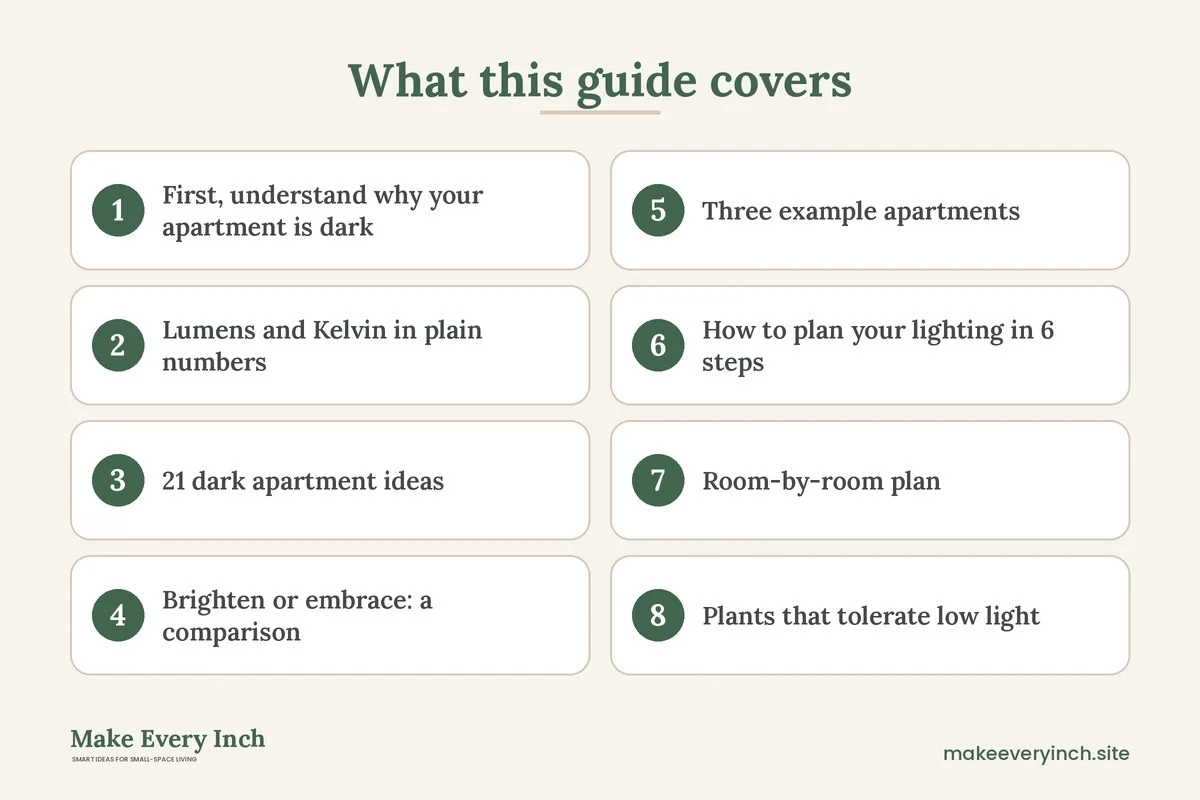
Dark apartment ideas start with an honest question: do you want this room to feel bright, or do you want it to feel intentionally dim? A north-facing studio, a ground-floor unit behind a tree or an apartment with one window on an airshaft will never behave like a sunny corner flat. You can fight that with light and reflection, or you can lean in with deep color and glow. Both approaches work, and both fail when they are half-hearted. This guide covers how to measure your light, how many lumens and what color temperature to use, 21 ideas split between brightening and embracing, a comparison table, three example apartments, a room-by-room plan, plants for low light, a budget guide and a checklist. For a rental-focused lighting list, see our guide to renter friendly lighting ideas for dark apartments.
First, understand why your apartment is dark
Walk through the space at three times: morning, midday and early evening. Note which windows get direct sun, which only get sky light, and which rooms need a lamp on at noon. A south or west window in the northern hemisphere gives the most sun. A north-facing window gives soft, steady, bluish light with no direct beams, which is flattering but weak. Low light also comes from deep window reveals in thick walls, nearby buildings, awnings, balconies above you and dark floors that absorb what does come in.
Then decide what you can change. Window coverings, bulbs, lampshades, mirrors, rugs and textiles are all easy. Paint, flooring and fixtures depend on your lease. Photograph the walls and ceiling before you touch anything, and ask in writing before painting. Most of the ideas below need no permission at all.
Lumens and Kelvin in plain numbers
Lumens measure how much light a bulb puts out, and Kelvin measures its color. A common rule of thumb for living spaces is about 10 to 20 lumens per square foot of floor, so a 150 square foot living room needs roughly 1,500 to 3,000 lumens in total, spread across several lamps. Kitchens and bathrooms are often planned higher, at around 30 to 40 lumens per square foot, because you do tasks there. A dark room tends toward the upper end of every range.
For color, 2700K reads as warm white, similar to an old incandescent bulb. 3000K is a slightly crisper warm white that suits kitchens. 4000K and above looks cool and a little clinical, and it can make a dark room feel flat and gray, so save it for a desk or a bathroom mirror. Look for a color rendering index (CRI) of 90 or higher on the box, since low-CRI bulbs make skin, food and wood look dull. Always match every bulb in a room to the same Kelvin number, or the room will look patchy.
21 dark apartment ideas
Brighten a dim space
1. Layer three kinds of light
Combine ambient light (a ceiling fixture or large lamp), task light (a desk or reading lamp) and accent light (a small lamp or a plug-in sconce on a shelf). A single overhead bulb creates shadows in the corners, which is what makes a room feel cave-like. Three or four lamps at different heights fix that quickly.
2. Put lamps at eye level and below
Ceiling light alone makes a dark room feel heavy. Table and floor lamps lighten the lower half of the room, where the eye rests. Aim for a bulb of about 800 lumens in a main floor lamp and 450 to 600 lumens in side table lamps.
3. Swap to warm, high-CRI LED bulbs
Replace old or dim bulbs with 2700K LEDs rated CRI 90 or higher. A standard 60 watt equivalent is about 800 lumens, so check the lumen figure and ignore the watts. Good bulbs cost about $3 to $8 each and are the cheapest upgrade in this guide.
4. Choose pale, translucent lampshades
A dark or thick shade can swallow half the lamp’s output. White linen, cream paper or pleated cotton shades spread light up and down. Brass or white interiors reflect more than black ones.
5. Hang a large mirror opposite a window
A mirror placed across from a window bounces daylight deep into the room. Lean a floor mirror of about 24 by 60 inches against a wall if you cannot drill. Angle it so it reflects the sky or a light wall rather than a parking lot or a dark corner.
6. Use sheer curtains hung high and wide
Replace heavy drapes with white or off-white sheers hung at least 4 to 6 inches beyond the frame on each side, so the whole glass stays uncovered. Mount the rod near the ceiling to make the window feel taller. Sheers still give daytime privacy on a low floor.
7. Clean and clear every window
Dirty glass, old screens and stacked items on the sill can cut a surprising amount of light. Wash the glass inside and out where you can, and check whether the screen can be removed in winter. Trim shrubs outside only if the building allows it.
8. Choose warm light colors, not stark white
In a north-facing room, cool white paint turns gray. Warm off-whites with a touch of yellow, cream or pale greige look brighter because they reflect light in the same warm tone as the sun. A paint with a light reflectance value (LRV) of 70 or more is a good target, and the number is printed on most paint chips.
9. Use removable wallpaper or paint only if allowed
Peel-and-stick wallpaper in a pale, low-pattern design brightens a wall without paint. Test a hidden corner and keep the lease in mind. See removable wallpaper ideas for choices and removal tips.
10. Go glossy and metallic
Satin and semi-gloss surfaces bounce light, and so do brass, mirrored trays, glass vases and polished lamp bases. A glossy white side table or a lacquered tray adds sparkle without clutter. Keep matte surfaces for the largest areas, so the room does not look like a showroom.
11. Lighten the floor with a rug
A dark floor drinks light. A large pale rug, at least 5 by 8 feet in a living room, turns the floor into a reflector and defines the seating area. Choose a flat weave in cream or sand, and add a rug pad for grip.
Embrace the moody side
12. Paint or cover one wall deep
Deep green, navy, charcoal, aubergine and oxblood all feel richer in low light than white feels. If you are renting, use peel-and-stick wallpaper or large fabric panels on a single wall, and keep the rest pale. Painting a whole room dark in a dim apartment can feel like a cocoon, which is the point, so commit.
13. Use matte walls with metallic accents
Matte dark walls absorb glare and make art and brass pop. Add brass frames, a copper lamp or a gold-framed mirror to give the eye something shiny. This contrast is what stops a dark room from feeling dead.
14. Light low and warm at night
Skip the overhead light in the evening. Use three or four lamps at 2200K to 2700K and 300 to 500 lumens each, plus a dimmer where possible. Smart bulbs or plug-in dimmers (about $10 to $25) let you control mood without rewiring.
15. Use candles safely
Candles are part of the dark-room look, but never leave them unattended or near curtains. Use stable holders, trim wicks to about a quarter inch and keep them away from shelves above. Flameless LED candles with a flicker mode give a similar glow with no risk, which matters in many leases.
16. Add velvet, wool and leather
Dark rooms need texture so they do not look flat. Velvet pillows, a wool throw, a leather chair and a chunky knit rug add depth that light rooms get from daylight. Mix at least three textures within one color family.
17. Make a dark reading nook
A corner with a deep wall color, a comfortable chair, a floor lamp with a warm 2700K bulb and a small side table becomes the best spot in the apartment. Dim corners are ideal for this, since you do not need daylight to read when you have a good lamp.
18. Hang art in dark frames on dark walls
Black or dark wood frames disappear into dark walls and let the art seem to float. Light the art with a plug-in picture light or a small directional lamp. This looks expensive and costs about $25 to $60 per light.
19. Choose dark furniture only if the room is not tiny
A dark sofa in a small room can feel heavy. In a moody room, though, a deep green or charcoal sofa against a matching wall looks seamless, and the room seems bigger because edges blur. Keep legs visible so the furniture does not look like a block.
20. Use dark ceilings with care
A ceiling painted in a dark tone can look cozy, but it lowers the apparent height. Do it only with permission and at least an 8 foot ceiling. A safer renter alternative is a dark fabric canopy or a large plant shelf above eye level.
21. Add low-light plants
Even a dark corner can hold plants that tolerate low light. Good choices are snake plant (Sansevieria), ZZ plant, pothos, cast iron plant and philodendron heartleaf. They survive, but they rarely thrive in true darkness, so rotate them to a brighter spot every few weeks. A small LED grow bulb in a clamp lamp, around $15 to $30, helps them keep growing.
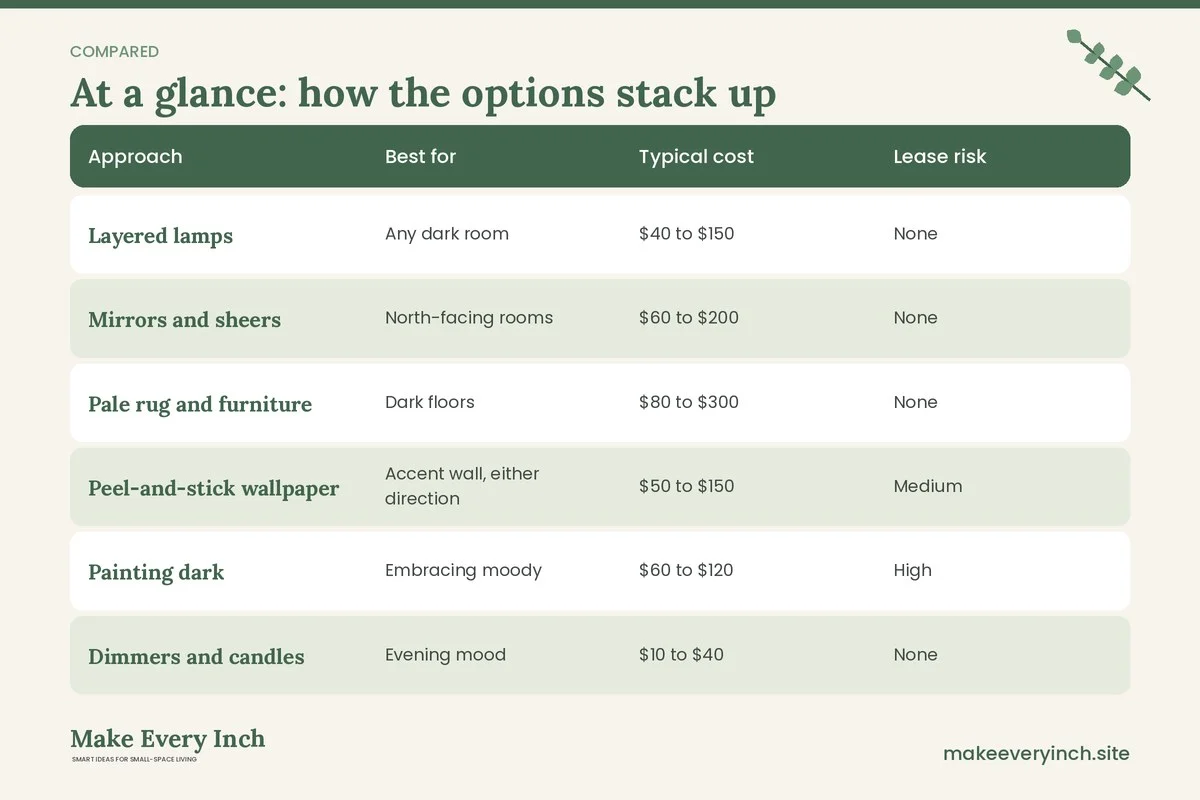
Brighten or embrace: a comparison
| Approach | Best for | Typical cost | Lease risk | Main tool |
|---|---|---|---|---|
| Layered lamps | Any dark room | $40 to $150 | None | Three or four warm bulbs |
| Mirrors and sheers | North-facing rooms | $60 to $200 | None | Mirror opposite window |
| Pale rug and furniture | Dark floors | $80 to $300 | None | Cream flat-weave rug |
| Peel-and-stick wallpaper | Accent wall, either direction | $50 to $150 | Medium | Light or deep pattern |
| Painting dark | Embracing moody | $60 to $120 | High | Matte deep color |
| Dimmers and candles | Evening mood | $10 to $40 | None | Plug-in dimmer, LED candles |
| Low-light plants | Dim corners | $15 to $80 | None | Snake plant, ZZ plant |
Three example apartments
A north-facing studio, brightened
A 400 square foot studio has one north window and a dark wood floor. The renter hangs white sheers high and wide, leans a 24 by 60 inch mirror opposite the window, lays a cream 5 by 8 foot rug and uses four lamps with 2700K bulbs and pale shades. Total spend is about $250, and the room reads as soft and bright even on a gray afternoon.
A one-bedroom, embraced
A ground-floor one-bedroom sees almost no direct sun because of a large tree outside. The tenant leans into it with deep green peel-and-stick wallpaper on the sofa wall, a velvet sofa, brass frames and warm lamps on dimmers. It feels like a lounge in the evening, and the dim daytime light no longer feels like a flaw.
A split approach in a small two-bedroom
The living room faces a courtyard and gets little light, so the owner keeps it pale and mirrored. The bedroom, which is only used at night, gets deep navy bedding, charcoal curtains and soft lamps. Matching the mood to the use of each room is the most dependable strategy when light varies from room to room.
How to plan your lighting in 6 steps
- Step 1: List each room’s current light sources and write the bulb lumens and Kelvin
- Step 2: Calculate the target lumens, using about 10 to 20 per square foot in living areas
- Step 3: Place ambient light first, then add task lights where you read, cook or work
- Step 4: Add accent lights low in corners and on shelves
- Step 5: Match every bulb to one color temperature, usually 2700K
- Step 6: Put dimmers or smart plugs on the lamps you use at night
Test the result at dusk, which is when dark apartments feel their worst. If a corner still looks black, move a lamp closer or add a small plug-in light. For deeper guidance on layering, see small living room lighting ideas.
Room-by-room plan
Living room
Layer a floor lamp behind the sofa, a table lamp on a console and a small accent lamp on a shelf. Hang a mirror opposite the window. If you want a moody look, paint or paper the sofa wall deep and add lamp dimmers. See small apartment living room ideas.
Bedroom
Use two matching bedside lamps with 2200K to 2700K bulbs at about 400 lumens, plus a dimmer. A dark bedroom is a good bedroom, since darkness helps sleep. Blackout lining behind sheers lets you brighten by day and darken by night. See small bedroom lighting ideas.
Kitchen
Add under-cabinet LED strips at 3000K with a plug-in cord, and a pale tray on the counter. Choose a white or light backsplash with a satin finish. See small kitchen lighting ideas.
Bathroom
Use 3000K to 4000K bulbs with CRI 90 or higher at the mirror, since you see skin tone there. A mirror, pale towels and a glossy shower curtain brighten a windowless bath. See small bathroom lighting ideas.
Entry and hallway
A plug-in sconce, a mirror and a pale runner stop a narrow hall from feeling like a tunnel. A small lamp on a console works when there is no ceiling light.
Plants that tolerate low light
Plants prefer light, so match expectations to reality. A north window usually supports snake plant, ZZ plant, pothos and cast iron plant. A room with no window at all will not support any plant for long without a grow light. Use a bulb of about 10 to 15 watts with a full-spectrum rating and run it 8 to 10 hours a day on a timer. Water less in low light, because soil stays wet longer, and let the top inch or two dry before watering. If a plant stretches toward the window, rotate it a quarter turn each week.
Renter-friendly ways to change a dark apartment
Nearly everything above can be done without touching the walls. Use lamps, not new fixtures. Use leaning mirrors, not drilled ones. Replace bulbs in existing fixtures, and keep the old ones in a box for move-out. Use removable wallpaper, fabric panels and adhesive strips only after a test patch. If you want a hardwired fixture replaced, ask in writing. Photograph the rooms before and after, and keep receipts for anything the landlord might ask about. For wider renter guidance, read our renter friendly apartment decorating ideas.
Finishes that help and finishes that hurt
In a dark apartment, finish is as important as color. Glossy and satin paint, lacquered furniture, glass tabletops and polished metal bounce light, while flat dark wood, black matte metal and heavy fabrics absorb it. In a brightening plan, keep matte surfaces on large planes, such as walls, and add gloss in small doses. In a moody plan, flip it: let walls be matte so they glow softly, and add gloss in a few accents so the room has highlights. Avoid mixing many mid-tone finishes, which looks muddy in low light.
Furniture choices for low-light rooms
Choose furniture with open legs, so light passes under it and the floor stays visible. Pick lighter upholstery near a window and darker upholstery away from it. In a moody room, a tufted velvet sofa or a leather chair has a rich look that low light flatters. In a brighter plan, a white or oatmeal sofa, a glass coffee table and a pale wood bookshelf keep the room airy. Keep tall dark bookcases away from the one window, because they block what little light you have. See small living room furniture ideas for sizes that fit.
Budget guide
Under $75
Four warm LED bulbs with CRI 90 or higher, two pale lampshades and a plug-in dimmer. This is the best first step for any dark apartment.
About $200
Add a leaning floor mirror, white sheer curtains and a rod, and a small lamp for a dark corner.
$450 and up
Add a large pale flat-weave rug, a velvet or linen sofa in your chosen tone, peel-and-stick wallpaper for one wall and plug-in picture lights.
Mistakes to avoid
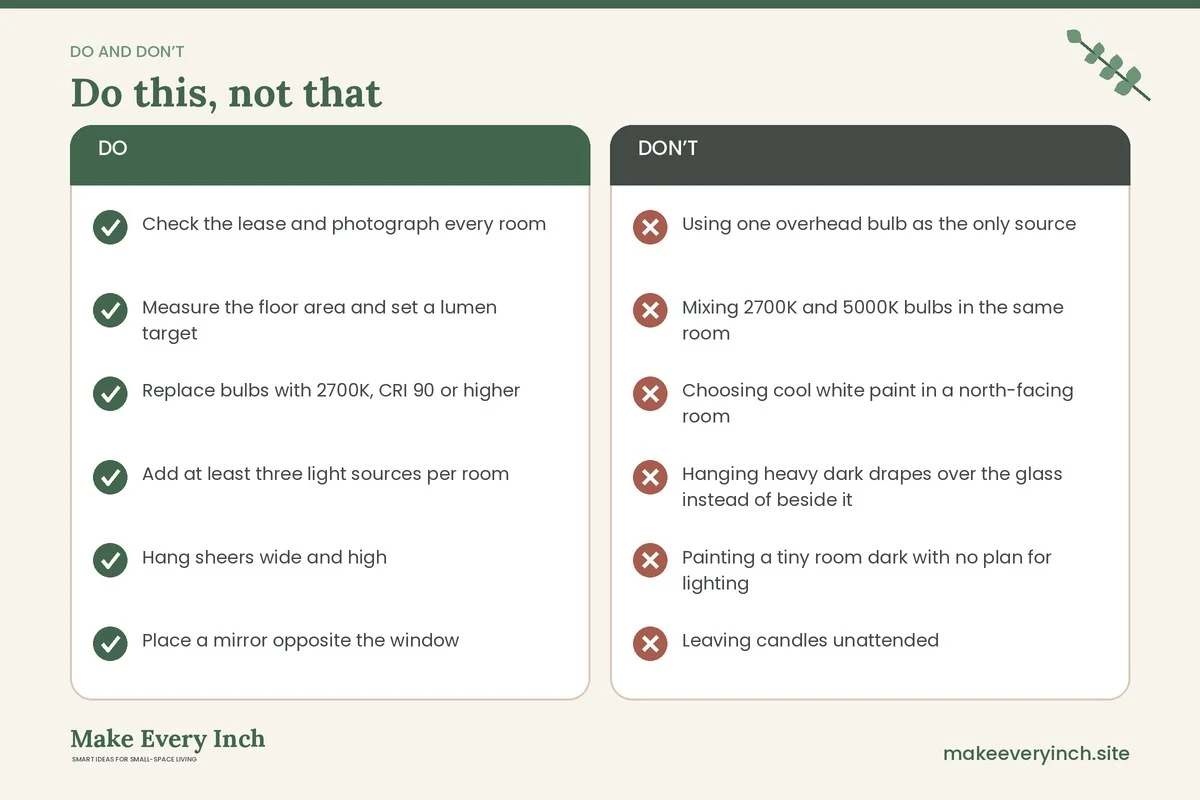
- Using one overhead bulb as the only source
- Mixing 2700K and 5000K bulbs in the same room
- Choosing cool white paint in a north-facing room
- Hanging heavy dark drapes over the glass instead of beside it
- Painting a tiny room dark with no plan for lighting
- Leaving candles unattended
- Ignoring the lease before painting or drilling
- Buying plants that need bright sun
Dark apartment checklist
- Check the lease and photograph every room
- Measure the floor area and set a lumen target
- Replace bulbs with 2700K, CRI 90 or higher
- Add at least three light sources per room
- Hang sheers wide and high
- Place a mirror opposite the window
- Choose one direction, brighten or embrace
- Add textures in dark rooms
- Choose low-light plants
- Test the room at dusk
FAQ
How do I make a dark apartment brighter?
Layer three or more lamps at 2700K, add a mirror opposite the window, hang sheer curtains wide and high and use pale, glossy surfaces. Light-colored rugs also help.
What color temperature is best for a dark apartment?
Use 2700K for living areas and bedrooms, and 3000K in kitchens. Avoid mixing temperatures in the same room.
How many lumens do I need in a dark room?
A rough target is 10 to 20 lumens per square foot of floor, so a 150 square foot room needs about 1,500 to 3,000 lumens. Dark rooms often need the higher number.
Should I paint a dark apartment white?
Not always. In a north-facing room, a warm off-white with an LRV of 70 or more usually looks better than stark white, which can turn gray. If you like moody color, a deep shade is also a valid choice.
Can I use dark colors in a small, dark apartment?
Yes, if you commit and light it well. Use one color across walls and furniture, add metallic accents and use warm lamps on dimmers.
What can I do if I rent and cannot paint?
Use peel-and-stick wallpaper after testing, fabric panels, leaning mirrors, lamps, rugs and sheer curtains. All are removable.
Which plants survive in a dark apartment?
Snake plant, ZZ plant, pothos and cast iron plant tolerate low light. In true darkness, add a grow bulb on a timer.
Do mirrors really help dark rooms?
They help when they reflect a window or a light surface. A mirror facing a blank dark wall adds very little.
Keep going: Keep going with renter friendly lighting ideas for dark apartments, small bedroom lighting ideas and small apartment makeover on a budget.
Save this guide for later
Pin the ideas you like to Pinterest so you can come back to them when you plan your space.