21 Renter Friendly Lighting Ideas for Dark Apartments
Quick answer: The best renter friendly lighting ideas add light at three heights without touching the wiring: plug-in wall sconces, floor and table lamps, and warm, high-quality bulbs. Aim for 2700K to 3000K bulbs with a CRI of 90 or more, layer at least three sources per room, hide cords with paintable covers, and keep the original fixtures so you can restore them at move-out.
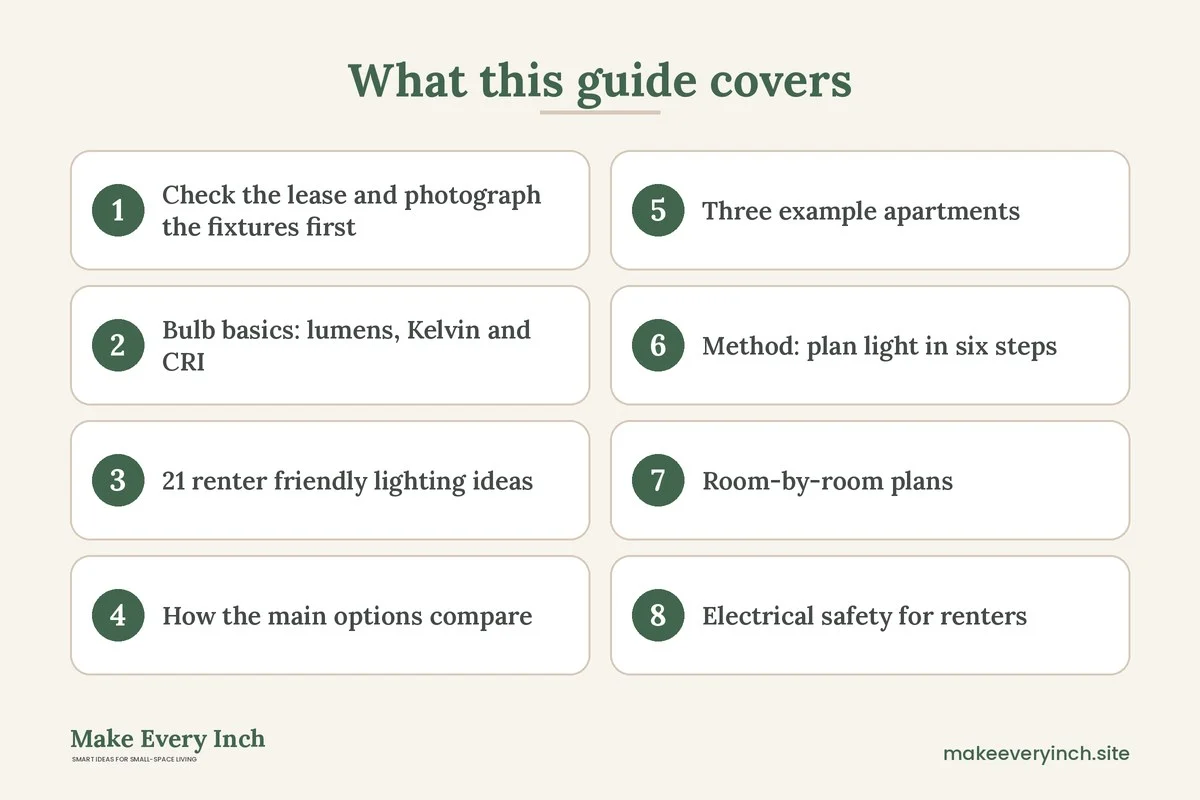
Renter friendly lighting ideas matter most in the apartments that need them most: a single dim ceiling fixture, a north-facing window, beige walls and no permission to rewire anything. The usual landlord fixture is a flat, one-bulb light that makes a room look flat and tired, and a dark apartment can feel smaller than it is. The fix is rarely one big purchase. It is a set of small, removable layers that bring light down to eye level, bounce it off walls and ceilings, and warm it up. This guide covers the lease check, bulb basics, 21 ideas, a comparison table, three example apartments, a step-by-step method, room-by-room plans, a budget guide, mistakes to avoid, an electrical safety section and a checklist. For the wider approach to making a rental feel like yours, see our hub guide on renter-friendly apartment decorating ideas.
Check the lease and photograph the fixtures first
Before you buy anything, read the lease for clauses about alterations, adhesives, drilling and electrical work. Most leases allow you to change a light bulb, plug in a lamp and use removable adhesive, but ban anything that involves hardwiring, new holes or changes to the fixtures the landlord installed. If a clause is vague, ask in writing and keep the reply.
Photograph every ceiling fixture, switch plate and outlet before you change anything, and take another set when you move out. If you swap a fixture with written permission, store the original in a labeled box with its screws and shade, so you can put it back. Landlords care about the electrical system for good reasons, so treat the wiring as off limits unless you have written approval and a licensed electrician.
Bulb basics: lumens, Kelvin and CRI
Most dark apartments are not short of fixtures. They are short of the right light. Three numbers on the bulb box do most of the work.
Lumens measure brightness
Wattage tells you how much power a bulb uses, and lumens tell you how much light it makes. As a rough guide, a bulb of about 450 lumens replaces an old 40 watt bulb, 800 lumens replaces 60 watts, 1,100 lumens replaces 75 watts and 1,600 lumens replaces 100 watts. A common planning guideline is 10 to 20 lumens per square foot in living areas and more in kitchens and work areas, so a 150 square foot living room needs roughly 1,500 to 3,000 lumens spread over several sources.
Kelvin measures color temperature
Kelvin (K) describes how warm or cool the light looks. 2700K is a warm, golden white that suits living rooms and bedrooms. 3000K is a soft white that works in kitchens and bathrooms. 4000K is a neutral white, and 5000K and above looks bluish and clinical. In a dark apartment, many people reach for cool bulbs because they seem brighter, then find the room feels like an office. Stay between 2700K and 3000K for most rooms, and keep any cooler bulbs for a desk or a closet.
CRI measures color accuracy
The color rendering index (CRI) runs from 0 to 100 and shows how true colors look under the bulb. Look for 90 or higher. A high CRI makes wood, skin tones, food and paint look richer, which helps a plain rental look better without any decor.
Check the socket label
Every lamp and fixture has a maximum wattage on its label. Never exceed it, even if the LED bulb you are using draws far less power, because the rating exists for heat. Also check whether the bulb is rated for an enclosed fixture, since LEDs fail early in a closed glass dome if they are not made for it.
21 renter friendly lighting ideas
Wall and ceiling light without wiring
1. Plug-in wall sconces
A plug-in sconce hangs on a single screw or a heavy-duty removable hook and plugs into the nearest outlet, which gives you wall-mounted light at eye level. Look for a sconce with an on and off switch on the fixture or an inline switch on the cord, and check the product’s weight rating against the mounting method. If the lease bans holes, a sconce that mounts on a rated adhesive plate may be an option, and the product listing should state the weight it holds.
2. Paintable cord covers
A cord cover is a slim raceway that sticks to the wall and hides the cable from a sconce or a lamp down to the outlet. Choose a paintable one, paint it the wall color before you stick it on, and use the manufacturer’s adhesive on a clean, dry wall. A 5 to 8 foot kit often costs about $10 to $20. When you move out, warm the cover with a hair dryer and peel slowly.
3. Swag lights with a ceiling hook
A plug-in pendant on a cord, hung from a hook and draped to the outlet, adds a ceiling-level light over a dining table or a reading chair. The hook is the catch, because it usually needs a screw into the ceiling. Ask permission, since a single small hole is the kind of thing many landlords allow, and fill it at move-out. If a hole is not allowed, choose a floor lamp with an arc.
4. Swap the shade or the bulb in the existing fixture
Replacing a bulb is almost always allowed. Install a warm, high-CRI LED in the fixture the landlord gave you, and make sure it matches the socket type and the enclosed-fixture rating. Where the lease permits, add a fabric or paper shade over a bare bulb, as long as it does not touch the bulb or sit against hot parts of the fixture.
5. Flush-mount covers
Some leases allow you to clip a decorative diffuser or a clip-on shade over an existing dome. These are removable and need no tools. Avoid anything that traps heat around a bulb, and keep the original cover stored.
6. A plug-in ceiling light alternative
If the room has no overhead light at all, a torchiere floor lamp that bounces light off the ceiling is the closest substitute. Look for a dimmable one that takes an LED bulb of 800 to 1,600 lumens, and place it in a corner so the ceiling and the wall both reflect the light.
Lamps that do the heavy lifting
7. A floor lamp in the darkest corner
Dark corners make a room feel smaller. A floor lamp with an upward-facing shade lifts the ceiling visually and spreads light across two walls. An arc lamp reaches over a sofa without a ceiling hook, and a slim tripod suits a tight corner.
8. Table lamps at different heights
Two lamps on a console or a dresser look balanced, and a third on a side table makes light feel layered. Keep the bottom of the shade at about eye level when seated so you do not stare into the bulb. Choose shades in a light, translucent fabric, since dark shades absorb much of the light.
9. A clip-on or clamp lamp
A clamp lamp attaches to a bookshelf, a headboard or a desk edge, with no holes. It is the cheapest way to add task light in a bedroom or a work corner, and it takes up no floor space. Check that the clamp pads protect the furniture surface.
10. A picture light that plugs in
A battery or plug-in picture light over art or a mirror gives you a glow on the wall. Battery models avoid cords, and plug-in ones stay brighter. Mount with a removable adhesive that is rated for the weight.
11. Under-cabinet task lighting
Plug-in or battery under-cabinet bars, often 12 to 24 inches long, brighten the countertop where you chop and cook. Stick them under the cabinet with the supplied adhesive or a removable mounting tape, and hide the cable with a cord cover. See our guide to small kitchen lighting ideas for more.
12. A mirror opposite the window
This is not a light, but it multiplies one. A large mirror placed to catch window light reflects it across the room. Lean a floor mirror rather than hanging it if the lease restricts holes.
Smart and decorative light
13. Smart bulbs
A smart bulb lets you dim and change color temperature from a phone or a voice assistant. This is useful in a rental, because one bulb can serve as warm 2700K light in the evening and brighter, cooler light for cleaning. Check which hub, app or standard it needs, and keep the wall switch on, since turning it off cuts the bulb’s connection.
14. Smart plugs for lamps
A smart plug turns any lamp into a scheduled one. Set living room lamps to come on at sunset, so you arrive home to a lit apartment. Check the plug’s amperage rating against the lamp, and use it only with lamps and not with heaters or other high-wattage appliances unless it is rated for them.
15. LED strip lights behind furniture
A strip on the back of a TV unit, a headboard or under a shelf gives indirect light, which is easy on the eyes. Use a strip with a dimmable controller, and choose warm white if you want a calm glow. Test the adhesive on a hidden spot, because strong adhesive can lift paint. See the safety section below for heat and power limits.
16. LED strips inside shelves and cabinets
Strips mounted inside a bookshelf or a glass cabinet highlight objects, and light up a dark corner at a low cost. Stick them to the shelf, not to the wall.
17. String lights as a soft glow
String lights draped along a bookshelf, a curtain rod or a tension rod bring in a warm background light for evenings. They are decor more than task light, so combine them with lamps.
18. A rechargeable lamp for flexible spots
Battery lamps with a rechargeable base can sit on a windowsill, a bathroom shelf or an entryway table with no cord. Look for a warm setting and a dimmer, and charge it on a schedule.
Layout and the light itself
19. Layer light at three heights
Use ceiling or high light for general fill, mid-height light from lamps and sconces for tasks and mood, and low light from floor strips or small lamps for atmosphere. A room with only one source looks flat, and a room with three looks deeper and larger.
20. Use light-colored surfaces
Pale walls, a light rug, white curtains and glossy or mirrored surfaces bounce more light than dark, matte ones. Sheer curtains on the window let in daylight and give privacy. Keep heavy drapes for the evening only.
21. Clean and clear the window
Remove blinds from the top half of the window if the lease allows, wash the glass and move furniture that blocks it. Free daylight is the best fix for a dark apartment, and it costs nothing. Keep the original blinds stored and rehang them at move-out.
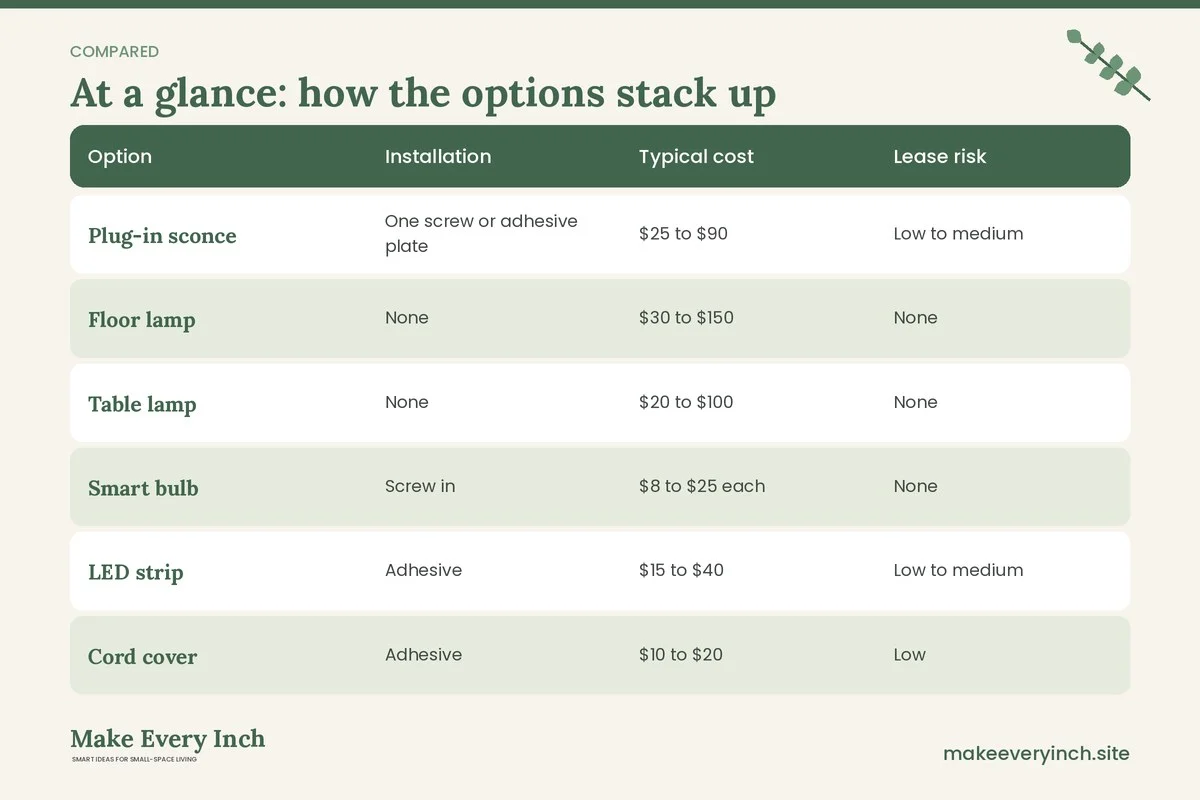
How the main options compare
| Option | Installation | Typical cost | Lease risk | Best for |
|---|---|---|---|---|
| Plug-in sconce | One screw or adhesive plate | $25 to $90 | Low to medium | Bedrooms and living rooms |
| Floor lamp | None | $30 to $150 | None | Dark corners |
| Table lamp | None | $20 to $100 | None | Side tables and consoles |
| Smart bulb | Screw in | $8 to $25 each | None | Flexible mood and schedule |
| LED strip | Adhesive | $15 to $40 | Low to medium | Indirect glow |
| Cord cover | Adhesive | $10 to $20 | Low | Hiding sconce cords |
| Swag pendant | Ceiling hook | $30 to $100 | Medium | Dining corners |
| Clamp lamp | Clamp | $15 to $40 | None | Desks and headboards |
Prices are typical ranges and vary by retailer and brand.
Three example apartments
The north-facing studio
A 400 square foot studio with one window and one ceiling fixture feels dim all day. Replace the ceiling bulb with a warm, high-CRI LED, place an arc floor lamp beside the sofa and add a table lamp on the nightstand. Hang a large mirror on the wall that faces the window by leaning it on a dresser. Add a smart plug to the floor lamp so it turns on at sunset. The room now has light at three heights and no wiring changes.
The one-bedroom with a builder-grade fixture
A one-bedroom has a flat, dome-shaped ceiling light that casts harsh shadows. Leave the fixture, but fit a 2700K bulb of about 800 lumens, and use a dimmer-compatible LED only if the wall switch is a dimmer. Add two plug-in sconces on either side of the bed with paintable cord covers, and a lamp on the dresser. At move-out, remove the covers with a hair dryer and fill the screw holes if the lease allows.
The dark galley kitchen
A narrow kitchen has one center light and shadowed counters. Add two or three under-cabinet bars on the underside of the upper cabinets, with cords tucked in a cord cover along the backsplash edge. Swap the ceiling bulb for 3000K. Keep the lights on a smart plug so one tap turns on all of them. The counters become bright enough for chopping, and there is nothing to repair afterward.
Method: plan light in six steps
Step 1. Map the room
Draw the room and mark the windows, outlets, switches and the existing fixture. Note which outlets are controlled by a wall switch, since a switched outlet lets you turn a lamp on from the door.
Step 2. Set the base level
Replace the bulb in the existing fixture with a warm, high-CRI LED of the right brightness. This single change often improves the room more than any lamp.
Step 3. Add task light
Put light where you read, cook, work and apply makeup. Use a clamp lamp, an under-cabinet bar or a table lamp, and position it beside the work, not behind you, to avoid shadows.
Step 4. Add ambient and accent light
Add a floor lamp in the darkest corner, then a sconce or a strip for glow. Use warm bulbs, and dimmable ones where you can.
Step 5. Hide the cords
Run cords along baseboards and furniture legs, and use cord covers or clips. Never run a cord under a rug or through a doorway where it can be stepped on.
Step 6. Test and adjust
Sit where you spend time in the evening and look for glare, shadows and dark patches. Move lamps a few inches, change a bulb and add a dimmer or a smart plug. Photograph the room when you are done.
Room-by-room plans
Living room
Use a floor lamp in the darkest corner, a table lamp by the sofa and a picture light or strip behind the TV. Keep one overhead source on a dimmer or a smart bulb. See small living room lighting ideas for more layouts.
Bedroom
Use matching table lamps or plug-in sconces on each side of the bed, with warm 2700K bulbs of 450 to 800 lumens. Add a low-glow strip behind the headboard. See small bedroom lighting ideas.
Kitchen
Use under-cabinet bars for tasks and a 3000K bulb overhead. Keep cords short and away from the stove and sink.
Bathroom
Replace the bulbs above the mirror with high-CRI, damp-rated ones where the lease allows, and add a battery sconce or a lamp on a dry shelf. Keep all plugged-in lights away from water. See small bathroom lighting ideas and our guide to renter-friendly bathroom upgrades.
Entry
Place a table lamp or a rechargeable lamp on a console, and add a mirror to bounce light. See small entryway ideas and no entryway apartment ideas.
Electrical safety for renters
Lighting is one of the few areas of home decor where a mistake can cause a fire, so take it seriously.
- Do not rewire fixtures, replace switches or open junction boxes without written permission and a licensed electrician.
- Buy products with a recognized safety listing mark, such as UL or ETL, and check the product’s rating.
- Never exceed the maximum bulb wattage on a lamp’s label.
- Do not daisy-chain extension cords or power strips, and use a surge-protected power strip with an on and off switch.
- Do not run cords under rugs, over nails or through door frames.
- Keep LED strip power supplies ventilated and not covered by fabric or boxes.
- Keep plug-in lights away from sinks, showers and tubs, unless rated for damp locations.
- Use smart plugs only within their amperage rating.
- Test any socket adapter or outlet-style device against the lease, since some landlords forbid them.
- Replace frayed cords, and stop using any lamp that flickers, buzzes or smells hot.
Budget guide
Under $60
Four warm, high-CRI LED bulbs, a clamp lamp and a roll of paintable cord cover. This alone transforms most dark rentals.
About $200
A floor lamp, two table lamps, a pair of plug-in sconces and a few smart plugs.
$450 and up
A full layered setup, with smart bulbs, a mirror, under-cabinet bars, an arc floor lamp and quality shades.
Mistakes to avoid
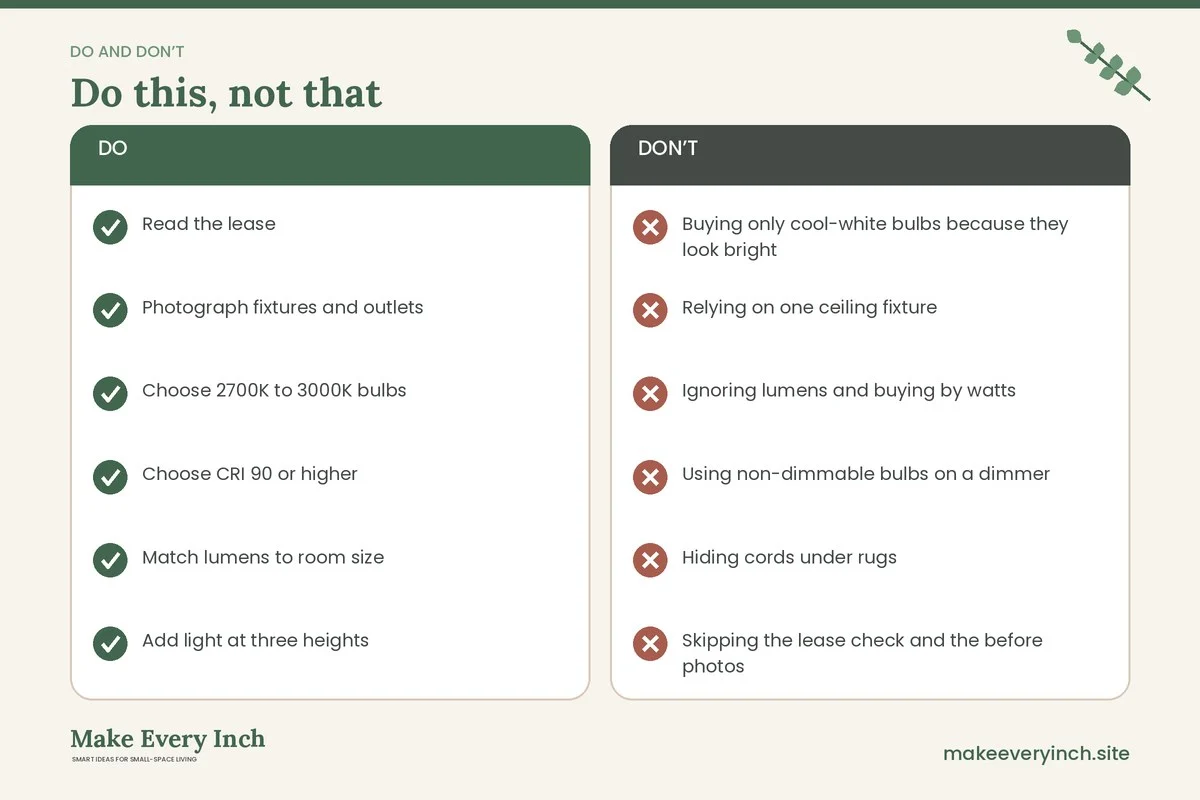
- Buying only cool-white bulbs because they look bright
- Relying on one ceiling fixture
- Ignoring lumens and buying by watts
- Using non-dimmable bulbs on a dimmer
- Hiding cords under rugs
- Skipping the lease check and the before photos
- Putting LED strips on fresh paint without a test
- Picking dark lampshades that absorb light
Renter lighting checklist
- Read the lease
- Photograph fixtures and outlets
- Choose 2700K to 3000K bulbs
- Choose CRI 90 or higher
- Match lumens to room size
- Add light at three heights
- Use plug-in sconces or lamps
- Hide cords with paintable covers
- Check safety marks and wattage limits
- Store original fixtures and shades
- Photograph at move-out
FAQ
What is the best lighting for a dark apartment?
Use layers: a warm, high-CRI bulb in the ceiling fixture, a floor lamp in the darkest corner and a table lamp or sconce at eye level. A mirror opposite a window helps too.
Can I install wall sconces in a rental?
You can use plug-in sconces. Some need a screw or hook, so check the lease, and ask first if you are unsure.
What Kelvin and CRI should I choose?
Choose 2700K to 3000K for most rooms and CRI 90 or more for accurate color.
How many lumens do I need?
A common guideline is 10 to 20 lumens per square foot in living spaces and more in kitchens. Spread them over several sources.
Are LED strips safe for rental walls?
They can be, if you test the adhesive in a hidden spot and remove it slowly with heat. Strong adhesive can lift paint, especially on fresh or flat paint.
Can I change the light fixtures in my apartment?
Not without written permission. Changing bulbs is fine, and a licensed electrician should do any fixture swap.
Do smart bulbs work with a regular switch?
They do, but only while the switch stays on. If someone flips it off, the bulb loses power and its smart features.
How do I hide lamp cords on a wall?
Use a paintable cord cover in the wall color, and route the cord down to the outlet in a straight line.
Keep going: Explore our small living room lighting ideas, security deposit safe apartment upgrades and renter-friendly wall decor ideas.
Save this guide for later
Pin the ideas you like to Pinterest so you can come back to them when you plan your space.