15 Small Home Design Ideas with Natural Light for Every Room
Quick answer: Good small home design natural light thinking treats daylight as something that travels through the whole home, not just a window problem in one room. Map where light enters, keep the path from window to far wall open, use light finishes and mirrors to push it deeper, and put the rooms you use most by the best windows. Never block escape windows, and ask permission before changing glass, doors or paint.
Small home design natural light planning starts with a change of mindset: daylight is not a feature of one room, it is a resource that moves through your home, and every wall, door and piece of furniture either helps it travel or stops it. In a small home, a single window may serve three spaces at once, so the way you arrange everything between that window and the back of the home matters more than the window itself. This guide shows how to map the light you have, how to read orientation and time of day, and how to carry daylight from room to room using layout, finishes, mirrors and openings. It includes a light-path method, an orientation table, fifteen ideas, three example homes, safety notes, mistakes and a checklist. For the wider picture, start with our pillar on small home ideas. If your rooms stay dim, our guides to dark apartment ideas and small room paint ideas for low light go deeper on single spaces.
Map the light you already have
Before changing anything, learn how daylight actually behaves in your home. Light changes through the day and the year, and a plan that ignores this will disappoint you.
Pick a clear day and visit each main space at three times: mid-morning, early afternoon and late afternoon. At each visit, note where the sun lands, how far the bright patch reaches into the room and which spaces stay in shade. A simple sketch of the floor plan with arrows from each window works well. Mark the spots where you read, cook, work or sit, and mark the darkest corners.
Then look for the blockers. These are the objects and surfaces between a window and the space behind it. Tall furniture facing a window, solid doors left closed, dark walls on the lit side and heavy curtains all absorb or block light. Mark each blocker on your sketch. Most small homes have three to six blockers that can be moved or changed without any construction.
Finally, check your windows for obstructions outside, such as trees, neighboring walls or balcony railings. You usually cannot change these, but knowing about them helps you decide where light is worth chasing and where you should plan for lamps instead.
Read your orientation
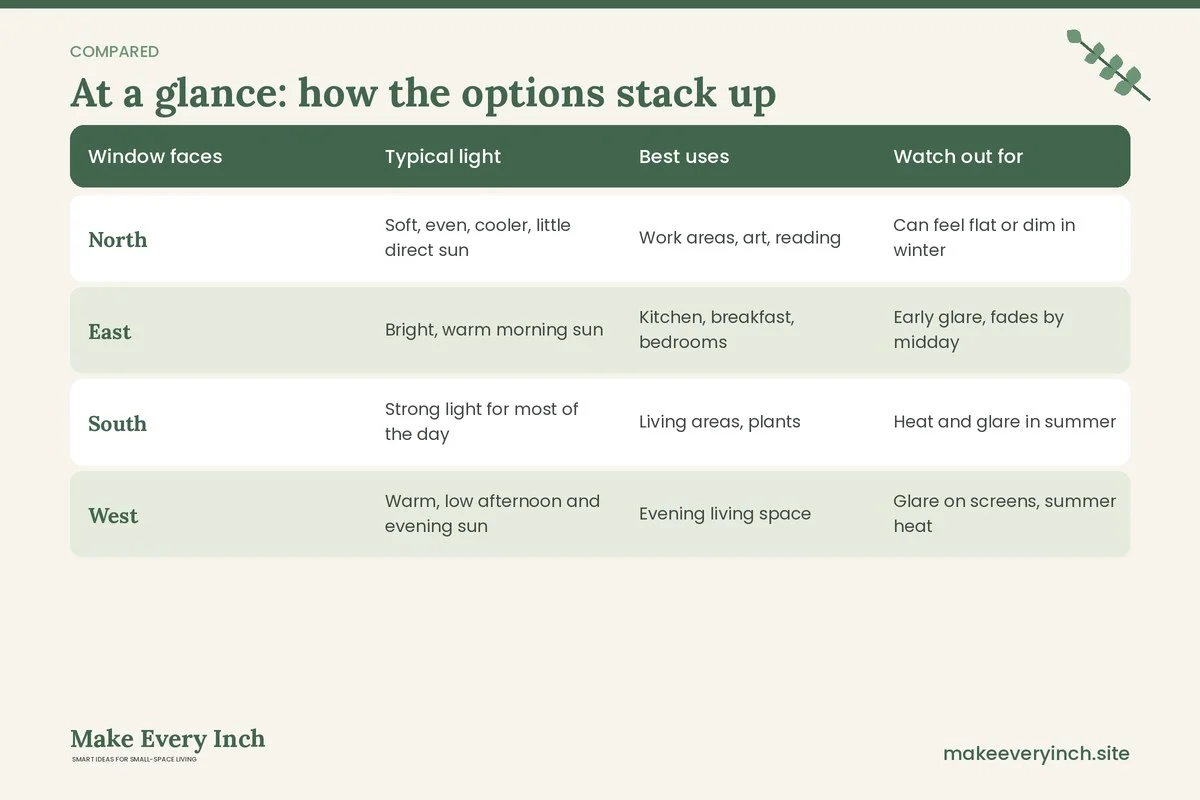
Which way a window faces changes the quality of light. The patterns below describe the northern hemisphere and reverse in the southern hemisphere. They are general tendencies, since latitude, climate and surrounding buildings all shift the result.
| Window faces | Typical light | Best uses | Watch out for | |
|---|---|---|---|---|
| North | Soft, even, cooler, little direct sun | Work areas, art, reading | Can feel flat or dim in winter | |
| East | Bright, warm morning sun | Kitchen, breakfast, bedrooms | Early glare, fades by midday | |
| South | Strong light for most of the day | Living areas, plants | Heat and glare in summer | |
| West | Warm, low afternoon and evening sun | Evening living space | Glare on screens, summer heat |
Use this table to decide where each activity belongs. A desk that gets harsh western glare at three in the afternoon might move to a north window, and a bedroom with a bright east window may suit people who like to wake early. If you cannot move rooms, you can still move the sofa, the desk or the table to the place that fits.
The light-path method
Think of each window as a source and draw the path the light would take if nothing were in the way. In a small home, the most useful paths are these.
- Window to far wall. Light reaches deepest when it can travel along the floor and bounce off a pale wall at the far end.
- Window to doorway to next room. A door left open, or a door with glass, lets light flow into a hallway or a second room.
- Window to ceiling. Light bouncing off a pale ceiling softens the whole room.
For each path, ask what stops it and whether you can change that. Often the answer is a piece of furniture placed squarely in the beam, a dark rug that swallows the light on the floor or a solid door that could stay open.
15 ways to bring daylight through a small home
Group one: keep the path open
1. Turn furniture to let light through
Place low furniture in front of windows and put tall pieces perpendicular to the wall, so the light can pass along their sides. A bookcase turned sideways to a window blocks far less than one facing it. Keep a clear gap, around 6 to 12 inches, between big pieces and the glass if you can. Never block a window that is your escape route, and keep radiators and vents clear.
2. Open interior doors, or change what they are
A closed door in a small home cuts a room off from daylight. Leave doors open when privacy allows, and consider removing a door from a closet or alcove you do not need to close, with the landlord’s permission if you rent. Replacing a solid door with a glazed one is a bigger job, so use a professional and check the rules for fire doors and bathroom privacy.
3. Rethink wall height and partitions
A tall partition or a wall of closed shelving can cast a long shadow across a room. Lower it, open it or replace a solid divider with a slatted, open-backed or glass-like alternative. Do not remove or alter any wall without a qualified professional and the required permits, since it may be load-bearing or may contain wiring and pipes. For lighter division ideas, see studio apartment ideas with a room divider.
4. Keep the sightline to the window clear
When you stand at the entrance, the best view is a window or bright wall at the far end. Keep that line free of tall objects and clutter. A visible patch of daylight at the end of the line makes the whole home feel brighter and longer.
Group two: finishes that carry light
5. Choose light, low-sheen walls
Pale walls with a soft or matte finish reflect light without glare, while glossy finishes can create hot spots. If you paint, get permission first, choose low-VOC paint and ventilate while you work and while it dries. Keep children and pets away until the odor has gone. Sample a color on the wall and look at it in the morning and evening before committing. See colors that make small rooms look bigger.
6. Lighten the floor
A dark floor absorbs a large share of the light that enters a room. If you cannot change the floor itself, use a light rug that matches or sits close to the floor tone. A large rug in a pale tone bounces light upward and joins separate spaces. For sizing, see how to choose rug size for a small living room.
7. Paint the ceiling light
The ceiling is the largest surface that reflects light down. A white or very pale ceiling helps daylight spread, and a slightly lighter shade than the walls adds height. A dark ceiling can work in a bold room but will absorb light in a home with little to spare. Our guide to small room ceiling ideas that draw the eye up shows options.
8. Use matching tones across rooms
When adjacent rooms share a related color palette, light seems to continue from one to the next. Hard color breaks at doorways chop the home into boxes. Repeat one or two colors in each room, and the daylight from one space seems to belong to all of them. See small room color schemes that feel cohesive.
Group three: reflect and borrow
9. Place mirrors to bounce light
Hang or lean a mirror on the wall that sits perpendicular to the window, or opposite it, so it catches the light and sends it deeper. Check what it reflects, since a mirror aimed at clutter doubles the clutter, and avoid angling it where the sun could reflect into your eyes or onto anything flammable. Anchor large mirrors securely and keep them out of reach of rough play. More positions are in small room mirror placement ideas.
10. Borrow light from the next room
A glazed door, a pass-through, an open doorway or a window between rooms lets one space borrow from another. If structural changes are not possible, keep the doors open and place a light-colored surface or a mirror where it can catch the borrowed light. Any new opening in a wall needs professional advice and permits.
11. Add reflective accents, in moderation
Glass, polished metal and glossy ceramics bounce small amounts of light. A glass tabletop, a metal lamp base or a glazed vase near a window adds sparkle without clutter. Use them as accents, not as the main strategy.
Group four: windows and what covers them
12. Dress the window to give back the glass
Mount curtain rods wide of the frame, so the fabric rests on the wall and not on the glass when it is open. Choose sheer or light-filtering fabrics in pale tones to soften glare while still admitting daylight. Hang them high to make the window feel taller. Be careful with blind cords, which can be hazardous to young children and pets, so choose cordless options or secure the cords out of reach. See small room window treatment ideas.
13. Clean the glass and clear the outside
Dirty glass can cut a noticeable amount of light. Clean both sides where you can do so safely, and do not lean out of upper windows. Trim plants you are responsible for outside, but do not cut anything on a shared or landlord-owned property without permission.
14. Use privacy film or frosted glass carefully
If privacy is the reason you keep a curtain closed, a removable film on the lower half of the window can let light in and keep strangers from looking in. Get permission if you rent, test a small patch and make sure any window you need for escape can still be opened. Never apply anything that traps heat against glass in strong sun without checking the instructions.
Group five: when the sun runs out
15. Layer artificial light that mimics daylight
Even the best design leaves dim corners and dark evenings. Add lamps at different heights, choose bulbs with a warm to neutral color temperature that suits the room and put the brightest sources where you work or cook. Aim lights at pale walls and the ceiling so they reflect softly, as sunlight would. Stay within the wattage rating of every fixture and avoid overloading sockets or power strips. For more, read our guide to layered lighting ideas for small apartments.
Three example homes
These are illustrations, and the numbers are approximate.
Example 1: A studio with one window
The only window faces west, so the room is dark in the morning and glaring in the evening. The renter turns the desk to sit beside the window, not in front of it, moves a tall shelf from the window wall to a side wall and hangs a mirror on the wall that is perpendicular to the glass. Sheer curtains hang high on a rod that extends beyond the frame. A floor lamp aimed at the ceiling fills the back corner after sunset. The room now reads as one bright space and the evening sun no longer hits the screen.
Example 2: A one-bedroom with a dark inner hallway
The living room has a large east window, but the hallway has no window and the bedroom door stays shut. The resident keeps the bedroom door open during the day, swaps a dark runner for a pale one, paints with permission a lighter color in the hallway and hangs a mirror where it reflects the living room window. Light now reaches the end of the hallway. At night, a small plug-in wall light covers the same area.
Example 3: A narrow family home with a deep floor plan
Windows sit at the front and back, and the middle of the ground floor stays gloomy. The family opens the interior doors, lowers a tall bookcase that blocked the path between the front and back windows and moves the dining table into the lighter half. They anchor all tall furniture, use cordless blinds for the children’s rooms and place a pale rug under the table. The center of the home now borrows light from both ends.
Safety notes you should not skip
- Egress: Keep at least one clear exit route from every sleeping area, and never block a window that serves as a fire escape.
- Load-bearing walls: Do not remove or alter walls, enlarge openings or add glazing without a qualified professional and the required permits.
- Electrical load: Do not exceed the ratings of fixtures, sockets or power strips, and use a licensed electrician for any wiring.
- Anchoring: Anchor tall furniture and large mirrors, and keep them out of play areas.
- Paint and ventilation: Choose low-VOC paint, ventilate during and after painting and keep children and pets away until it is dry. Be cautious when disturbing old paint, which may contain lead.
- Window safety: Use cordless coverings, keep furniture that can be climbed away from windows in homes with children and check that window guards or stops are in place when needed.
- Heat and glare: Reflected sunlight can focus heat, so keep flammable items out of mirror and glass reflection paths.
- Lease and drilling: Never drill, paint or alter windows without written permission if you rent.
Common mistakes to avoid
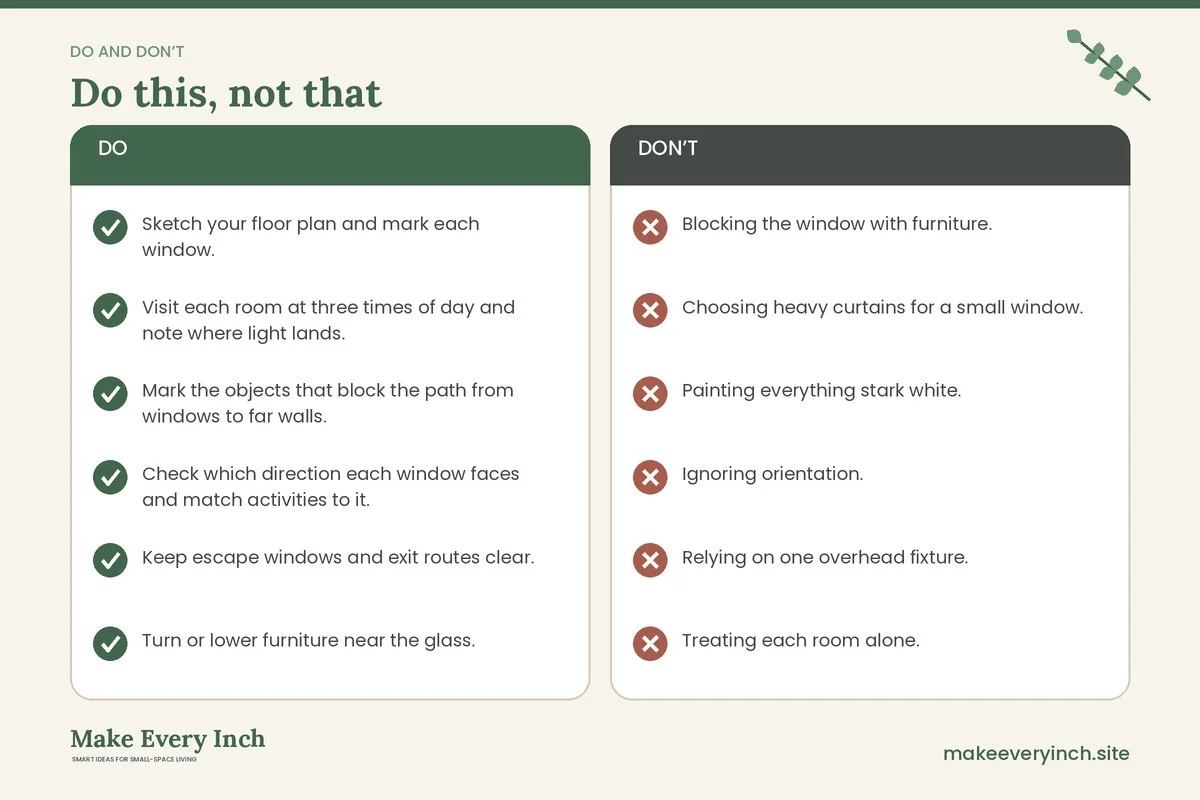
- Blocking the window with furniture. A sofa back against the glass looks neat and wastes the light.
- Choosing heavy curtains for a small window. They cover the glass and the light with it.
- Painting everything stark white. Very bright white can look cold or glare, and a warm pale tone often reads softer.
- Ignoring orientation. A plan that works in a south-facing home may fail in a north-facing one.
- Relying on one overhead fixture. A single ceiling light flattens a room when the sun goes down.
- Treating each room alone. Light moves between spaces, so plan the path through the whole home.
Checklist
- Sketch your floor plan and mark each window.
- Visit each room at three times of day and note where light lands.
- Mark the objects that block the path from windows to far walls.
- Check which direction each window faces and match activities to it.
- Keep escape windows and exit routes clear.
- Turn or lower furniture near the glass.
- Leave interior doors open where privacy allows.
- Choose a pale rug and a light ceiling.
- Place a mirror perpendicular to or opposite a window.
- Hang curtains wide and high, and use cordless blinds near children.
- Add lamps at several heights for evenings.
- Ask permission before painting or altering anything.
FAQ
What is the quickest way to get more natural light?
Clear the window, open the interior doors and move bulky furniture out of the beam. These steps cost almost nothing and often make a visible difference within an hour.
Do mirrors really help?
They can, if they face a light source and reflect something pleasant. They do not create light, only redirect it, so a mirror in a dark corner with no light to catch will not help much.
Can I get more light as a renter?
Yes. Cleaning glass, moving furniture, using light curtains, adding mirrors, choosing pale rugs and layering lamps all work without alterations. For more ideas, see renter-friendly window treatment ideas and small bedroom ideas for renters.
Which rooms should get the best light?
Put the rooms and activities you use most during the day at the best windows. That might be the kitchen and living area for some households and the home office for others. See small home office ideas for desk placement.
Is it worth adding a window or skylight?
Possibly, but it is a major project that needs a professional, permits and, if you rent, the owner’s agreement. Try the free and reversible changes first and see how much they achieve.
Keep going: Keep brightening your home with our pillar guide to small home ideas, the room-by-room small living room ideas and the practical small space organization ideas.
Save this guide for later
Pin the ideas you like to Pinterest so you can come back to them when you plan your space.