Small Bedroom Storage Ideas That Save Floor Space
Quick answer: The best small bedroom storage ideas that save floor space move storage off the floor and into unused volume: tall narrow units anchored to the wall, under-bed drawers or bins, over-door racks, wall-mounted shelves and a bed frame with built-in storage. Weigh what each spot will hold, anchor every tall piece, keep 24 to 30 inches of walkway and never drill without permission.
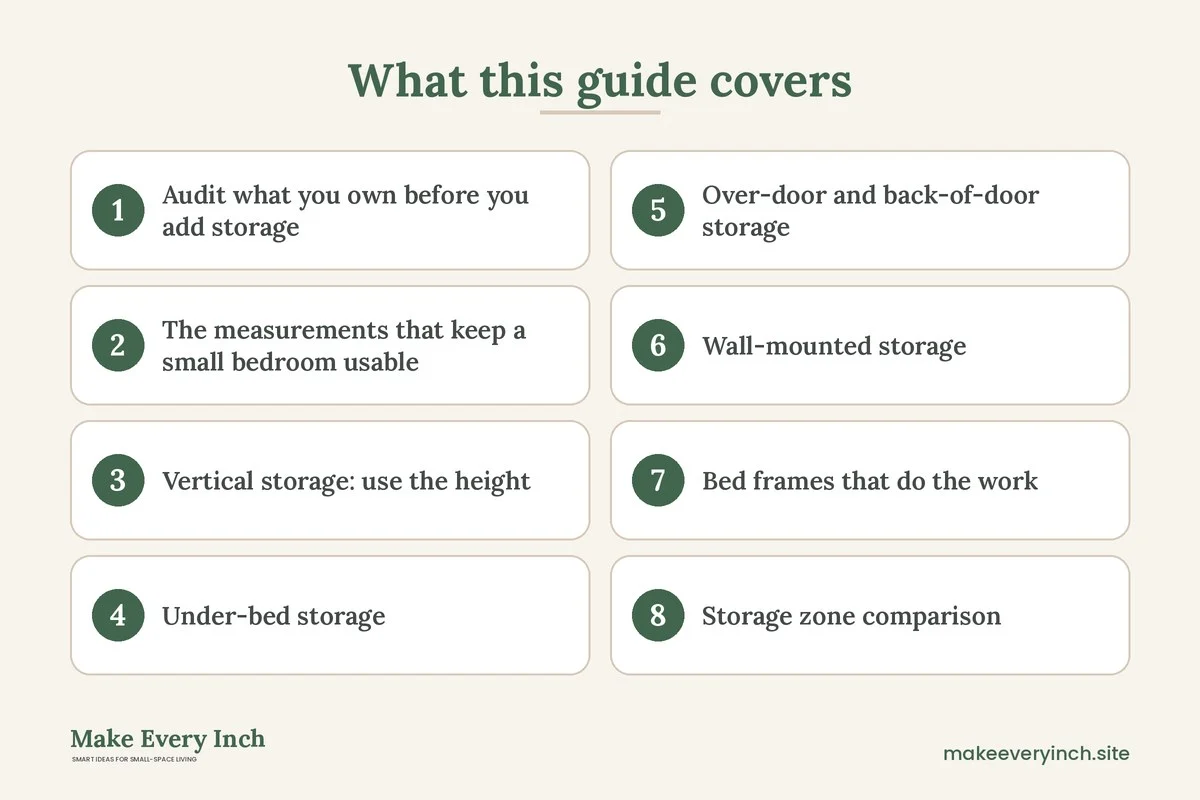
Small bedroom storage ideas that save floor space all follow one rule: if the floor is full, build up, hang or tuck away. A small bedroom rarely lacks stuff-holding capacity in total. It lacks free floor, because a bed, a dresser and a nightstand already claim most of it. Every extra basket, rack or chest adds to the clutter on the ground, so the trick is to find the volume that nobody is using. That means the space above the door, the strip of wall above the bed, the gap under the mattress, and the height between the top of the wardrobe and the ceiling. This guide walks through each of those zones with measurements, weight limits and anchoring advice. It covers vertical storage, under-bed options, over-door and back-of-door ideas, wall-mounted shelving, bed frames, a comparison table, three example rooms, a safety section and a checklist. For the main overview, read our pillar guide to small bedroom ideas, then pair this post with the broader small bedroom storage ideas roundup and our guide to small bedroom layout ideas. If you are thinking about the sleeping setup next, the companion post on small bedroom ideas with a king bed covers the biggest piece of furniture.
Audit what you own before you add storage
Storage that saves floor space starts with knowing what needs a home. Empty the surfaces first: the dresser top, the chair, the floor corner where clothes pile up. Sort what you find into four groups: daily items, weekly items, seasonal items and things you could pass on. Daily items need to be within arm’s reach, which means between about 24 and 60 inches off the floor. Weekly items can live a little higher or lower. Seasonal items such as winter coats, spare bedding and luggage can go to the hardest places to reach, like the top of the wardrobe or under the bed.
Next, measure the volume you have. Write down the height of the ceiling, the height of the bed frame from floor to the underside of the slats, the width of the wall above the headboard and the clear height above the door. Most rooms have more free height than people expect. A standard ceiling of 8 feet gives 96 inches, and a typical dresser tops out near 36 to 48 inches, which leaves 4 feet or more of vertical room that is often empty. Photograph the room from the doorway. Photos make wasted space obvious in a way that standing in the room does not.
Finally, decide what you will let go of. Floor-saving storage works best when the load is reasonable. If you plan to buy a tall unit and fill it to the brim, you simply move the clutter upward. Give each category a fixed space, and when that space is full, donate something before adding more.
The measurements that keep a small bedroom usable
Storage only helps if you can still move around it. These numbers are common planning guides, and local codes or your own needs may differ.
- Walkway beside the bed: 24 to 30 inches on at least one side, and 18 inches as a bare minimum for a tight second side.
- Drawer pull-out clearance: a dresser drawer needs roughly 30 to 36 inches in front of it so the drawer opens and you can stand.
- Door swing: keep the area swept by the door clear. If a door opens into the room, shelves and hooks on the nearby wall should not interfere with the swing.
- Wardrobe or tall unit depth: 12 to 16 inches is slim, and 20 to 24 inches is standard. In a tight room, choose slim.
- Under-bed clearance: measure from the floor to the lowest part of the frame. Many frames give 6 to 18 inches, and some leave more.
- Wall shelf height: the lowest shelf over a bed should leave at least 18 to 24 inches above the mattress so you can sit up without bumping it.
- Reach range: most people reach comfortably between 15 and 70 inches. Above that you need a step stool.
Mark the footprint of each new piece on the floor with painter’s tape before you buy. Walk the route from the door to the bed and to the window. If the tape blocks a natural path, the piece is the wrong size.
Vertical storage: use the height
1. A tall, narrow wardrobe or shelving column
A unit that is 12 to 16 inches deep and 60 to 80 inches tall holds more than a wide, low dresser, and it takes a quarter of the floor. Place it in a corner or beside the door where its height will not block light. Fill the upper shelves with seasonal items in labeled boxes, the middle with daily folded clothes and the bottom with shoes.
2. Stack storage above the existing dresser
If you already own a dresser, the wall above it is unused. A shelf or a pair of shelves 8 to 12 inches deep, mounted 12 to 18 inches above the top, adds a second level without a larger footprint. A tall dresser is another route, since a chest that is narrow and tall holds as many clothes as a wide, low one. See our guide to the best small dressers for features to compare.
3. A bookcase turned into a wardrobe
A narrow bookcase with baskets or fabric bins holds sweaters, scarves and bags. Bins keep the lines clean and hide the contents. Choose bins that fit the shelf depth so nothing hangs over the edge. For ideas on slim units, read our post on best narrow bookshelves.
4. A hanging rail at ceiling level
A second rail mounted above the first doubles the hanging space in a wardrobe or a niche. Keep the high rail for short items, such as shirts, and the low rail for dresses or coats. Use a pull-down hanging rod for the top level if reaching is hard, and check the manufacturer’s weight limit.
5. The ceiling gap above the wardrobe
Boxes or baskets placed across the top of a wardrobe use the dead space between the cabinet and the ceiling. Keep them light, because items stored overhead can fall. Store soft things such as spare blankets, pillows or empty luggage, and never stack heavy objects there.
For more ideas that use the full height of a room, see our guide to vertical storage ideas.
Under-bed storage
The area under a bed is usually the largest unused volume in a small bedroom. A double or queen frame can hide around 15 to 25 cubic feet when the clearance is 8 to 14 inches. That is enough for a season of clothes or a full set of bedding.
6. Shallow rolling drawers
Wheeled drawers 6 to 10 inches high slide out from under most frames. They keep items clean, and the sides prevent dust. Make sure the wheels suit your flooring, because hard casters can scratch wood and sink into thick carpet.
7. Lidded bins and fabric boxes
Bins with lids are cheaper than drawers and let you shape the storage to the gap. Choose rigid sides so they stack neatly, and add handles for pulling. Label the end that faces out.
8. Bed risers, used carefully
Risers lift a frame by 3 to 8 inches and add storage height. Use only risers rated for the weight of the bed, the mattress and the sleepers, and check that all four stand firmly. A wobbly bed is a safety risk. If the frame has a center support leg, add a riser there as well.
9. Vacuum bags for bulky bedding
Compressible bags shrink comforters and winter clothes to a fraction of their size. Do not leave natural-fiber items such as down or wool compressed for months, since long compression can damage the loft. Use them for synthetics and for short-term seasonal storage.
10. A roll-out frame between the legs
If your frame sits on legs, a low platform with wheels, 4 to 6 inches high, can slide out like a large tray. Weight is spread over the platform, so it handles books and shoes well. Ensure the wheels roll smoothly before loading it.
Our dedicated guide to under-bed storage ideas goes deeper on sizes and containers, and our list of the best beds with storage shows what to look for if you are replacing the frame.
Over-door and back-of-door storage
The door is a surface that costs no floor space at all. Its back, its top and the space beside it can carry a surprising amount.
11. An over-door hook rack
A rack hooks over the top of the door and holds robes, bags and the next day’s outfit. Check the door thickness first, since most racks fit a range of about 1.5 to 1.75 inches. Choose padded hooks if the door has a finish you want to protect. Keep the load modest, usually under 10 to 15 pounds per rack, or whatever the maker specifies.
12. An over-door shoe organizer
Fabric or mesh pockets hold shoes, accessories, scarves and small bottles. An organizer with 12 to 24 pockets uses about 12 inches of the door’s width. Mind the door swing, and check that the door still closes fully when loaded.
13. Adhesive hooks and slim rails
Adhesive hooks suit light items, such as a hat or a bag, and are good for renters who cannot drill. Follow the weight rating, clean the surface first and allow the adhesive to cure for the stated time. Our post on no-drill storage ideas for renters explains the details.
14. A hanging mirror with storage behind it
A mirror mounted on the back of a door gives a dressing area without a stand-alone piece. Some versions open to reveal shallow shelves for jewelry. A light plastic or frameless mirror suits adhesive mounting, but a heavy glass one needs proper hardware. Check the wall or door and the mount weight before you hang it.
Wall-mounted storage
Walls are the best resource a small bedroom has. The key is to choose the right fixing for the load and the wall.
15. Floating shelves
A shelf 6 to 10 inches deep keeps books, plants and a lamp off the floor. Always attach heavy loads to studs or use anchors rated for the weight and the wall material. A typical drywall anchor holds far less than a stud, so read the label. Never exceed the shelf’s stated limit, and do not rely on guesswork for a loaded shelf.
16. A wall-mounted nightstand
A small shelf or drawer at the bedside frees the floor under it, so the area is easy to sweep and the room looks larger. Mount it at about the height of the top of the mattress, or a couple of inches above, for easy reach.
17. A ladder shelf or leaning unit
A leaning ladder shelf needs no drilling. Its slanted shape means it is narrower at the top, so the footprint on the floor is small. Make sure it rests firmly and is anchored to the wall if it is tall or the floor is carpeted. Tall furniture that leans can tip if it is overloaded or bumped.
18. A pegboard or rail system
A board with movable hooks and baskets turns a wall into a flexible wardrobe. It suits jewelry, scarves, bags and daily items. It needs solid mounting, so use the correct anchors for the board and the load.
19. A headboard with shelves
A wall-mounted shelf above the head of the bed holds a lamp, books and a glass of water without a nightstand. Keep the lowest shelf at least 18 to 24 inches above the mattress, and round off the corners or add a lip so items do not slide off. In an earthquake-prone area, add a rail or a lip, and keep heavy objects off high shelves above where you sleep.
20. Hooks in a row
A single board with 3 to 5 hooks, mounted at 60 to 66 inches, takes bags, robes and jackets. It is a cheap and useful addition, and takes up no floor. For more options that avoid holes in a rental, read our post on renter-friendly shelving.
Bed frames that do the work
The bed is the largest object in the room, so it is the best place to hide storage.
21. Platform beds with drawers
A platform frame with drawers along the sides or the foot uses the whole footprint of the mattress. Check the clearance needed to open the drawers, which is usually 18 to 24 inches. If a side is against a wall, the drawers on that side will not open, so plan for it.
22. Lift-up storage beds
Gas-lift frames raise the mattress to reveal a full-length compartment. They hold more than drawers but make access slower. Keep seasonal items in the compartment, and confirm that you have enough ceiling clearance and room at the foot for the lift to rise.
23. A storage headboard
A headboard with a built-in shelf or cubby gives you a bedside surface and a place for books. Check that the depth does not cut into the walkway. A shallow unit of 4 to 8 inches suits a tight room.
24. A bed raised onto a platform
A loft or high bed frees the whole floor below for a desk, a wardrobe or a dresser. It needs sufficient ceiling height, usually 8 feet or more, and a safe ladder. Leave at least 30 inches between the mattress top and the ceiling so you can sit up without bumping your head. Do not use a high bed for young children without checking the manufacturer’s age and safety guidance.
For other frames and furniture, our guide to small bedroom furniture ideas compares common options, and the post on small space storage furniture covers multipurpose pieces.
Storage zone comparison
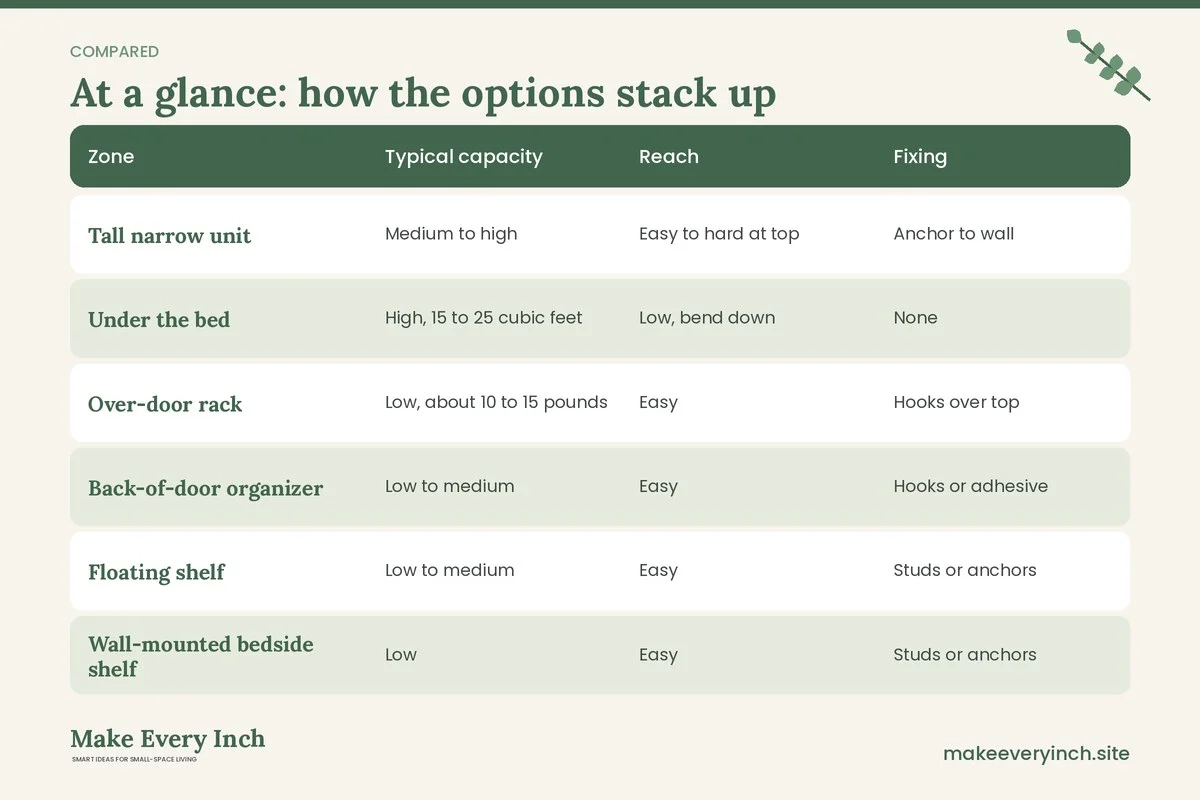
The table below compares the main floor-saving zones. The weights are broad planning ranges only, so always follow the instructions that come with a specific product.
| Zone | Typical capacity | Reach | Fixing | Main watch-out |
|---|---|---|---|---|
| Tall narrow unit | Medium to high | Easy to hard at top | Anchor to wall | Tipping, so anchor it |
| Under the bed | High, 15 to 25 cubic feet | Low, bend down | None | Dust, so use lids |
| Over-door rack | Low, about 10 to 15 pounds | Easy | Hooks over top | Door closing |
| Back-of-door organizer | Low to medium | Easy | Hooks or adhesive | Door swing |
| Floating shelf | Low to medium | Easy | Studs or anchors | Weight rating |
| Wall-mounted bedside shelf | Low | Easy | Studs or anchors | Height over bed |
| Bed with drawers | High | Medium | None | Drawer clearance |
| Lift-up bed | Very high | Hard | None | Access and lift space |
| Loft bed | Very high below | Medium | Self-supporting | Ceiling height, safety |
Safety: weights, anchoring and fixings
Floor-saving storage moves weight up, and that means more risk if something fails. A few rules prevent most problems.
- Anchor every tall piece. Wardrobes, bookcases and tall dressers can tip, especially when drawers are open or when climbed on. Use the anti-tip kit supplied with the furniture, fixed to studs or with suitable wall anchors. If you rent, ask the landlord before drilling.
- Never drill without permission. In a rental, check the lease and get written approval. Choose freestanding, leaning or adhesive options where you cannot make holes.
- Know your wall. Before drilling anywhere, check for studs, pipes and electrical wiring behind the surface. A stud finder helps, but it does not replace caution. If unsure, hire a professional.
- Respect weight ratings. Every shelf, hook and rail has a limit. Subtract a margin, load heavy items low and keep the limit in mind when books or boxes are added.
- Keep heavy items low. Place books, shoes and boxes on the lower shelves, and soft items high. Never store heavy things above a bed.
- Keep exits and sleep zones clear. Do not block the door or the window, and avoid hanging objects above the pillow that could fall.
- Watch the electrics. Do not run cords under rugs or through tight gaps. Avoid covering sockets, lamps or heaters with fabric, and do not overload a power strip.
- Ventilation. Closed boxes under the bed and packed wardrobes trap moisture. Leave small gaps, add airing time and avoid storing damp items.
- Low-VOC finishes. If you paint or finish new shelves, choose low-VOC products, work with the window open and let the surface air out before the room is used for sleep.
Three example rooms
A 9 by 10 foot room with a full bed
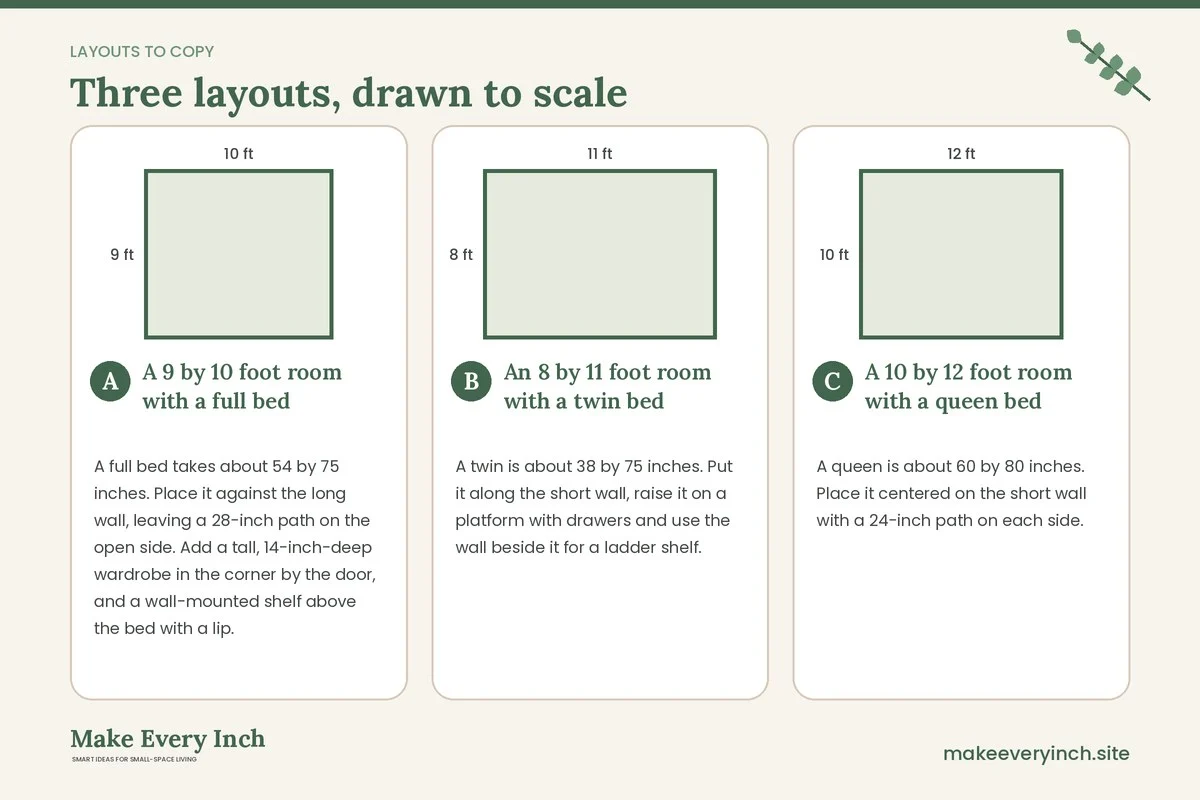
A full bed takes about 54 by 75 inches. Place it against the long wall, leaving a 28-inch path on the open side. Add a tall, 14-inch-deep wardrobe in the corner by the door, and a wall-mounted shelf above the bed with a lip. Store seasonal clothing in rolling drawers under the bed, and hang a hook rack on the back of the door. The dresser is replaced by the wardrobe, so the floor stays clear. This room gains roughly 6 square feet of clear floor compared with a dresser and two nightstands.
An 8 by 11 foot room with a twin bed
A twin is about 38 by 75 inches. Put it along the short wall, raise it on a platform with drawers and use the wall beside it for a ladder shelf. A pegboard by the window holds daily items, and a floating desk shelf folds down for work. The result is a floor with only the bed and a narrow path. See our guide to small bedroom desk ideas for desk options.
A 10 by 12 foot room with a queen bed
A queen is about 60 by 80 inches. Place it centered on the short wall with a 24-inch path on each side. Use wall-mounted bedside shelves in place of nightstands, a tall, slim dresser on the opposite wall and a lift-up frame for spare bedding. Add over-door hooks for robes and an organizer for accessories. If you are comparing sizes, our post on small bedroom ideas with a queen bed covers the specifics.
Common mistakes
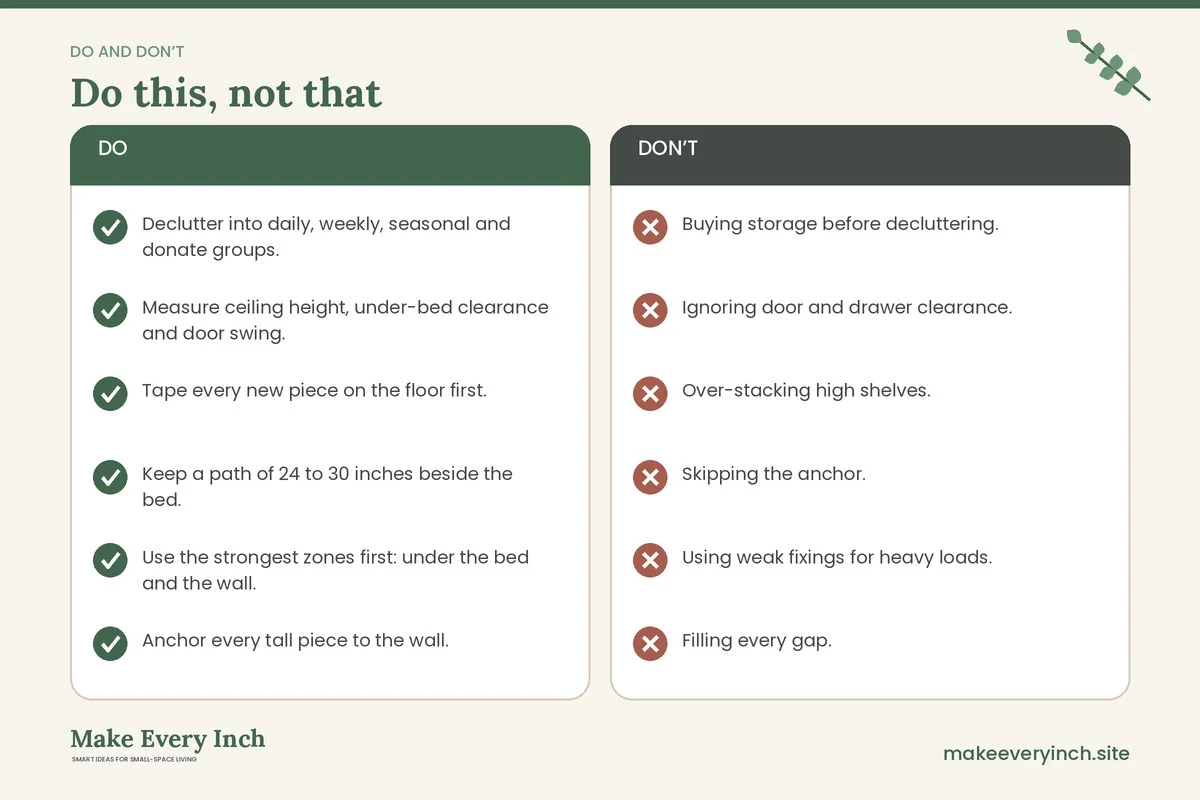
- Buying storage before decluttering. More containers hide the problem, so reduce first.
- Ignoring door and drawer clearance. A beautiful unit that blocks the door is useless.
- Over-stacking high shelves. Heavy items above head height are a risk.
- Skipping the anchor. An unanchored tall piece is a tipping hazard.
- Using weak fixings for heavy loads. The wall may hold a picture, but not a loaded shelf.
- Filling every gap. A little empty wall makes the room feel calmer.
- Forgetting access. If you cannot reach something without moving three others, it will not get used.
Floor-saving checklist
- Declutter into daily, weekly, seasonal and donate groups.
- Measure ceiling height, under-bed clearance and door swing.
- Tape every new piece on the floor first.
- Keep a path of 24 to 30 inches beside the bed.
- Use the strongest zones first: under the bed and the wall.
- Anchor every tall piece to the wall.
- Check the weight rating of every shelf and hook.
- Keep heavy items low and soft items high.
- Get permission before drilling in a rental.
- Leave airflow in closed storage.
- Label boxes on the visible end.
- Review every three months and let go of what you do not use.
FAQ
What is the best storage to save floor space in a small bedroom?
The under-bed area and the wall are usually the most effective. Under-bed drawers and wall shelves add storage without a larger footprint, and a tall narrow unit adds a lot more.
How do I add storage without drilling?
Use over-door racks, leaning shelves, adhesive hooks within their weight rating, under-bed bins and freestanding tall units. Check the lease for your landlord’s rules.
How tall can I safely stack storage?
Keep tall pieces anchored and keep the heaviest items low. Do not store heavy items above a bed, and follow the maker’s instructions for any unit.
How much weight can an over-door rack hold?
Many hold roughly 10 to 15 pounds, but ratings vary, so check the packaging and the door. Overloading can damage the door or pull the rack off.
Are storage beds worth it?
They can be, if you have enough clearance for the drawers or the lift. They suit rooms where a dresser would otherwise crowd the floor.
Can a loft bed work in a small bedroom?
Yes, if the ceiling is high enough and the frame is stable. Always follow the maker’s guidance on height, ladders and age.
Keep going: Keep planning with our small bedroom organization ideas, small bedroom ideas for renters and small bedroom ideas without a closet.
Save this guide for later
Pin the ideas you like to Pinterest so you can come back to them when you plan your space.