Small Bathroom Storage Ideas for Tight Spaces
Quick answer: The best small bathroom storage ideas for tight spaces use five zones in order: the wall above the toilet, a recessed or shallow niche, the back of the door, the space inside and under the vanity, and the shower itself. Choose moisture-proof materials, keep 21 inches or more of clear floor in front of the toilet, anchor every tall piece, and never drill into tile without permission.
Small bathroom storage ideas for tight spaces have to do something unusual: they must fit in a room where every surface is wet, warm or in the way. A bathroom of 5 by 8 feet has one door, one mirror and a handful of fixtures, so the usual advice to add a bookcase simply does not apply. Steam rusts metal, splashes warp cheap board and a shelf that sticks out 12 inches can become a hip bruise. This guide takes a different route from a general roundup. It organizes storage by zone, from the toilet wall to the shower, and gives you the depths, heights and clearances that decide whether a piece works. It also covers moisture-proofing, safety, a comparison table, three example rooms, a weekly routine, mistakes and a checklist. For the bigger picture, see our pillar guide to small bathroom ideas. If you want a sorting method rather than furniture, read small bathroom organization ideas. For a quick list of compact products, try our post on tiny bathroom storage ideas, which this guide complements instead of repeating.
Start with a zone audit, not a shopping list
Before buying a single basket, stand in the doorway and look at the room as five zones. Each one has different depth limits, different moisture levels and a different kind of item that belongs there.
- Zone 1, the toilet wall: the vertical space above and beside the toilet. It is dry most of the time and has the most unused height.
- Zone 2, the niche or recess: any shallow cavity or the dead space between studs, between the vanity and the wall, or beside the mirror.
- Zone 3, the door: the back of the door and the wall behind it, which is often the emptiest surface in the room.
- Zone 4, the vanity: the cabinet, the drawers, the counter and the sides.
- Zone 5, the shower or tub: the wettest zone, where everything must tolerate daily water.
Now list what you actually own that lives in the bathroom. Sort it into daily items (toothbrush, face wash, hair tools), weekly items (masks, razors, cleaning spray), backup items (spare toilet paper, soap, shampoo) and rarely used items (first aid, guest supplies). Daily items belong between about 36 and 60 inches off the floor, where an adult reaches without bending. Weekly items go lower or higher. Backups can live in the hardest-to-reach spot. Tight rooms fail when daily items are stored in the worst places, so put this sorting first.
Measure the room with a tape and note these numbers on paper: the width and depth of the room, the distance from the toilet center to each side wall (most codes expect about 15 inches or more each way, so do not block it), the door swing and the height of any window sill. Then you can match each product to a real clearance.
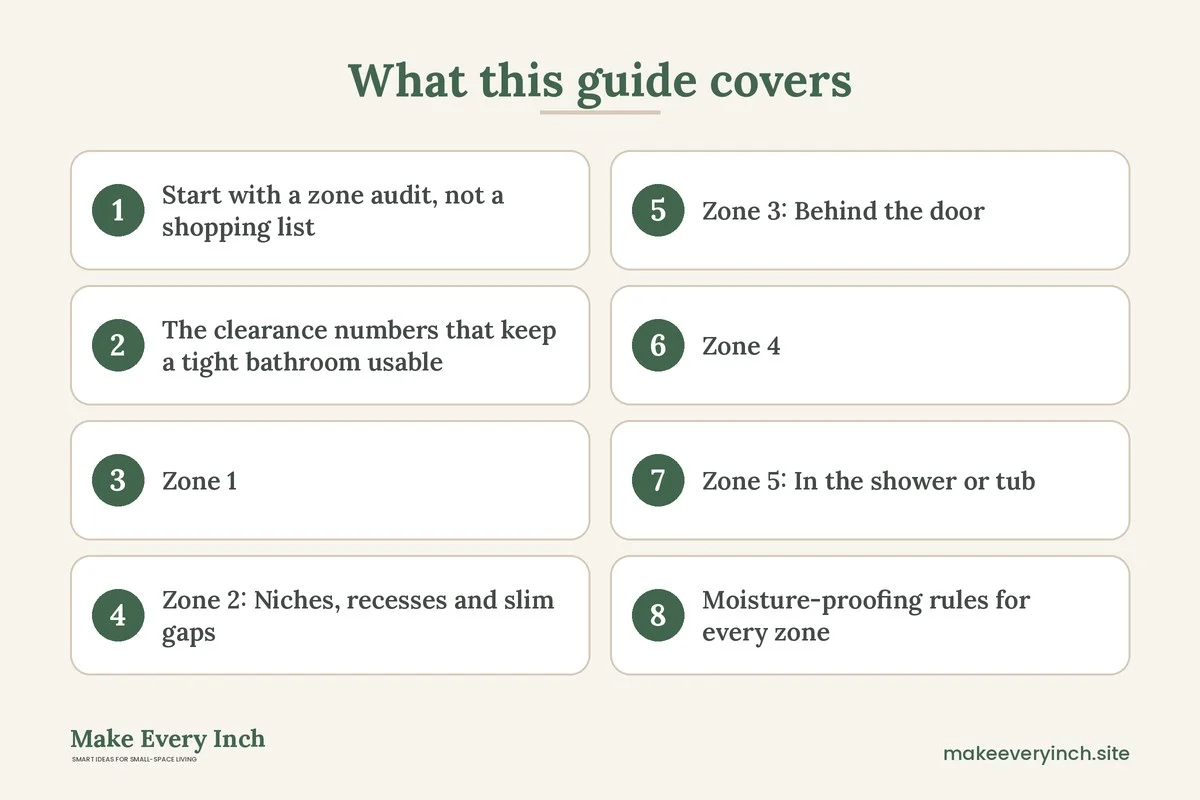
The clearance numbers that keep a tight bathroom usable
Storage should never reduce the space you need to use the fixtures. These ranges are typical guidance, and local rules and your own body may differ, so treat them as starting points.
- Floor in front of the toilet: about 21 inches of clear space is a common comfort target, and more is better.
- Toilet centerline to a side wall or fixture: often 15 inches or more each side.
- Shelf depth over the toilet: 6 to 9 inches deep is usually enough for towels and bottles, and a deeper shelf starts to threaten your head when you stand up.
- Lowest shelf above the tank: leave about 8 to 12 inches above the tank lid, so you can still reach the flush and clean the tank.
- Door swing: a door that opens inward needs a clear arc. A shelf or hook on the wall behind the door must be thin enough not to stop the door early.
- Walkway: 24 inches between the vanity and the opposite wall is workable in a very small room.
- Daily reach zone: 36 to 60 inches from the floor for everyday items.
Mark these limits with painter’s tape on the wall and floor. Live with the tape for a day. If you bump it, it is too big.
Zone 1: Over-the-toilet storage that does not loom
The space above the toilet is the classic answer, and it deserves a careful version. Three styles dominate.
An open shelf pair
Two shelves, one above the other, hold folded towels on the lower shelf and baskets or jars on the upper. Keep the top shelf at or below roughly 72 inches so you can reach it without a stool. Because the shelves are open, they dry quickly, which helps in a damp room.
A narrow cabinet over the tank
A cabinet with doors hides clutter. Pick one that is 6 to 8 inches deep and about 20 to 24 inches wide, with a bottom that clears the tank lid by at least 8 inches. Closed doors keep steam and dust off the contents, but a cabinet without vents can hold humidity, so leave the doors open for a while after a shower. For product ideas, see our list of the best over-the-toilet storage.
A freestanding frame
A frame that straddles the toilet needs no wall fixing, which suits rentals, though it still needs to be stable. A tall frame can tip if you lean on it or if a child climbs it, so choose a wide base, place heavy items low and use the manufacturer’s anti-tip fixing if provided. In a rental, check the lease before drilling for any anchor.
Whatever you choose, remember that the toilet is a splash and humidity zone. Do not store open medicine or loose cotton on the shelf closest to the bowl, and wipe the shelf once a week.
Zone 2: Niches, recesses and slim gaps
A niche pushes storage into the wall instead of the room, so it costs zero floor space. There are two types.
A built-in shower niche
A tiled recess in the shower wall holds shampoo, soap and a razor. Typical sizes run about 12 by 24 inches or 14 by 30 inches, set between studs, with the bottom sloped slightly outward so water drains. Because it is part of the waterproofing, it must be built by a qualified tiler, and the finish should be fully sealed. This is a remodel project and one for owners, not renters. Plan the height so the shelf sits at roughly 36 to 48 inches from the floor of the shower, where it is easy to reach, and avoid putting it on an exterior wall without checking insulation.
A recessed medicine cabinet
A cabinet recessed between studs gives you 3 to 4 inches of depth with almost no intrusion. Check what is in the wall before cutting. Wiring, pipes and vents may run through the cavity, and a bathroom wall may hold wiring that needs ground fault protection. Hire a licensed electrician if the wall has any wiring, and use a stud finder and your own careful inspection. Do not cut into a wall without that check.
Slim gaps between fixtures
For a renter, the equivalent is a rolling cart of 6 to 8 inches wide that slides into the gap between the vanity and the toilet or beside the washing machine. A rolling cart uses space you can not use for anything else, and it rolls out for cleaning. Choose a plastic, coated metal or sealed wood cart with a lip, and place it away from direct water spray.
Zone 3: Behind the door
The back of the door is a large flat surface that most people ignore, and it is a favorite in tight rooms.
- Over-the-door hooks: two or three hooks hold robes and towels with no drilling. Check that the hook fits the thickness of your door, and that the door still closes.
- A slim over-the-door rack: a rack with narrow shelves, no deeper than 4 inches, holds daily items. Keep weight light, as a heavy rack can strain the hinges.
- A hanging organizer: clear pockets hold hair tools, makeup and cleaning supplies. Choose plastic or mesh that dries quickly.
- A wall rail behind the door: on the wall that the open door covers, a thin rail with a few hooks stays out of the way. Measure the door swing first.
A door that swings into the room should not hit what you hang behind it. Open the door fully and check the clearance with a ruler. If the door cannot open past 90 degrees, it is blocking something, and you need a slimmer organizer or a sliding door.
Zone 4: Vanity storage inside and under
The vanity holds the most, and it is often used worst. Open the cabinet and look at the layout. Plumbing, usually a trap and two supply lines, takes up the middle. Everything else is wasted unless you add structure.
Under the sink
Use a U-shaped organizer that wraps around the trap, so you recover the full width. A two-tier pull-out on the side holds bottles. Install a small bin on the inside of the door for hair ties and small tools. Place a tray or a mat under the pipes to catch leaks, and check weekly for drips, as a hidden leak causes mold and damage.
Drawers
If the vanity has drawers, divide them with a flexible tray insert. Put daily items at the front and backups at the back. A shallow drawer of 3 inches holds small tools, while a deeper one holds bottles on their sides.
The counter
Limit the counter to the items you use twice a day. A small tray, a soap dispenser and a cup are enough. A tray keeps wet items from marking the surface and makes cleaning easy. Our post on small bathroom vanity ideas covers which vanity shapes give the most storage per inch.
The sides and the mirror
The side of a vanity can hold a towel bar, or an adhesive hook for a hair dryer. A mirror cabinet turns the wall above the sink into storage. If you choose one, check that any lighting or outlet near the sink is protected by a ground fault circuit interrupter (GFCI), and do not plug a hair dryer in near standing water.
Zone 5: In the shower or tub
This is the wettest zone, so material choice matters most.
- Corner shelves: a tension pole or a corner caddy holds bottles. Pick rust-resistant materials, such as coated metal or plastic, and wipe the bottoms weekly to prevent buildup.
- A hanging caddy on the shower rod: easy to remove for cleaning. Do not overload it, as the rod may fall.
- Suction or adhesive hooks: these suit smooth, flat, clean surfaces. Follow the weight limit, and test by pressing hard. If an item falls, it may crack tile or hurt a foot, so keep heavy bottles low.
- A tub-edge tray: a tray across the tub holds a book and a candle, though it should be removed during showers to limit slip risk.
- Soap and razor holders: a small basket on a hook handles the smaller things.
Slip risk matters here. Items on the shower floor become hazards, so keep the floor clear. A non-slip mat helps, and a mat must be lifted and dried after use to prevent mold. Never place glass containers in the shower, because a dropped bottle is dangerous on a wet floor.
Moisture-proofing rules for every zone
A bathroom wrecks the wrong materials fast. These rules apply to every piece you add.
- Choose finishes that tolerate water: plastic, glass, coated or stainless metal, sealed wood and ceramic usually work. Raw particleboard swells when wet.
- Check the metal: cheap plated metal can rust at the weld points. Look for coatings and rust-resistant hardware.
- Keep ventilation running: run the exhaust fan during and for roughly 20 minutes after a shower, or open a window if there is one. A fan should vent outdoors and not into an attic. If your bathroom has no fan, see our guide to small bathroom ideas without a window.
- Leave a gap behind objects: an inch of air behind a basket or a caddy lets the wall dry, which stops mold from growing in the shadow.
- Use open storage for towels: damp towels in a closed cabinet smell and breed mildew.
- Wipe weekly: a quick pass with a cloth stops soap scum and rings.
- Mind the paint: if you repaint shelves, choose a low-VOC, moisture-resistant finish, and ventilate the room while it cures.
Safety notes that matter in a wet room
Bathrooms combine water, electricity, hard surfaces and steam, so a few rules deserve repeating.
- Anchor tall furniture: any piece taller than about 40 inches, such as a tall cabinet or a ladder shelf, should be fixed to a stud or a suitable wall anchor with the supplied hardware. A tall piece that tips is a serious hazard, especially for children.
- Use waterproof fixings: screws and anchors in a wet area should be corrosion-resistant, such as stainless steel, so they do not rust and stain the wall.
- Never drill into tile without permission: in a rental, drilling breaks the waterproof layer and can leak behind the wall. Ask your landlord, or choose freestanding and over-the-door options. Even in your own home, use the correct tile bit, mark studs and pipes first, and seal the hole.
- Electrical safety: keep cords, lamps and heaters away from water. Outlets in a bathroom should be protected by GFCI, and a hair dryer should stay unplugged when not in use. Do not add an extension lead in a bathroom. If you are unsure, ask a licensed electrician.
- Slip risk: keep shelves out of the walkway, keep the floor clear and use a mat with a non-slip backing.
- Medicines and chemicals: store them out of reach of children, in a closed cabinet, and avoid humid spots that may damage them.
Comparison table: which zone for which job
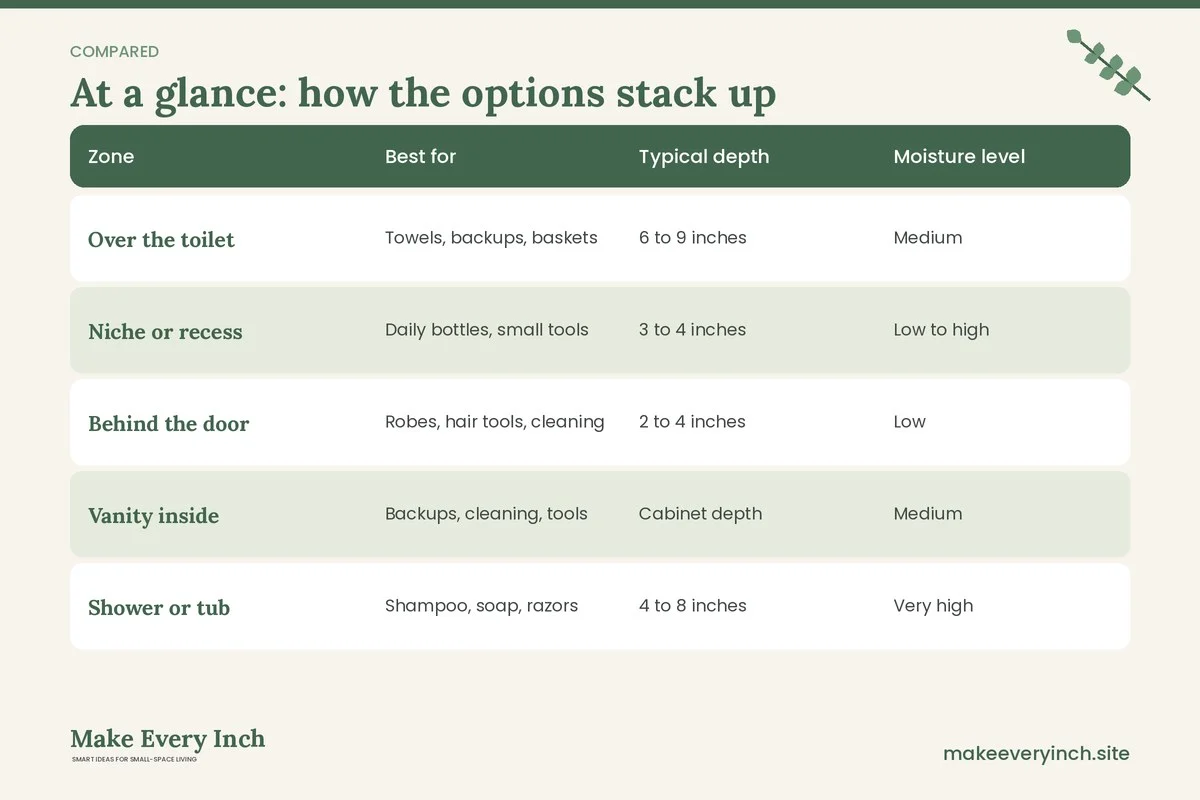
The table below ranks the zones by what they hold and what they cost in space and effort. Use it to decide where to start.
| Zone | Best for | Typical depth | Moisture level | Installation |
|---|---|---|---|---|
| Over the toilet | Towels, backups, baskets | 6 to 9 inches | Medium | Wall fixing or freestanding |
| Niche or recess | Daily bottles, small tools | 3 to 4 inches | Low to high | Built-in, needs a professional |
| Behind the door | Robes, hair tools, cleaning | 2 to 4 inches | Low | No drilling needed |
| Vanity inside | Backups, cleaning, tools | Cabinet depth | Medium | Inserts, no drilling |
| Shower or tub | Shampoo, soap, razors | 4 to 8 inches | Very high | Caddy or hooks |
Three example rooms
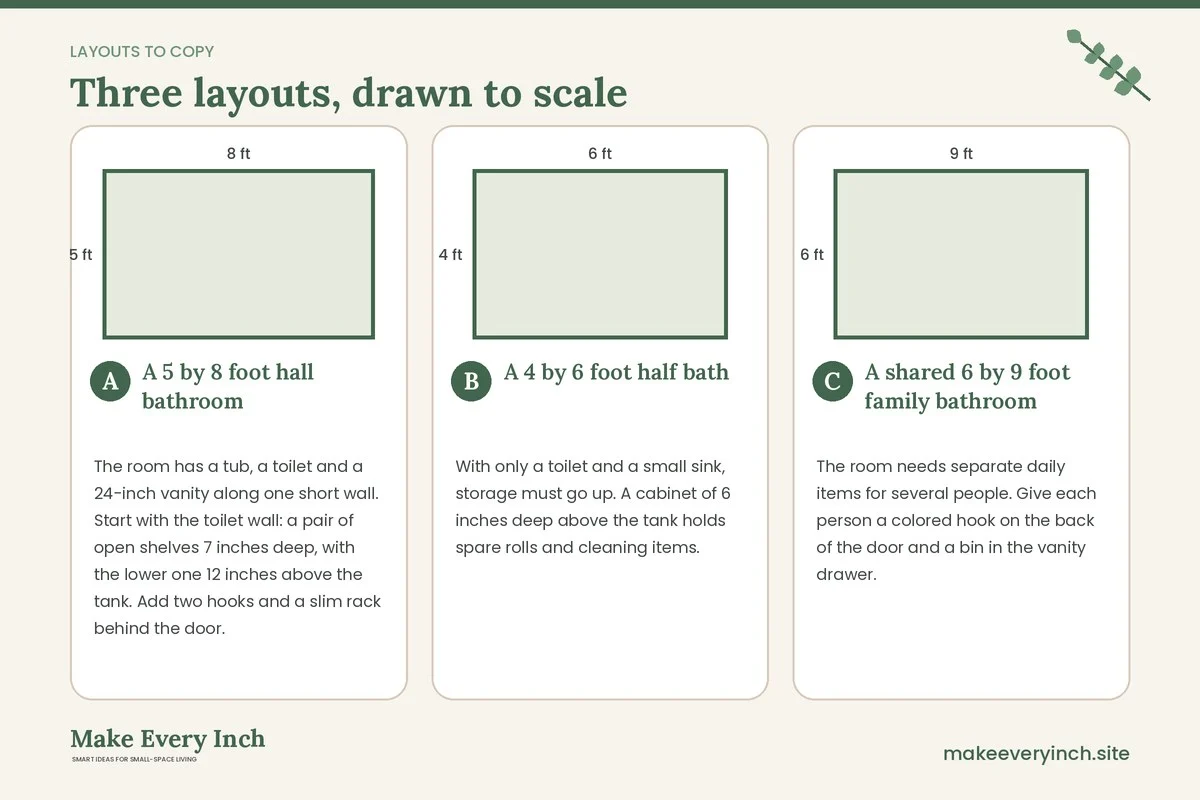
A 5 by 8 foot hall bathroom
The room has a tub, a toilet and a 24-inch vanity along one short wall. Start with the toilet wall: a pair of open shelves 7 inches deep, with the lower one 12 inches above the tank. Add two hooks and a slim rack behind the door. Inside the vanity, fit a U-shaped organizer around the trap. In the tub, hang a corner caddy on a tension pole. The result adds roughly four zones of storage without losing floor, and the walkway stays at about 30 inches.
A 4 by 6 foot half bath
With only a toilet and a small sink, storage must go up. A cabinet of 6 inches deep above the tank holds spare rolls and cleaning items. A slim rolling cart of 6 inches wide sits beside the toilet only if the side clearance remains over 15 inches. Otherwise, use a wall rail with hooks and a small basket. A pedestal sink has no cabinet, so add a wall shelf above the sink for the daily items, and keep the shelf out of the way of the mirror.
A shared 6 by 9 foot family bathroom
The room needs separate daily items for several people. Give each person a colored hook on the back of the door and a bin in the vanity drawer. A pair of tall, narrow shelves of 10 inches depth stand beside the vanity and are anchored to the wall. Use the tub rim and a caddy for kids’ bath items, and keep the heavy bottles low. Adults get the upper shelves, children the lower. Review the plan every season, because needs change.
A weekly routine that keeps tight storage working
Storage that no one maintains turns into clutter within a month. These habits take about ten minutes.
- After each shower: run the fan, squeegee or wipe the wet surfaces, and hang towels to dry.
- Once a week: wipe shelves, empty the caddy and rinse it, and check under the sink for drips.
- Once a month: remove expired products and move backups to the top shelf.
- Each season: reassess the plan. Winter needs more towels, and summer may need sun care.
A good rule is one in, one out. When a new bottle arrives, the old one goes. This keeps the number of items in step with the shelf space you have.
Mistakes to avoid
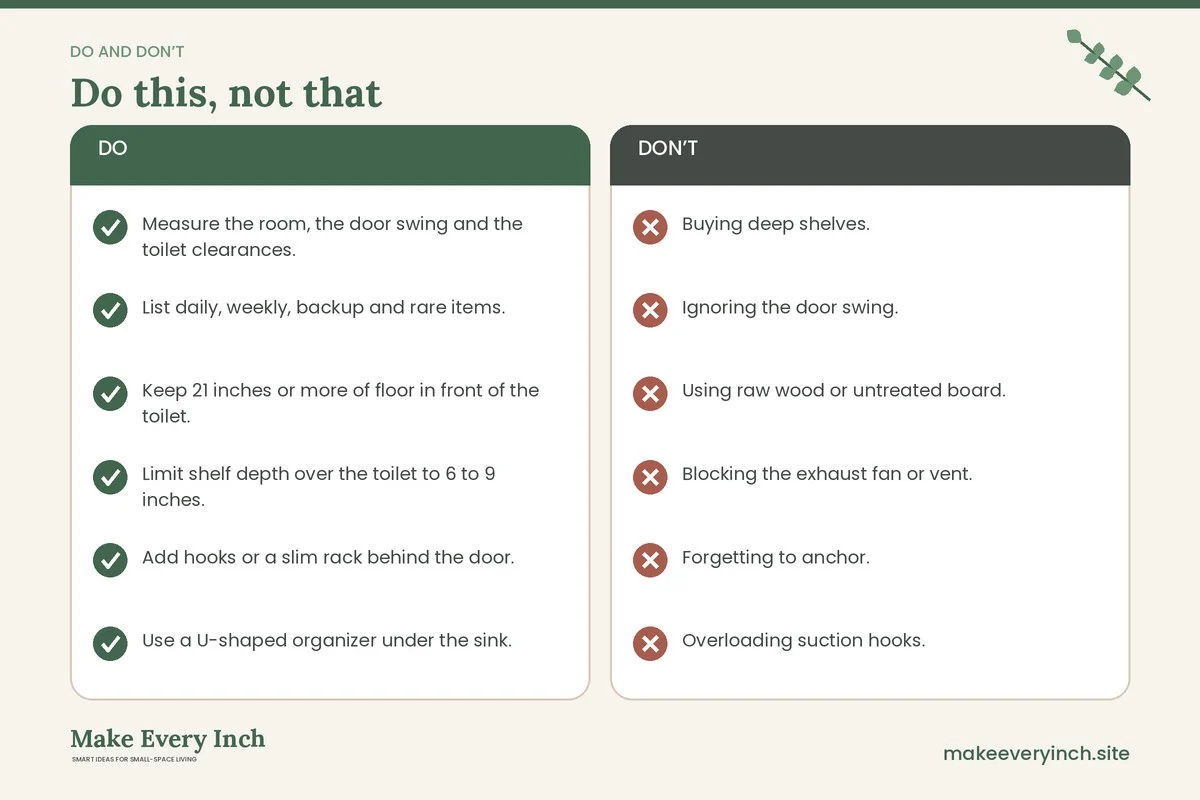
- Buying deep shelves. A shelf over 10 inches deep in a tiny room becomes a head bump.
- Ignoring the door swing. An organizer that blocks the door is useless.
- Using raw wood or untreated board. It swells and mold appears.
- Blocking the exhaust fan or vent. Items in front of a vent trap steam.
- Forgetting to anchor. A tall unit that is not fixed can fall.
- Overloading suction hooks. They fail without warning, so keep loads light.
- Storing everything on the counter. A clear counter is easier to clean and feels larger.
Quick storage checklist
- Measure the room, the door swing and the toilet clearances.
- List daily, weekly, backup and rare items.
- Keep 21 inches or more of floor in front of the toilet.
- Limit shelf depth over the toilet to 6 to 9 inches.
- Add hooks or a slim rack behind the door.
- Use a U-shaped organizer under the sink.
- Pick moisture-proof, corrosion-resistant materials.
- Anchor any tall unit with the right hardware.
- Ask permission before drilling into tile.
- Check that outlets near water are GFCI protected.
- Run the fan during and after showers.
- Wipe and review every week.
FAQ
What is the best storage for a very small bathroom?
Start with the walls: shelves or a narrow cabinet over the toilet, hooks on the back of the door and an organizer under the sink. These use vertical and hidden space and keep the floor clear.
How deep should an over-the-toilet shelf be?
Most are 6 to 9 inches deep. A deeper shelf can hit your head when you stand, so measure the space above the tank before you buy.
How do I add storage without drilling into tile?
Use over-the-door hooks, a freestanding frame, a tension pole in the shower and a rolling cart. If you want a fixed shelf in a rental, ask your landlord first. Our guide to no-drill storage ideas for renters lists more options.
How do I stop storage from getting moldy?
Ventilate during and after showers, leave a small gap behind items, keep towels on open racks and wipe surfaces weekly. If mold keeps coming back, look for a leak or poor airflow.
Is a recessed niche worth the effort?
In a remodel, a niche gives storage with no loss of floor, but it requires proper waterproofing and a qualified installer. In a rental or a quick update, a caddy is the sensible choice.
Where should I put towels in a tight bathroom?
Hang them on hooks or a rail where air can reach them. Keep a spare towel in a basket on a shelf above the toilet, and avoid stacking damp towels in a closed cabinet.
Keep going: Keep planning with our small bathroom shelving ideas, renter-friendly bathroom ideas and the companion guide to small bathroom ideas without a window.
Save this guide for later
Pin the ideas you like to Pinterest so you can come back to them when you plan your space.