9 Small Living Room Color Schemes That Feel Open
Quick answer: Small living room color schemes open the space when they keep walls, large furniture and curtains in a narrow range of related tones, use the 60-30-10 split for balance, match undertones, and add contrast only in small doses. Pale or mid-tone walls with a slightly deeper sofa, a rug close to the floor color, curtains the color of the wall and one or two accent colors in cushions and art work in most rooms. Always judge a color in your own light at different times of day.
Small living room color schemes open a tight room when they do three things at once: they reduce visual breaks, they bounce light around and they give the eye a calm path from the floor to the ceiling. Many people believe the only answer is white. White can work, but it can also feel cold or flat, and a narrow, well-chosen range of color often looks more spacious than a stark one. This guide looks at the question from a palette point of view. It covers how color affects perceived size, how to read undertones and light, nine ready-to-use palettes, a split for walls, furniture and accents, a comparison table, three example rooms, finishes, safety notes for painting and a checklist. For the wider topic, see our main guide to small living room ideas, and for a general overview of color and size read colors that make small rooms look bigger.
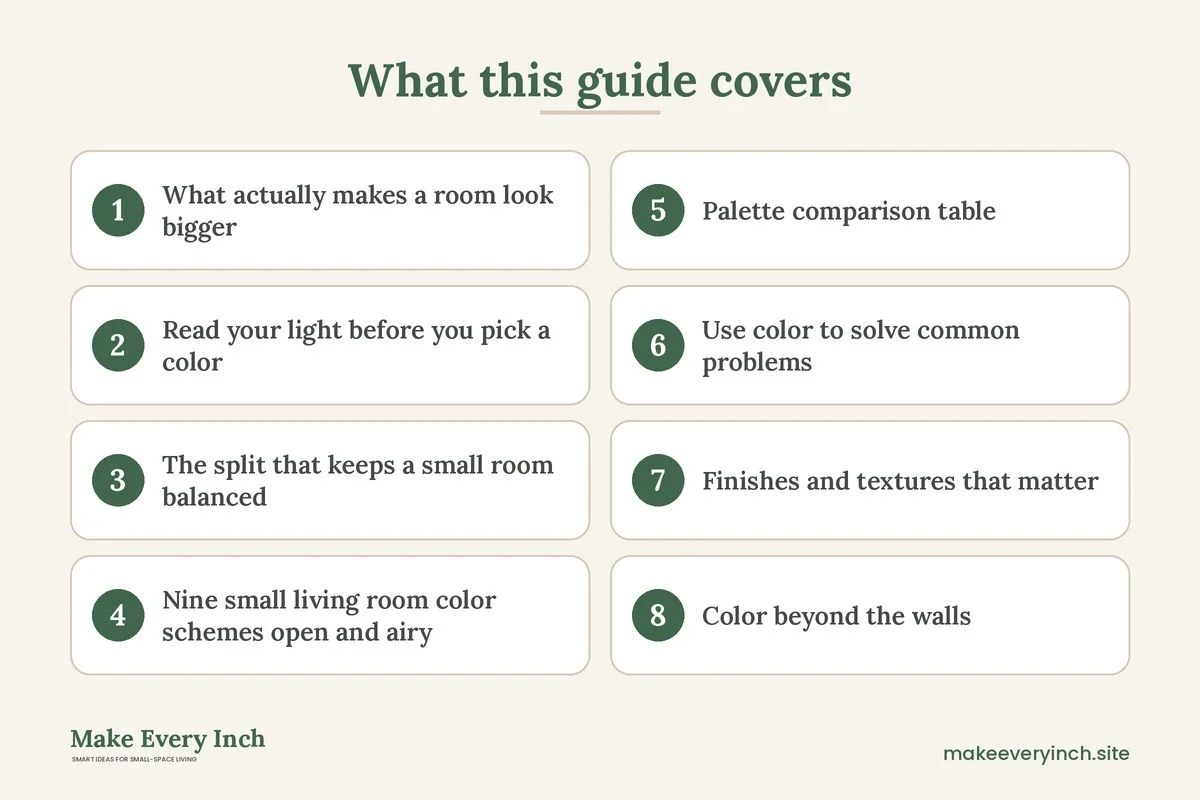
What actually makes a room look bigger
Color changes how large a room feels through a handful of simple effects. Knowing them lets you break the rules with confidence.
- Light reflection. Light colors reflect more light, so the room looks brighter and the walls seem to recede. Dark colors absorb light and make surfaces feel closer, though they can add depth when used with care.
- Low contrast. When walls, trim, curtains and large furniture sit close in tone, the eye does not stop at each edge. The room reads as one calm shape, not as a collection of boxes.
- Continuity. A floor, wall and ceiling that share a family of colors blur the corners.
- Temperature. Cool colors, such as soft blue, green and gray, tend to recede, and warm colors, such as terracotta and deep yellow, tend to advance. Neither is wrong, but warm tones make a room feel snug while cool tones make it feel airy.
- Vertical lines. A ceiling that is lighter than the walls feels higher. Curtains hung close to the ceiling add height.
These are tendencies, not laws. A small room painted deep green can feel like a jewel box and not a cave, provided the light is good and the other colors are quiet. The question is which effect you want most: airy, cozy or dramatic.
Read your light before you pick a color
The same paint looks different in every room. Before you choose anything, check three things.
Direction of the window
North-facing rooms receive cooler, steadier light, and colors can look grayer and flatter. Warm whites, soft creams and gentle yellows or peaches help. South-facing rooms receive warm, strong light, and almost any color works, though very warm shades can feel heavy by midday. East-facing rooms are bright in the morning and softer later, and west-facing rooms glow in the evening. Look at the room at 9 in the morning, noon and 7 in the evening.
Artificial light
Bulbs change color too. Warm bulbs, around 2700 kelvin, add yellow to the walls. Cooler bulbs, around 4000 kelvin or more, make colors look blue and clinical. Choose one bulb temperature for the whole room, and test your samples under it. For more on this topic, read our post on small living room lighting ideas and the guide to small room paint ideas for low light.
Undertones
Almost every neutral has an undertone. A white may lean yellow, pink, blue, green or gray. Hold a sample next to a pure white sheet of paper and the lean shows. Match undertones across the room, so that a cool gray wall is not paired with a creamy yellow sofa. If you are unsure, hold the sample beside the sofa, the floor and the curtains, and see which one looks off.
The split that keeps a small room balanced
Designers often use the 60-30-10 rule: about 60 percent of the room in a dominant color, 30 percent in a secondary color and 10 percent in an accent. In a small living room this works well with a small twist.
- 60 percent, the quiet field. Walls, ceiling, curtains and often a large rug. Choose a light or mid-tone color, or two close ones.
- 30 percent, the supporting tone. The sofa, a big chair or a bookcase. It should be a step deeper or warmer than the walls, so that the room has some body.
- 10 percent, the accent. Cushions, art, a throw, a lamp base and plants. This is where you can use a bolder color, or a contrast such as black.
If you add wood, count it as part of the 30 percent, and let the wood tone repeat in a few small items so that it feels deliberate. Keep metal finishes to two at most, such as black and brass, to avoid a busy look.
Nine small living room color schemes open and airy
Soft neutrals
1. Warm white with oatmeal
Warm white walls and ceiling, an oatmeal or light beige sofa, a natural jute rug and pale wood. Accents come from soft clay and sage. This is a gentle, forgiving palette for rooms with little light, since the warmth stops white from looking stark.
2. Greige with soft white trim
Mid-light greige walls, white trim and a sofa a shade deeper. Charcoal accents add definition. Greige hides small marks, and it suits both warm and cool light, as long as you check the undertone.
3. Cloud white on white
Walls, ceiling and trim in the same white, in a satin or eggshell finish. Add texture, such as linen, bouclé, a woven basket and a wool throw, so that the room does not look flat. This is a good fit for a south-facing room and for a rental with white walls already.
Cool and fresh
4. Pale blue-gray with white
A pale, slightly gray blue on the walls with a white ceiling and a pale gray sofa. Navy or ink accents and a few brass items give it structure. Blue-gray recedes, and it reads as calm in a small space.
5. Misty green with cream
Soft green on the walls, cream curtains and a natural linen sofa. Add plants, wood and rattan. Green connects the room to a window view and feels restful. Pick a shade with gray in it, since a very bright green can overwhelm a small space.
6. Pale aqua with sand
A watery tint with sand and driftwood. Works well in a sunny room. Keep the aqua light, and let the sand tones ground the room.
Warm and enveloping
7. Pale blush with terracotta accents
A barely there blush wall, a cream sofa and terracotta pots, cushions and a ceramic lamp. The pink undertone adds glow, which is good for a north-facing room. Keep the blush muted so it reads as neutral.
8. Butter yellow with white
A soft yellow wall adds cheer in a dim room. Combine it with white curtains, a gray or oatmeal sofa and wood. Test it under both daylight and evening light, since yellow shifts a lot.
Dramatic but still open
9. Deep tone on one wall, light elsewhere
Paint one wall, ideally the one behind the sofa or the wall with the window, in a deep green, navy or charcoal, and keep the other walls and the ceiling pale. The dark wall adds depth, and the pale walls bounce light. Use this when you want drama without the cave effect. Repeat the dark color in a small item opposite, such as a lamp or a frame.
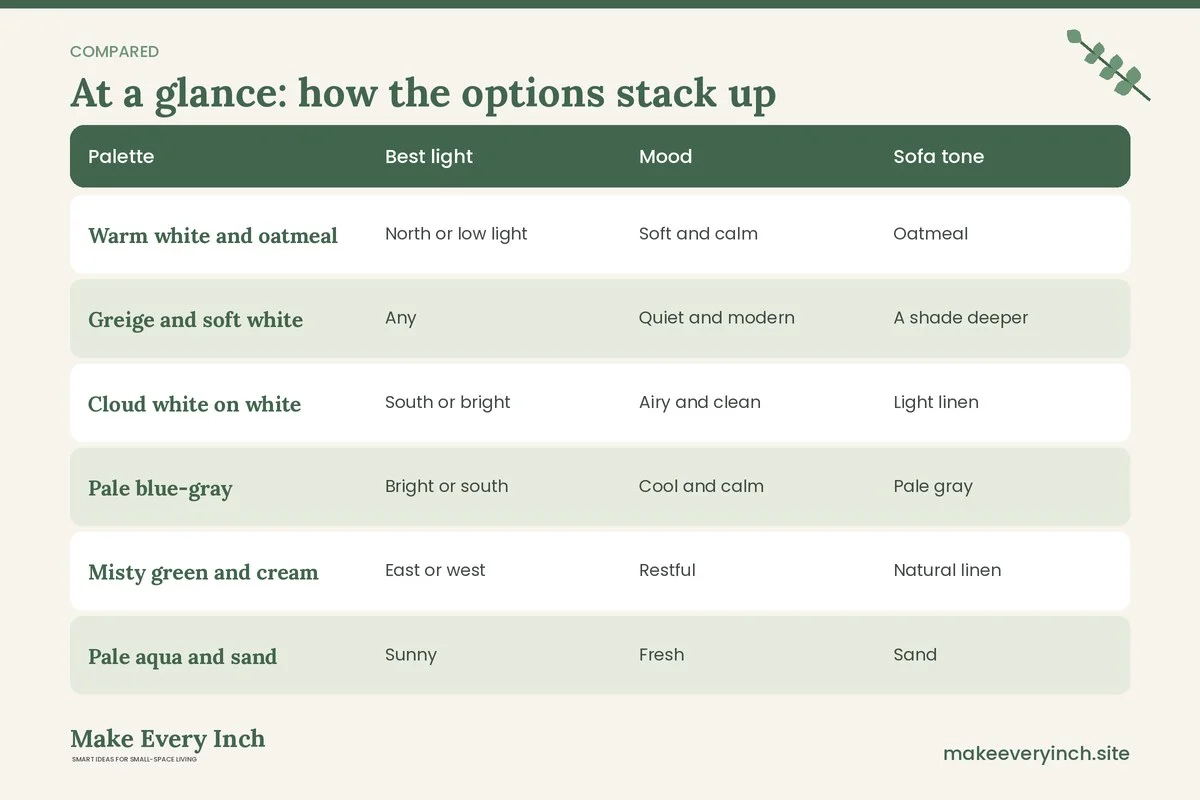
Palette comparison table
| Palette | Best light | Mood | Sofa tone | Accent idea |
|---|---|---|---|---|
| Warm white and oatmeal | North or low light | Soft and calm | Oatmeal | Clay, sage |
| Greige and soft white | Any | Quiet and modern | A shade deeper | Charcoal |
| Cloud white on white | South or bright | Airy and clean | Light linen | Texture, wood |
| Pale blue-gray | Bright or south | Cool and calm | Pale gray | Navy, brass |
| Misty green and cream | East or west | Restful | Natural linen | Plants, rattan |
| Pale aqua and sand | Sunny | Fresh | Sand | Driftwood |
| Blush and terracotta | North | Warm and soft | Cream | Terracotta |
| Butter yellow and white | Dim rooms | Cheerful | Gray or oatmeal | White, wood |
| One deep wall | Good light | Dramatic | Light neutral | Matching lamp or frame |
Use color to solve common problems
A low ceiling
Paint the ceiling a lighter tone than the walls, in a flat finish. Use vertical stripes in the curtains or an upright bookcase. Hang curtains close to the ceiling and let them fall to the floor.
A dark room
Choose warm whites and light, warm neutrals. Add a mirror opposite the window and keep the window free of heavy drapes. Avoid cool grays, which can turn dull and flat. If the room is truly dark, accept some warmth, and use lighting to lift it.
A long, narrow room
Paint the two short walls a slightly deeper tone than the long walls, which makes the room feel shorter. Keep the long walls pale.
A room with too many furnishings
Match the walls to the largest pieces. A sofa and a bookcase in the same tone as the wall blend in and make the room look cleaner.
A room with a small window
Paint the window frame the same color as the wall, so the window does not shout. Choose light curtains and hang them wide.
A room with a busy floor
If the floor has strong color or grain, keep the walls plain and the rug calm. Let the walls act as a quiet backdrop.
Finishes and textures that matter
Sheen changes the look of any color. A flat or matte finish hides bumps and scatters light softly, but it marks more easily. Eggshell and satin finishes reflect a little light and wipe clean, so they suit a family room. High gloss bounces the most light but shows every flaw, so it is best saved for trim or a doorway when the wall is smooth.
Texture can do the work of contrast. When a palette is tonal, add variety through materials: a nubby rug, a smooth ceramic lamp, a linen curtain, a leather chair, a woven basket. Without texture, a pale room feels flat, and with it the room feels rich. Aim for at least three textures in a tonal scheme.
Pattern should be small in scale and low in contrast. A large pattern on a rug is fine, but a bold pattern on a sofa, a curtain and a wall in a small room tires the eye. If you want pattern, keep it in one or two items, and in the same color family as the room.
Color beyond the walls
Floors
A light floor or a light rug opens a room. If the floor is dark and you cannot change it, use a lighter rug in a similar tone to the sofa so that the seating area still glows. Rugs that match the floor color make the floor look larger. See our guide on how to choose a rug size for a small living room.
Curtains
Hang curtains in the same color as the wall, or a shade lighter. This hides the curtain edge and makes the window look as part of the wall. Hang the rod close to the ceiling and wide of the window frame. Choose a light fabric, so that daylight filters through.
Large furniture
A sofa in the same family as the walls takes up less visual room. If you like contrast, make it a step deeper and not black against white. A pale sofa on a pale rug against pale walls looks serene, and dark legs add a sharp line that keeps it from vanishing.
Ceilings
A ceiling painted in a very pale tint of the wall color looks higher than a stark white one in some rooms, and softer. Use a flat finish to hide imperfections.
Art and accessories
Frame art in colors that repeat the room. A large piece in a light mat feels airier than a cluster of dark frames. Keep accessories in groups of odd numbers and leave surfaces partly empty.
Three example rooms
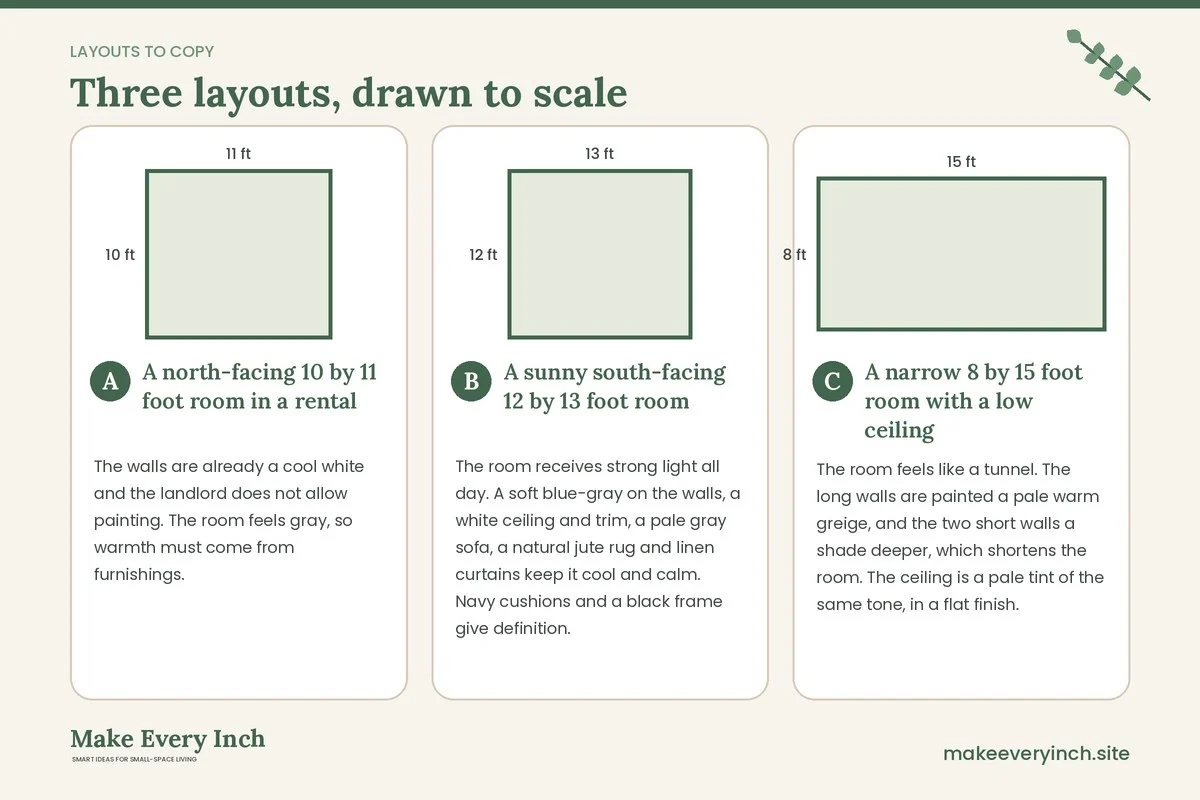
A north-facing 10 by 11 foot room in a rental
The walls are already a cool white and the landlord does not allow painting. The room feels gray, so warmth must come from furnishings. Choose a warm oatmeal sofa, a cream rug, curtains in a warm off-white hung wide and high, and a lamp with a warm bulb at each end of the sofa. Add terracotta and sage cushions and a wood side table. A big mirror opposite the window brings in more light. The room stays within one warm family, which reads as larger than a mixed scheme. Because it is a rental, ask before any paint is applied, and use removable options such as peel-and-stick panels only if the lease permits.
A sunny south-facing 12 by 13 foot room
The room receives strong light all day. A soft blue-gray on the walls, a white ceiling and trim, a pale gray sofa, a natural jute rug and linen curtains keep it cool and calm. Navy cushions and a black frame give definition. A pair of green plants adds life. The pale walls stop the sun from feeling harsh, and the cool tone keeps the room fresh in the afternoon.
A narrow 8 by 15 foot room with a low ceiling
The room feels like a tunnel. The long walls are painted a pale warm greige, and the two short walls a shade deeper, which shortens the room. The ceiling is a pale tint of the same tone, in a flat finish. The sofa sits across the room, in a tone a step deeper than the walls, and a rug in a similar tone under it holds the group together. Curtains run from just under the ceiling to the floor in the wall color. A tall bookcase painted to match the wall disappears into it. The room feels wider and taller without any wall being moved.
Test colors the right way
Never choose from a small chip in a shop. Follow these steps.
1. Narrow to three. Pick three colors in the same family, perhaps one lighter and one deeper than your first choice.
2. Get large samples. Paint sample boards, or large squares on the wall, at least 12 inches wide. Put a second coat on to avoid a thin look.
3. Move them around. Look at each sample on the wall by the window, in a corner and beside the sofa.
4. Check at three times. Look in morning, midday and evening, and again under lamps at night.
5. Hold furniture beside it. Put fabric swatches, the rug and the curtain beside each sample.
6. Wait a day. Colors look different when you are fresh. Choose the one you like on the second day.
Safety and practical notes for painting
- Ask permission. If you rent, get the landlord’s approval in writing before painting, and ask what you must do at move-out.
- Choose low-VOC or zero-VOC paint. It gives off fewer fumes, which matters in a small room with limited air flow.
- Ventilate. Open windows, and use a fan to pull air out. Keep children, pets and anyone sensitive to smells out of the room until it has aired.
- Protect electrical points. Turn off power at the breaker before removing switch plates, and do not paint over sockets. Avoid getting water or paint into outlets.
- Test for old paint. In older homes, paint may contain lead. If the paint is flaking in a home built before the 1980s, use a test kit or a professional before sanding or scraping.
- Use a stable ladder. Place it on a flat surface and do not overreach. Have someone nearby.
- Dispose of paint properly. Follow your local rules, and do not pour paint down a drain.
- Anchor tall furniture. If you move a bookcase to repaint behind it, put it back with anti-tip hardware fixed to the wall where the lease allows it.
Mistakes that close a room in
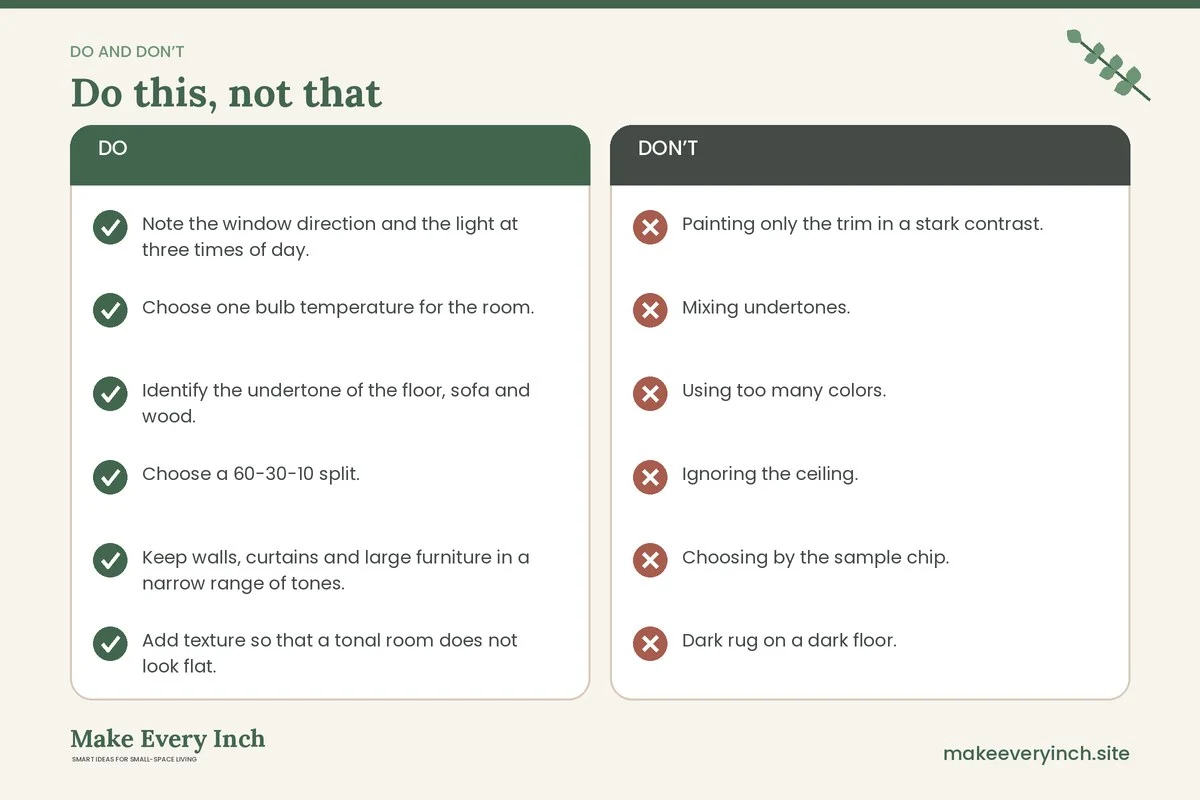
- Painting only the trim in a stark contrast. A thick white line around a gray room breaks it into pieces. Choose a trim shade close to the wall.
- Mixing undertones. A pink-beige sofa on a green-gray wall looks dirty.
- Using too many colors. More than three main colors in a small room is hard to resolve.
- Ignoring the ceiling. A bright white ceiling over beige walls can look harsh. Soften it.
- Choosing by the sample chip. Always test large samples.
- Dark rug on a dark floor. It forms a hole in the room.
- Heavy curtains in a dim room. Fabric that blocks the light closes the room in.
- Forgetting the lighting. A cool bulb makes a warm paint look dull.
Budget approach
A palette change does not require repainting the whole room. Start with what is cheap and reversible. Swap cushions, throws and a lamp shade first. Add a rug in a lighter tone, and change the curtains. These steps shift the room’s feel for a small outlay. If you paint, begin with the one wall that does the most, and consider a sample pot for a small accent piece, such as a bookcase or a side table. Second-hand furniture can be painted or reupholstered to fit the palette. Spread the work over several weekends, and judge each change before the next.
Weekend plan
Friday evening
Look at the room in the evening light and note how it feels. Photograph it in daylight and under the lamps.
Saturday
Choose a palette from this list, buy samples and paint large squares. Move them around the room. Order or find swatches for the fabrics.
Sunday
Decide, and begin with the easy swaps: curtains, cushions and rug. Paint if allowed, with the room aired and the furniture protected. Stand back before adding accents.
Checklist
- Note the window direction and the light at three times of day.
- Choose one bulb temperature for the room.
- Identify the undertone of the floor, sofa and wood.
- Choose a 60-30-10 split.
- Keep walls, curtains and large furniture in a narrow range of tones.
- Add texture so that a tonal room does not look flat.
- Limit the main colors to three.
- Test large samples at different times of day.
- Check the lease before painting or wallpapering.
- Use low-VOC paint and ventilate well.
- Protect sockets and switches, and ladder safely.
- Anchor tall furniture to the wall when you put it back.
FAQ
What is the best color to make a small living room look bigger?
There is no single best color. Light, warm or cool neutrals that suit your light, with low contrast between walls, curtains and large furniture, usually work best.
Is white always the best choice for a small living room?
No. A white that suits the room’s light can be excellent, but some rooms look flat or cold in white. A soft greige, pale green or pale blue-gray can feel more open and more comfortable.
Can a small living room have dark walls?
Yes, if the light is good and the rest of the room is calm. Painting one wall dark, or using a deep tone with a light ceiling and pale furnishings, adds depth without closing the room in.
Should the ceiling be white?
Often a very pale tint of the wall color works better than stark white. A flat finish hides flaws and keeps the ceiling soft.
How many colors should I use?
Two or three main colors plus a neutral. Keep the accent to about 10 percent of the room.
What color sofa suits a small living room?
One a step deeper than the walls, or in the same family. A light or mid-tone sofa on a light rug looks calm. See our guide on how to choose a sofa for a small living room.
Can I change the color scheme without painting?
Yes. Curtains, a rug, cushions, throws, lamp shades and art change the palette. For rentals, these are the safest steps. Our post on small living room ideas for renters offers more.
How do I link the living room to the next room?
Pick one color that repeats in both and keep the undertones consistent. Our post on small room color schemes that feel cohesive covers this.
Keep going: Keep planning with our small living room layout ideas, studio apartment color schemes and small living room ideas for awkward layouts.
Save this guide for later
Pin the ideas you like to Pinterest so you can come back to them when you plan your space.