Small Living Room Rug Size: How to Choose With Measurements
Quick answer: To choose rug size for a small living room, measure your seating area, not the whole floor. For most layouts, pick a rug where at least the front legs of the sofa and chairs rest on it, with roughly 6 to 18 inches of bare floor showing around the edge. Common sizes are 5 by 8 feet for compact rooms and 8 by 10 feet when the seating is larger. Tape the shape on the floor first, and secure the rug so it lies flat.
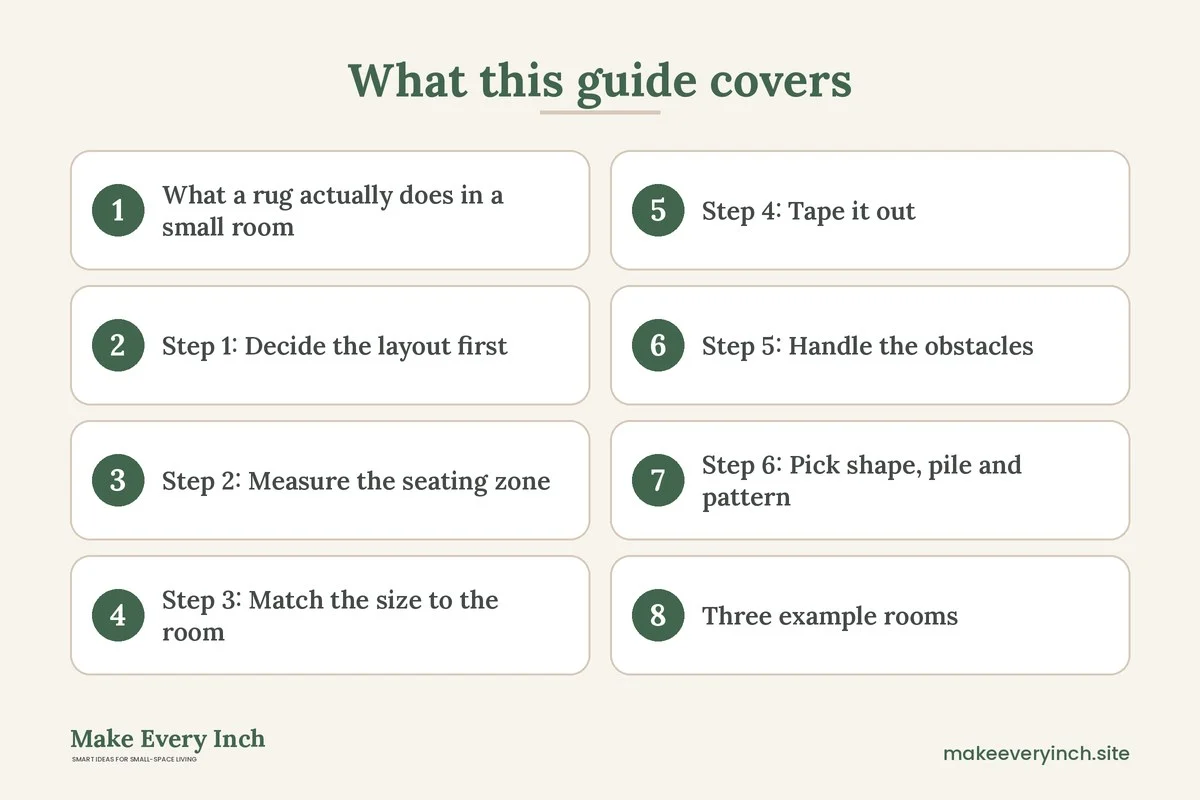
If you want to choose rug size small living room layouts can handle, the first lesson is that the rug is not meant to cover the room. It is meant to define the seating zone. In a compact space the wrong rug does two kinds of damage: a rug that is too small looks like a doormat floating in the middle, and a rug that is too big eats the floor and makes the walls feel closer. This guide shows how to measure, how to compare layouts, which common sizes suit which rooms, how to handle doors, vents and thresholds, and how to keep a rug safe and flat. It includes a size table, three example rooms, a taping method and a checklist. For the wider topic of styling a compact room, see our pillar guide on small room decor ideas.
What a rug actually does in a small room
A rug does four jobs. It anchors the seating so the furniture reads as one group. It adds color, pattern or texture. It softens sound and warms the floor underfoot. And it draws a visual boundary, which matters most in open plans and studios where the living room has no walls of its own. A good rug choice does all four without making the room look smaller.
Each job asks for something different. Anchoring asks for enough size to sit under the furniture. Color and pattern ask for restraint, because a bold pattern across a big area can dominate a small room. Comfort asks for a pile height that does not catch doors or furniture. The boundary job asks for a shape that matches the layout. Understanding which job matters most for you will help you choose.
Step 1: Decide the layout first
Before you look at sizes, decide how the furniture will sit. The right rug size changes with the layout, so this is the most important step. There are three common ways to place a rug in a living room.
All legs on the rug
Every piece of seating, plus the coffee table, sits fully on the rug. This is the most formal and the most generous, and it needs the biggest rug. In a small room it only works when the seating group is compact. It can make a room feel pulled together, but it needs enough floor that the rug does not touch the walls.
Front legs on the rug
The front legs of the sofa and chairs rest on the rug, and the back legs sit on bare floor. This is often the best choice for small rooms. It ties the group together, uses a smaller rug, and keeps a margin of floor visible. If you are unsure, start with this layout.
Rug floating in front of the furniture
Only the coffee table or the space between seats sits on the rug, and no legs rest on it. This is the weakest choice because the rug can look like it is floating, and it is easy to trip on the edge. Use it only if the room is too tight for any other layout, and then choose a rug at least wide enough to look intentional.
Step 2: Measure the seating zone
Measure the seating zone rather than the entire floor. Take these steps.
- Measure the width of the sofa. Include the arms.
- Measure the depth from the back of the sofa to the front of the coffee table, or to where your feet land.
- Measure the full footprint of the seating group, including any chairs.
- Measure the floor from wall to wall in both directions.
- Note doors, closet doors, radiators and floor vents, and measure how far each one swings or extends.
Write the numbers down. Then use the principle that the rug should extend beyond the seating group by a few inches on each side in the long direction, and that it should not touch walls. Many designers suggest leaving roughly 6 to 18 inches of bare floor around the rug in a small room, though your own room may need less or more. Treat these as starting points, not strict rules.
Step 3: Match the size to the room
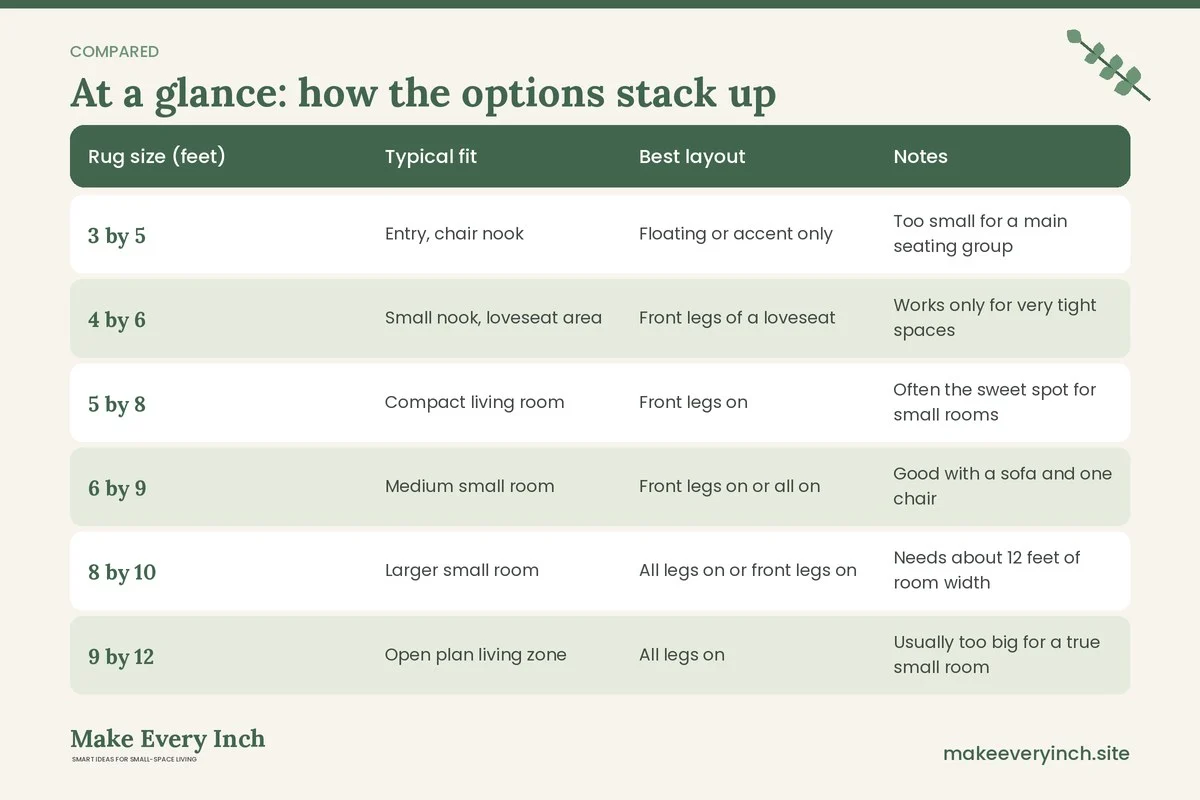
The table below gives general starting points for common rug sizes. Use it as a guide, and always check against your own measurements. Sizes are approximate, and actual products vary.
| Rug size (feet) | Typical fit | Best layout | Notes |
|---|---|---|---|
| 3 by 5 | Entry, chair nook | Floating or accent only | Too small for a main seating group |
| 4 by 6 | Small nook, loveseat area | Front legs of a loveseat | Works only for very tight spaces |
| 5 by 8 | Compact living room | Front legs on | Often the sweet spot for small rooms |
| 6 by 9 | Medium small room | Front legs on or all on | Good with a sofa and one chair |
| 8 by 10 | Larger small room | All legs on or front legs on | Needs about 12 feet of room width |
| 9 by 12 | Open plan living zone | All legs on | Usually too big for a true small room |
| Round 5 to 6 | Corner or chair group | Under a table or chairs | Softens a boxy room |
If your room is under about 10 by 12 feet, a 5 by 8 or a 6 by 9 will often work. If your room is closer to 12 by 14 feet, an 8 by 10 may fit comfortably. When two sizes both seem possible, the smaller one with a clear border is usually calmer than the larger one that nearly touches the walls.
Step 4: Tape it out
Paper and tape are the cheapest way to avoid a bad choice. Use painter’s tape or wide paper.
1. Mark the proposed rug rectangle on the floor with low-tack tape.
2. Place the furniture in its final position.
3. Check that the front legs sit on the tape area, or inside it.
4. Check the border of bare floor on every side. A narrow border of a few inches can look cramped, while a wide one of a foot or more looks deliberate.
5. Walk the path from the door to the seating, and from the seating to windows, to see if the rug blocks a doorway or a drawer.
6. Leave the tape down for a day, and look again at different times of day.
Remember to test the tape on a hidden area first if you have a delicate floor, and remove it slowly. Do not leave tape for weeks.
Step 5: Handle the obstacles
Small rooms are full of obstacles. These are the ones that most often change the rug choice.
Doors
Check the swing of every door. A rug with a thick pile can catch the bottom of a door. Measure the clearance and, if needed, choose a low-pile or flat-weave rug. Do not trim a rug in a way that weakens it, and ask before changing a door.
Floor vents and radiators
Keep rugs from blocking heating and cooling vents. A rug over a vent can restrict airflow, and some heat sources can damage a rug. Keep a clear gap, and never place a rug against a radiator or heater.
Thresholds and transitions
If the living room opens to a hall or kitchen, check where the floor changes. A rug that ends at a threshold can create a lip that people trip over. Leave a clear border of floor, or choose a rug that stops well before the transition.
Furniture with low clearance
Some sofas and consoles sit only a fraction of an inch above the floor. A thick rug can make them rub, and may stop drawers from opening. Measure the clearance and choose a thinner rug if necessary.
Step 6: Pick shape, pile and pattern
Size is the main decision, but shape, pile and pattern matter in a small room.
Shape
Rectangles suit most layouts, because they follow the lines of the sofa and the room. Round rugs soften a room full of corners and work well under a small table or in a corner chair nook. Runners suit narrow rooms or hallways, and can be placed under a pair of side tables. Avoid irregular shapes in a very small room, because they can make the floor feel fussy.
Pile height
Low pile and flat weaves lie flat, slide under doors and furniture, and are easier to vacuum. High pile feels soft but can catch on doors and hide crumbs. For a small living room that is used every day, many people prefer low to medium pile. If you have a robot vacuum, check its clearance limits.
Color and pattern
Light and neutral rugs tend to make a small room feel open, and a medium tone hides marks. A pattern with a medium-scale design can hide wear, while a very large pattern can overwhelm a small floor. If you want a bold piece, make it the only bold item in the room. For help with palettes, see our guide to studio apartment color schemes and the post on dark apartment ideas.
Three example rooms
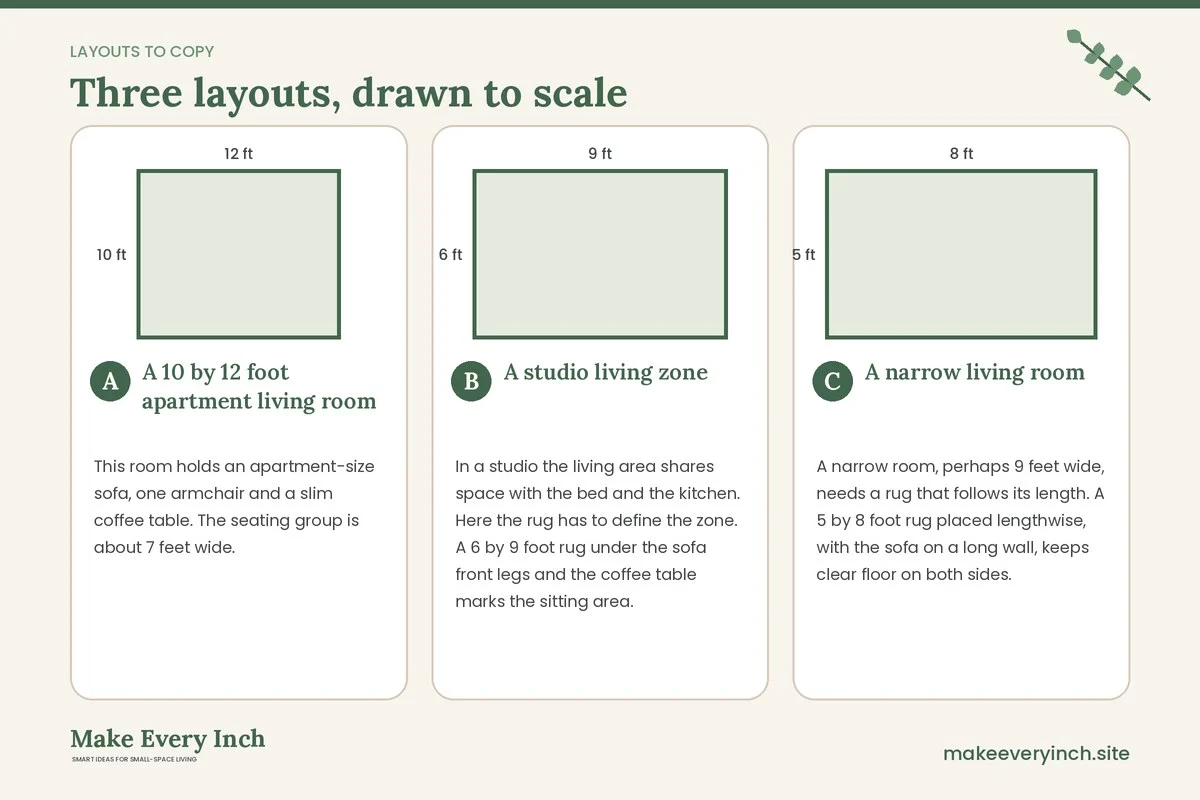
A 10 by 12 foot apartment living room
This room holds an apartment-size sofa, one armchair and a slim coffee table. The seating group is about 7 feet wide. A 5 by 8 foot rug placed so the front legs of the sofa and chair rest on it ties the group together, and leaves bare floor of roughly a foot at the sides. An 8 by 10 would nearly touch the walls and make the room feel crowded.
A studio living zone
In a studio the living area shares space with the bed and the kitchen. Here the rug has to define the zone. A 6 by 9 foot rug under the sofa front legs and the coffee table marks the sitting area. A second, smaller rug or runner by the bed separates the sleeping area. Do not let the two rugs overlap or touch. For more ideas, read studio apartment layout ideas that create zones.
A narrow living room
A narrow room, perhaps 9 feet wide, needs a rug that follows its length. A 5 by 8 foot rug placed lengthwise, with the sofa on a long wall, keeps clear floor on both sides. Avoid a rug that spans the full width, because it removes the border that makes the room look wider. See narrow living room ideas for layout options.
Keep the rug safe and flat
A rug that curls or slides is a hazard, and a small room has little space to absorb a fall. Follow these safety points.
- Use a pad or grip. A rug pad or non-slip underlay helps hold a rug in place. Choose one suited to your floor type, because some materials can mark certain finishes. Check the maker’s guidance.
- Fix curled corners. Do not leave curled corners or edges. Use rug tape that is rated for your floor, test it in a hidden spot, and ask the landlord if the floor is delicate.
- Keep cords out. Never run cords under a rug. A cord under a rug can be damaged by foot traffic and can overheat, and it is a hazard.
- Mind lamps and heat. Keep rugs clear of heaters and hot lamps, and keep lamp cords tidy. See renter friendly ways to hide cords.
- Watch pets. Some rugs and pads shed fibers that pets can chew or swallow. Choose with pets in mind, and clean up any loose threads.
- Check allergies. Some rugs and pads can trap dust. Vacuum regularly and follow the care label.
- Ask first. Before using adhesive on floors or moving heavy furniture on a delicate surface, check your lease.
- Lift with care. Large rugs are heavy. Ask for help rolling them, and keep your back straight.
Common mistakes to avoid
Buying by the floor area
The most common error is choosing a rug to fill the room. A rug should fit the seating, with a margin. A rug that fills the floor leaves no border, and the room feels smaller.
Forgetting the coffee table
If the coffee table sits partly on the rug and partly off, the legs may wobble. Place either all of it on the rug or none of it, and check that it sits level.
Ignoring traffic paths
A rug should not sit across the main path from the door. If it does, people will catch the edge. Shift it so the path stays on bare floor or on a rug that lies very flat.
Choosing a pattern first
It is easy to fall in love with a pattern and then discover the size does not fit. Measure first, then pick the pattern from the sizes that work.
Using several small rugs
Three small rugs in a small room create more edges and more visual breaks. One properly sized rug usually looks calmer. Our guide on small space decorating mistakes to avoid covers this and other errors.
Rugs and the rest of the room
The rug interacts with everything else. Its color can match or contrast with the sofa, curtains and walls. Its size affects how the lighting looks, because lamps cast pools of light onto rugs. Its texture can soften a hard floor, and help with sound in an apartment. When you change the rug, check whether you also need to adjust the lamps, curtains or art.
For lighting, our guides to renter friendly lighting ideas and small living room lighting ideas can help. For layouts, read small living room ideas and small living room layout ideas. For apartments that blend several functions, see apartment decorating styles.
Budget notes
You can improve a rug choice without spending much. Measure carefully, tape the shape and wait a day before you commit. Look at secondhand, remnant and clearance options if you are comfortable with them, and have a rug professionally cut or bound only if the maker says it is suitable. Pair a smaller rug with a pad. If you are trying to stretch a budget, see budget small space ideas and small apartment decor under 100.
Common questions
Can a rug be too big for a small living room?
Yes. If it leaves less than a few inches of floor at the edges, or touches the walls, the room can feel crowded. A visible border usually looks better.
Should the sofa be on the rug?
In most small rooms, at least the front legs should rest on the rug. That ties the group together. Putting all legs on works when the rug is large enough.
What if my room is too small for a 5 by 8 rug?
Try a 4 by 6 under a loveseat, or a round rug in a corner. Remember that a rug too small to reach the furniture may look like a mat.
Is a round rug a good choice?
It can be, especially in a room full of straight lines or with a corner chair group. Check that it supports the legs of the main furniture.
How do I stop a rug from sliding?
Use a non-slip pad suited to your floor, and check the manufacturer’s advice. Keep corners flat and avoid placing rugs over thresholds.
Can I layer rugs?
You can, with care. Put a flat-weave rug under a smaller one, and keep the edges from overlapping into a trip hazard. In very small rooms, one rug is usually simpler.
Final checklist
- Decide the layout: all legs on, front legs on, or floating.
- Measure the seating group and the room.
- Check door swings, vents, radiators and thresholds.
- Tape the proposed rug shape and live with it for a day.
- Leave roughly 6 to 18 inches of bare floor around the rug.
- Choose low or medium pile for doors and furniture.
- Pick a pattern scale that suits the room.
- Use a non-slip pad and keep corners flat.
- Never run cords under the rug.
- Keep rugs away from heaters and hot lamps.
- Check the lease before using adhesive or tape on floors.
Keep going: Next, read the pillar guide on small room decor ideas, review small space decorating mistakes to avoid, and plan the rest of the room with small living room ideas.
Save this guide for later
Pin the ideas you like to Pinterest so you can come back to them when you plan your space.