How to Choose a Sofa for a Small Living Room
Quick answer: To choose a sofa for a small living room, measure the room, the walkway and the delivery path first, then look for a depth of about 32 to 36 inches, a length of roughly 65 to 80 inches, slim arms, visible legs and a seat that is firm enough to sit up from. Pick a fabric that suits your household, tape the footprint on the floor and confirm the return rules before you buy.
If you want to choose a sofa for a small living room, the hardest part is that the sofa is both the largest and the most used piece in the room. It sets the walkway, decides where the TV goes, and shapes how welcoming the room feels. A sofa that is a few inches too deep can turn a comfortable room into an obstacle course, while one that is too small leaves you perched on the edge. This is a buying guide, not a list of products. It explains what to measure, which shapes and features suit tight rooms, how materials and fillings compare, what to check before delivery, three example rooms, a decision table and a checklist. For the wider shopping context, our pillar on the best furniture for small apartments covers the whole room, and our sibling post on small space furniture layout rules explains where the sofa should go once you have chosen it.
Start with the room, not the showroom
Most sofa regrets start with shopping first and measuring second. A showroom has high ceilings, wide aisles and lighting that makes every piece look compact. Your living room has a door, a radiator and a walkway that you have to live with. Do the measuring before you look at any sofa.
Measure the wall and the floor
Find the wall the sofa will sit on, and measure its length. Subtract anything that must stay clear, such as a door swing, a radiator, a vent or a window you need to open. Then measure the floor in front of the wall to the opposite wall or media unit. In many small rooms, a clear walkway of about 30 to 36 inches in front of the sofa is a good target, and about 24 inches is a tighter minimum for a path used only now and then. Subtract the walkway from the floor depth and you know the most sofa depth you can afford, once you add room for a coffee table or a pouf if you want one.
Measure the delivery path
A sofa that fits the room but not the building is a real problem. Measure the width of the front door, the hallway, the stairwell, any turn, the elevator and the apartment door. Check ceiling height on stairs and overhead pipes. Compare these to the sofa’s width, depth, height and diagonal depth, which manufacturers often list. Many sofas have removable legs, removable arms or a modular design, which can help with tight turns. If the dimensions are close, ask the seller about the delivery process and the return policy before you pay.
Tape the footprint
Use painter’s tape to mark the sofa’s length and depth on the floor, and stand cardboard boxes to approximate the height. Leave it for two days. Walk past, open doors, and sit on a chair at the edge of the tape to imagine the seat. If you feel hemmed in, shorten the sofa or reduce its depth. This low-cost step prevents many returns.
The dimensions that matter most
A sofa has several measurements, and they work together.
- Length: many small living rooms suit a sofa of about 65 to 80 inches. A loveseat is usually 55 to 65 inches, and a full sofa is often 80 to 90 inches or more.
- Depth: standard sofas are often 36 to 40 inches deep. Shallower models of 30 to 35 inches save floor space but feel less like a lounge. Depth has a bigger effect on a small room than length.
- Height: a low back of about 30 to 33 inches keeps sightlines open, especially if the sofa floats in the room. A tall back adds support but also visual weight.
- Seat depth: the part you sit on is usually 20 to 24 inches. Deeper seats suit lounging and shorter ones suit upright sitting.
- Seat height: often 17 to 19 inches. Taller people or those with sore knees may prefer a higher seat, since it is easier to stand from.
- Arm width: arms can take 4 to 10 inches on each side. Slim arms give you more seat in the same length.
- Leg height: 5 to 8 inches of leg shows the floor and looks lighter than a skirted base.
Compare the overall length to the seat length. Two sofas with the same overall measurement can differ by a full seat width because of the arms.
Sofa shapes and how they behave in a small room
Loveseat
A loveseat seats two and often measures 55 to 65 inches long. It suits a tiny living room, a bedroom sitting area or a studio, where the sofa shares the room with a bed. The trade-off is that two adults can feel close, and a guest has nowhere to lie down. Pair it with an armchair for extra seating.
Apartment sofa
An apartment sofa is typically 70 to 80 inches long with a shallower depth and slimmer arms. It seats three people for short periods and is the usual choice for living rooms of 10 by 12 feet. Look for models described as compact, and compare actual dimensions, since labels vary.
Standard sofa
A standard sofa of 80 to 90 inches or more suits rooms of about 12 by 14 feet or larger. In a smaller room it can dominate, so measure carefully. If you host often, a standard sofa with slim arms can still work when the rest of the furniture is lightweight.
Small sectional or chaise sofa
A small L-shaped sofa or a sofa with a chaise gives lounging space without a second piece. The footprint is larger, though, and the orientation (left or right) matters. Check that the chaise side does not block a door or a walkway. If you are weighing this option, read our guide to the best sectionals for small living rooms.
Sleeper or convertible sofa
A sofa bed or a daybed converts for guests. It is useful when you have no spare room, but the mechanism takes space and it needs a clear area to unfold. Folding mechanisms have pinch points, so keep hands and children clear while opening and closing, and do not stand on a half-opened frame. Check how much floor you need when it is open.
Armless or low-arm sofa
An armless sofa or a bench-style sofa looks light and fits tight spaces, because you gain seating length without bulk. The downside is that there is nothing to lean on, so it suits people who sit upright or use cushions.
Comparison table: sofa types for small rooms
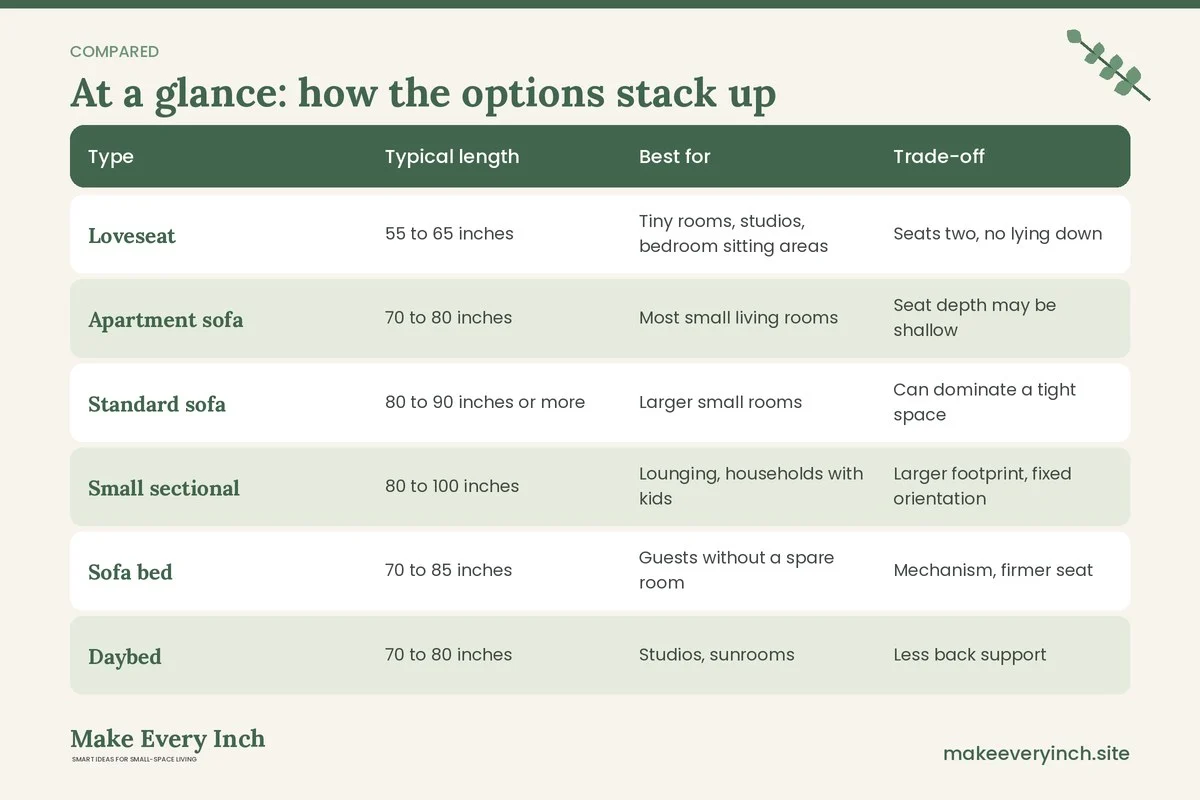
| Type | Typical length | Best for | Trade-off |
|---|---|---|---|
| Loveseat | 55 to 65 inches | Tiny rooms, studios, bedroom sitting areas | Seats two, no lying down |
| Apartment sofa | 70 to 80 inches | Most small living rooms | Seat depth may be shallow |
| Standard sofa | 80 to 90 inches or more | Larger small rooms | Can dominate a tight space |
| Small sectional | 80 to 100 inches | Lounging, households with kids | Larger footprint, fixed orientation |
| Sofa bed | 70 to 85 inches | Guests without a spare room | Mechanism, firmer seat |
| Daybed | 70 to 80 inches | Studios, sunrooms | Less back support |
| Armless bench sofa | 60 to 80 inches | Minimal rooms | No arms to lean on |
Features that help in small rooms
Slim arms
Arms that are 4 to 6 inches wide leave more seat in a given length. Rolled arms look cozy but take more width. Track arms and square arms are slim and tidy. If you want an arm that can hold a mug, a flat top of 6 inches is a useful minimum.
Raised legs
Legs of 5 to 8 inches show the floor, which helps a room look larger and helps cleaning. They also let you slide storage boxes underneath. Check how the legs attach, whether they can be removed and how they affect the seat height.
A shallower back or a low back
A low back keeps the sofa from blocking light and sightlines, especially when it floats. A back that is too low can feel unsupported, so add a cushion or a pillow.
Modular or removable parts
Modular sofas arrive in pieces, which can help in tight stairwells. Removable arms and backs help too. They also allow you to reconfigure later, such as turning a sectional into a sofa and a chair.
Storage
Some sofas include a chaise with storage, or drawers in the base. This can replace a separate chest, but the base is usually bulkier and raises the seat. Weigh the added storage against the extra weight and the loss of visible floor. For stand-alone options, see our guide to the best storage ottomans.
Washable or replaceable covers
If you have children, pets or spill-prone habits, covers that can be removed and washed extend the sofa’s life. Check the care label, since some covers are dry-clean only.
Materials and fillings: what to weigh
The frame, the cushion fill and the fabric together decide how the sofa feels over time. This section avoids brands and focuses on the types you will see.
Frames
A solid hardwood frame or an engineered wood frame with reinforced joints is a common sign of durability. A plain softwood frame with staples alone may wear faster. Ask about joint construction, such as corner blocks, dowels or screws, and about weight limits. Metal frames, often found in sofa beds, add strength but also weight.
Cushion fills
- Foam: holds its shape and is firm, with density varying by product. Higher density usually lasts longer.
- Foam wrapped in fiber or feathers: softer on the surface, with a firm core. It needs fluffing.
- Feather or down blends: very soft, need regular plumping, and can aggravate allergies.
- Spring-based seats: supportive, but heavier and sometimes noisier.
For small rooms, a firm or medium-firm seat helps you stand up from a low seat, and cushions that stay in place keep the sofa looking tidy.
Fabrics
| Fabric type | Strengths | Trade-offs |
|---|---|---|
| Tightly woven polyester or blends | Durable, often stain-resistant | Can feel less natural |
| Cotton or linen blends | Breathable, relaxed look | Wrinkles and stains more easily |
| Performance fabrics | Designed to resist spills and wear | Can feel slightly synthetic |
| Leather or faux leather | Wipeable, firm | Can be cold, scratches, may crack with age |
| Velvet | Rich look, soft | Shows crush marks and pet hair |
| Boucle and textured weaves | Cozy, hides crumbs | Can snag with claws |
Pick a mid-tone or a light-to-medium color if the room is small and dark, and avoid a pattern that is too large for a short sofa. A solid color in a texture usually looks calm, and you can add pattern with pillows.
Choose by how you live
The best sofa depends on what you do on it.
- Mostly sitting upright to watch TV or read: a seat depth of 20 to 22 inches and a firmer cushion work well.
- Lounging or napping: a deeper seat, a chaise or a sofa with a low back and big cushions suits you.
- Hosting: consider a longer sofa, a pair of poufs or a light chair that can be moved.
- Sleeping guests: a sofa bed or a daybed saves a separate bed, but check the mattress feel and the floor space.
- Pets and children: washable covers, tight weaves and legs that raise the sofa for cleaning are useful.
- Working from the sofa: a firm seat with upright back support, and a side table or a C-shaped table for the laptop.
Place the sofa, then plan the rest
Once you have a sofa in mind, decide where it will go and how the rest of the room supports it. The following ideas keep the sofa from taking over.
- Against the longest wall: this is the simplest option and frees the floor.
- Floated to divide a studio: pull the sofa 12 to 24 inches from the back wall if you need room for a console, and make sure the walkway behind it is workable. See our studio apartment ideas with a room divider post.
- Facing the window: this suits rooms with a view and keeps the TV on a side wall.
- Under a window: low-back sofas work under windows, but check radiators and window latches.
Next, choose a coffee table or alternatives. A table 14 to 18 inches from the sofa edge is typical, and a round or oval shape avoids sharp corners in a tight walkway. If the room is small, a nest of tables, a tray ottoman or a side table may serve better. Our post on small living room ideas without a coffee table shows several approaches.
Three example rooms
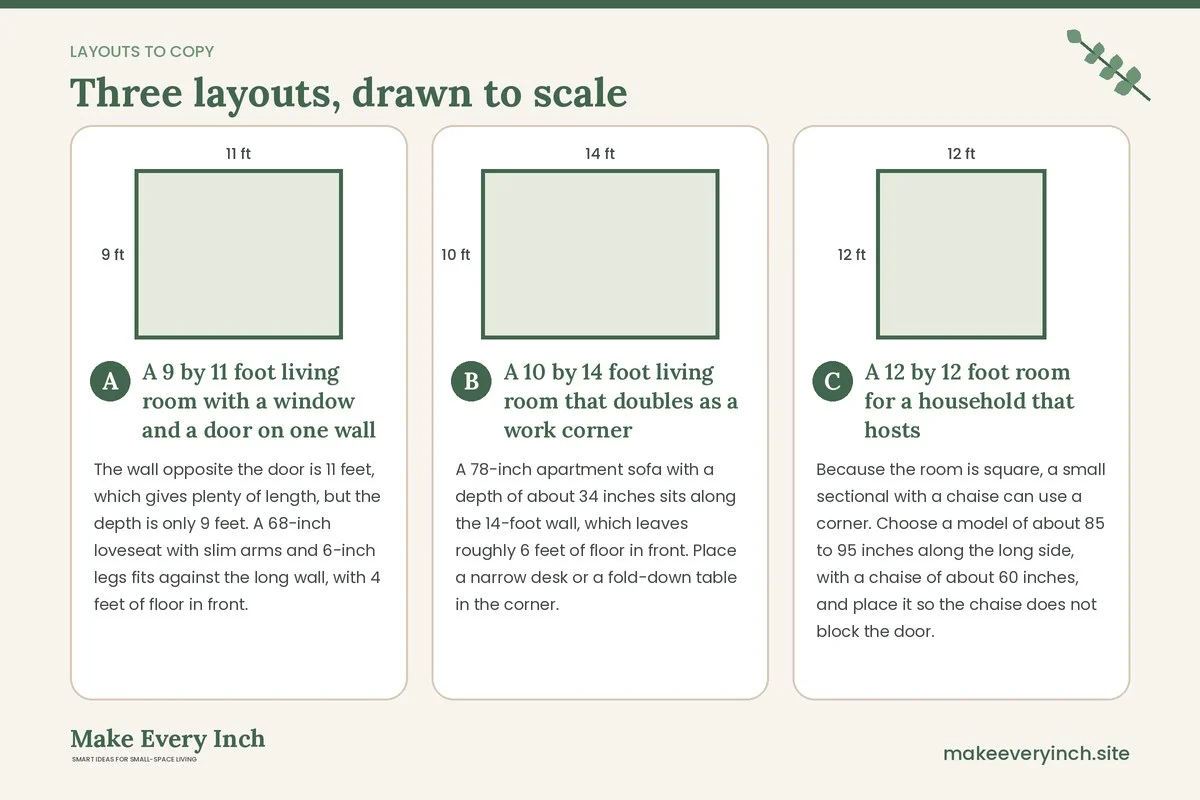
A 9 by 11 foot living room with a window and a door on one wall
The wall opposite the door is 11 feet, which gives plenty of length, but the depth is only 9 feet. A 68-inch loveseat with slim arms and 6-inch legs fits against the long wall, with 4 feet of floor in front. A small round table and a slim bookcase fill the corner. The loveseat seats two, and a floor cushion or a stool serves extra guests. This setup keeps the walkway at about 36 inches.
A 10 by 14 foot living room that doubles as a work corner
A 78-inch apartment sofa with a depth of about 34 inches sits along the 14-foot wall, which leaves roughly 6 feet of floor in front. Place a narrow desk or a fold-down table in the corner. The sofa has a low back, so the room feels open from the door. A firm seat supports laptop use, and washable covers handle everyday wear. For more on this layout, see our small living room layout ideas.
A 12 by 12 foot room for a household that hosts
Because the room is square, a small sectional with a chaise can use a corner. Choose a model of about 85 to 95 inches along the long side, with a chaise of about 60 inches, and place it so the chaise does not block the door. Add two poufs that tuck under a console. The L shape seats four to five people, and the chaise supports lounging. Keep a 30 to 36 inch path to the kitchen. If the lease allows, anchor a tall bookcase on the opposite wall.
What to check before you buy
Use this list in the shop or while reading a product page.
1. Dimensions: length, depth, height, arm width, seat depth, seat height and leg height.
2. Diagonal depth: the number that tells you if it will turn a corner.
3. Weight: useful for stairs and for moving it later.
4. Delivery: whether it arrives assembled, in parts or in a box, and whether the seller carries it inside.
5. Return policy: time limits, restocking charges and who pays for the return.
6. Warranty: what it covers (frame, springs, cushions) and for how long.
7. Fabric care: washable covers, spot cleaning, dry-clean only.
8. Smell and off-gassing: new foam and finishes can have a smell. Ventilate the room by opening a window for a few days and keep pets and children away from fresh packaging.
9. Fire safety labels: check that the product carries the safety labels required where you live.
10. Test sit: try the seat for at least ten minutes if possible, and stand up a few times.
Safety and lease notes
A sofa is heavy, so plan the move with a second person and protect floors with sliders or furniture pads. Keep sofa beds away from heaters and make sure the mechanism is locked before use. Fold and unfold mechanisms slowly, and keep fingers away from hinges. If the sofa sits near a bookcase or a wall shelf, anchor any tall furniture, and never hang shelves over the sofa unless they are fixed into studs and within the hardware’s stated load limit. If you rent, do not drill without permission; use freestanding lamps and shelves instead. Our guide to renter friendly lighting ideas shows lighting options that need no wiring.
Common mistakes when choosing a small living room sofa
- Buying by the label. Words like compact or apartment size vary, so compare dimensions.
- Ignoring depth. Many people check only the length, then find the sofa blocks the room.
- Forgetting the delivery path. Measure doors, stairs and corners.
- Choosing a seat that is too soft. A very soft seat can be hard to rise from and sag early.
- Matching the sofa to the showroom lighting. View swatches at home in daylight and evening light.
- Skipping the tape test. A taped outline costs nothing and reveals problems.
- Choosing a color that fights the room. A light neutral can make a small room feel bigger, but think about stains and pets.
- Overlooking the coffee table. The sofa and table need to work together.

Budget approach
You do not have to buy the biggest or most expensive option. Decide which features matter most (depth, firmness, washable covers), accept trade-offs on others and plan to spend more on the frame and the cushions than on decorative details. Secondhand sofas can be a good source if you check the frame, the cushions and the smell, and measure the delivery path. If funds are tight, a simple sofa with a good frame and cheap pillows beats a stylish one that sags. Our budget friendly furniture ideas for small apartments post covers other ways to stretch a budget.
Pulling it together: a decision checklist
- Measure the wall, the walkway and the delivery path.
- Tape the footprint for two days.
- Aim for a depth of about 32 to 36 inches and a length of 65 to 80 inches, adjusting to your room.
- Choose slim arms and raised legs.
- Pick a seat firmness you can stand up from easily.
- Match the type to how you live, such as sitting, lounging, hosting or sleeping.
- Choose a fabric that fits pets, children and cleaning habits.
- Check frame construction, warranty and return policy.
- Ventilate a new sofa for a few days.
- Anchor tall furniture nearby, and avoid drilling without permission.
- Plan the coffee table, lamp and rug around the sofa.
FAQ
What size sofa is best for a small living room?
Many small rooms suit a sofa of about 65 to 80 inches long and 32 to 36 inches deep. Measure your own room, since the right size depends on the walkway and other furniture.
Is a loveseat or a sofa better for a small space?
A loveseat saves floor and suits tiny rooms, but it seats only two. An apartment sofa seats three and often fits rooms of about 10 by 12 feet. Pick based on how many people use it.
Should I choose a sectional for a small living room?
It can work in a room that is square or has a free corner, because it adds seating and lounging space. In a narrow room it can block the path. See our sectional guide for more.
How deep should a small sofa be?
Many people choose 32 to 36 inches, which saves floor space while keeping a seat usable. Very shallow sofas can feel perched, so sit on one if you can.
Do legs make a sofa look smaller?
Raised legs of about 5 to 8 inches show the floor beneath the sofa, which tends to make a room feel lighter and more open. They also help with cleaning.
What fabric should I choose?
Tightly woven or performance fabrics suit homes with children and pets, and cotton or linen blends suit calm adult households. Look at care instructions and removable covers.
How do I get a sofa up narrow stairs?
Measure the stairwell and turns, compare them with the sofa’s diagonal depth and look for models with removable legs, arms or a modular design. Ask about delivery options before you buy.
Keep going: Keep planning with our best sofas for small apartments, our small space furniture layout rules and our small living room ideas.
Save this guide for later
Pin the ideas you like to Pinterest so you can come back to them when you plan your space.