27 Small Living Room Ideas That Make a Tiny Space Feel Bigger
Quick answer: The best small living room ideas start with a layout that keeps walkways clear, then add furniture on legs, wall and vertical storage, light colors, layered lighting and one big mirror. Choose multi-purpose pieces, keep surfaces clear and edit what you own, then use the guides below for each problem.
Small living room ideas work best when you treat the room as a system: the layout decides how it moves, the furniture decides how it holds things, the color and light decide how it feels, and the habits decide whether it stays that way. A room of 120 to 200 square feet can sit, store, entertain and sometimes work, as long as every item earns its place. This guide is the hub for our whole living room series. It shares 27 ideas, a decision table, three example rooms, a weekend plan and a checklist, and it links to a deeper guide for every topic, so you can go from the big picture to the details.
Start here: which small living room problem do you have?
Most small living rooms suffer from one or two problems, not all of them at once. Find yours and jump to the matching guide.
- The room feels cramped and awkward: read small living room layout ideas and narrow living room ideas.
- There is nowhere to put things: read small living room storage ideas.
- The furniture is too big or the wrong shape: read small living room furniture ideas and small living room ideas with a sectional.
- The room is dark or flat: read small living room lighting ideas.
- The room feels cold or empty: read cozy small living room ideas.
- You rent: read small living room ideas for renters and small apartment living room ideas.
- The TV dominates the room: read small living room TV wall ideas.
- You want a bigger change: read small living room makeover ideas.
- The coffee table is in the way: read small living room ideas without a coffee table.
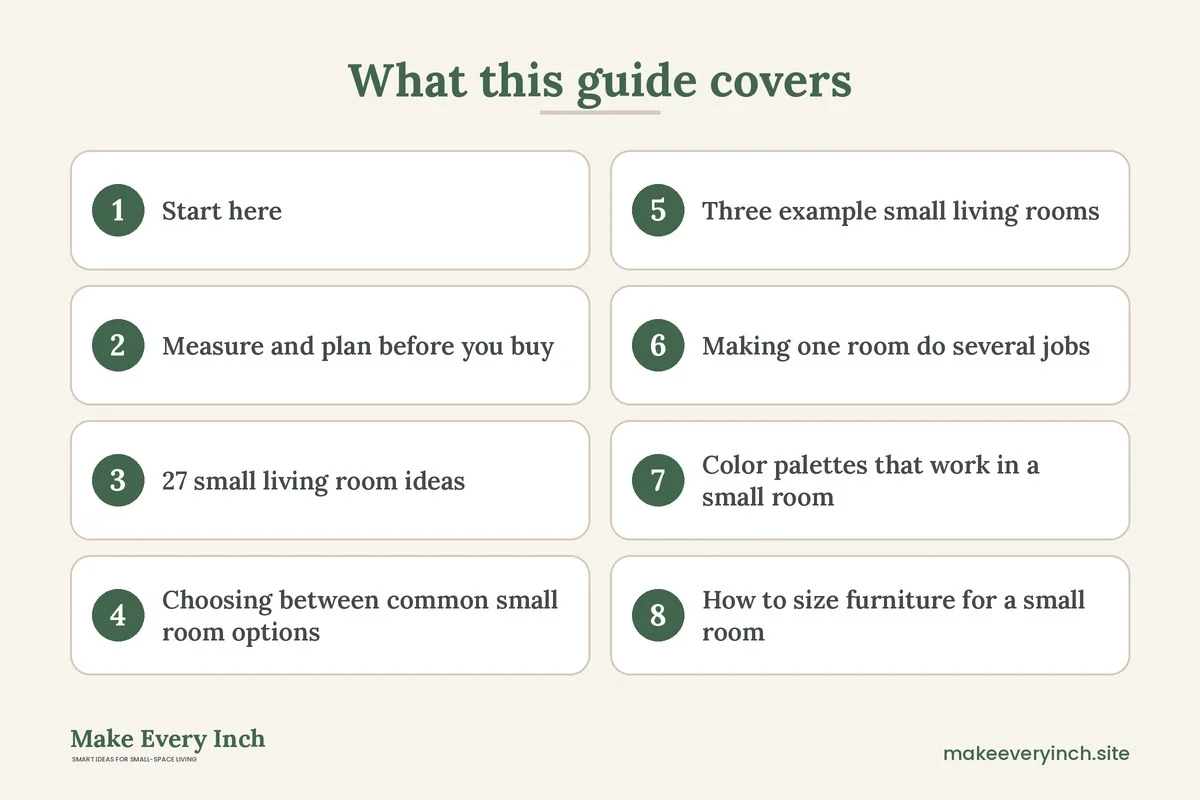
Measure and plan before you buy
Measure the room wall to wall, then measure the windows, doors, radiators, vents and outlets. Draw a simple plan on graph paper or a free app, and mark where people walk. A good small room keeps a path of 30 to 36 inches clear between the door and the main seat, and 14 to 18 inches between the sofa and the coffee table. Write down the three things the room must do, such as seating for four, a place to work and storage for books, and plan around them. Plans prevent the most common small-room mistake, which is buying a piece that looks perfect in the store and does not fit at home.
27 small living room ideas
Layout ideas
1. Float the sofa away from one wall
Pulling a sofa a few inches off a wall, or using it to divide a space, can make the room feel organized. In a narrow room, keep the sofa against the long wall and leave the center open.
2. Anchor the room with one rug
A rug that is big enough for the front legs of every seat ties the furniture together and makes the room look larger. Skip small rugs that float like islands.
3. Keep one clear sight line
From the door, you should see the window or a bright wall. A clear line draws the eye through the room.
4. Choose a focal point
The TV wall, a window, a fireplace or a piece of art can be the focus. Arrange seats toward it, and keep the other walls quiet.
5. Use a corner for a flexible zone
A corner can hold a reading chair, a desk or a plant stand, which gives the room a second function without more floor space.
Furniture ideas
6. Pick a sofa with a slim arm and visible legs
Legs show the floor underneath, which makes the room feel lighter. Slim arms save six to eight inches of width.
7. Use a loveseat or a compact sectional
A small sectional can give more seats than a sofa and chairs. Keep the chaise on the side that does not block a walkway.
8. Swap the coffee table for nesting tables
Two nesting tables, a pouf or a small round table take little room and move when you need space.
9. Use ottomans with storage
An ottoman holds blankets, games and remotes and doubles as a seat or a footrest.
10. Choose a console that is slim
A console 10 to 14 inches deep fits behind a sofa or along a wall and holds lamps and baskets.
11. Pick chairs that can move
Light armchairs and stools can come to the sofa when guests visit and tuck away afterward.
Storage ideas
12. Use the walls
Floating shelves, picture ledges and wall-mounted cabinets use the space above eye level. Keep the lower area open.
13. Choose tall, narrow bookcases
Tall pieces store more per square foot of floor. Anchor them to the wall for safety.
14. Hide clutter in closed storage
Baskets with lids, cabinets with doors and a media console with drawers hide the small things that make a room look busy.
15. Use the space behind the sofa
A slim console or a low shelf behind the sofa holds books and lamps and defines the zone.
16. Use the window
A deep window sill, a bench or a slim shelf under the window adds storage without taking walkway.
Color and style ideas
17. Use a light, warm palette
White, cream, soft gray and pale sage reflect light. Add contrast with wood, black or deep green in small pieces.
18. Paint the walls and trim the same color
When the walls and trim match, edges disappear and the room feels taller. If you cannot paint, use the same idea in your textiles.
19. Use fewer patterns, larger scale
One large pattern is calmer than many small ones. Repeat colors across the room so the eye can rest.
20. Add texture
Linen, wool, wood and woven baskets add depth in a neutral room without cluttering it.
Light and mirror ideas
21. Layer the lighting
Use a floor lamp, a table lamp and a small accent light so the room works for reading, TV and company. Warm bulbs of 2700K feel inviting.
22. Hang a large mirror
Put it opposite a window to double the light, or lean one against a wall for a relaxed look.
23. Hang curtains high and wide
Mount the rod near the ceiling and extend it past the frame. Light, sheer panels let daylight in and make the ceiling look taller.
Finishing touches
24. Edit the surfaces
Keep only a few objects on each surface. Group items in threes and leave space around them.
25. Use plants
A tall plant in a corner adds height and life, and a trailing plant on a shelf softens edges.
26. Hang art at the right height
The center of a picture should be about 57 inches from the floor. Large art on one wall looks better than many small frames.
27. Add a throw and a few pillows
Soft layers make the room welcoming. Stick to two or three colors and keep the pillow count modest.
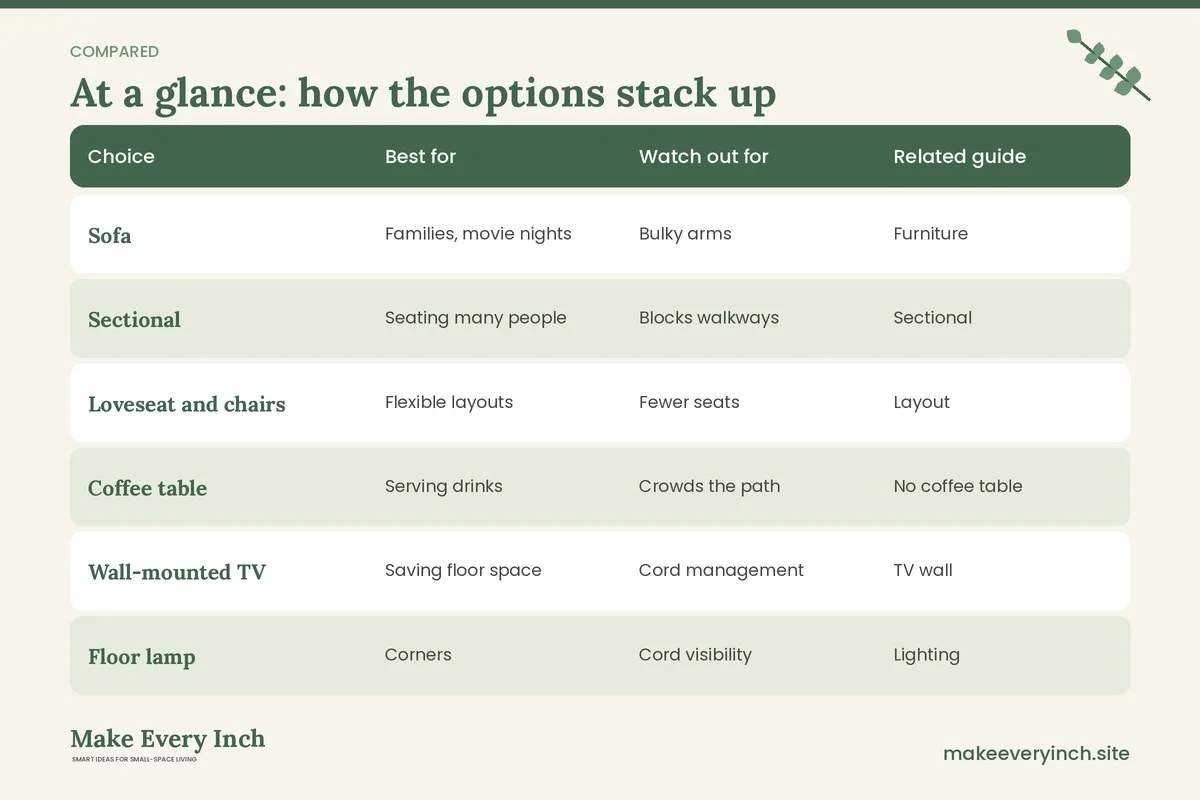
Choosing between common small room options
| Choice | Best for | Watch out for | Related guide |
|---|---|---|---|
| Sofa | Families, movie nights | Bulky arms | Furniture |
| Sectional | Seating many people | Blocks walkways | Sectional |
| Loveseat and chairs | Flexible layouts | Fewer seats | Layout |
| Coffee table | Serving drinks | Crowds the path | No coffee table |
| Wall-mounted TV | Saving floor space | Cord management | TV wall |
| Floor lamp | Corners | Cord visibility | Lighting |
Three example small living rooms
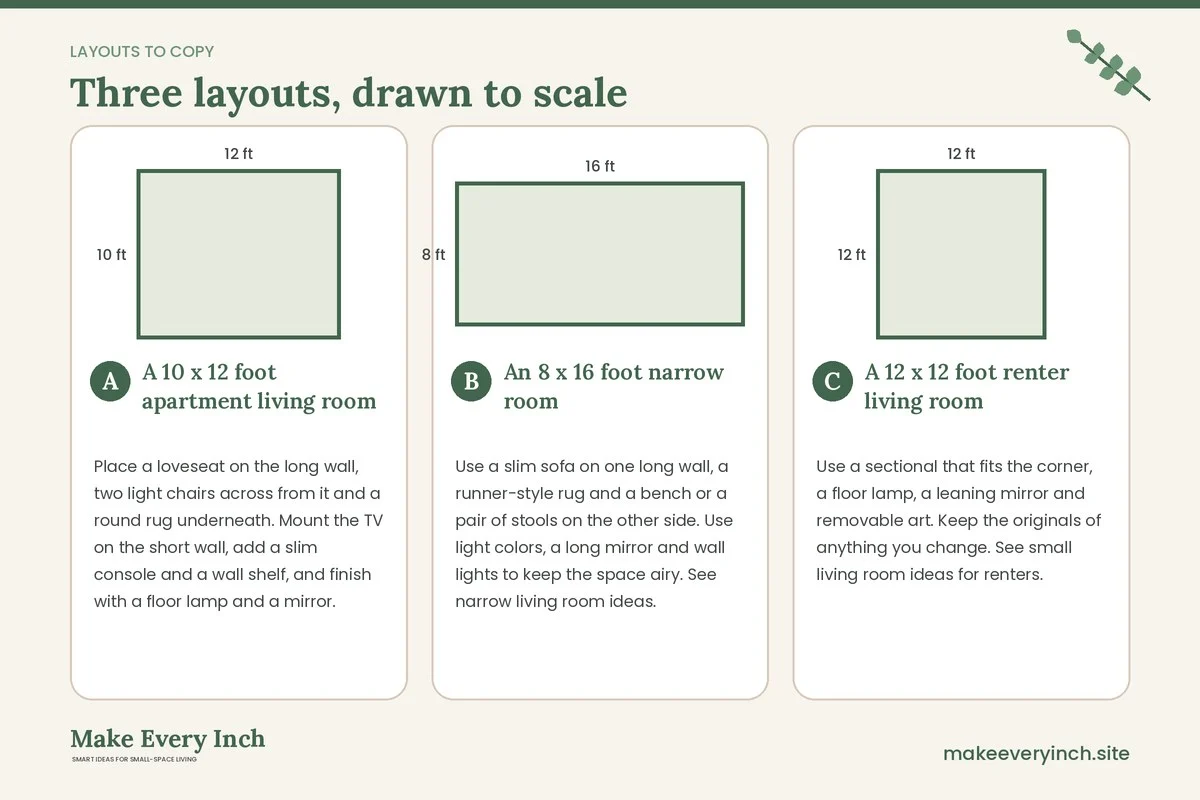
A 10 x 12 foot apartment living room
Place a loveseat on the long wall, two light chairs across from it and a round rug underneath. Mount the TV on the short wall, add a slim console and a wall shelf, and finish with a floor lamp and a mirror. See small apartment living room ideas.
An 8 x 16 foot narrow room
Use a slim sofa on one long wall, a runner-style rug and a bench or a pair of stools on the other side. Use light colors, a long mirror and wall lights to keep the space airy. See narrow living room ideas.
A 12 x 12 foot renter living room
Use a sectional that fits the corner, a floor lamp, a leaning mirror and removable art. Keep the originals of anything you change. See small living room ideas for renters.
Making one room do several jobs
Many small living rooms also serve as an office, a dining spot or a guest bed, so plan the zones early. A work zone needs a surface, a chair and good light: a slim desk behind the sofa or a wall-mounted drop-leaf table can serve, and a lamp makes the corner feel separate from the lounge. A dining zone can be a drop-leaf table, a bar-height shelf or a round table that folds. A guest zone is easiest with a sofa bed, a daybed or floor cushions that store in a closet. Whatever you pick, choose pieces that fold, stack or hide, and leave the main walkway clear. If you can describe each zone in one sentence, the room will feel organized rather than crowded.
Color palettes that work in a small room
Soft neutral
Cream walls, a warm gray sofa, a jute rug and wood accents create a calm base. Add one accent color, such as sage or terracotta, in pillows and art.
Light and fresh
White walls, a pale blue or sage sofa, a white rug and light wood read as airy. This palette suits rooms with little natural light because it bounces every bit of daylight around.
Warm and cozy
Warm white walls, a camel or rust sofa, a patterned wool rug and brass accents feel welcoming. Keep the palette to three colors to avoid a heavy look.
Bold but controlled
A deep green or navy accent wall can add depth if the rest of the room stays light. Choose the wall behind the sofa and repeat the color in a pillow and a plant pot. Dark colors can make a small room feel snug rather than small, as long as you add light.
How to size furniture for a small room
Furniture should fit the room by scale, not just by fit. A good rule is to leave at least a third of the floor visible. Measure the sofa against the wall, and keep it at least 8 inches shorter than the wall it sits on so it does not feel jammed. For a typical 10 x 12 foot room, a sofa of 72 to 80 inches is ideal. Choose a coffee table that is two thirds the length of the sofa, or skip it. Keep accent chairs below 30 inches wide, and make sure doors and drawers can open fully. Tape the footprint of each piece on the floor with painter’s tape and live with the tape for a day to see how the traffic flows.
Small details that make a big difference
The details are what separate a tidy room from a designed one. Hide cords with a cable box or a clip, swap harsh switch plates for plain ones, replace a worn lampshade and iron the curtains. Make sure the TV sits at eye level and that nothing blocks a vent. Choose frames in a single finish and hang them in a grid or a line. Store remotes, chargers and throws in a single tray or basket. These small steps cost little and give the room a polished feel.
Keeping a small living room tidy
A small room shows clutter fast, so build habits. Give every category of item a home, such as a basket for throws, a drawer for remotes and a shelf for books. Do a five-minute reset each night: return cups to the kitchen, fold the throw, straighten the pillows and clear the table. Once a season, remove items from shelves, edit what no longer fits and rotate decor. Following the one-in, one-out rule, remove an old item whenever you bring in a new one. With these habits, the room stays ready for guests without a big cleanup.
A weekend plan
Friday evening
Measure, sketch the plan and photograph the room. Decide on the three jobs the room must do.
Saturday
Declutter. Remove anything that does not serve a job, donate it and clean the room. Rearrange the existing furniture to match the plan and live with it for a day.
Sunday
Fix lighting and add storage. Swap bulbs, add the mirror and install the shelves. Style the surfaces and note what still bothers you.
Common mistakes in small living rooms
Buying furniture before measuring is the most common error, followed by pushing everything against the walls, which leaves a dead center. Another is using too many small items, which looks cluttered, and a rug that is too small. Lighting from one overhead fixture also flattens the room. Finally, many people keep items they do not use, which crowds the space.
Budget, renter and makeover paths
If your budget is small, begin with the free changes: rearrange the furniture, declutter and move the lamps. Then add inexpensive upgrades like bulbs, a rug and a mirror. If you rent, choose removable solutions and read the lease. If you are ready for a bigger change, plan a full makeover in stages: layout first, then storage, then color, then decor. The small living room makeover ideas guide walks through this order with a cost table, and small living room ideas for renters shows how to do it without losing your deposit.
Checklist
- Measure the room and sketch a plan
- Decide the three jobs the room must do
- Keep walkways of 30 to 36 inches
- Choose furniture with visible legs
- Add storage on walls and in closed pieces
- Layer the lighting with warm bulbs
- Hang a large mirror
- Use a rug that fits the seating
- Edit the surfaces
- Add plants and soft textures
FAQ
What are the best small living room ideas?
Clear walkways, furniture on legs, wall storage, light colors, layered lighting and a large mirror.
How do I make a small living room look bigger?
Use light colors, a large mirror, high curtains and a rug that fits, and keep surfaces clear.
Should I put the sofa against the wall?
Often yes, in a narrow room. In a wider room, floating it slightly can define a zone.
Do I need a coffee table?
Not always. Nesting tables, a pouf or a small side table can replace it. See small living room ideas without a coffee table.
What size rug is best?
One large enough for the front legs of the sofa and chairs, often 5 x 8 or 8 x 10 feet.
How can I add storage?
Use walls, tall bookcases, storage ottomans, baskets and a console. See small living room storage ideas.
What lighting is best?
Layered, warm light from lamps and sconces. See small living room lighting ideas.
How do I decorate a rental living room?
Use removable items such as lamps, rugs, art on strips and furniture.
Keep going: Explore our small living room layout ideas, small living room storage ideas and cozy small living room ideas.
Save this guide for later
Pin the ideas you like to Pinterest so you can come back to them when you plan your space.