Studio Apartment Ideas: The Complete Guide to Living Well in One Room
Quick answer: The best studio apartment ideas start with zones, not furniture. Divide the room into sleep, living, eat, work and entry areas, use one strong divider such as a shelf, a rug or a sofa back, raise storage up the walls, choose furniture with two jobs, layer light at three heights and keep every exit and window clear. Measure first, tape the plan on the floor and check the lease before you drill.
Studio apartment ideas all begin with the same problem: one room has to be a bedroom, a living room, a dining room, an office and an entry at once. There is no door to close on a mess and no hallway to hide a coat rack. The good news is that a studio is also the easiest home to change, because every decision shows up in a single view and a few well-chosen moves can transform it. This pillar guide pulls together everything we know about small one-room living. It covers how to plan zones, where to put the bed, how to divide the space without building walls, how to store more, how to light the room, how to work and eat in it, how to decorate it, how to avoid common mistakes and how to stay safe. Each section links to a detailed guide, and the final section lists every studio post in one place. If your studio is also a rental, keep the lease in mind throughout.
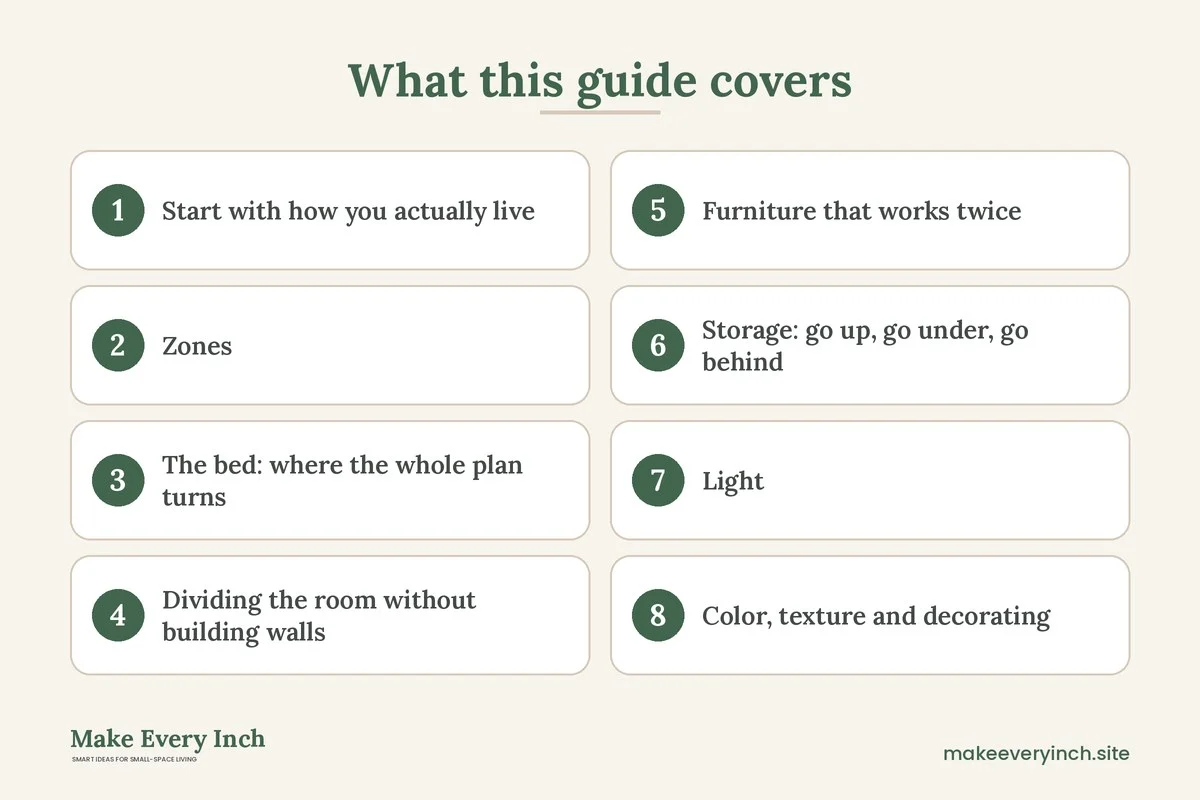
Start with how you actually live
Before buying anything, spend a few days noticing what you do in the room. Where do you sit when you come home? Where do you eat? Do you work from the bed? Do you cook often or mostly reheat? A studio rewards honesty, because every piece of furniture has to earn its footprint. A dining table that is used twice a month is a poor trade for a desk you use every day.
Write a short list of the activities your studio must support, and rank them. Sleep is always first, and the others follow. A person who works from home needs a very different plan from a couple who mostly eat out. If you share the space, the plan changes again, so read our guide to studio apartment ideas for couples before you settle on a layout.
Next, measure. Draw the room on graph paper or in a free floor planner, and mark the windows, the door, the radiator, the outlets, the kitchen and the bathroom door swing. Note the ceiling height too, because vertical storage depends on it. Then tape the footprint of every major piece on the floor with painter’s tape and live with the tape for a day. Tape costs nothing and prevents most expensive mistakes.
Zones: the secret behind every good studio
A studio feels big when it reads as several small rooms, and small and chaotic when it reads as one big pile. Zoning is the habit of giving each activity a clear place, a clear boundary and its own light. The usual zones are:
- Sleep zone: the bed, a bedside surface and a place for clothes.
- Living zone: a sofa or chairs, a small table and, often, a screen.
- Eating zone: a table for two or a counter with stools, close to the kitchen.
- Work zone: a desk or a fold-down surface with a chair and a lamp.
- Entry zone: hooks, a bench or tray, a mirror and a place for shoes.
You do not need a wall to create a zone. A rug defines the living area, a change in paint or wall color marks the sleeping nook, a lamp creates an island of light and a bookcase gives a physical edge. Our guide to studio apartment layout ideas that create zones shows plans for rectangular, square and L-shaped studios, with measurements for the paths between zones.
A few measurements help. Keep main walkways at 30 to 36 inches wide, and leave at least 24 inches at the side of the bed and in front of storage you open daily. Leave 36 inches in front of the kitchen counters if you can. Keep a clear line from the front door to the window, because that line makes a room feel open. Place the largest piece first, usually the bed or the sofa, and arrange everything else around it.
The bed: where the whole plan turns
The bed is the largest object in a studio, and where it goes decides the rest. There are four common choices: in a corner, along a wall, in an alcove and hidden in the furniture.
Corner and wall beds
Pushing the bed into a corner frees the most floor, but it makes the bed harder to make and means one person climbs over the other. A bed with its long side against the wall acts like a sofa during the day, especially with bolsters and a throw. A bed with its head against the wall keeps 24 inches free on both sides.
Queen beds in a small room
Many people want a queen bed in a studio, and it can work when the room is at least about 9 by 12 feet and the bed is placed with care. A queen mattress is roughly 60 by 80 inches, so it takes more floor than you might expect. Read our practical guide to studio apartment ideas for a queen bed for layouts, bed frame choices and tips on keeping the walkway clear.
Murphy beds and fold-away options
If you need the floor back every day, a wall bed that folds up changes the equation. When the bed is up, you gain a living room, a workspace or a place to exercise. When it is down, the room becomes a bedroom. Many versions include a sofa or a desk built in. Installation, anchoring and weight are serious issues, so see our guide to studio apartment ideas with a Murphy bed and the safety section below before you choose one.
Making the bed feel like a separate room
Even without a wall, you can make the sleeping area feel separate. A curtain on a ceiling track, a shelf behind the headboard, a change in wall color or a canopy all help. A bed placed in an alcove or in a corner of the room feels more private than one in the middle. Our post on studio apartment ideas with a separate bedroom feel covers screens, curtains, shelving and lighting that create the sense of a bedroom without building a wall.
Dividing the room without building walls
A divider does two jobs: it blocks the line of sight and it gives each zone its own edge. The best choice depends on how much light you need to keep, how much storage you want and what your lease allows.
- A bookcase: open shelves divide the room and add storage, but they need anchoring.
- A curtain on a track or tension rod: soft, cheap and easy to move, and good for the sleeping area.
- A folding screen: freestanding and portable, so it suits renters.
- A sofa with its back to the bed: furniture does the dividing, with a console behind it as a drop zone.
- A rug or a paint change: no height, but a clear visual boundary.
- A glass or slatted panel: keeps light moving through the room.
For a full look at the options, see our guide to studio apartment ideas with a room divider. If you like to build, our collection of DIY room divider ideas for studio apartments has projects at different skill levels, and renter-friendly ways to divide a studio apartment shows how to do it without drilling or leaving marks.
Furniture that works twice
In a studio, every piece should do at least two jobs, and the best pieces are slim, light-colored and raised on legs so the floor shows underneath. A visible floor reads as more space. Good examples include a storage ottoman that serves as a seat, a footrest and a coffee table, a bench with space inside for shoes or blankets, a bed with drawers underneath, a console that is also a desk and nesting tables that spread out only when you have guests.
Scale matters as much as function. A sofa that is 72 to 80 inches wide fits most studios, while a deep sectional eats the room. Choose tables with a smaller top and open legs, chairs that can be moved easily and shelves that go up rather than out. For a detailed buying approach, see our guide to studio apartment furniture ideas, and for the sofa area in particular, read small apartment living room ideas for studios. If you want help with buying decisions across the whole home, our guide to the best furniture for small apartments covers the general rules.
Storage: go up, go under, go behind
A studio has no closet for coats, no pantry for pans and no hall for the vacuum, so storage is the difference between a calm room and a cramped one. Think in three directions.
Go up
Walls are free storage. Use shelves above the door, a tall bookcase, a row of hooks and wall cabinets that reach toward the ceiling. Keep the things you use rarely on the top shelves and the things you use daily at arm height. Anchor tall furniture to the wall so it cannot tip.
Go under
The space under the bed is the largest hidden storage in the studio. Use rolling bins, drawers or a platform with built-in compartments. Raised sofas and consoles can also hide flat boxes.
Go behind
Doors and the backs of furniture are often overlooked. An over-the-door rack, a slim rolling cart between the fridge and the wall and hooks on the side of a cabinet all add capacity without using floor. Our complete guide to studio apartment storage ideas lists dozens of options, and for a broader view, see our pillar on small space organization ideas.
Storage only helps if it is used well. Limit what you keep, group items by activity and label bins. Our post on how to make a studio apartment feel organized describes daily and weekly routines that keep the room tidy in a few minutes a day.
Light: three layers make one room feel like several
Many studios have a single window wall and one harsh ceiling fixture, which flattens the room. Layer your light instead. Use ambient light for general glow, task light where you read, cook or work and accent light to mark the zones. A floor lamp by the sofa, a clip light on the headboard, a warm lamp on the desk and a string of small lights over the kitchen counter can each mark a different part of the room.
Use warm bulbs, about 2700 kelvin, for the living and sleeping zones, and a brighter, cooler bulb for the desk and the kitchen. Keep the windows as clear as possible, hang curtains high and wide so the glass looks larger and place mirrors across from windows to bounce light. Do not block the window with a tall bookcase or a bed head. Our guide to studio apartment lighting ideas covers plug-in options, dimmers and lamp placement.
Color, texture and decorating
Color can unify a studio or divide it. A restrained palette of two or three tones, repeated across the room, makes a small space look calm. Pale walls, medium-tone furniture and a few darker accents work well. You can use a deeper color behind the bed to mark the sleeping zone, as long as the lease allows paint. Our guide to studio apartment color schemes offers palettes by light level, window direction and mood.
Texture does the rest of the work. Layer a rug, a throw, curtains in a natural fabric and a few plants. Hang art at eye level, about 57 inches from the floor to the center, and lean large pieces on shelves and furniture if you cannot drill. Mirrors, glass and pale reflective surfaces expand the feeling of space. For more inspiration and a broader range of styles, read our collection of studio apartment decorating ideas.
Making it feel bigger
Some tricks are about perception, not square feet. Keep the floor visible, use furniture on legs, align shelves and frames on clear lines, repeat colors, choose curtains that run from the ceiling to the floor and keep surfaces clear. A single large mirror often does more than several small ones. Fewer, larger objects look calmer than many small ones. Put the largest pieces against the walls, and leave the middle open. Our guide to studio apartment ideas for making space feel bigger gives a step-by-step approach, and the pillar on small living room ideas has more techniques for the seating area.
Working, eating and entering
A desk in a studio
If you work from home, the desk deserves a proper place, ideally away from the bed so your brain can switch off at night. A wall-mounted fold-down desk, a narrow console, a desk behind the sofa or a small table by the window can all work. A chair that tucks under, a lamp and a few outlets matter as much as the surface. See our posts on studio apartment ideas for working from home and how to fit a desk into a studio apartment for plans by room shape.
An eating area
You do not need a full dining set. A drop-leaf table, a bar counter with two stools, a round pedestal table or a folding table against the wall can seat two to four. Choose a table that matches the shape of the room and does not block the path between the kitchen and the bed. Read our guide to studio apartment dining area ideas for layouts and sizes, and the pillar on small kitchen ideas for the cooking side of the studio.
An entry
With no hallway, the front door opens straight into your living space. A small entry zone, even just a rug, hooks and a bench, keeps shoes, bags and mail from spreading. A mirror by the door makes the room feel larger and helps you check your look on the way out. Our post on studio apartment entryway ideas shows how to make a real entry out of a few square feet. For more ideas that apply to any door, see small entryway ideas.
Studio apartment ideas by situation
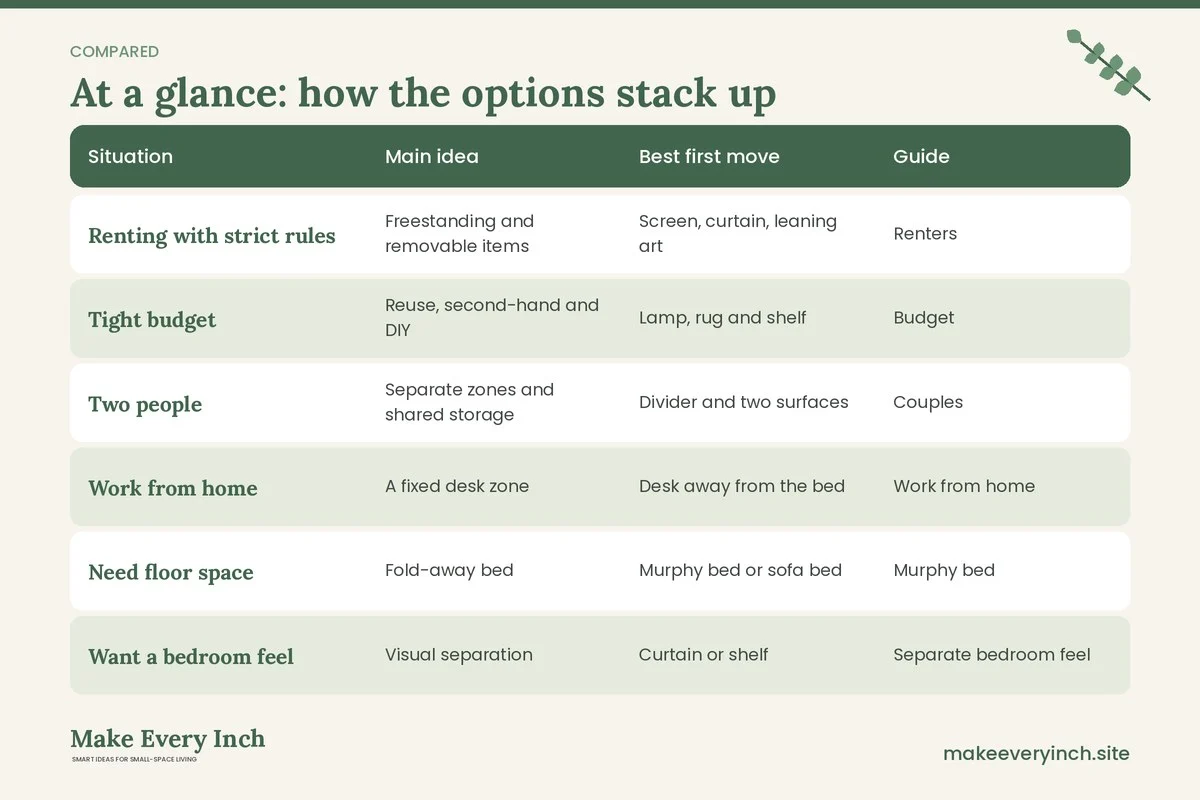
Not every studio is the same, and the best plan depends on who lives there and how much freedom you have. The table below matches common situations to the main idea and the guide that covers it.
| Situation | Main idea | Best first move | Guide |
|---|---|---|---|
| Renting with strict rules | Freestanding and removable items | Screen, curtain, leaning art | Renters |
| Tight budget | Reuse, second-hand and DIY | Lamp, rug and shelf | Budget |
| Two people | Separate zones and shared storage | Divider and two surfaces | Couples |
| Work from home | A fixed desk zone | Desk away from the bed | Work from home |
| Need floor space | Fold-away bed | Murphy bed or sofa bed | Murphy bed |
| Want a bedroom feel | Visual separation | Curtain or shelf | Separate bedroom feel |
| Cluttered space | Routines and storage | Under-bed bins and hooks | Organized |
Renting a studio: what you can and cannot change
Most studios are rentals, and the lease sets the limits. Read it before you drill, paint or install anything. Ask the landlord in writing about nail holes, wall anchors, paint, wallpaper, ceiling tracks and changes to light fixtures. Photograph the room on move-in day and keep the photos.
Renters have plenty of options. Freestanding bookcases, floor lamps, tension-rod curtains, plug-in sconces, adhesive hooks within their weight rating, rugs and screens all leave no trace. Our guide to studio apartment ideas for renters lists dozens of ways to make the room feel like yours, and the broader pillar on budget small space ideas helps you spread spending across the items that matter most.
Studio apartment ideas on a budget
A studio rewards smart spending because there is so little floor. Put your money into the three things you touch every day: the bed and mattress, a good light and a comfortable chair or sofa. Save on the rest. Buy second-hand tables and shelves, repaint or cover worn pieces, make your own art and reuse crates, ladders and trays as storage. Our guide to studio apartment ideas on a budget gives a step-by-step plan, with ideas for each room zone and a method for ordering your purchases so nothing is wasted. Prices vary widely by region, store and season, so compare before you commit.
Studio safety: do not skip this part
A studio puts the bed, the kitchen, the door and the electrics within a few steps of each other. A little planning makes the room much safer.
Egress and fire exits
Keep the path from the bed to the front door clear at all times, and make sure no furniture, divider or storage blocks the door or the windows. If the studio has a window that serves as an emergency exit, do not block it with a bookcase, a bed head or a heavy curtain. Do not hang a curtain or a screen so it traps you in the sleeping area. Test smoke and carbon monoxide alarms regularly, and place a small extinguisher near the kitchen but away from the stove. Know the building’s exit routes and keep a flashlight by the bed.
Anchoring
Tall bookcases, shelving units, wall beds and wardrobes can tip, especially in a home with children or pets. Use anti-tip straps or wall anchors into studs where the lease allows. If it does not, choose lower units, put heavy items on the bottom shelf and ask the landlord about approved fixings. Never rely on adhesive hooks for heavy items. A fold-away bed must be installed according to the maker’s instructions, with the right wall type and anchors.
Electrical
Studios often have few outlets, so people plug in too many devices. Do not daisy-chain power strips, avoid covering cords with rugs and keep cords away from foot traffic. Use a surge-protected strip rated for the load, and keep it off the floor if there is any risk of spills. Do not run cords under a divider or a curtain. Check that lamps, string lights and heaters match the rating of the outlet, and unplug heaters when you leave. If an outlet is warm, loose or sparks, stop using it and report it to the landlord.
Ventilation
A single room holds moisture from cooking, showers and breathing, so ventilation matters. Use the kitchen and bath fans, open a window for a few minutes each day and do not seal off the room with thick dividers or heavy fabric that stops air from circulating. Keep furniture a few inches from exterior walls to prevent damp and mold, and use a vent-friendly layout around radiators and air returns. Never block a vent with a bookcase or bed. If you smell gas, leave and call the emergency number.
Lease permission
Before you drill, install a track, paint, hang a heavy divider or move a built-in feature, get permission in writing. Some leases prohibit certain heaters, cooking equipment or changes to fixtures, and some require that fire exits remain unobstructed. A short email can save a deposit.
Mistakes that make a studio feel smaller
Most studio problems come from a small set of repeated errors. Avoid these and the room improves at once.
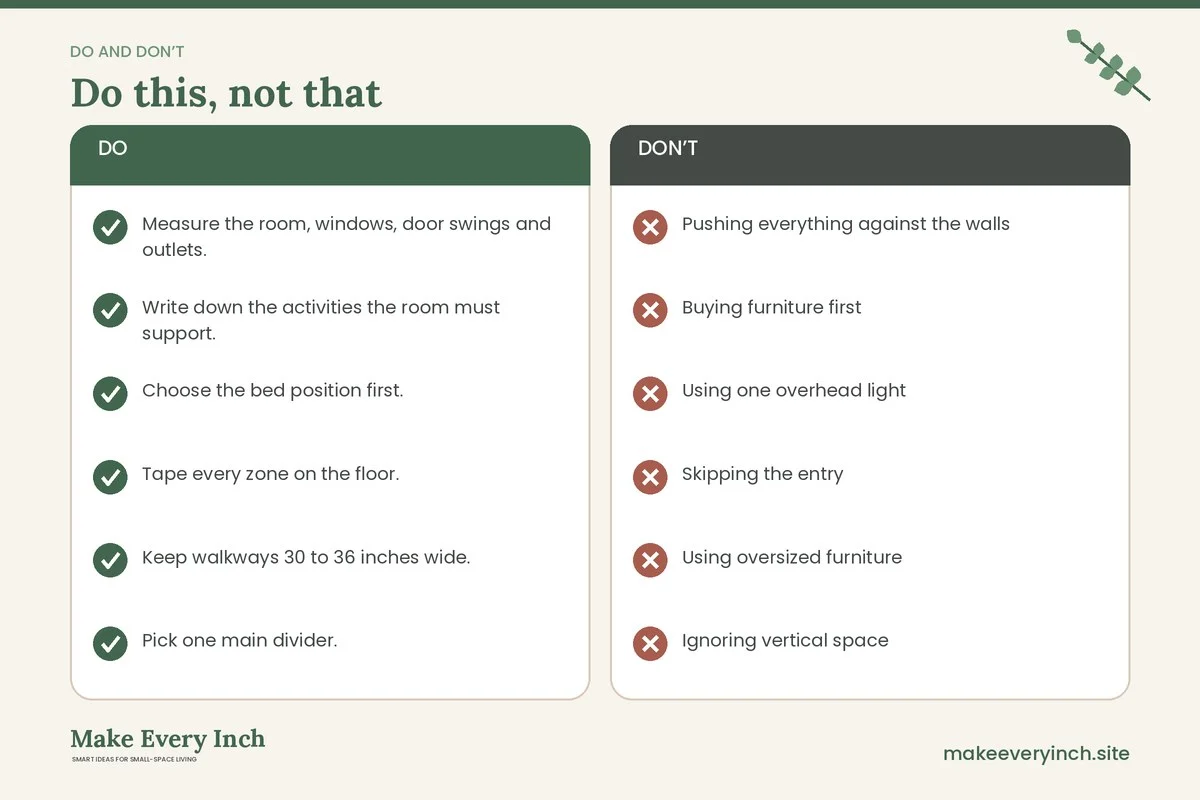
- Pushing everything against the walls: it leaves a dead hole in the middle and makes the room feel like a waiting room.
- Buying furniture first: measure and tape the plan before you shop.
- Using one overhead light: layers of light are essential.
- Skipping the entry: with no landing spot, coats and bags pile up.
- Using oversized furniture: a sofa that is too deep eats the room.
- Ignoring vertical space: unused wall height is wasted storage.
- Blocking the window: light is the cheapest square footage.
Our guide to studio apartment layout mistakes to avoid covers each of these in depth, with fixes.
A planning table for the first week
Use this table to sequence your project so you work from the biggest decisions to the smallest.
| Step | Task | Time | Result |
|---|---|---|---|
| 1 | Measure the room and draw the plan | 1 hour | Accurate floor plan |
| 2 | Choose the bed position | 1 hour | Anchor for the layout |
| 3 | Tape the zones on the floor | 1 hour | Visible footprints |
| 4 | Pick the divider | 1 to 2 hours | Clear edges |
| 5 | Plan storage in three directions | 1 hour | Storage list |
| 6 | Add layered light | 1 hour | Zone lighting |
| 7 | Add color, rug and texture | 2 hours | Finished look |
| 8 | Run the safety check | 30 minutes | Clear exits |
Studio checklist
- Measure the room, windows, door swings and outlets.
- Write down the activities the room must support.
- Choose the bed position first.
- Tape every zone on the floor.
- Keep walkways 30 to 36 inches wide.
- Pick one main divider.
- Add storage up, under and behind.
- Use at least three layers of light.
- Keep a clear path from the bed to the door.
- Anchor tall furniture where the lease allows.
- Avoid daisy-chained power strips.
- Ventilate daily and keep vents clear.
- Get permission in writing before any change.
- Photograph the room on move-in day.
FAQ
What is the best layout for a studio apartment?
There is no single best layout, but most good plans put the bed in a corner or alcove, the sofa on the opposite side with its back to the bed as a divider, the dining area near the kitchen and the desk by a window. Tape the plan on the floor first.
How do I separate the bedroom from the living area in a studio?
Use a bookcase, a curtain, a folding screen, a sofa back or a rug and wall color change. Keep the divider light so it does not block windows or exits. See our guide to a separate bedroom feel.
Can I fit a queen bed in a studio?
Often yes, if the room is roughly 9 by 12 feet or larger and you leave about 24 inches at the sides and a clear walkway. A smaller bed or a fold-away bed is easier in very small rooms.
How can I make a studio apartment look bigger?
Keep the floor visible, use furniture with legs, hang curtains high, add a large mirror across from the window, repeat colors and remove clutter. Layered lighting helps too.
How much storage does a studio need?
It depends on how many people live there and how much you own, but a good rule is to use every vertical surface, the area under the bed and the backs of doors, and to keep only what you use. Review the contents twice a year.
Is it safe to use a room divider or a loft bed in a studio?
It can be, if exits and windows stay clear, tall pieces are anchored, and you have permission from the landlord. Never block a door, a window that serves as an exit or a vent. Check any loft or wall bed against the maker’s instructions.
How do I decorate a studio as a renter?
Use removable and freestanding items such as rugs, lamps, curtains on tension rods, leaning art and screens. Get written permission before you paint, drill or wallpaper.
How do I work from home in a studio without living in my office?
Keep the desk away from the bed, use a fold-down or console desk that you can clear at the end of the day and use a lamp or screen to mark the work zone.
All our studio apartment guides
Here is every studio post in one place. Pick the topic that matches your biggest problem and work through the list.
- Studio apartment furniture ideas: how to choose slim, multi-use pieces that fit one room.
- Studio apartment ideas for couples: ways for two people to share a single room without conflict.
- Studio apartment ideas for making space feel bigger: visual tricks and layout moves that add airiness.
- Studio apartment ideas for renters: removable and freestanding upgrades that respect the lease.
- Studio apartment ideas for working from home: desk setups that keep work and rest apart.
- Studio apartment ideas on a budget: low-cost plans that put money where it matters.
- Studio apartment ideas with a Murphy bed: layouts that use a fold-away bed to free the floor.
- Studio apartment ideas with a separate bedroom feel: screens, curtains and shelves that make a sleeping nook.
- Studio apartment layout ideas that create zones: plans for splitting one room into clear areas.
- Studio apartment storage ideas: storage up, under and behind for a clutter-free room.
- How to fit a desk into a studio apartment: compact desk positions for every room shape.
- How to make a studio apartment feel organized: daily routines and systems that keep order.
- Studio apartment color schemes: palettes that unify or divide a single room.
- Studio apartment decorating ideas: styling tips for texture, art and personality.
- Studio apartment dining area ideas: tables, counters and nooks for eating.
- Studio apartment entryway ideas: a landing zone where the door meets the room.
- Studio apartment ideas for a queen bed: fitting a larger bed without losing the floor.
- Studio apartment ideas with a room divider: divider types compared for light, storage and cost.
- Studio apartment layout mistakes to avoid: common errors and how to fix them.
- Studio apartment lighting ideas: layered lamps, task lights and mood lighting.
- DIY room divider ideas for studio apartments: build-it-yourself dividers for every skill level.
- Renter-friendly ways to divide a studio apartment: no-drill separation methods.
- Small apartment living room ideas for studios: seating areas that fit inside a studio.
Keep going: Keep going with our small bedroom ideas, small living room ideas and small space organization ideas.
Save this guide for later
Pin the ideas you like to Pinterest so you can come back to them when you plan your space.