17 Small Living Room Furniture Ideas for Tight Spaces
Quick answer: The best small living room furniture ideas are slim, raised on legs and able to do two jobs. Choose a sofa 72 to 80 inches wide, a nesting or lift-top table, light chairs and storage you can sit on. Measure the room and doorways before you buy, and leave a 30 to 36 inch walkway.
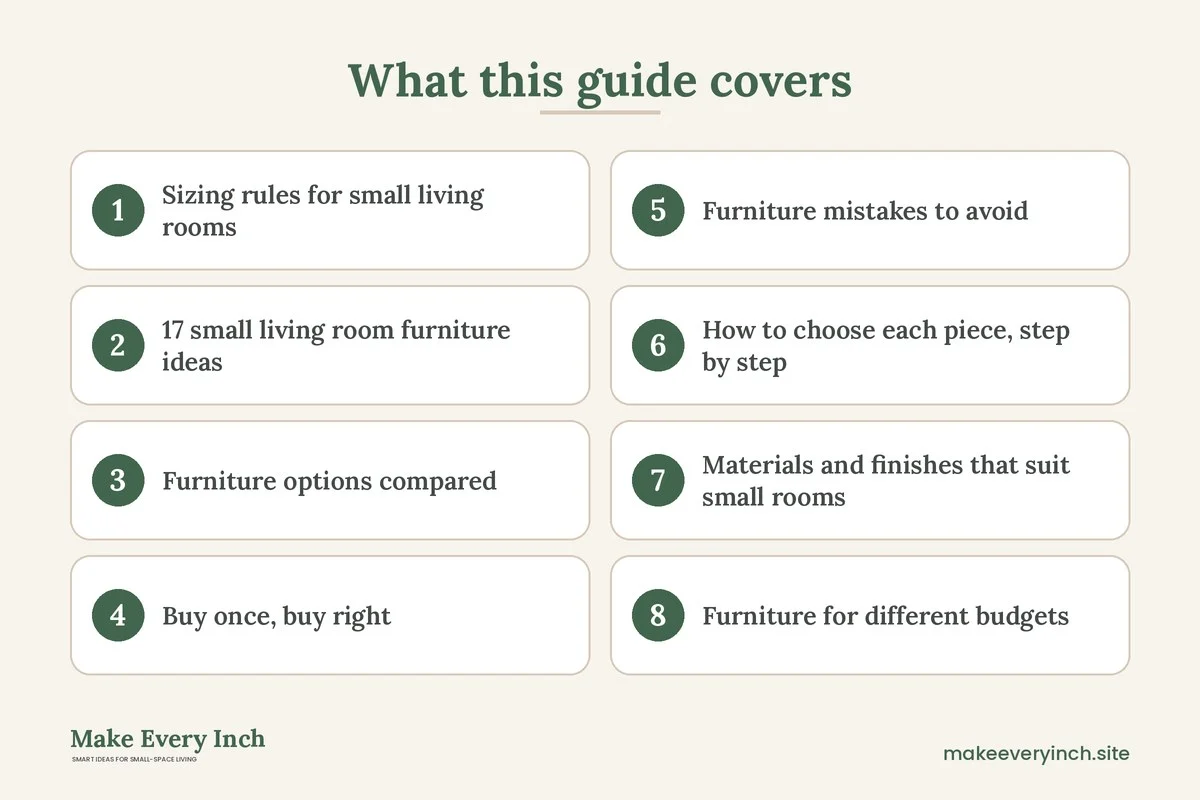
Small living room furniture ideas start with proportion, not style. A sofa that is two inches too deep can swallow a room, and a chair that blocks a walkway never gets used. This guide shares 17 furniture ideas for tight spaces, a comparison table, sizing rules and a checklist so the next piece you buy actually fits.
Sizing rules for small living rooms
Measure the room, the doorways, the stairs and the elevator before you shop. Mark the furniture footprint on the floor with painter’s tape and live with it for a day. As a rule, sofas 72 to 80 inches wide with a depth under 36 inches suit rooms under 11 x 13 feet. Keep 30 to 36 inches for the main path and 14 to 18 inches between the sofa and coffee table.
Choose furniture with visible legs, slim arms and light colors. Seeing the floor underneath makes the room feel bigger.
17 small living room furniture ideas
1. An apartment-size sofa
Look for 72 to 80 inches wide, track arms and a seat depth around 20 to 22 inches. Our sectional guide covers when a larger piece still works.
2. A loveseat plus a chair
In a very small room, a loveseat and one accent chair give you three seats and a better walkway than a full sofa.
3. A modular sofa
Modular pieces can be rearranged as you move or as the room changes, which makes them useful for renters.
4. A sleeper sofa
A sleeper or daybed turns the living room into a guest room without a separate bed.
5. Nesting tables
Two or three nesting tables can be pulled apart for guests and tucked together when you need floor space.
6. A lift-top coffee table
The top lifts to work or eat at sofa height and has storage underneath.
7. Slim side tables
A C-shaped table slides over the sofa arm and holds a laptop or a drink without taking floor space.
8. Ottomans and poufs
Ottomans offer extra seats, footrests and storage. Pick two small ones instead of a single large table.
9. A swivel chair
A swivel chair turns toward the TV or the conversation and fits where a standard armchair cannot.
10. Armless accent chairs
Armless chairs are narrower and easy to slide in and out. Choose a woven or open back for a lighter look.
11. A slim console
A console 10 to 12 inches deep fits behind a sofa or along a narrow wall for lamps, keys and mail.
12. A wall-mounted desk
A drop-leaf or wall-mounted desk gives you a workspace that folds away. See small apartment living room ideas for work-from-home setups.
13. A TV stand with storage
A low stand with doors hides cables and games and keeps the wall clear for art. See our TV wall ideas.
14. A bookcase with a closed base
Closed doors on the bottom and open shelves on top give storage and display in a narrow footprint.
15. A bench with a lid
A bench at the window or entry doubles as seating and blanket storage.
16. A round table
Round tables have no corners to bump into and are easier to move around in a tight room.
17. Mirrors and glass
A mirror is not furniture, but a large one opposite a window or a glass-top table can make a room feel bigger without taking space.
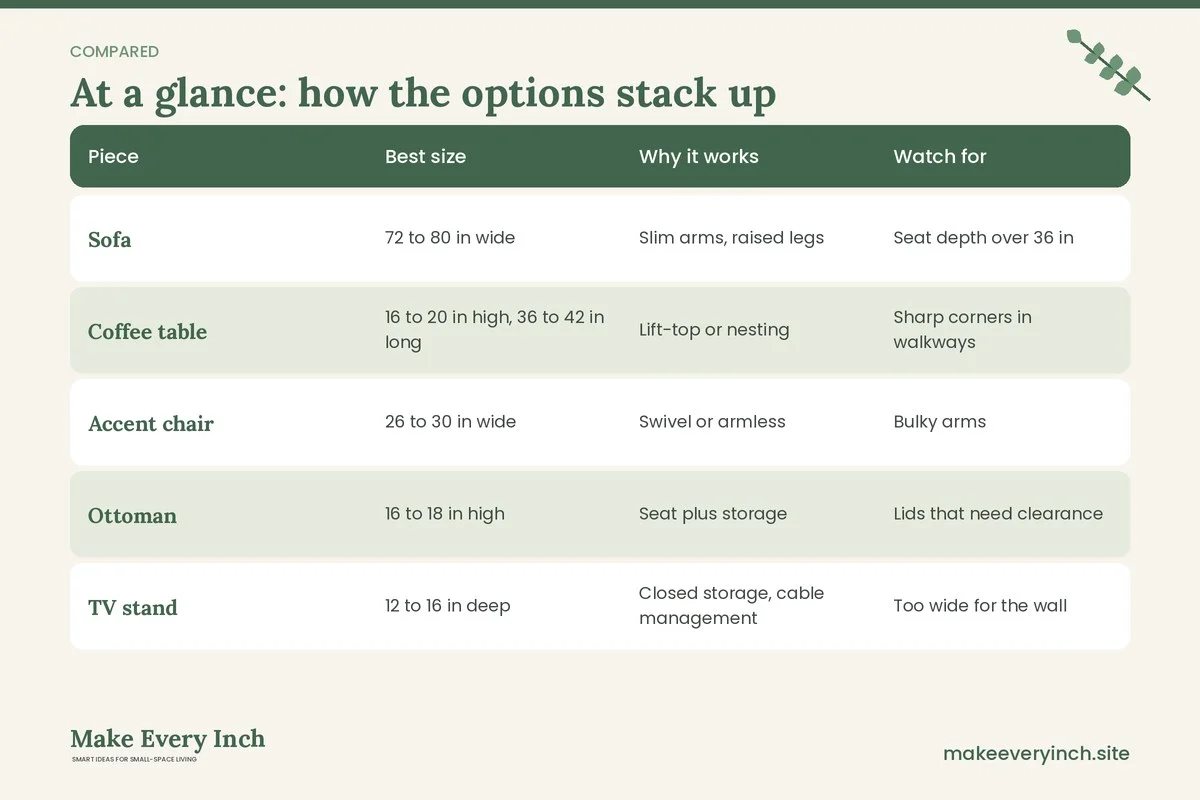
Furniture options compared
| Piece | Best size | Why it works | Watch for |
|---|---|---|---|
| Sofa | 72 to 80 in wide | Slim arms, raised legs | Seat depth over 36 in |
| Coffee table | 16 to 20 in high, 36 to 42 in long | Lift-top or nesting | Sharp corners in walkways |
| Accent chair | 26 to 30 in wide | Swivel or armless | Bulky arms |
| Ottoman | 16 to 18 in high | Seat plus storage | Lids that need clearance |
| TV stand | 12 to 16 in deep | Closed storage, cable management | Too wide for the wall |
Buy once, buy right
Start with the biggest piece, usually the sofa, and build around it. Choose a neutral base and add color in pillows, a rug and art, since those are cheap to change. Check the return policy and measure the delivery path. If you rent, avoid pieces that need to be bolted to the wall.
For a layout plan, see small living room layout ideas. For hiding what you own, see our storage ideas.
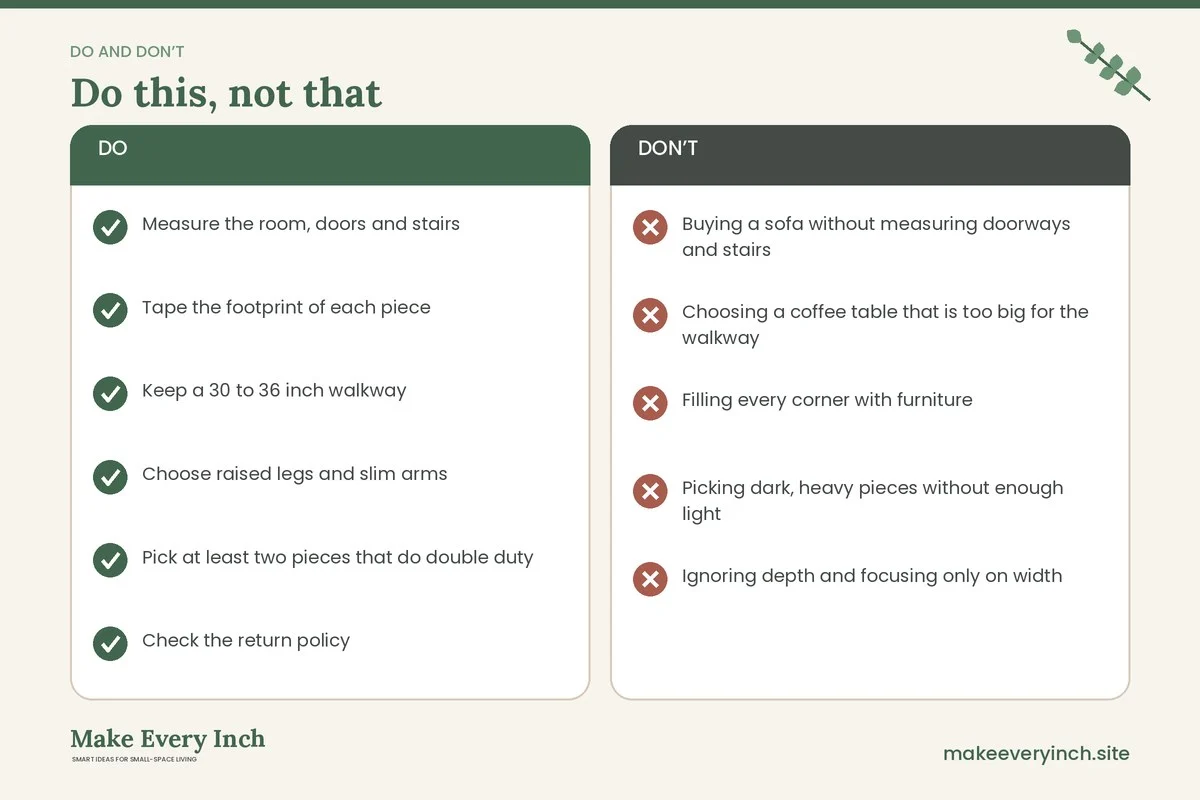
Furniture mistakes to avoid
- Buying a sofa without measuring doorways and stairs
- Choosing a coffee table that is too big for the walkway
- Filling every corner with furniture
- Picking dark, heavy pieces without enough light
- Ignoring depth and focusing only on width
How to choose each piece, step by step
Buying furniture for a small living room is easier when you do it in order. Start with the anchor, then the supporting pieces, then the extras.
Step 1: the sofa
Decide on the number of seats you need. If you usually sit alone or with one other person, a loveseat is enough. Measure the wall and subtract 30 inches for the walkway. Choose a sofa 72 to 80 inches wide and 32 to 36 inches deep with raised legs. Check the seat height and depth by sitting on it, since a deep seat can feel cramped in a small room if you are short. Choose a fabric you can clean easily.
Step 2: the table
Choose a coffee table about two thirds the length of the sofa and 16 to 18 inches high. If space is tight, use nesting tables or ottomans. See no coffee table ideas.
Step 3: the chair
Pick one chair, not two, until you know how the room feels. A swivel chair, a slipper chair or an armless chair fits in small spaces. Place it at an angle to the sofa to make conversation easy.
Step 4: the TV unit
Choose a console that is 12 to 16 inches deep and wide enough to hold the TV with a few inches on each side. Closed doors hide clutter. If you mount the TV, use a slim shelf for devices.
Step 5: storage and extras
Add a bookcase, a console or a bench only after the main pieces are in place. Use storage ideas to decide what you really need.
Materials and finishes that suit small rooms
Light woods such as oak and ash look airy, while dark woods add contrast and can feel heavy in large pieces. Metal frames in a slim profile keep the room open. Glass tops show the floor but can show fingerprints. Upholstery in linen or cotton blends feels relaxed, and performance fabrics suit homes with children and pets. Choose a color family for the large pieces and use accents for personality. Avoid shiny finishes that reflect clutter.
| Material | Visual weight | Best for | Care |
|---|---|---|---|
| Light wood | Light | Tables, shelves | Wipe with a soft cloth |
| Dark wood | Heavy | Accent pieces | Show dust |
| Metal | Light | Frames, legs | Wipe dry |
| Glass | Very light | Table tops | Needs frequent cleaning |
| Linen | Medium | Sofas, curtains | Wrinkles |
| Performance fabric | Medium | Sofas | Easy to clean |
Furniture for different budgets
You can furnish a small living room in stages. Begin with the sofa, since it is the piece you use the most, and add the rest over time. Secondhand tables, shelves and chairs are easy to find and can be refinished. Floor models and sale items work well if you measure first. Avoid buying a full set from one brand, since a mix of pieces looks more personal. Set a budget for each piece, and keep a list of things you will buy only when you find the right one.
Furniture arrangement and layout
After you buy, test the arrangement before you commit. Tape each footprint on the floor, walk the path and sit in each seat. If you need a refresher, see our layout ideas and makeover guide.
Delivery and assembly tips
Measure doors, hallways, stairs and elevators, and ask the seller for the diagonal depth of the sofa. Clear the path before the delivery day and protect floors with a blanket or tape. Ask whether the sofa can be delivered in parts or has removable legs. Keep the packaging until you are sure you like the piece, and check the return policy and fees. Photograph the piece on arrival so you have a record if something is damaged.
Furniture ideas by room size
Rooms under 10 x 10 feet
Choose a loveseat or a 70 inch sofa, one swivel chair and a nesting set. Mount the TV and use a floating shelf for devices. Use wall lights and a mirror, and keep everything else off the floor.
Rooms around 10 x 12 feet
Use a 78 inch sofa, a slim chair and a lift-top coffee table or two ottomans. Add a console behind the sofa and a tall bookcase on one wall. A 5 x 8 foot rug ties the pieces together.
Rooms around 12 x 14 feet
You can fit a small sectional or a sofa plus two chairs. Add a round coffee table and a console for storage. Keep a clear 36 inch path along one side. See sectional ideas for layouts that suit this size.
Open-plan rooms
Use the back of the sofa to define the zone, a rug to anchor it and a console behind the sofa to add storage. Choose a sofa with a finished back and keep the dining chairs in a similar style so the two zones feel related.
Multi-purpose furniture worth the money
Some pieces earn their place by doing two jobs. A storage ottoman is the best example: it is a seat, a footrest, a table and a box. A lift-top coffee table lets you eat or work at sofa height. A sleeper sofa serves guests without a spare room. A drop-leaf console becomes a dining table for four. A bench with storage handles shoes at the door or blankets at the sofa. A wall-mounted desk folds up when you finish work. Look for sturdy hinges, smooth mechanisms and finishes that match the room.
Furniture to avoid in small living rooms
Oversized recliners, bulky rolled arms, heavy glass tables with sharp corners, low-slung sofas with deep seats and pieces with skirts that hide the floor all take up visual space. Avoid buying a set of matching furniture in a single finish, because it makes the room look like a showroom. Skip furniture that needs a lot of clearance to open, such as a chest with a heavy lid. If you cannot move a piece alone, think twice before you buy it, because you will want to rearrange. Test every piece by sitting on it, opening every drawer and checking it from the doorway.
Furniture care in a small room
In a small room, every piece is used daily, so it gets worn faster. Rotate cushions weekly, vacuum fabric monthly and use felt pads under legs to protect floors. Treat wood with a suitable oil once or twice a year. Keep pieces out of direct sun to prevent fading. If a sofa sags, add firmer inserts or replace the cushions instead of the whole piece. Looking after furniture keeps it looking good and lets you keep it through several moves.
Questions to ask in the store or before you click buy
Does it fit through the door, up the stairs and into the room? What is the seat depth, and will I be comfortable on it for an evening? Are the legs removable? Can the cover be taken off and cleaned? How much clearance does it need around it? Does it match the other materials in the room? Is there a warranty, and what does it cover? What is the return window, and who pays for the return? Is there a floor model I can sit on? Writing these questions down stops you from buying on impulse and is especially helpful when you are shopping online.
A simple scorecard for each piece
Give every piece you are considering a score from 1 to 5 for fit, comfort, storage, looks and price. Add the numbers and compare. If a piece scores under 15, keep looking. If two pieces tie, choose the one that does more than one job. The scorecard turns a fuzzy decision into a clear one and helps you stay on budget. Keep the scorecard in your phone so you can use it in a store.
Mixing old and new furniture
Rarely will you start from nothing. Most small living rooms contain a mix of inherited pieces, gifts and purchases. To make them work together, repeat one element, such as the leg shape, the wood tone or the color, in at least three places. Paint or refinish one outlier, such as a dark side table, to match the rest. Use textiles and a rug to link different pieces, and keep the number of finishes to three. A single standout piece, such as a vintage chair or a unique lamp, can be the personality of the room while everything else stays quiet. If a piece does not suit the room, store it, sell it or place it in another room instead of forcing it to fit.
A final tip: sit on every piece, in the store or at home, before you commit, because comfort decides how often you use it.
Furniture checklist
- Measure the room, doors and stairs
- Tape the footprint of each piece
- Keep a 30 to 36 inch walkway
- Choose raised legs and slim arms
- Pick at least two pieces that do double duty
- Check the return policy
FAQ
What size sofa fits a small living room?
A sofa 72 to 80 inches wide and under 36 inches deep fits most rooms under 11 x 13 feet. Measure before you buy.
What furniture makes a small living room look bigger?
Pieces with visible legs, slim arms and light colors, plus a large mirror and a rug that sits under the seating.
Is a sectional too big for a small living room?
Not always. A compact L-shaped sectional can work in a room of about 10 x 12 feet if you leave the walkway clear.
What is the best coffee table for a small space?
A round, nesting or lift-top table in a light finish, or two ottomans instead of a single large table.
How many chairs should a small living room have?
One or two. A swivel or armless chair is easier to move than a bulky armchair.
How do I buy furniture online without a mistake?
Check the exact dimensions, tape them on the floor, measure the delivery path and confirm the return policy before you order.
Keep going: Explore our small apartment living room ideas, small living room layout ideas and cozy small living room ideas.
Save this guide for later
Pin the ideas you like to Pinterest so you can come back to them when you plan your space.