Small Living Room Furniture Ideas Budget Guide: 12 Smart Moves
Quick answer: The smartest small living room furniture ideas budget plan is to spend first on the piece you use most, which is usually the sofa, then buy secondhand for tables and storage, and choose pieces that do two jobs. Measure the room, keep 30 to 36 inches of walkway, and wait on decor until the big pieces are settled.
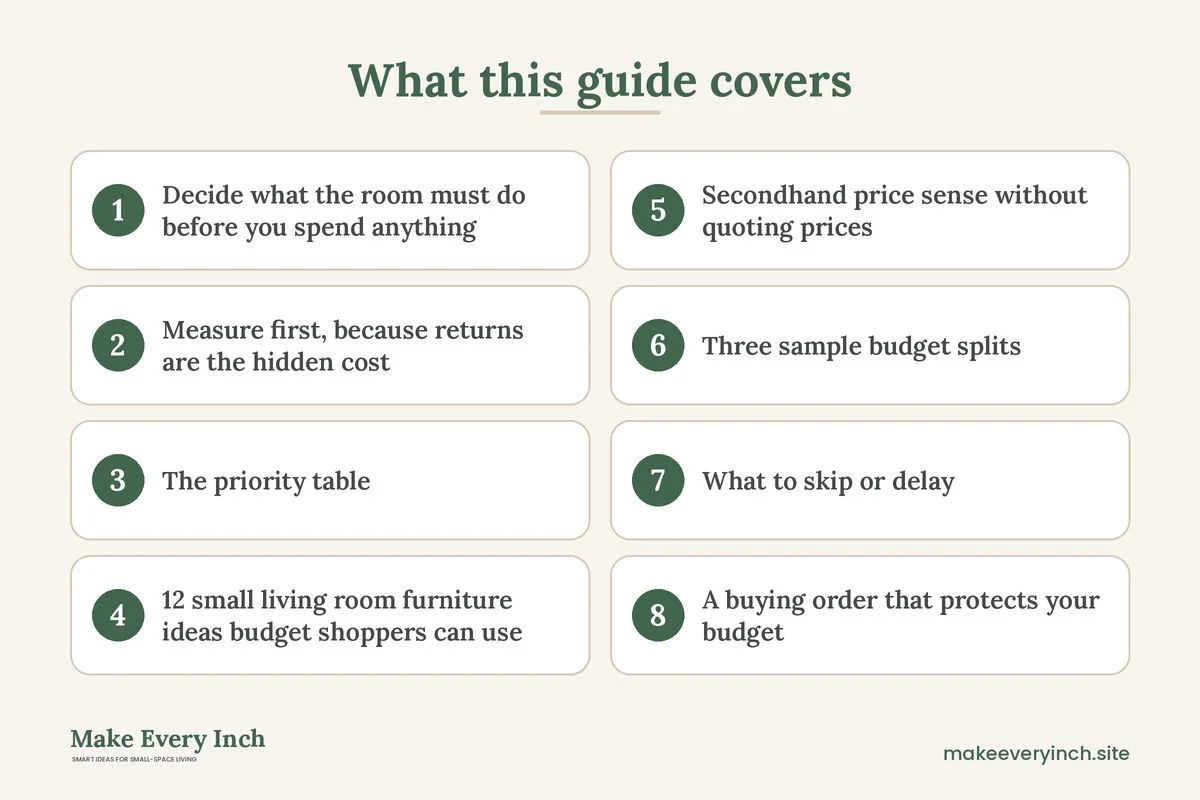
Small living room furniture ideas budget plans work best when you stop asking what looks good and start asking what earns its footprint. In a compact room every piece competes for the same few square feet, so a cheap item that does not fit costs more than a pricier one that does. This guide is built around money decisions rather than style: which piece deserves the largest share of your budget, which pieces are safe to buy used, which multifunction items pay for themselves, and what order to buy things in. It includes measurements, a priority table, a secondhand inspection routine, three sample budget splits and a checklist. For the wider topic, read the main guide to small living room furniture ideas, the broader small living room ideas pillar and our companion piece on small living room layout ideas on a budget.
Decide what the room must do before you spend anything
Budget mistakes in small rooms rarely come from overpaying for one item. They come from buying five items that each solve a different imaginary problem. Before you open a shopping app, write down the three jobs your living room does every week. Typical answers are seating for two to four people, a place to put a drink or a laptop, somewhere to hide remotes and blankets, and a spot for a screen. Anything that does not serve one of those jobs can wait.
Then count real use. If you watch television most evenings, the sofa carries the room and deserves the most money. If you host often, flexible seating matters more than a plush couch. If you work from the sofa, a surface that slides over your lap may matter more than a coffee table. Naming the main job tells you where to spend and where to save, and it keeps you from splitting a small budget evenly across things that are not equally important.
Finally, set a ceiling and a buffer. Choose a total you are comfortable with, then hold back roughly 10 to 15 percent for the things nobody plans for: delivery, felt pads, a missing screw set, a rug pad, a lamp bulb. The buffer is usually the difference between a finished room and one that waits months for a last item.
Measure first, because returns are the hidden cost
A budget disappears quickly when a piece does not fit and has to be returned, resold or kept out of guilt. Ten minutes with a tape measure protects the whole plan. Measure the room, the doorways, the stairwell or elevator, and any tight turn the furniture must pass.
- Doorway and hallway width: many standard interior doors give 28 to 32 inches of clear width. Compare that with the depth and diagonal of any large piece, and remember that arms and legs may be removable.
- Walkway: keep 30 to 36 inches for the main path and about 24 inches for a side path you use occasionally.
- Sofa depth: 30 to 36 inches suits most compact rooms. A depth of 38 inches or more can swallow the floor in a room under 11 feet across.
- Sofa length: 68 to 80 inches fits many small rooms. Very small rooms may only take a loveseat in the 55 to 65 inch range.
- Sofa to coffee table: 14 to 18 inches of gap so knees clear the table and a hand can still reach it.
- Sofa to screen: about 7 to 9 feet is comfortable for many small rooms, depending on screen size.
- Side table height: within 2 inches of the sofa arm, often 20 to 26 inches.
- Rug size: a rug around 5 by 8 feet usually works, with at least the front legs of the main seating on it.
Mark each footprint on the floor with painter’s tape and live with the tape for a few days. If you keep catching your toe on a corner, the piece is too big or in the wrong place. Pay attention to height as well. A tall bookcase or wardrobe can look stable but should be anchored to the wall with the hardware the maker supplies, especially in homes with children or pets. In a rental, ask before drilling, or choose low furniture and wall-friendly anchoring methods. Our guide to no-drill storage ideas for renters covers lower-risk options.
The priority table: where the money should go
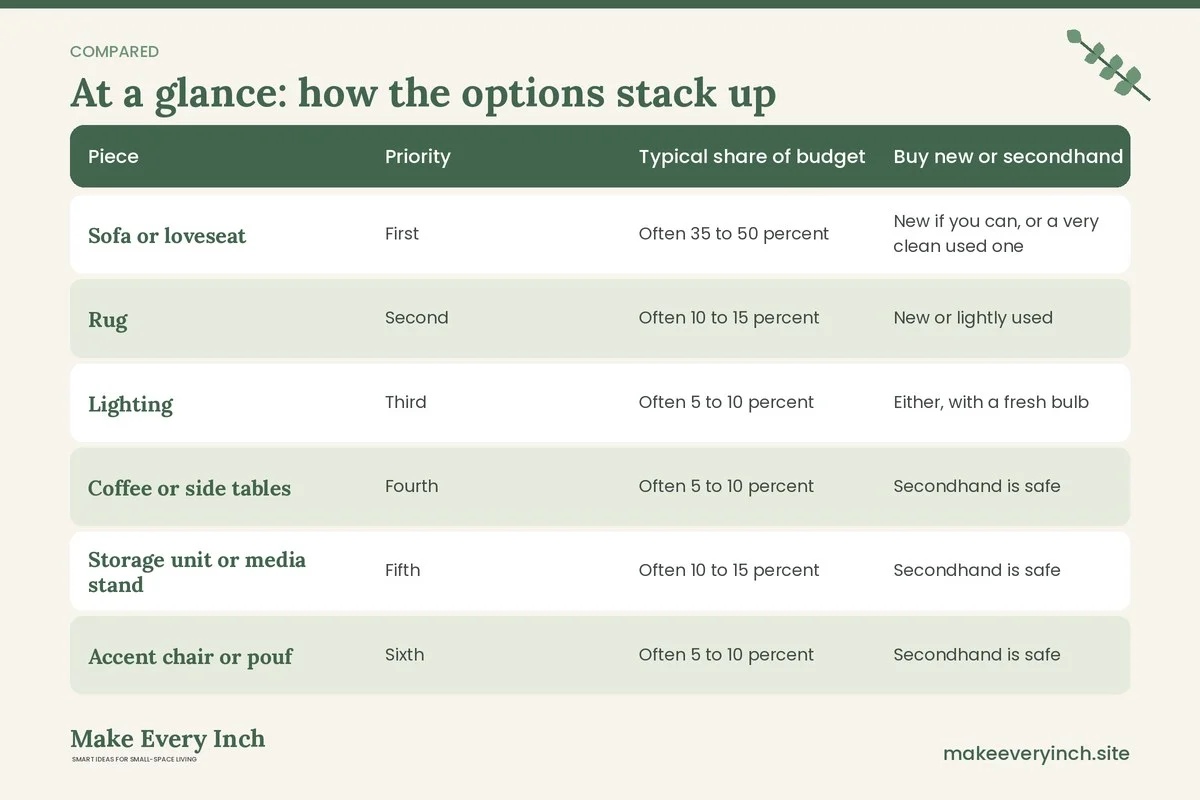
Not every piece deserves the same share. The table below shows a typical order of priority and how much of a budget each category often takes. The percentages are hedged rough ranges, because they shift with your room and your local market. Use them as a starting point, not a rule.
| Piece | Priority | Typical share of budget | Buy new or secondhand |
|---|---|---|---|
| Sofa or loveseat | First | Often 35 to 50 percent | New if you can, or a very clean used one |
| Rug | Second | Often 10 to 15 percent | New or lightly used |
| Lighting | Third | Often 5 to 10 percent | Either, with a fresh bulb |
| Coffee or side tables | Fourth | Often 5 to 10 percent | Secondhand is safe |
| Storage unit or media stand | Fifth | Often 10 to 15 percent | Secondhand is safe |
| Accent chair or pouf | Sixth | Often 5 to 10 percent | Secondhand is safe |
| Decor and plants | Last | Whatever remains | Anything |
The sofa leads because it is the heaviest daily use, the hardest to fix and the most visible. Frames, springs and cushion fill are difficult to judge cheaply, so a poor sofa tends to cost more over time through sagging and discomfort. Everything below it is lower risk. A used side table with a scratch is still a side table, and a coat of paint or a tray hides a lot.
12 small living room furniture ideas budget shoppers can use
Spend where the body touches
1. Put the largest share into the sofa
Choose the sofa you will sit on most nights and give it the biggest slice of the budget. Look for a firm frame, supportive cushions and a depth that fits the room. A slim-arm design saves 4 to 6 inches over a bulky roll arm, which matters in a small space. If you need guidance, read our overview of the best sofas for small apartments.
2. Consider a loveseat plus a chair
A loveseat of about 55 to 65 inches and one armchair often cost less together than a long sofa, and they seat as many people while leaving a cleaner path. The chair can be an inexpensive secondhand find that you reupholster or cover later.
3. Pick fabric for durability, not trend
A plain, tightly woven fabric usually hides wear better than a delicate weave. Neutral covers let you change the mood with throws and cushions, which are cheaper to swap than a sofa. If the sofa you love has a worn cover, a fitted slipcover may extend its life for a modest cost.
Buy secondhand with a checklist
4. Use secondhand for tables, shelves and chairs
Small tables, shelving, stools and wooden chairs are the safest secondhand categories. They are simple, sturdy and easy to inspect. Online marketplaces, local classifieds, estate sales, thrift shops and neighborhood swap groups often have them for well below the cost of new, though prices vary widely by city and season. For styling ideas, see our post on thrifted apartment decor ideas.
5. Run a five-point inspection
Before you pay for a used piece, check five things. Wobble the legs and the top to test joints. Open every drawer and door for smooth movement. Smell upholstery and drawers for smoke, damp or pets. Look under cushions and inside seams for stains and pests. Measure it against your tape marks in the room. If any of these fail, walk away, because a repair often costs more than patience.
6. Be careful with used upholstery
A used sofa can be a bargain, but upholstery hides problems. Sit in the middle and at each end, lift the cushions, press on the frame and look for sagging or sharp springs. Be cautious about bedbug risk and ask where the piece has been stored. If you are not sure, a hard-surfaced piece such as a wooden bench or bookcase is the safer secondhand buy.
7. Refresh instead of replacing
Sanding and repainting a wooden table, swapping knobs or adding felt pads often costs a small fraction of a replacement. A coat of paint can make mismatched pieces read as a set. Use paint or finishes suited to the material, ventilate well and let the piece cure fully before use.
Choose pieces that do more than one job
8. A storage ottoman instead of a coffee table
A lidded ottoman provides seating, a footrest, a tray surface and hidden storage for throws and games. It replaces two or three separate purchases. Look for a firm top and a lid that stays open on its own. Our guide to the best storage ottomans explains what to check.
9. Nesting tables in place of one big table
A set of two or three nesting tables costs less than many single tables and takes up the footprint of one. Pull them out for guests and tuck them away when the room needs floor space. They also suit small budgets because you can buy a basic set and upgrade one piece later.
10. A bench or console that doubles as storage
A narrow bench with baskets beneath can sit under a window or behind the sofa. It seats guests, holds shoes or blankets and replaces a separate storage unit. A console 10 to 14 inches deep behind a floating sofa gives you a lamp surface and a drop zone without cutting into the seating area. For more ideas, see small space storage furniture.
11. A sofa bed or daybed only if you host
A sleeper is useful when guests stay regularly, but it often costs more and sits less comfortably than a standard sofa. If guests are rare, an air mattress stored in a closet and a regular sofa may serve the same need for less money.
12. Wall space instead of floor space
Shelves, wall hooks and a slim bookcase use height rather than footprint. Floating shelves can be affordable and flexible, but check the wall type and weight rating. Taller freestanding pieces should be anchored to the wall for safety. Our vertical storage ideas post explains how to build upward without crowding the room.
Secondhand price sense without quoting prices
Prices change by city, season and demand, so rather than chase a single number, use ratios and signals. A reasonable used item for a small room often sells well below its new price, but the discount depends on age, brand reputation, condition and how fast the seller wants it gone. Watch the listings for a week to learn what typical pieces sell for in your area. Then follow these habits.
- Ask for measurements and extra photos. Photos from a distance hide corners and stains.
- Offer politely and in a range. Many sellers expect a conversation, so an offer a little under the ask is common.
- Check end-of-month and moving-season listings. People who are relocating often sell quickly and flexibly.
- Bring a helper and a tape measure. You will need both when picking up.
- Pay safely. Meet in a public spot or use a method that protects both sides.
Three sample budget splits
The splits below show how the priority table behaves in three different rooms. The shares are rough ranges, not exact amounts, and you should adjust them to your own total.
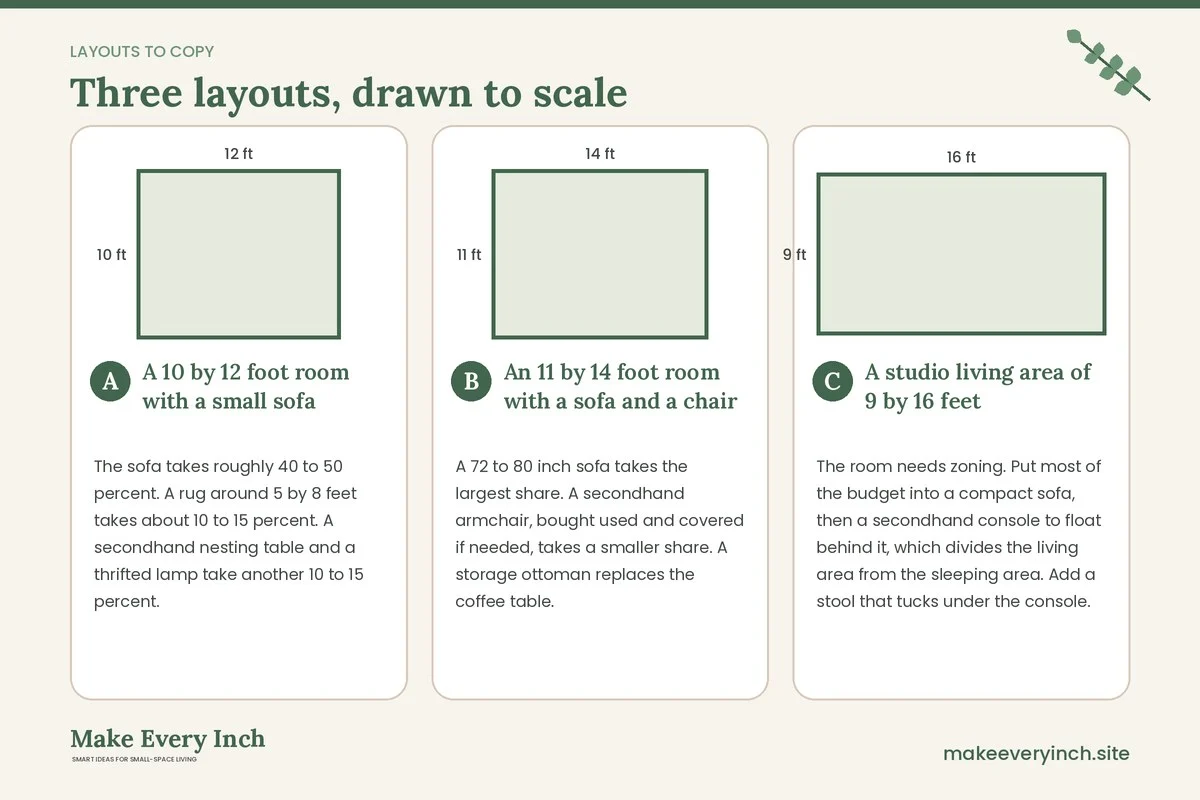
A 10 by 12 foot room with a small sofa
The sofa takes roughly 40 to 50 percent. A rug around 5 by 8 feet takes about 10 to 15 percent. A secondhand nesting table and a thrifted lamp take another 10 to 15 percent. A slim storage unit takes 10 to 15 percent, and the remainder goes to throws and a plant. The plan keeps a 36-inch walkway and puts the main money where you sit.
An 11 by 14 foot room with a sofa and a chair
A 72 to 80 inch sofa takes the largest share. A secondhand armchair, bought used and covered if needed, takes a smaller share. A storage ottoman replaces the coffee table. Because the chair is used, you can afford a better rug. This split suits people who read or host and want a second seat without spending twice on upholstery.
A studio living area of 9 by 16 feet
The room needs zoning. Put most of the budget into a compact sofa, then a secondhand console to float behind it, which divides the living area from the sleeping area. Add a stool that tucks under the console. Skip a large coffee table and use a tray on a pouf. This plan relies on a few multifunction pieces rather than many single-purpose ones, and it keeps a 30-inch path along the wall.
What to skip or delay
Some purchases are better postponed. Waiting often saves money and helps you avoid pieces that do not fit the finished room.
- A matching set. Sets look tidy but force you to buy items you may not need. Mixed pieces are often more flexible and cheaper.
- A large coffee table. In a small room it often costs more floor than it gives surface. Start with an ottoman or nesting pair.
- A big media unit. A wall-mounted screen or a slim stand saves floor space. See small living room TV wall ideas on a budget for options.
- Decor before furniture. Pillows, frames and vases are easy to add later. Furniture changes the shape of the room.
- Trend-driven shapes. Very curved or oversized pieces can look dated and waste space.
A buying order that protects your budget
Buy in an order that lets you adjust. First, the sofa, because every other measurement depends on it. Second, the rug, because it anchors the seating group and changes how the rest looks. Third, the lighting, because a good lamp makes cheap furniture look better. Fourth, tables and storage, which you can often find secondhand while you live with the first three. Last, the decor. Space the purchases a few weeks apart if you can. Living with the room for a short period shows what is missing and stops you buying things you do not use. For ideas on lighting, read our guide to small living room lighting ideas.
Common budget mistakes
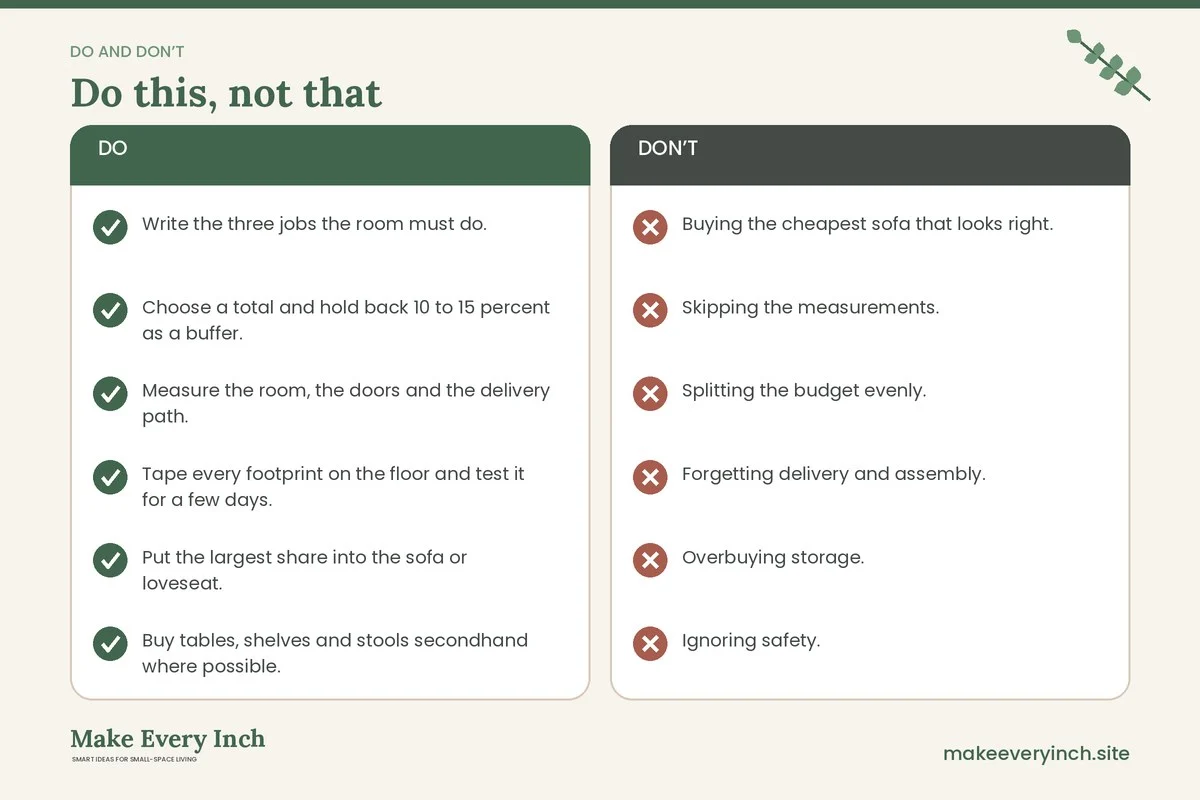
- Buying the cheapest sofa that looks right. Comfort and frame quality matter more than a low price, because you use the sofa every day.
- Skipping the measurements. A piece that does not fit is the most expensive piece you can buy.
- Splitting the budget evenly. Equal shares starve the important pieces and overfund the minor ones.
- Forgetting delivery and assembly. Include them in the total, or you may blow the budget at the last step.
- Overbuying storage. A big unit can fill a small room. Reduce what you own first. Our small apartment decluttering ideas post helps.
- Ignoring safety. Anchor tall furniture to the wall and keep cords tidy, especially around children and pets.
Budget checklist
- Write the three jobs the room must do.
- Choose a total and hold back 10 to 15 percent as a buffer.
- Measure the room, the doors and the delivery path.
- Tape every footprint on the floor and test it for a few days.
- Put the largest share into the sofa or loveseat.
- Buy tables, shelves and stools secondhand where possible.
- Use the five-point inspection on every used piece.
- Choose at least two multifunction pieces, such as a storage ottoman or nesting tables.
- Keep a 30 to 36 inch main walkway.
- Anchor tall furniture with the maker’s hardware or ask your landlord first.
- Add lighting before decor.
- Buy in stages and live with each stage for a few weeks.
FAQ
What should I buy first for a small living room on a budget?
Start with the sofa or loveseat, because it carries the most daily use and sets the measurements for everything else. Then add a rug and a light, and fill in tables and storage over time.
Is it safe to buy a sofa secondhand?
It can be, but inspect it carefully. Check the frame, the cushions and the seams, ask about smoke and pets, and be cautious about pests. If you cannot check it in person, a hard-surfaced piece is a safer used purchase.
How much of my budget should go on the sofa?
Many people give the sofa roughly a third to a half of the total, though the right share depends on your room and your market. If you will sit there for hours each day, lean toward the higher end.
Which multifunction pieces give the most value?
A storage ottoman, nesting tables and a bench with baskets usually do the most for the money, because each replaces two or more single-purpose pieces and saves floor space.
Do I need a coffee table in a small living room?
Not always. A tray on an ottoman or a pair of side tables can serve the same purpose for less money and less floor. Read our guide to small living room ideas without a coffee table for options.
How can I make cheap furniture look more expensive?
Keep the palette limited, add a good rug and warm lighting, hide cords, and use matching finishes or paint on mismatched pieces. Clean lines and a tidy surface do more than an expensive label.
Keep going: Keep planning with our small living room storage ideas on a budget, small apartment living room ideas on a budget and small living room makeover under 500.
Save this guide for later
Pin the ideas you like to Pinterest so you can come back to them when you plan your space.