Renter Friendly Shelving Ideas Without Drilling
Quick answer: The best renter friendly shelving ideas without drilling are leaning ladder shelves, tension pole shelves, freestanding bookcases, over-door racks and adhesive shelves for light loads only. Ask your landlord first, photograph the wall, load heavy items low, follow every stated weight limit and anchor tall units only in a way your lease allows.
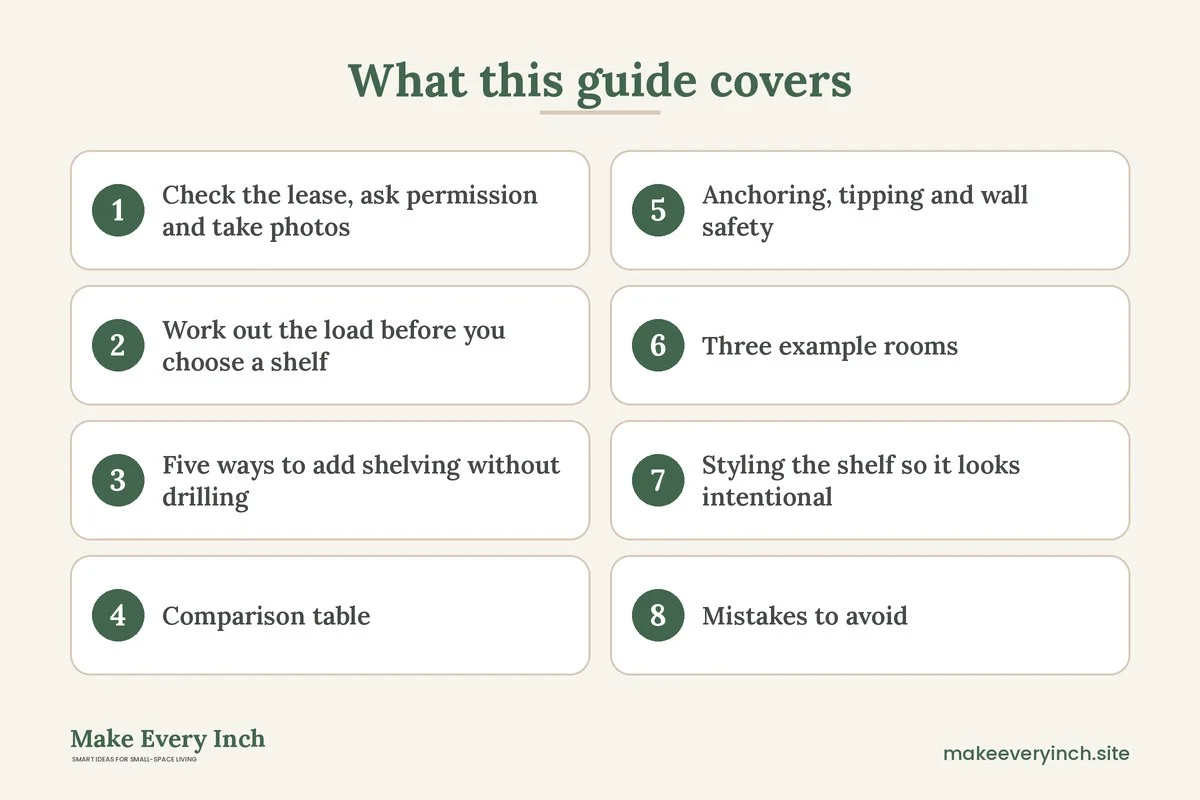
Renter friendly shelving ideas without drilling answer a question almost every tenant asks within a week of moving in: where do the books, plants and kitchen things go when the lease says no holes? Shelves are the fastest way to turn bare wall space into storage, and the usual way to hang them is a drill and a few anchors. You can get the same function with other methods, but each one has limits that matter, mostly around weight, stability and what it does to a wall. This guide is about those limits. It covers the lease and photo steps, a way to estimate load, five types of no-drill shelving (leaning, tension, freestanding, adhesive and over-door), a comparison table, three example rooms, tip-over and wall safety, a move-out plan and a checklist. For a wider list of storage tricks across the home, read our guide to no-drill storage ideas for renters. This post goes deeper on shelves alone, and it fits into our hub on renter-friendly apartment decorating ideas.
Check the lease, ask permission and take photos
Start by reading the clauses on alterations, wall fixtures and adhesives. Some leases ban anything that touches the wall, even removable hooks, while others only ban nails and screws. Ask in writing before you attach anything, even a strip, and keep the reply. A short message works: say what you plan to use, where, and that you will remove it at move-out.
Next, document each wall and floor where shelving will go. Take dated photos of the paint, the baseboard and any marks or chips that already exist. A wide shot and a close-up of each spot is enough. Keep them with your lease. This record protects your deposit if a tiny mark appears at move-out, because you can show what was there on day one. Our guide to security-deposit-safe apartment upgrades lists more habits that protect a deposit.
Never drill without permission. Even a small hole can be a charge, and a stud, pipe or wire behind the wall can make a hole a real hazard. If you do get written permission for a few holes in a wall, ask the landlord where they prefer them, and avoid the area near outlets, switches and plumbing.
Work out the load before you choose a shelf
The most common failure of a no-drill shelf is overload. Before you shop, think about what you will actually put on it. A rough weight guide helps you pick the right method.
- Light (a few pounds per shelf): small plants, candles, a few paperbacks, spice jars, framed photos.
- Medium (roughly 10 to 25 pounds per shelf): a row of hardcovers, a stack of dishes, a few canned goods, a mid-size plant in a pot.
- Heavy (more than 25 pounds per shelf): a full row of large hardcovers, cast-iron cookware, a big ceramic pot, a speaker, a printer.
These are rough ranges, and the exact numbers depend on the product, so always follow the maker’s stated limit and treat it as a ceiling, not a target. A good habit is to load to about half of the stated limit, since real objects shift, lean and add dynamic weight when you pull them off.
Weigh a sample if you are unsure. Stack the items on a kitchen or bathroom scale and note the total for one shelf. Then compare it with the limit. A shelf of books is heavier than it looks, and a single linear foot of hardcovers can weigh well over ten pounds.
Match the load to the method. Adhesive shelves belong in the light category. Tension and over-door shelves manage light to medium. Leaning and freestanding shelves take medium to heavy loads, because their weight goes to the floor.
Five ways to add shelving without drilling
Leaning shelves
1. A ladder shelf
A ladder shelf rests against the wall at a slight angle, with the base on the floor and the top resting on the wall. The deeper shelves sit at the bottom and the shallower ones at the top. Because the weight goes to the floor, it holds medium loads well. Place it on a flat surface, keep the angle the maker intended, and put the heaviest things on the lowest shelf. Add felt pads to the top contact points to protect paint, and a non-slip pad under the feet on slick floors. Check that it does not slide when you touch it.
2. A leaning bookcase with a lip
Some leaning units have a back rail that rests against the wall, with a flat shelf profile instead of a ladder shape. They suit narrow walls beside a door or a window. Keep the unit away from heaters, which can warp wood and make the shelf unstable.
3. A leaning mirror with a shelf
A tall mirror leaned against the wall can sit above a small console that holds shelves. The mirror itself should have a stable base and a lean angle, and it must not be a tip hazard for children or pets. Anchor it only with permission, or wedge it with felt pads at the base.
4. A leaning ladder as a towel or blanket rack
A plain wooden ladder leaned against the wall works as an open rack for blankets, towels and baskets. Keep the load light and the angle correct.
Tension shelving
5. A tension pole shelf
A pole runs from floor to ceiling and holds shelves by pressure. The pole pushes against both surfaces with a spring, so it needs a ceiling that can bear a small load. These are best in a corner or an alcove with a flat, solid ceiling. Avoid textured, popcorn or hollow ceilings, which can mark or crumble, and never use them near a sprinkler head or a smoke alarm. Check the tension again after a day and a week, since changes in temperature and load can loosen it. Keep loads light to medium and follow the maker’s guidance on height.
6. A tension rod shelf in a window or an alcove
A tension rod with a board resting on two rods can hold a few light pots or jars across a window frame or in a recess. Use two rods for the board, and do not trust a single rod to hold a pot full of soil. Place it where a tipped pot will not hit anyone.
7. A shower caddy-style pole in a bath
A tension pole with baskets fits a corner of a shower. Keep the load light and choose rust-resistant materials. For bathroom ideas, see our guide to renter-friendly bathroom ideas.
Freestanding shelves
8. A narrow open bookcase
A freestanding bookcase is the sturdiest no-drill option for heavy loads. A narrow model, around 8 to 12 inches deep, fits hallways and the space between a sofa and a wall. A wider, deeper model suits a living room. Our guide to the best narrow bookshelves covers what to look for. Keep heavy items low, and leave the top shelf for light things.
9. A cube unit
A modular cube unit can be set up in different shapes, and it grows with your needs. Use cube-sized bins to keep items tidy. Connect cubes with the supplied hardware where the maker provides it.
10. A metal wire rack
A rolling wire rack suits a kitchen, a laundry corner or a closet. It carries medium to heavy loads and sits on locking wheels. Lock the wheels when loaded, and keep it away from an exit route.
11. A shelf over a radiator or heater
Do not place a shelf over a radiator unless it is specifically designed to clear it, because heat can damage items and be a fire risk. Leave generous clearance.
12. A console or sideboard with a shelf
A console table with a lower shelf gives you a surface and a place for baskets. It is a good choice in an entry or behind a sofa.
Adhesive shelving
13. Adhesive-backed floating shelves
Some shelves hold on with a strong adhesive pad or strip. These have the lowest weight ratings, usually suitable for plants, candles and small frames, not for books. Follow the instructions about cleaning the wall, applying pressure and waiting before loading. Leave the wall to cure for as long as the maker says. Test the wall in a hidden spot first, because adhesive can lift paint on flat, new or poorly bonded surfaces. If the lease bans adhesives, skip this option entirely.
14. Adhesive hooks with a rail
A small rail on adhesive hooks holds light items, such as mugs, brushes or a lightweight plant. Use the number of hooks the maker rates for the load, space them evenly and do not exceed the limit.
15. Adhesive-mounted picture ledges
A narrow ledge on strips holds frames that stay upright. Use it for light frames and for postcards, and never for heavy items. Our guide to renter-friendly wall decor ideas explains how to test adhesive safely.
16. How to remove adhesive without damage
When it is time to remove an adhesive strip, pull the tab slowly and parallel to the wall, not out. Warming the strip gently with a hair dryer can help. Never rip. If paint lifts, stop and photograph the spot so you can tell the landlord. Do not scrub hard on matte paint.
Over-door and over-fixture shelving
17. An over-door rack
An over-door rack hooks over the top of a door and hangs along its face, with no screws. It holds shoes, cleaning supplies, pantry items or toiletries. Check that the door still closes, that hooks are padded and that the weight stays within the limit. Do not use it on a door that must close tightly for fire or security reasons, and do not use it on an exit door where it could snag clothing or block the swing. Our guide to small coat storage ideas has more ideas for doors.
18. An over-the-toilet unit
A freestanding unit over the toilet uses vertical space in a small bathroom. It must be stable, with a wide base, and be anchored with permission when tall. Browse the best over-the-toilet storage for choices.
19. An over-the-sink or over-cabinet rack
A rack that hooks over a cabinet door or sits across a sink gives you more shelf space in a small kitchen. Keep the load within the limit and check that the cabinet door still closes properly.
20. A shelf riser in a cabinet
A riser doubles the usable space in a cabinet without any attachment. Use a stable model and keep heavy items on the bottom.
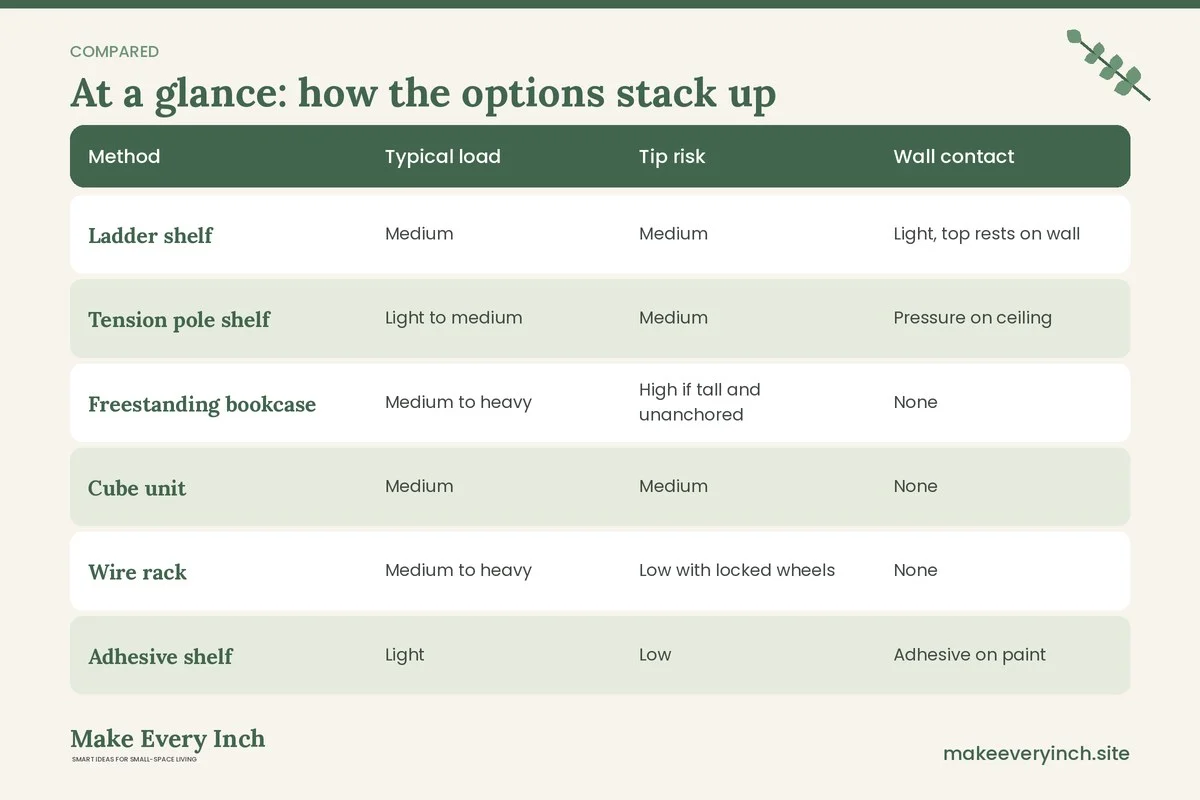
Comparison table: which method fits which job?
The ratings are general guidance. Always follow the stated limit for the product you choose.
| Method | Typical load | Tip risk | Wall contact | Lease risk | Best place |
|---|---|---|---|---|---|
| Ladder shelf | Medium | Medium | Light, top rests on wall | Low | Living room, bedroom |
| Tension pole shelf | Light to medium | Medium | Pressure on ceiling | Medium | Corners, alcoves |
| Freestanding bookcase | Medium to heavy | High if tall and unanchored | None | Low | Any room |
| Cube unit | Medium | Medium | None | Low | Kids rooms, offices |
| Wire rack | Medium to heavy | Low with locked wheels | None | Low | Kitchen, laundry |
| Adhesive shelf | Light | Low | Adhesive on paint | High | Small decor |
| Over-door rack | Light to medium | Low | Door only | Low | Pantry, bedroom, bath |
| Cabinet riser | Medium | Low | None | None | Kitchen |
Anchoring, tipping and wall safety
Tall furniture can tip, and the risk is highest in homes with children, pets or earthquakes. Any shelf taller than about waist height should be treated as a tipping hazard. The best practice is to anchor it to a stud with a strap or bracket, but that needs a screw, so it needs permission. If you cannot anchor, take these steps.
- Choose a low and wide unit. A shelf that is wider than it is tall resists tipping.
- Load heavy items low. Keep the center of gravity near the floor, and the top shelf for light objects.
- Use the wall. A unit that leans back slightly against the wall resists forward tipping.
- Avoid pulling on drawers or shelves. If a unit has drawers, open only one at a time, since multiple open drawers can shift the balance.
- Keep away from doors. A shelf near a door can be hit by it.
- Keep clear of outlets and heaters. Do not block outlets or vents, and keep a gap from heat sources.
- Check regularly. Give the unit a gentle push each month to make sure it is stable.
For electrical safety, do not route cords over shelves where they can be pinched, do not overload power strips attached to shelves and do not hang lamps from a shelf that was not designed for them. In a bathroom, keep plug-in devices away from water.
For ventilation and finishing, if you decide to paint or stain a thrifted shelf, use a low-VOC product in a ventilated room and let it cure fully before use. Strong odors can linger in a small rental, and fresh paint can stick to the wall if the shelf touches it, so allow time before leaning it.
Three example rooms
A living room wall of about 10 feet
The wall beside the sofa is bare. A pair of 30-inch-wide freestanding bookcases, each about 12 inches deep, stand against the wall, with a gap between them for a lamp. The heavy books sit on the lower two shelves of each, and baskets with blankets take the middle. A ladder shelf in the corner holds plants and framed prints on its lower shelves. A tension pole in the opposite corner holds light decor. Nothing is attached to the wall except, if permitted, anchoring straps for the bookcases. Photos of the wall were taken before the move.
A small kitchen with no wall space
The kitchen has a narrow alcove between the fridge and the wall, about 10 inches wide. A rolling wire cart fits the gap and holds pantry items on three shelves, with the heaviest cans on the bottom. An over-door rack on the pantry door holds spices and wraps, with the weight kept well under the limit. A cabinet riser doubles the plate shelf. A tension rod under the sink holds cleaning bottles. No holes were needed, and the wheels are locked when the cart is in place. See our guide to small kitchen storage ideas without remodeling for more.
A small bedroom with a low window
The bedroom has a window with a deep sill and no wall space beside the bed. A narrow ladder shelf at the head of the bed holds books and a lamp base, with the lamp on the second shelf. A freestanding cube unit under the window holds clothes in fabric bins. A tension rod shelf in a closet alcove holds shoes. An adhesive picture ledge above the dresser holds a few light frames, after a test patch passed. The tall unit is placed away from the bed so it cannot fall onto the sleeper, and the bed has a clear path to the door. For ideas in this space, read our post on small bedroom storage ideas.
Styling the shelf so it looks intentional
A shelf looks best with a mix of heights, textures and empty space. Place books in both vertical and horizontal stacks. Add a plant, a small object and a basket, and leave about one third of the shelf empty. Keep heavier items low and lighter items high. Group items in odd numbers, and repeat a color. On a ladder shelf, the changing depth suits larger items below and smaller ones above. On an open bookcase, back the shelves with a removable panel of paper or fabric only if the lease allows and the adhesive is safe.
Mistakes to avoid
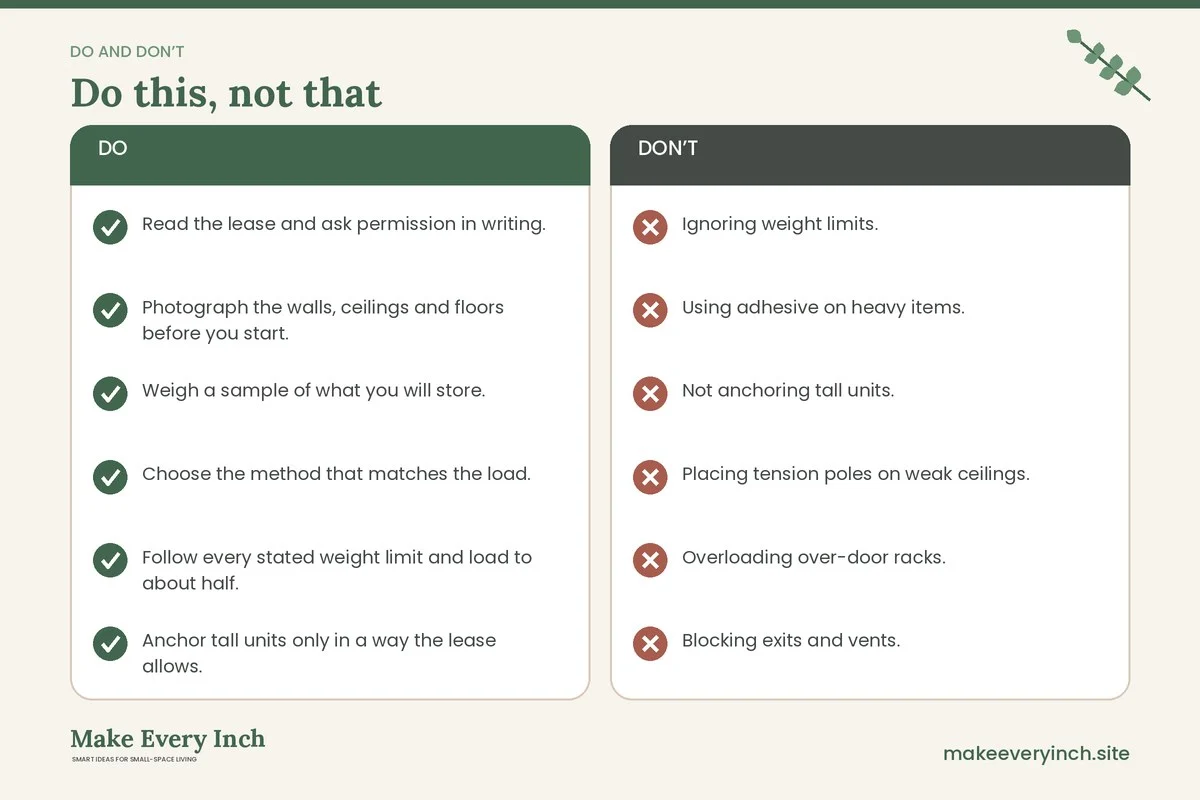
- Ignoring weight limits. The stated load is a limit, not a target.
- Using adhesive on heavy items. Strips are for light loads.
- Not anchoring tall units. If you cannot strap it, choose a lower one.
- Placing tension poles on weak ceilings. Textured or hollow ceilings can fail.
- Overloading over-door racks. A rack that pulls the door off its track is a repair bill.
- Blocking exits and vents. Keep clear paths and airflow.
- Skipping the photos. Without a record, a small mark can become a deposit dispute.
- Forgetting move-out. Plan how each shelf comes off before you put it up.
Moving out: take it all down cleanly
Plan removal ahead of time. Empty each shelf, release tension poles slowly, and remove adhesive using the technique above. Wipe marks with a damp cloth. Fill any approved holes using the method the landlord prefers. Compare the room with your move-in photos, take new photos and keep them. If you can, do a walkthrough with the landlord and ask for confirmation in writing. Shelving that sits on the floor leaves the least trace, which is why freestanding and leaning types are the safest choice for a short lease. For a longer list of ways to protect your deposit, see our post on organization ideas for renters.
Shelf checklist
- Read the lease and ask permission in writing.
- Photograph the walls, ceilings and floors before you start.
- Weigh a sample of what you will store.
- Choose the method that matches the load.
- Follow every stated weight limit and load to about half.
- Anchor tall units only in a way the lease allows.
- Put heavy items low and light items high.
- Test adhesive in a hidden spot and wait the full cure time.
- Check the tension pole again after a day and a week.
- Keep shelves away from heaters, exits and sprinklers.
- Use low-VOC finish on any shelf you paint.
- Photograph the room again at move-out.
FAQ
Can I put up shelves without drilling?
Yes. Leaning, tension, freestanding, adhesive and over-door shelves all work without drilling. The right one depends on the load, the wall and your lease.
How much weight can an adhesive shelf hold?
Only the weight on the maker’s label, and usually this is light. Treat adhesive as suitable for small plants and frames, not for books. Load to well below the rating.
Are tension pole shelves safe?
They can be, on a solid, flat ceiling, with light to medium loads. Check the tension after a day and a week, and avoid textured or hollow ceilings and sprinkler areas.
How do I stop a freestanding bookcase from tipping?
Anchor it with permission, load heavy items low, choose a wide base and keep the top shelf light. If you cannot anchor it, choose a lower unit.
Will an over-door rack damage my door?
It can scuff the edge or paint if it is overloaded or poorly padded. Use rubber pads, keep the load under the limit and check that the door still closes.
What is the best no-drill shelf for heavy books?
A freestanding bookcase, because its weight goes straight to the floor. Our guide to the best narrow bookshelves can help you pick a size.
Keep going: Keep going with our no-drill storage ideas for renters, the companion guide on renter-friendly ways to divide a studio apartment and our list of small apartment living room ideas without drilling.
Save this guide for later
Pin the ideas you like to Pinterest so you can come back to them when you plan your space.