19 No Entryway Apartment Ideas to Create an Entry From Nothing
Quick answer: The best no entryway apartment ideas define a zone instead of building a room. Mark it with a rug, add a slim console or wall hooks beside the door, hang a mirror, light it with a lamp or sconce and keep the door swing clear. Use a bookcase or a screen only if it leaves a path of about 30 to 36 inches and does not block exits, and check your lease before drilling.
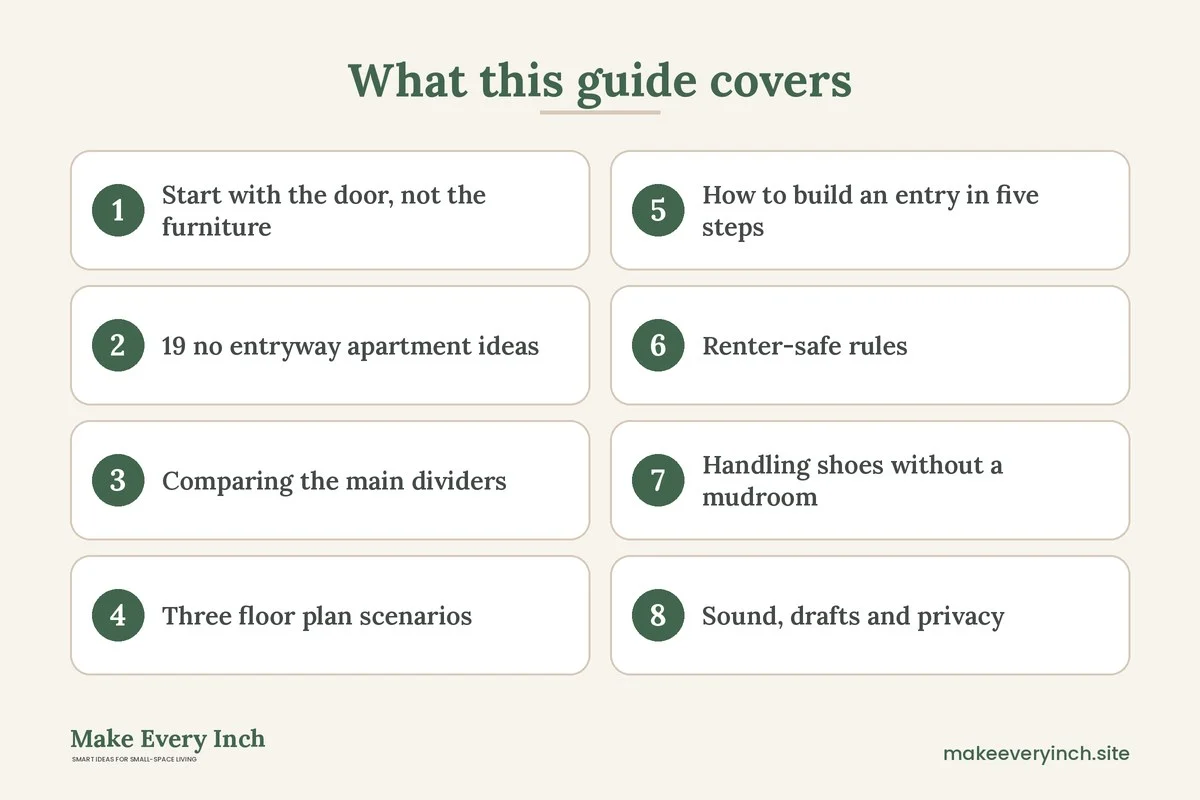
No entryway apartment ideas start with a simple fact: if your front door opens straight into the living room or kitchen, you do not have an entry, so you have to create one. That is common in studios and older buildings, and it causes the same problems every day: shoes in the middle of the floor, bags on the sofa and a sense that there is no place to land. The fix is not a bigger floor plan. It is a defined zone of about 3 by 4 feet that gives the door its own purpose, plus a few well-chosen pieces. This guide covers how to measure, 19 ways to build the zone, a comparison table, three floor plan scenarios, a step-by-step method, budget levels, mistakes and a checklist. For style and layout inspiration once the zone exists, see our pillar guide to small entryway ideas.
Start with the door, not the furniture
Open the door fully and stand where the person who enters would stand. Note where the door stops, which way it swings and how many steps there are before the sofa, the table or the kitchen counter. The door swing is the one fixed rule, because anything inside its arc will be hit or will block the door from opening. Cut a piece of string as long as the door width, pin it to the hinge and sweep it across the floor to mark the arc, or tape it with painter’s tape.
Then measure the clear floor between the door and the first major piece of furniture. You want at least 36 inches for a comfortable path, and a minimum of about 30 inches. Also check the building’s rules. In many places, fire codes and leases require a clear route to exits, so do not block the door, a hallway or a window that serves as a second exit. If you are unsure, ask your landlord, and never trade safety for storage.
19 no entryway apartment ideas
Define the zone
1. Anchor the landing with a rug
A rug is the quickest way to make an entry from nothing, because it turns a patch of floor into a place. Choose a low-pile or flat-weave rug about 2 by 3 feet or a runner 24 to 30 inches wide, and place it just inside the door. Use a rug pad suited to your floor, and check that the door clears the rug by at least a quarter inch.
2. Use a different floor color to mark the edge
If the rug is too small, a thin strip of contrasting color suggests a line. A washable doormat inside the door, followed by a runner, creates two layers that read as an entrance. Pick a darker, patterned rug, which hides dirt and grit well.
3. Place a console as a soft wall
A console table 9 to 14 inches deep, placed perpendicular to the wall beside the door, creates a visual edge without blocking light. It also gives you a surface for keys and mail. Use a model with open legs, so the floor remains visible underneath.
4. Build a half wall with a bookcase
An open bookcase placed at a right angle to the wall creates a divider that holds storage on both sides. Choose a unit about 30 to 42 inches wide and no more than 12 inches deep, and anchor it to a wall stud with a furniture strap if your lease allows. Leave the top shelf for baskets and the bottom for shoes. Never place a tall unit where it could block a path, and for renters who cannot drill, see our guide to renter friendly shelving.
5. Use a folding screen
A three-panel screen stands about 5 to 6 feet tall, folds flat and requires no installation. It blocks the view of the living room from the door, and it creates a sense of arrival. Position it so you can pass by comfortably, and avoid placing it where it could trap you in a hurry. A fabric or rattan screen also absorbs a little sound.
6. Hang a curtain on a ceiling track or a tension rod
A lightweight curtain hung from a tension rod or an adhesive-mounted track divides the zone without a wall. A sheer fabric keeps the room bright, and a heavier fabric adds privacy. Check the rod’s weight rating, and keep the fabric clear of the door.
Storage and surfaces
7. Use wall hooks behind the door
The back of the door and the wall beside it are free storage. Over-the-door hooks, which hang on the top of a door with no screws, hold coats and bags, though a very thick door may not take them. If you may drill, mount a rail with 3 to 5 hooks at about 60 to 66 inches high.
8. Add an adhesive hook rail
If the lease bans screws, a hook rail with adhesive strips holds light items such as scarves, keys and tote bags. Read the weight rating, clean the wall with rubbing alcohol before you stick, and allow the full cure time. Our guide to no drill storage ideas for renters goes through the options.
9. Choose a slim shoe cabinet
A flip-down shoe cabinet about 7 to 9 inches deep keeps shoes out of sight, and the top becomes a console. It is the best answer when shoes are the main problem. Pick one with adjustable shelves, so it can hold boots as well as sandals.
10. Use a bench with storage
A bench about 14 inches deep and 36 inches long gives a place to sit and a place to hide shoes. Choose one with a lid or open cubbies. Place it along the wall that is farthest from the door swing, and check the door still clears.
11. Float a wall shelf for keys and mail
A shelf 5 to 6 inches deep holds a tray, a small plant and a lamp. If you can drill, anchor it into studs or use rated anchors. If you cannot, a freestanding narrow shelf, about 10 inches deep, does the same job.
12. Keep a tray or a basket for the daily pile
Even with no entry, you need a spot for the things you carry in. A tray on the console for keys and a basket on the floor for bags prevent the pile on the sofa. Empty the basket every week.
Light, mirror and mood
13. Hang a mirror at the door
A mirror serves three purposes: it lets you check your outfit, it reflects light and it makes the zone feel like its own place. Hang or lean one about 20 by 30 inches or larger beside the door. Avoid facing it at the front door in a way that blinds you at night.
14. Add a lamp or a plug-in sconce
A small lamp on a console, or a plug-in sconce, lights the entry without altering the room. Warm bulbs, around 2700 K, feel welcoming. For options that need no wiring, see our guide on renter friendly lighting ideas.
15. Use a motion-sensor light
A battery puck light or a plug-in motion-sensor light turns on as you open the door, which helps in a dark room and saves fumbling for a switch. Choose one with a warm color setting, and check the battery type.
16. Create a visual backdrop
A strip of removable wallpaper or a leaning piece of art behind the console helps the zone read as a separate area. Even a single framed print does the job. See removable wallpaper ideas for tips, and test the adhesive in a hidden spot first.
Practical details
17. Set up a shoe rule
Decide how many pairs live in the entry, such as four per person, and keep the rest in a closet or under the bed. Use a boot tray with a lip for wet shoes, and a mat for drying. A clear rule is stronger than any shoe rack.
18. Add sound and privacy
If the door opens into the living room, hallway noise and sightlines can be a problem. A rug, a curtain or a bookcase absorbs some sound, and a door draft stopper at the bottom reduces noise and drafts. A door sweep on a rental is usually removable, but ask first.
19. Hide the electrical panel or utility box
If the door sits next to a breaker panel or a meter, do not block access. Leave at least 30 inches clear in front of it, and use a lightweight cover that you can lift away, such as a framed canvas on hinges or a curtain. Check your local rules or ask the landlord, since many codes require clear access.
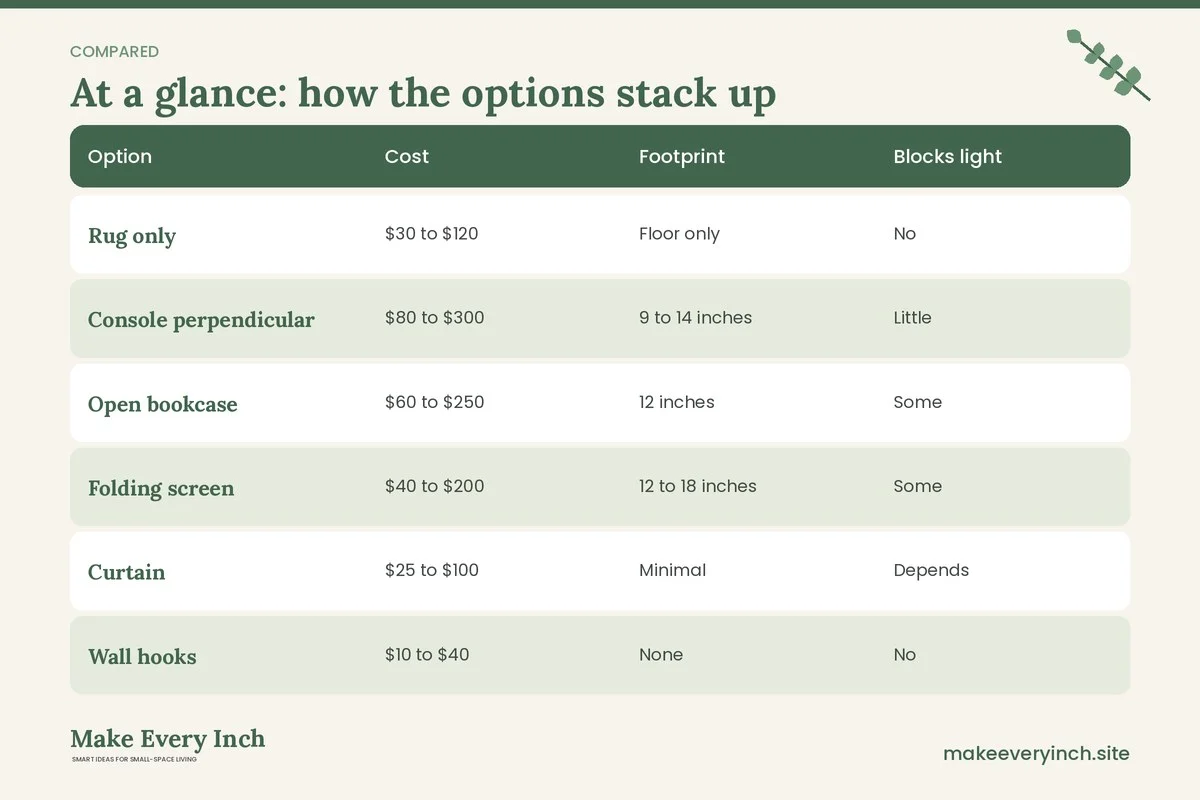
Comparing the main dividers
| Option | Cost | Footprint | Blocks light | Renter-friendly |
|---|---|---|---|---|
| Rug only | $30 to $120 | Floor only | No | Yes |
| Console perpendicular | $80 to $300 | 9 to 14 inches | Little | Yes |
| Open bookcase | $60 to $250 | 12 inches | Some | Yes, with a strap if allowed |
| Folding screen | $40 to $200 | 12 to 18 inches | Some | Yes |
| Curtain | $25 to $100 | Minimal | Depends | Yes |
| Wall hooks | $10 to $40 | None | No | Depends on method |
| Shoe cabinet | $60 to $250 | 7 to 9 inches deep | No | Yes |
Three floor plan scenarios
The studio with a door beside the kitchen
The door opens onto a 4 foot stretch beside the counter. Place a runner along the wall, a shoe cabinet on the wall that faces the counter and a mirror above it. Hang three hooks at the end by the door. Keep a 36 inch path from the door to the kitchen, and do not put the shoe cabinet where the door hits it. Total cost can be about $300.
The one-bedroom with the door beside the sofa
The sofa back sits only 3 feet from the door. Turn a narrow console behind the sofa so its back faces the door, place a lamp on it and add a rug at the door. The console becomes the landing, and the sofa becomes the wall. Hang a mirror on the wall beside the door, and use a basket for bags beneath the console. Check the sofa does not block the door when it opens.
The loft with a door onto an open room
There is plenty of space, but no walls. Use a screen or an open shelf to create a corner about 4 by 5 feet, with a bench against the wall, a rug and a floor lamp. Because the loft is large, you can use a tall bookcase to create a visual wall, but leave a gap at one end for a clear path. Keep the screen on the side away from the door so the door swing stays clear.
How to build an entry in five steps
Step 1: Map the door swing
Mark the arc with tape. Nothing goes inside it, apart from a flat mat.
Step 2: Choose the walls
Pick the wall closest to the door, and the one the door opens toward. These are your two working walls. Measure them for hooks, a shelf and a console.
Step 3: Place the rug
Put the rug in the center of the zone, close enough to the door to catch dirt. Add a pad.
Step 4: Add the storage
Place the shoe cabinet or a bench against the wall, then add hooks and a tray. Test the layout by walking through with a coat and a bag.
Step 5: Add light and a mirror
Put a lamp on the console, hang the mirror and take a photo from the door. If the zone reads as a place, you are done. If not, remove an object and try again.
Renter-safe rules
Read the lease for rules about drilling, paint, adhesives and emergency exits. Photograph the walls and floor before and after you install anything. Use adhesive strips rated for the weight, and clean the wall first. Do not use anything that blocks a window or a door used as an exit. If you want to drill, ask in writing, and keep the original hardware. For a wider look at what is safe, read our guide to security deposit safe apartment upgrades.
Handling shoes without a mudroom
Shoes are the biggest source of entry mess, and a rule works better than a rack. Keep a maximum number of pairs by the door, and rotate the rest. Use a boot tray, about 30 inches long, with a raised edge for wet pairs, and set a washable mat beside it. A shoe cabinet with doors hides them, and an open rack lets them dry. Let wet shoes dry before closing them in a cabinet, since moisture builds odor. A small bowl of baking soda or cedar blocks keeps the air fresh. If you have guests who take off shoes, a bench or a chair makes it easy.
Sound, drafts and privacy
When a door opens to a living space, anyone outside can see in, and noise carries both ways. A screen or a bookcase blocks the sightline. A heavy curtain, a rug and soft furnishings absorb sound. A door sweep, a draft stopper or a self-adhesive weatherstrip reduces gaps, which cuts noise and drafts at the same time. If you share a hallway, a door viewer cover or a peephole cover adds privacy, so check that it does not damage the door. A smart doorbell may be allowed in some buildings, but ask first.
Making a small zone feel designed
Keep the zone to three levels: a floor layer, a mid layer at hand height and a wall layer. The rug and the shoes sit on the floor, the console, tray and lamp live at mid height and the mirror and hooks live on the wall. Keep the colors of the three layers close, with one accent. Leave the console about one third empty so the zone looks calm. A repeating shape, such as round mirror and round tray, ties the pieces together. A plant adds life, so choose one that tolerates a draft and low light.
Budget guide
Under $75
A rug, a hook rail with adhesive strips and a tray, bought secondhand where you can.
About $250
A slim console or shoe cabinet, a mirror, a plug-in lamp and a runner with a pad.
$500 and up
A custom-sized bookcase divider, a quality screen, a bench with storage and a good mirror.
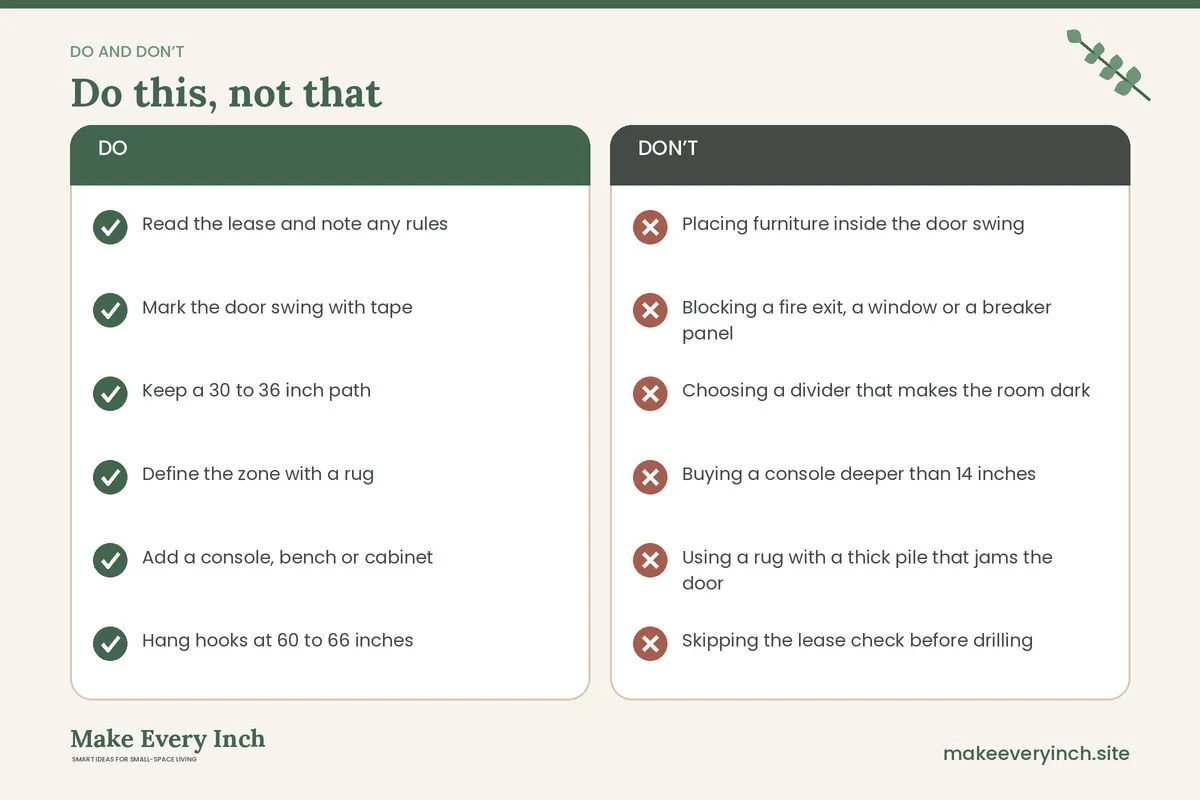
Mistakes to avoid
- Placing furniture inside the door swing
- Blocking a fire exit, a window or a breaker panel
- Choosing a divider that makes the room dark
- Buying a console deeper than 14 inches
- Using a rug with a thick pile that jams the door
- Skipping the lease check before drilling
- Leaving shoes with no rule
- Hanging adhesive hooks above their weight rating
Entry-from-nothing checklist
- Read the lease and note any rules
- Mark the door swing with tape
- Keep a 30 to 36 inch path
- Define the zone with a rug
- Add a console, bench or cabinet
- Hang hooks at 60 to 66 inches
- Hang a mirror and add a lamp
- Set a shoe rule
- Keep exits and panels clear
- Photograph before and after
FAQ
How do I create an entryway in an apartment with no entry?
Mark a 3 by 4 foot zone with a rug, add a console or a shoe cabinet, a mirror and a lamp, and install hooks beside the door. Keep the door swing and a clear path free.
How can I separate the entry from the living room?
Use an open bookcase, a folding screen, a curtain on a tension rod or a console placed at a right angle to the wall. Choose one that does not block light or exits.
What can I do if I cannot drill into the walls?
Use over-the-door hooks, adhesive hook rails rated for the weight, a freestanding console, a leaning mirror and a tension rod curtain. See no drill storage ideas for renters.
Where do I put shoes if there is no entry?
Use a slim shoe cabinet, a bench with storage or a boot tray beside the door. Limit the pairs kept there, and move the rest to a closet or under the bed.
How much space do I need for an entry zone?
About 3 by 4 feet is comfortable, but even a 2 by 3 foot rug and a wall of hooks help. Keep a path of 30 to 36 inches clear.
Is it safe to block part of the room with a bookcase?
Only if it leaves clear paths and exits, and is secured against tipping. Use an anti-tip strap if your lease permits, and keep it short enough to see over.
What lighting works best for a no-entry apartment?
A warm lamp or a plug-in sconce, around 2700 K, and a motion-sensor light for arrival. Our guide to renter friendly lighting ideas lists more options.
How do I decorate the entry zone cheaply?
Use a thrifted console, a rug from a discount store, a second-hand mirror and a plant. Paint a frame to match, and add one piece of art. See small entryway ideas for style tips.
Keep going: Keep going with small entryway ideas, renter friendly shelving and security deposit safe apartment upgrades.
Save this guide for later
Pin the ideas you like to Pinterest so you can come back to them when you plan your space.