Small Living Room TV Wall Ideas Budget: 16 DIY and Thrift Plans
Quick answer: The best small living room tv wall ideas budget plans spend money only on the parts that carry weight or manage safety, which means the mount or stand, and then fill the rest with DIY and thrifted pieces. Paint a frame around the screen, build a simple shelf or ledge, hide cords with a raceway, and rescue a solid second-hand console. Hang the screen center about 40 to 44 inches from the floor, sit roughly 5 to 8 feet away, and follow the TV and mount instructions for studs, anchors and weight.
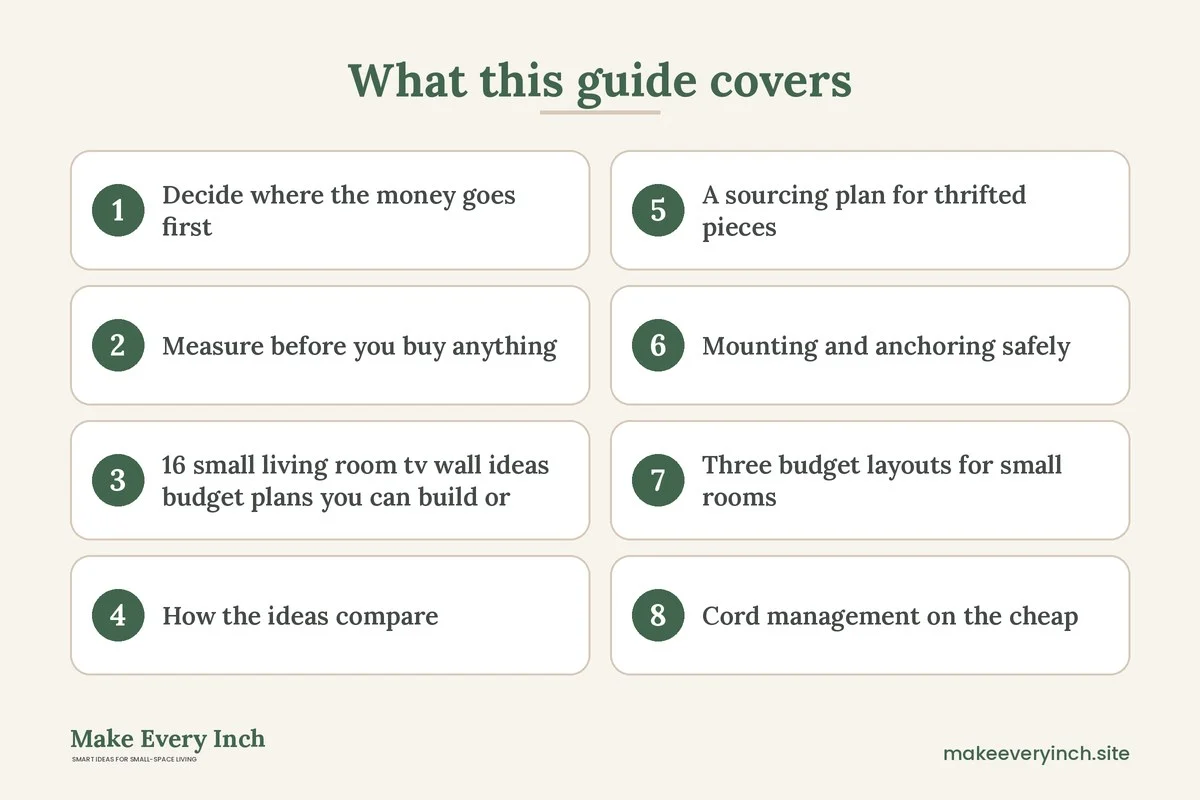
Small living room tv wall ideas budget plans start from an honest observation: the television itself is usually the largest purchase in the room, so the wall around it has to be cheap or it will never get finished. The good news is that most of what makes a TV wall look designed costs very little. Paint, a few boards, a thrifted console, a bundle of cord covers and some patience do more than an expensive built-in. This guide walks through how to set a budget by tier, which parts deserve real money and which do not, 16 ideas you can build or find, a table that compares them, measurements for height and viewing distance, a sourcing plan for second-hand finds, safety rules for mounting and anchoring, a checklist and a long FAQ. For the full overview, read our parent guide on small living room tv wall ideas and the broader pillar on small living room ideas. If your whole room needs a plan, our small living room makeover under 500 post shows how to split a limited budget across everything else.
Decide where the money goes first
A TV wall has four jobs: hold the screen safely, hide or tame the cords, store the small things that live near the screen, and look good enough that you do not mind seeing it when the screen is off. Each job has a cheap route and an expensive route, and you can mix them. Before you shop, write the four jobs on a page and decide which one matters most to you. Then spend there first.
Spend on safety, save on style
The one place to avoid cutting corners is whatever physically holds the screen. A mount or a stand must be rated for your TV’s weight and size, and it must be installed as its instructions say. A cheap mount that is rated correctly is fine, and an expensive piece of furniture that is too weak is not. Everything else, such as the frame around the screen, the shelves beside it and the paint behind it, is decoration, and decoration can be made from inexpensive materials without any loss of safety.
Use a simple three-tier budget
Rather than naming a fixed number, think in tiers. Prices vary by region, store and season, so treat any range below as a rough guess and check local listings before you commit.
- Lowest tier: you already own the TV and a stand or console. You spend only on paint, cord covers and a few small items. Many people can do this for a modest sum, often somewhere around the cost of a few cans of paint and a pack of cable clips.
- Middle tier: you add a mount or a second-hand console, plus lumber for a simple shelf or ledge. The total often lands in the range of a nice dinner out to a modest weekend shopping trip, depending on what you find.
- Higher tier: you buy a new mount, new lighting and some made-to-measure boards, and you pay someone to help with a tricky wall. This still costs far less than most built-in cabinets.
None of these figures is a promise. They are a way to compare your own plan against your own limit. Write down a ceiling, add a 15 percent cushion for surprises, and stick to it.
Measure before you buy anything
Measuring costs nothing and prevents the most expensive mistake, which is buying a piece that does not fit. Take these numbers first.
- Screen center height: about 40 to 44 inches from the floor in most living rooms, which puts the middle of the screen near seated eye level. If you mostly watch lying down, aim a few inches lower, and if you stand at the counter to watch, a few inches higher.
- Viewing distance: a rough guide for a modern flat screen is about 1.2 to 1.6 times the screen’s diagonal measurement for a very immersive view, and up to 2 to 2.5 times the diagonal for relaxed viewing. In a small room, 5 to 8 feet is common. A 43 inch screen suits about 5 to 7 feet, and a 55 inch screen suits about 6 to 9 feet. Check the figures against your own comfort.
- Wall width: measure the usable wall from corner to corner and from any window or door edge. Leave at least 4 to 6 inches of clear space beside any frame or shelf so the wall does not feel crammed.
- Console depth: most consoles are 14 to 18 inches deep. In a small room, a depth of 10 to 14 inches keeps the walkway open.
- Walkway: keep 30 to 36 inches clear in the main path, and at least 24 inches for a path you only use occasionally.
- Stud locations: find the vertical studs behind the wall with a stud finder, and mark them lightly with a pencil. Studs in many homes are about 16 inches apart, though this varies, so check rather than assume.
- Cord reach: measure from the TV’s outlet to the nearest socket. A cord that dangles is the number one reason a budget wall looks cheap.
Sketch the wall on graph paper at a scale of one square to two inches. Draw the screen, the stand or console, and any shelf or frame. Moving paper rectangles is free, and it shows you at once whether the layout is balanced.
16 small living room tv wall ideas budget plans you can build or find
Paint and finish ideas
1. A painted frame around the screen
Mark a rectangle on the wall that is 4 to 8 inches larger than the screen on every side, tape the edges and paint it in a deeper color than the rest of the wall. The screen looks inset, and the dark block hides the black rectangle when the TV is off. Paint is one of the cheapest changes you can make, and a single sample pot often covers a frame this size. Use painter’s tape and press the edge firmly to get crisp lines.
2. A two-tone wall
Paint the lower third of the wall, up to about the console height, in a darker shade, and keep the upper part light. This visually grounds the console and makes the ceiling feel taller. Choose a finish that wipes clean, since the lower wall takes more bumps.
3. A full dark wall
A dark color behind the TV reduces the glare contrast, so the screen blends in when it is off. Charcoal, deep green and navy are common choices. In a small room, keep the other walls light and add a lamp so the room does not feel like a cave.
4. A paint-and-line accent
Use tape and a small brush to draw a thin vertical stripe or an arch beside the TV. A simple shape in a contrasting color adds interest for the price of a sample pot. Keep the lines simple, and apply two coats for a solid look.
DIY structure ideas
5. A floating ledge for decor
A single board of about 4 to 6 inches deep, mounted above or beside the screen, holds a plant, a frame and a candle. Pick a board that matches your console, sand the edges, and finish it with stain or paint. Fasten it into studs, or use anchors rated for the load, and follow the hardware instructions. Keep it light, because a ledge is for decor and not for heavy items.
6. A plank wall behind the screen
Thin boards or lath strips, nailed or glued to the wall in a vertical pattern, create texture for a small cost. Stain them or leave them natural. A plank backdrop makes a small TV look intentional, and the vertical lines add height. Check the wall first, and in a rental, see our companion guide on small living room tv wall ideas renter friendly.
7. A DIY slat panel
Space thin strips about half an inch apart on a backing sheet, paint the whole panel, and hang it behind the screen. The gaps cast gentle shadows, and the panel can hide a cord channel. Cut the strips to the same length with a saw, or ask the store to cut them for you.
8. A simple media shelf on legs
A plain board on four short legs makes a low media bench for the cost of lumber and hardware. Keep the height at about 14 to 18 inches so the screen center lands in the right place. Choose boards thick enough to resist sagging, and check the weight limit against your TV.
9. A built-in look from stock bookcases
Place two narrow second-hand or flat-pack bookcases on each side of the screen, and add a board across the top. Paint the whole thing in the wall color for a built-in look. Anchor each bookcase to the wall with the hardware supplied, because tall furniture can tip.
Thrift and rescue ideas
10. A rescued console or dresser
A low dresser or sideboard from a thrift shop or online listing often has solid wood, and it gives you storage for far less than a new media unit. Check that the top is stable and flat, that the drawers slide, and that the frame can carry the TV. Sand and repaint it in one afternoon. Cut a small hole in the back panel for cords if needed.
11. Thrifted frames as a gallery
Gather a handful of second-hand frames, spray them one color, and fill them with prints, fabric or pages from old books. Arrange them beside the screen so the TV becomes part of a gallery wall. Keep the frames lighter than the TV in visual weight, and use a consistent mat color.
12. A mirror or a tray as a backdrop
A large framed mirror beside the screen bounces light and makes the wall feel wider. Place it so it does not reflect the screen glare back at the sofa. A thrifted wooden tray, hung on the wall with the right hardware, can act as a small shelf for a remote or a plant.
13. A secondhand cabinet with doors
If you want to hide cables, game consoles and boxes, find a cabinet with doors. Doors can be left open when you use the remote. Check that the back is open or can be cut for ventilation, since electronics need airflow.
Cord and lighting ideas
14. A paintable cord raceway
A plastic channel stuck to the wall hides cords, and you can paint it in the wall color so it nearly disappears. Run it straight and keep it vertical. In a rental, choose one with removable adhesive and test it first.
15. A bias light behind the screen
A low-cost LED strip stuck to the back of the TV casts a soft glow on the wall. It reduces eye strain in a dark room, and it adds depth for little cost. Use a strip that is made for indoor use, and keep it away from heat.
16. A plug-in picture light
A small light above a print or a shelf beside the TV gives the wall a layered look. Choose a warm bulb, around 2700 kelvin, and tuck the cord into the raceway.
How the ideas compare
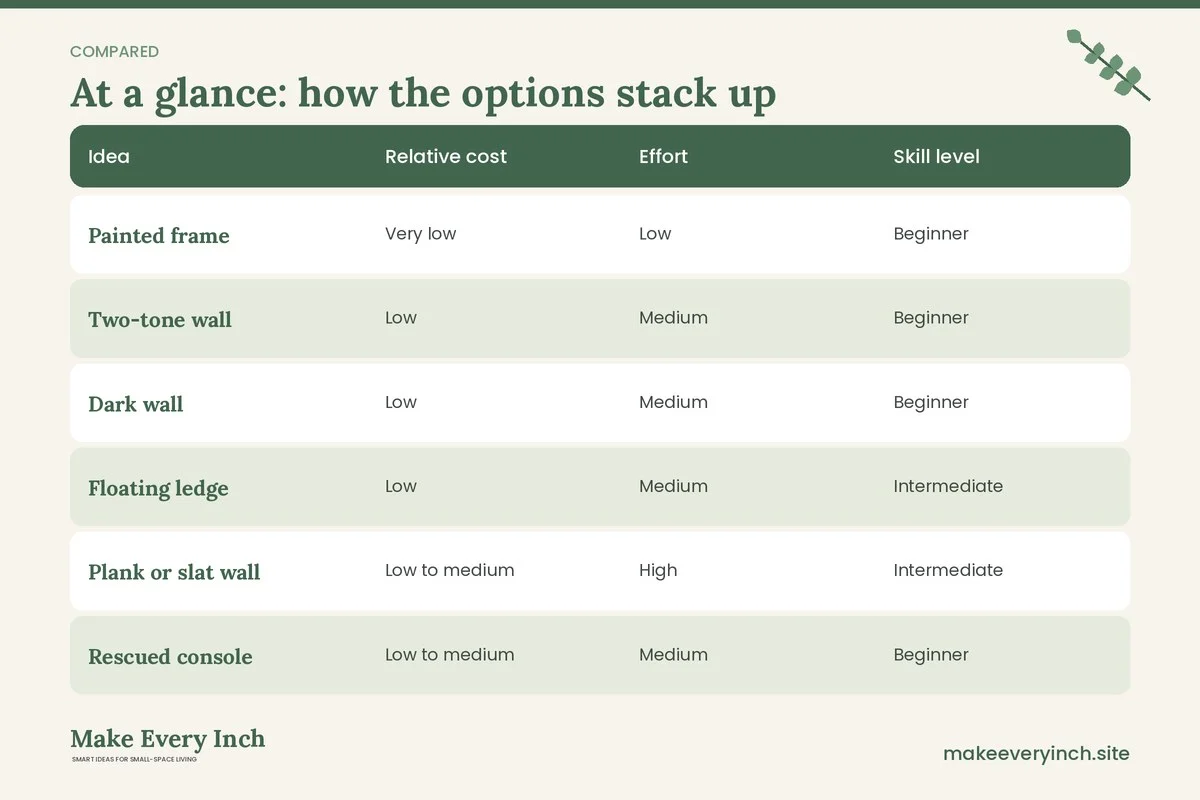
This table ranks the ideas by relative cost, effort and risk. Costs are relative rather than exact, because prices change.
| Idea | Relative cost | Effort | Skill level | Safety note |
|---|---|---|---|---|
| Painted frame | Very low | Low | Beginner | None |
| Two-tone wall | Low | Medium | Beginner | None |
| Dark wall | Low | Medium | Beginner | None |
| Floating ledge | Low | Medium | Intermediate | Anchor into studs or rated anchors |
| Plank or slat wall | Low to medium | High | Intermediate | Use proper fasteners |
| Rescued console | Low to medium | Medium | Beginner | Check weight rating, add anti-tip strap |
| Stock bookcases | Medium | Medium | Beginner | Anchor to the wall |
| Cord raceway | Very low | Low | Beginner | Keep clear of heat |
| Bias light | Very low | Low | Beginner | Keep away from heat |
| New mount | Medium | Medium | Intermediate | Follow mount and TV instructions |
A sourcing plan for thrifted pieces
Thrifting works best when you know what you want, because a table full of bargains is only a bargain if it fits your wall. Follow this plan.
Know your size limits
Write the maximum width, depth and height of the console on your phone before you leave. A piece that is two inches too wide for the wall will bother you every day. Remember that the screen’s stand or feet need space on the top, and that the TV should sit within the width of the console or slightly narrower, not hanging off the edge.
Know where to look
Second-hand furniture turns up in thrift stores, estate sales, community listings, moving sales and neighborhood groups. Early in the month and at the end of a semester, people often clear furniture. Check often, and be ready to move quickly, since good pieces go fast. Bring a tape measure, a flashlight and a friend to help lift.
Inspect before you pay
Check the following on any console or dresser.
- Does the top lie flat, with no wobble or warp?
- Do the joints feel tight when you push the frame side to side?
- Are the drawers dry and free of mold or strong smells?
- Is the back panel intact, or can you cut an opening for cords?
- Can it carry the weight of your TV? Compare the TV weight with any rating on the unit, and if there is none, choose a solid piece with a sturdy top.
- Are there signs of pests? Skip anything that looks suspicious.
Clean and refinish safely
Wipe the piece down with a mild soap and water mix, let it dry, and sand lightly. Prime it if it is glossy, and paint with two thin coats. Let it cure for several days before you put the TV on it, since fresh paint can stick to the feet of the TV. If an item has an old finish and you are not sure what it contains, ventilate the room and use a dust mask when sanding.
Mounting and anchoring safely
Budget does not mean cutting corners on safety. A screen can be heavy, and a fall can hurt people or pets. These rules apply to nearly every setup.
- Follow the TV and mount instructions. The manufacturer’s guide tells you the mounting pattern, the screws to use and the weight limit. Do not guess.
- Use studs or the right anchors. Mount into wall studs where the instructions call for it. If a stud is not available, use anchors rated for the load, and only if the mount instructions allow them. If you are unsure about your wall, ask a professional.
- Check the rating. The mount’s rating must exceed the weight of the TV, with room to spare.
- Level and tighten. Use a level, and tighten all bolts snugly, but do not overtighten.
- Strap furniture. If the TV sits on a console, use the anti-tip hardware that comes with the TV or the furniture. Strap tall bookcases to the wall.
- Keep cords safe. Do not run power cords inside the wall unless the product is rated for it. Use only products made for the purpose.
- Get help. A big screen is awkward to lift. Have a second person, and do not stand on a wobbly chair.
- Watch for pets and children. Place cords and small items out of reach, and make sure the unit cannot be pulled over.
Three budget layouts for small rooms
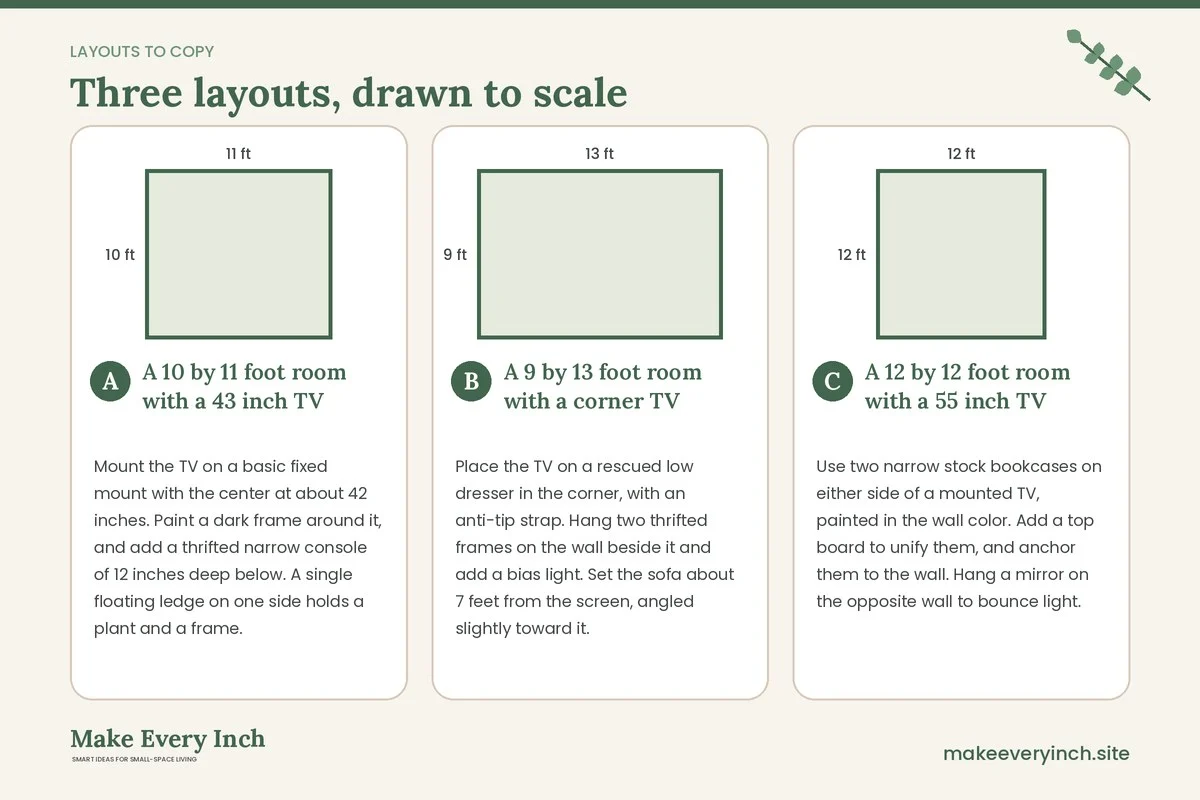
A 10 by 11 foot room with a 43 inch TV
Mount the TV on a basic fixed mount with the center at about 42 inches. Paint a dark frame around it, and add a thrifted narrow console of 12 inches deep below. A single floating ledge on one side holds a plant and a frame. The sofa sits about 6 feet away. The cords run in a painted raceway. This plan uses the lowest-cost items and keeps the walkway clear.
A 9 by 13 foot room with a corner TV
Place the TV on a rescued low dresser in the corner, with an anti-tip strap. Hang two thrifted frames on the wall beside it and add a bias light. Set the sofa about 7 feet from the screen, angled slightly toward it. A rug of 5 by 8 feet anchors the group. The corner placement saves wall space for a bookcase on the other side.
A 12 by 12 foot room with a 55 inch TV
Use two narrow stock bookcases on either side of a mounted TV, painted in the wall color. Add a top board to unify them, and anchor them to the wall. Hang a mirror on the opposite wall to bounce light. The sofa sits about 8 feet away, and the walkway stays at 36 inches. The built-in look is the most ambitious of the three, but it still costs far less than custom work.
Cord management on the cheap
Cords make a budget wall look budget, so give them a plan. Start by labeling each cord at both ends with a bit of tape, so you can unplug the right one later. Group the cords with reusable ties and run them along the back of the console. Use a power strip with surge protection, mounted behind the stand, and keep it out of reach of children. For a mounted TV, a raceway on the wall hides the run from the TV to the outlet. Paint the raceway the wall color. Leave a loop of slack so the TV can move if it is on an arm. Keep power cords and signal cords apart where you can, to reduce interference. Never staple through a cord.
Styling the wall so the TV does not dominate
A TV is a black rectangle, and the trick is to give the eye other things to look at. Use the rule of three: place the screen, then a pair of items at different heights. Add a plant, a lamp and a stack of books on the console. Keep the tops mostly clear, and group items rather than scattering them. Match the colors of the decor to the rug and cushions. Use odd numbers of items and vary their height. A single large print or a tall plant near the screen draws attention away from the black rectangle. Keep the sofa-facing side of the console tidy, because that is the part that you see all evening.
Lighting without a big bill
A TV wall needs a gentle light so the screen does not sit in a dark void. A lamp on the console, a bias light behind the screen and a floor lamp beside the sofa are enough. Avoid putting a bright light directly in front of the screen, which causes glare. Use bulbs of about 2700 kelvin for a warm look. A smart plug or a timer can turn the lamp on at sunset for a small cost. For more ideas, see our guide to small living room lighting ideas.
Storage that fits a small wall
Budget storage is mostly about using what you have. Baskets on the lower shelf hold remotes, game controllers and cables. A shallow tray on the console keeps small items together. Under the console, a flat storage box slides in for extra blankets. If you need more, a narrow bookcase or a slim shelf beside the TV can hold media. For more options, read our post on small living room storage ideas and the budget version, small living room storage ideas budget. If you also need a seat to match, see our guide to the best sofas for small apartments.
Common budget mistakes
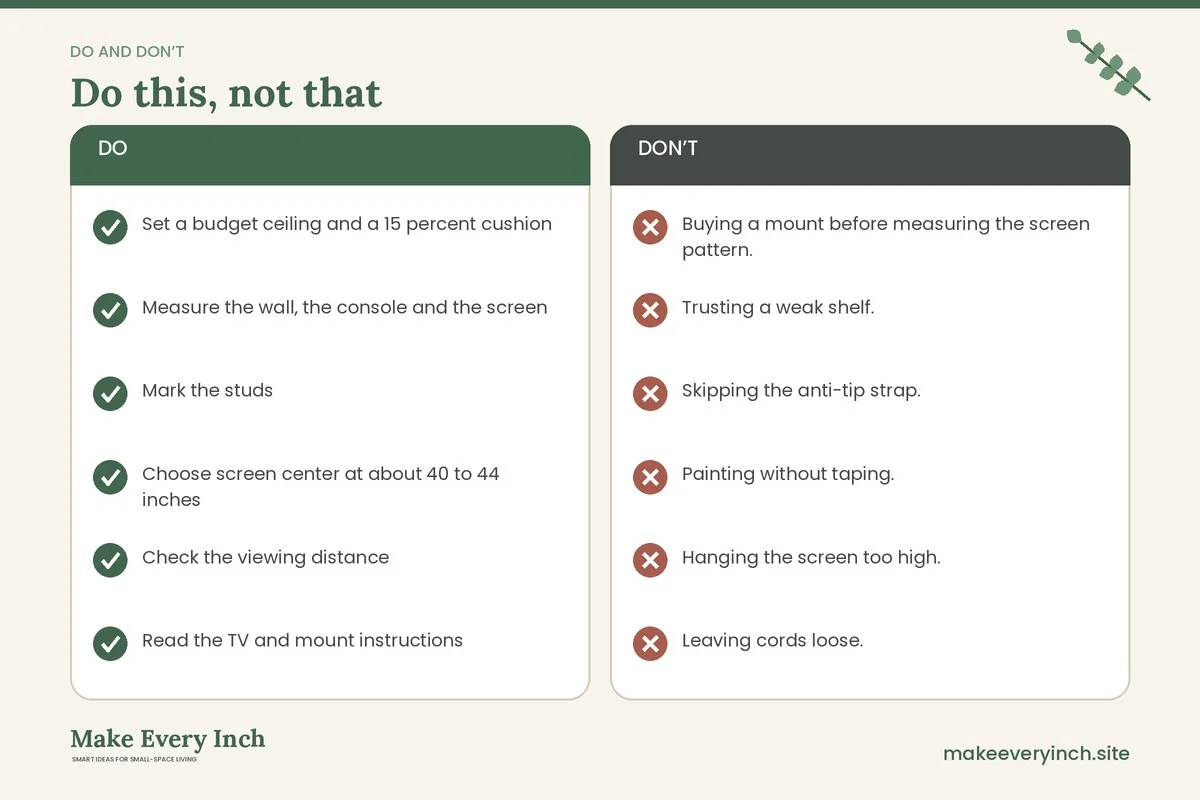
- Buying a mount before measuring the screen pattern. Check the mounting holes on the back of your TV first.
- Trusting a weak shelf. A floating shelf is for decor, so keep the TV on a rated mount or stand.
- Skipping the anti-tip strap. A thrifted console may be lighter than a new one, and a strap is cheap.
- Painting without taping. Messy lines undo the effect of the frame.
- Hanging the screen too high. Many people mount a TV above a fireplace, and then suffer neck strain. Aim for eye height.
- Leaving cords loose. One bundle of ties and a raceway changes the look.
- Buying too many small decor items. One large piece beats five tiny ones.
- Rushing the paint. Let each coat dry, and cure the piece before loading it.
A weekend budget plan
Friday evening
Measure the wall, the console and the screen. Find the studs, and mark them. Draw the layout on paper. List what you already own, and write a shopping list with a ceiling.
Saturday
Shop second-hand for a console or a frame, and buy paint, tape and a raceway. Paint the wall and the console. Let them dry overnight.
Sunday
Mount the TV or set it on the console, following the instructions, and strap furniture if needed. Run the cords, add a lamp and style the top. Step back, remove one item, and take a photo.
Checklist
- Set a budget ceiling and a 15 percent cushion
- Measure the wall, the console and the screen
- Mark the studs
- Choose screen center at about 40 to 44 inches
- Check the viewing distance
- Read the TV and mount instructions
- Check weight ratings
- Add an anti-tip strap to any console
- Paint the frame or the wall
- Run cords in a raceway
- Add a lamp and a bias light
- Style with odd numbers
FAQ
How can I make a TV wall look good on a small budget?
Paint a frame or a dark block behind the screen, use a thrifted console, hide the cords and add one lamp. These steps cost little and change the look of the wall.
How high should I hang a TV in a small living room?
Aim for the center of the screen at about 40 to 44 inches from the floor, which is near seated eye level. Adjust a few inches for your own seat height.
How far should I sit from the TV?
A rough guide is about 1.2 to 2.5 times the screen’s diagonal measurement, depending on how immersive you want the view. In a small room, 5 to 8 feet is common.
Is it cheaper to mount or to use a stand?
It depends on what you already own. A stand or a console you already have costs nothing, and a thrifted one often costs less than a new mount. A mount saves floor space, which matters in small rooms. Compare the two for your own wall.
Can I mount a TV on drywall without a stud?
Only if the mount instructions allow it, and only with anchors rated for the load. When in doubt, find a stud or hire help. Always follow the TV and mount instructions.
What can I use instead of a media console?
A low dresser, a sideboard, a bench with baskets or a pair of stacked bookcases can hold a TV, if the top is flat and the piece is sturdy. Add an anti-tip strap.
How do I hide cords without cutting the wall?
Use a paintable raceway on the surface, a cord cover behind the console, and ties to group cables. Do not run mains cords inside walls unless the product is made for it.
Is a thrifted piece safe for a TV?
It can be if it is sturdy, level and rated or clearly strong enough for the TV’s weight. Check the joints, strap it to the wall and do not use a wobbly piece.
How do I stop glare on the screen?
Place the TV away from direct window light, use curtains, and avoid bright lights facing the screen. A dark wall behind it also reduces the contrast.
What size TV is best for a small living room?
It depends on the viewing distance. Measure from the sofa to the wall, then pick a screen that fits the guide above and leaves a clear border.
Keep going: Keep planning with our small living room ideas for renters, small living room makeover ideas and cheap storage ideas for apartments.
Save this guide for later
Pin the ideas you like to Pinterest so you can come back to them when you plan your space.